Silent Noir: a Cottage on Dartmoor
Total Page:16
File Type:pdf, Size:1020Kb
Load more
Recommended publications
-

Historical Film Notes by Jerry Beck
UCLA Preserved Animation Website: HISTORICAL FILM NOTES BY JERRY BECK Theatre De Hula Hula (19--) Here is one in a long list of mystery films from the silent era. Clearly designed to be shown either in a vaudeville house or at a special exhibition requiring several musicians to accompany the action, it looks even to have had a specific score to match movements of the dancers. The film is processed in reverse to provide a negative effect that imparts an appropriate darkened-theater ambience to the proceedings. The bottom third of the picture is an animation “cycle” (a series of drawings repeated over and over) which gives a furious feel to the musicians. Most silent animation is based on wordplay and gag situations, but here the comical dance routines represent a wonderful early use of animation created for purely humorous effect. The animation itself is quite funny and charming, but those responsible for this delightful little gem probably will remain unknown. The Enchanted Drawing (1900) Cartoonist J. Stuart Blackton (1875-1941) was born in England and immigrated to the United States at the age of ten. In 1895, after a brief stint in vaudeville, Blackton became a reporter and cartoonist for the New York Evening World. A year later, Blackton was working for Thomas Edison’s film company, where he appeared on screen (as he does here) doing “Lightning Sketches” -- drawing at a rapid speed to the delight of onlookers. Inspired by Edison’s motion pictures, Blackton co-founded the Vitagraph studio to create films and distribute them to early nickelodeons. -

September 6, 2011 (XXIII:2) Anthony Asquith and Leslie Howard, PYGMALION (1938, 96 Min)
September 6, 2011 (XXIII:2) Anthony Asquith and Leslie Howard, PYGMALION (1938, 96 min) Directed by Anthony Asquith and Leslie Howard Written by George Bernard Shaw (play, scenario & dialogue), W.P. Lipscomb, Cecil Lewis, Ian Dalrymple (uncredited), Anatole de Grunwald (uncredited), Kay Walsh (uncredited) Produced by Gabriel Pascal Original Music by Arthur Honegger Cinematography by Harry Stradling Edited by David Lean Art Direction by John Bryan Costume Design by Ladislaw Czettel (as Professor L. Czettel), Schiaparelli (uncredited), Worth (uncredited) Music composed by William Axt Music conducted by Louis Levy Leslie Howard...Professor Henry Higgins Wendy Hiller...Eliza Doolittle Wilfrid Lawson...Alfred Doolittle Marie Lohr...Mrs. Higgins Scott Sunderland...Colonel George Pickering GEORGE BERNARD SHAW [from Wikipedia](26 July 1856 – 2 Jean Cadell...Mrs. Pearce November 1950) was an Irish playwright and a co-founder of the David Tree...Freddy Eynsford-Hill London School of Economics. Although his first profitable writing Everley Gregg...Mrs. Eynsford-Hill was music and literary criticism, in which capacity he wrote many Leueen MacGrath...Clara Eynsford Hill highly articulate pieces of journalism, his main talent was for Esme Percy...Count Aristid Karpathy drama, and he wrote more than 60 plays. Nearly all his writings address prevailing social problems, but have a vein of comedy Academy Award – 1939 – Best Screenplay which makes their stark themes more palatable. Shaw examined George Bernard Shaw, W.P. Lipscomb, Cecil Lewis, Ian Dalrymple education, marriage, religion, government, health care, and class privilege. ANTHONY ASQUITH (November 9, 1902, London, England, UK – He was most angered by what he perceived as the February 20, 1968, Marylebone, London, England, UK) directed 43 exploitation of the working class. -

New Findings and Perspectives Edited by Monica Dall’Asta, Victoria Duckett, Lucia Tralli Researching Women in Silent Cinema New Findings and Perspectives
in Silent Cinema New Findings and Perspectives edited by Monica Dall’Asta, Victoria Duckett, lucia Tralli RESEARCHING WOMEN IN SILENT CINEMA NEW FINDINGS AND PERSPECTIVES Edited by: Monica Dall’Asta Victoria Duckett Lucia Tralli Women and Screen Cultures Series editors: Monica Dall’Asta, Victoria Duckett ISSN 2283-6462 Women and Screen Cultures is a series of experimental digital books aimed to promote research and knowledge on the contribution of women to the cultural history of screen media. Published by the Department of the Arts at the University of Bologna, it is issued under the conditions of both open publishing and blind peer review. It will host collections, monographs, translations of open source archive materials, illustrated volumes, transcripts of conferences, and more. Proposals are welcomed for both disciplinary and multi-disciplinary contributions in the fields of film history and theory, television and media studies, visual studies, photography and new media. http://creativecommons.org/licenses/by-nc-nd/3.0/us/ # 1 Researching Women in Silent Cinema: New Findings and Perspectives Edited by: Monica Dall’Asta, Victoria Duckett, Lucia Tralli ISBN 9788898010103 2013. Published by the Department of Arts, University of Bologna in association with the Victorian College of the Arts, University of Melbourne and Women and Film History International Graphic design: Lucia Tralli Researching Women in Silent Cinema: New Findings and Perspectives Peer Review Statement This publication has been edited through a blind peer review process. Papers from the Sixth Women and the Silent Screen Conference (University of Bologna, 2010), a biennial event sponsored by Women and Film History International, were read by the editors and then submitted to at least one anonymous reviewer. -

Pass the Gravy by Steve Massa
Pass the Gravy By Steve Massa Max Davidson had appeared in movies since the early teens – act- ing at Biograph, supporting Fay Tincher in her Komic Comedy and Fine Arts comedy, and briefly headlining in his own Izzy Come- dies” – usually portraying stereo- typical Jewish tailors and mer- chants. After scoring a notable success co-starring with Jackie Coogan in the features “The Rag Man” and “Old Clothes” (both 1925) he was hired by producer Hal Roach to be part of his stable of supporting comedians. Proving himself in the service of Roach star comics Cuckoos” (1927) introductory description of “Love’s such as Stan Laurel, Charley Chase, and Mabel Greatest Mistake.” Screen freckles usually denote Normand in the shorts “Get ‘Em Young,” “Long Fliv fresh and fun-loving characters, but Spec’s spots the King” (both 1926), and “Anything Once” (1927), came with an icy heart, a malevolent grin, and Max was bumped up to the leading role in his own beady eyes that loved to see his screen father series and given the opportunity to flesh out his squirm. standard screen persona. The first entries were di- rected by Leo McCarey, then director-general of the In contrast to his sons like Spec, Max’s screen Roach Studio, who laid the ground work with shorts daughters are always his pride and joy, but still such as “Why Girls Say No,” “Jewish Prudence,” cause him a lot of aggravation, particularly when “Don’t Tell Everything,” and “Should Second they take up with boys he doesn’t approve of or as- Husbands Come First?” (all 1927). -

The North of England in British Wartime Film, 1941 to 1946. Alan
View metadata, citation and similar papers at core.ac.uk brought to you by CORE provided by CLoK The North of England in British Wartime Film, 1941 to 1946. Alan Hughes, University of Central Lancashire The North of England is a place-myth as much as a material reality. Conceptually it exists as the location where the economic, political, sociological, as well as climatological and geomorphological, phenomena particular to the region are reified into a set of socio-cultural qualities that serve to define it as different to conceptualisations of England and ‘Englishness’. Whilst the abstract nature of such a construction means that the geographical boundaries of the North are implicitly ill-defined, for ease of reference, and to maintain objectivity in defining individual texts as Northern films, this paper will adhere to the notion of a ‘seven county North’ (i.e. the pre-1974 counties of Cumberland, Westmorland, Northumberland, County Durham, Lancashire, Yorkshire, and Cheshire) that is increasingly being used as the geographical template for the North of England within social and cultural history.1 The British film industry in 1941 As 1940 drew to a close in Britain any memories of the phoney war of the spring of that year were likely to seem but distant recollections of a bygone age long dispersed by the brutal realities of the conflict. Outside of the immediate theatres of conflict the domestic industries that had catered for the demands of an increasingly affluent and consuming population were orientated towards the needs of a war economy as plant, machinery, and labour shifted into war production. -

Orme) Wilberforce (Albert) Raymond Blackburn (Alexander Bell
Copyrights sought (Albert) Basil (Orme) Wilberforce (Albert) Raymond Blackburn (Alexander Bell) Filson Young (Alexander) Forbes Hendry (Alexander) Frederick Whyte (Alfred Hubert) Roy Fedden (Alfred) Alistair Cooke (Alfred) Guy Garrod (Alfred) James Hawkey (Archibald) Berkeley Milne (Archibald) David Stirling (Archibald) Havergal Downes-Shaw (Arthur) Berriedale Keith (Arthur) Beverley Baxter (Arthur) Cecil Tyrrell Beck (Arthur) Clive Morrison-Bell (Arthur) Hugh (Elsdale) Molson (Arthur) Mervyn Stockwood (Arthur) Paul Boissier, Harrow Heraldry Committee & Harrow School (Arthur) Trevor Dawson (Arwyn) Lynn Ungoed-Thomas (Basil Arthur) John Peto (Basil) Kingsley Martin (Basil) Kingsley Martin (Basil) Kingsley Martin & New Statesman (Borlasse Elward) Wyndham Childs (Cecil Frederick) Nevil Macready (Cecil George) Graham Hayman (Charles Edward) Howard Vincent (Charles Henry) Collins Baker (Charles) Alexander Harris (Charles) Cyril Clarke (Charles) Edgar Wood (Charles) Edward Troup (Charles) Frederick (Howard) Gough (Charles) Michael Duff (Charles) Philip Fothergill (Charles) Philip Fothergill, Liberal National Organisation, N-E Warwickshire Liberal Association & Rt Hon Charles Albert McCurdy (Charles) Vernon (Oldfield) Bartlett (Charles) Vernon (Oldfield) Bartlett & World Review of Reviews (Claude) Nigel (Byam) Davies (Claude) Nigel (Byam) Davies (Colin) Mark Patrick (Crwfurd) Wilfrid Griffin Eady (Cyril) Berkeley Ormerod (Cyril) Desmond Keeling (Cyril) George Toogood (Cyril) Kenneth Bird (David) Euan Wallace (Davies) Evan Bedford (Denis Duncan) -

A Study Guide for Teachers
KAPUT A STUDY GUIDE FOR TEACHERS ABOUT THE STUDY GUIDE Dear Teachers: We hope you will find this Study Guide helpful in preparing your students for what they will experience at the performance of Kaput. Filled with acrobatic thrills and silly blunders, we’re sure Kaput will delight you and your students. Throughout this Study Guide you will find topics for discussion, links to resources and activities to help facilitate discussion around physical theatre, physical comedy, and the golden age of silent films. STUDY GUIDE INDEX ABOUT THE PERFORMANCE RESOURCES AND TOPICS FOR DISCUSSION 1. About the Performer 1. Be the Critic 2. About the Show 2. Tell a Story Without Saying a Word 3. About Physical Theatre 3. Making a Silent Film 4. About Physical Comedy 4. Body and Expression 5. The Art of the Pratfall 5. Taking a Tour 6. The Golden Age of Silent Films (1894 – 1924) 6. Pass the Ball 7. Physical Comedy + Silent Film = Silent Comedy 7. What’s in a Gesture? Being in the Audience When you enter the theater, you enter a magical space, charged, full of energy and anticipation. Show respect by watching and listening attentively Do not distract fellow audience members or interrupt the flow of performance Applause at the end of the performance is the best way to show enthusiasm and appreciation. About The Performer Tom Flanagan is one of Australia’s youngest leading acrobatic clowns. A graduate of the internationally renowned circus school, The Flying Fruit Flies; Tom started tumbling, twisting, flying and falling at the age of six. -

Silent Films, Hollywood Genres, and William Faulkner
SILENT FILMS, HOLLYWOOD GENRES, AND WILLIAM FAULKNER -Somdatta Mandal Much of the research concerning William Faulkner’s relationship to film focuses on the writer’s experience as a scriptwriter during the 1930s and 1940s, perhaps assuming that Faulkner’s serious interest in film began only with his arrival in Hollywood in 1932. But as Jeffrey J. Folks1 has pointed out, silent film had comprised a significant part of available popular entertainment in Oxford during Faulkner’s youth and according to Murray Falkner, Faulkner is said to have attended silent films regularly, as often as twice a week. John Faulkner says that after movies came to Oxford, which would have been about 1913, he and ‘Bill’ went every Friday - and would have gone oftener had they been allowed to.2 Though it is not possible to determine exactly what films Faulkner might have seen in the first years of film showings, the standard features certainly consisted, to a large extent of Westerns, melodramas and comedies. One may assume that among performers featured were Mary Pickford, Lilian Gish, Charles Chaplin, Buster Keaton, Harry Langdon and Fatty Arbuckle. The many Westerns that Murray Falkner recalled having seen with his brother William, may well have featured Tom Mix, William S. Hart, and Broncho Billy (G.M.Anderson) as well as many lesser known performers. Faulkner seems to have had the normal introduction to this aspect of American culture, though as an adult he may have had less contact with it. As mentioned earlier, Faulkner’s extensive knowledge of the silent film is evident from the many references to it in his fiction. -

ROMANTIC COMEDY Laughter and Culture Comedy, Repression, And
ROMANTIC COMEDY Laughter and Culture Comedy, Repression, and Cultural Dreamwork Sigmund Freud jokes function a form of liberation; whatever a society represses frequently returns in the form of comedy to taunt it. This often occurs quite literally in the figure of the Shakespearean- like fool who tells a truth that others dare not utter. Several likely prospects on the street but does a double take and hurries away when one of this would-be brides turns out to be black and another Jewish. For the Marx Brothers, nothing is sacred. From Racism to Social Integration Immigrants: Chaplin to Depardieu Chaplin, whose “Tramp” character embodies an essential ambivalence toward society. Thus, Chaplin comedies often play against the genre’s expectations, striking a note of pathos. The film’s attack on phoniness and its celebration of authentic feeling moves it, however, toward Chaplinesque pathos rather than comic triumph: Depardieu’s rediscovered integrity forces him to abandon his initial, self-centered goal of getting citizenship by whatever means possible. Integration and the Regeneration of Society Hundreds of other comedies in which an individual struggles to enter society. Through the theme of comic integration, American screen comedies demonstrate the flexibility of our democracy social structure through its ability to absorb new members and integrate them into a new social order, whose unity and diversity exceeds that of the old order. It Happened One Night (1934) , for example, begins with a ‘”bad’ marriage between an heiress (Claudette Colbert) and a playboy- socialite. The final marriage is “right’ not only because Colbert and Gable really love one another but also because it heals the divisions within society, establishing a new order through the symbolic marriage of representatives of different social classes. -
Introduction Keyword: Hokum
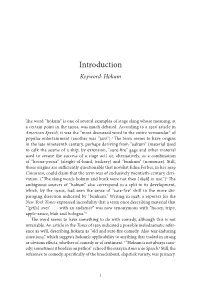
Introduction Keyword: Hokum The word “hokum” is one of several examples of stage slang whose meaning, at a certain point in the 1920s, was much debated. According to a 1926 article in American Speech, it was the “most discussed word in the entire vernacular” of popular entertainment (another was “jazz”).1 The term seems to have origins in the late nineteenth century, perhaps deriving from “oakum” (material used to calk the seams of a ship; by extension, “sure-fire” gags and other material used to secure the success of a stage act) or, alternatively, as a combination of “hocus-pocus” (sleight-of-hand, trickery) and “bunkum” (nonsense). Still, those origins are sufficiently questionable that novelist Edna Ferber, in her 1929 Cimarron, could claim that the term was of exclusively twentieth-century deri- vation. (“The slang words hokum and bunk were not then [1898] in use.”)2 The ambiguous sources of “hokum” also correspond to a split in its development, which, by the 1920s, had seen the sense of “sure-fire” shift in the more dis- paraging direction indicated by “bunkum.” Writing in 1928, a reporter for the New York Times expressed incredulity that a term once describing material that “ ‘get[s] over’ . with an audience” was now synonymous with “hooey, tripe, apple-sauce, blah and bologna.”3 The word seems to have something to do with comedy, although this is not invariable. An article in the Times of 1923 indicated a possible melodramatic refer- ence as well, describing hokum as “old and sure-fire comedy. Also tear-inducing situations,” which suggests hokum’s applicability to anything that traded in strong or obvious effects, whether of comedy or of sentiment.4 “Hokum is not always com- edy; sometimes it borders on pathos” echoed the essay in American Speech.5 Still, the reference to comedy, specifically of the knockabout, slapstick variety, was primary. -

Shail, Robert, British Film Directors
BRITISH FILM DIRECTORS INTERNATIONAL FILM DIRECTOrs Series Editor: Robert Shail This series of reference guides covers the key film directors of a particular nation or continent. Each volume introduces the work of 100 contemporary and historically important figures, with entries arranged in alphabetical order as an A–Z. The Introduction to each volume sets out the existing context in relation to the study of the national cinema in question, and the place of the film director within the given production/cultural context. Each entry includes both a select bibliography and a complete filmography, and an index of film titles is provided for easy cross-referencing. BRITISH FILM DIRECTORS A CRITI Robert Shail British national cinema has produced an exceptional track record of innovative, ca creative and internationally recognised filmmakers, amongst them Alfred Hitchcock, Michael Powell and David Lean. This tradition continues today with L GUIDE the work of directors as diverse as Neil Jordan, Stephen Frears, Mike Leigh and Ken Loach. This concise, authoritative volume analyses critically the work of 100 British directors, from the innovators of the silent period to contemporary auteurs. An introduction places the individual entries in context and examines the role and status of the director within British film production. Balancing academic rigour ROBE with accessibility, British Film Directors provides an indispensable reference source for film students at all levels, as well as for the general cinema enthusiast. R Key Features T SHAIL • A complete list of each director’s British feature films • Suggested further reading on each filmmaker • A comprehensive career overview, including biographical information and an assessment of the director’s current critical standing Robert Shail is a Lecturer in Film Studies at the University of Wales Lampeter. -
Original Writer Title Genre Running Time Year Director/Writer Actor
Original Running Title Genre Year Director/Writer Actor/Actress Keywords Writer Time Katharine Hepburn, Alcoholism, Drama, Tony Richardson; Edward Albee A Delicate Balance 133 min 1973 Paul Scofield, Loss, Play Edward Albee Lee Remick Family Georgian, Eighteenth Century, Simon Langton; Jane Colin Firth, Pride and Prejudice Drama, Romance, Jane Austen 53 min 1995 Austen, Andrew Crispin Bonham-Carter, Vol. I Romance Classic, Davies Jennifer Ehle Strong Female Lead, Inheritance Georgian, Eighteenth Century, Simon Langton; Jane Colin Firth, Pride and Prejudice Drama, Romance, Jane Austen 54 min 1995 Austen, Andrew Crispin Bonham-Carter, Vol. II Romance Classic, Davies Jennifer Ehle Strong Female Lead, Inheritance Georgian, Eighteenth Century, Simon Langton; Jane Colin Firth, Pride and Prejudice Drama, Romance, Jane Austen 53 min 1995 Austen, Andrew Crispin Bonham-Carter, Vol. III Romance Classic, Davies Jennifer Ehle Strong Female Lead, Inheritance Georgian, Eighteenth Century, Simon Langton; Jane Colin Firth, Pride and Prejudice Drama, Romance, Jane Austen 53 min 1995 Austen, Andrew Crispin Bonham-Carter, Vol. IV Romance Classic, Davies Jennifer Ehle Strong Female Lead, Inheritance Georgian, Eighteenth Century, Simon Langton; Jane Colin Firth, Pride and Prejudice Drama, Romance, Jane Austen 50 min 1995 Austen, Andrew Crispin Bonham-Carter, Vol. V Romance Classic, Davies Jennifer Ehle Strong Female Lead, Inheritance Georgian, Eighteenth Century, Simon Langton; Jane Colin Firth, Pride and Prejudice Drama, Romance, Jane Austen 52 min 1995 Austen,