How Old Are the Singapore Botanic Gardens' Great Tembusus?
Total Page:16
File Type:pdf, Size:1020Kb
Load more
Recommended publications
-
Introducing the Museum Roundtable
P. 2 P. 3 Introducing the Hello! Museum Roundtable Singapore has a whole bunch of museums you might not have heard The Museum Roundtable (MR) is a network formed by of and that’s one of the things we the National Heritage Board to support Singapore’s museum-going culture. We believe in the development hope to change with this guide. of a museum community which includes audience, museum practitioners and emerging professionals. We focus on supporting the training of people who work in We’ve featured the (over 50) museums and connecting our members to encourage members of Singapore’s Museum discussion, collaboration and partnership. Roundtable and also what you Our members comprise over 50 public and private can get up to in and around them. museums and galleries spanning the subjects of history and culture, art and design, defence and technology In doing so, we hope to help you and natural science. With them, we hope to build a ILoveMuseums plan a great day out that includes community that champions the role and importance of museums in society. a museum, perhaps even one that you’ve never visited before. Go on, they might surprise you. International Museum Day #museumday “Museums are important means of cultural exchange, enrichment of cultures and development of mutual understanding, cooperation and peace among peoples.” — International Council of Museums (ICOM) On (and around) 18 May each year, the world museum community commemorates International Museum Day (IMD), established in 1977 to spread the word about the icom.museum role of museums in society. Be a part of the celebrations – look out for local IMD events, head to a museum to relax, learn and explore. -
Seed Germination and Genetic Structure of Two Salvia Species In
Seed germination and genetic structure of two Salvia species in response to environmental variables among phytogeographic regions in Jordan (Part I) and Phylogeny of the pan-tropical family Marantaceae (Part II). Dissertation Zur Erlangung des akademischen Grades Doctor rerum naturalium (Dr. rer. nat) Vorgelegt der Naturwissenschaftlichen Fakultät I Biowissenschaften der Martin-Luther-Universität Halle-Wittenberg Von Herrn Mohammad Mufleh Al-Gharaibeh Geb. am: 18.08.1979 in: Irbid-Jordan Gutachter/in 1. Prof. Dr. Isabell Hensen 2. Prof. Dr. Martin Roeser 3. Prof. Dr. Regina Classen-Bockhof Halle (Saale), den 10.01.2017 Copyright notice Chapters 2 to 4 have been either published in or submitted to international journals or are in preparation for publication. Copyrights are with the authors. Just the publishers and authors have the right for publishing and using the presented material. Therefore, reprint of the presented material requires the publishers’ and authors’ permissions. “Four years ago I started this project as a PhD project, but it turned out to be a long battle to achieve victory and dreams. This dissertation is the culmination of this long process, where the definition of “Weekend” has been deleted from my dictionary. It cannot express the long days spent in analyzing sequences and data, battling shoulder to shoulder with my ex- computer (RIP), R-studio, BioEdite and Microsoft Words, the joy for the synthesis, the hope for good results and the sadness and tiredness with each attempt to add more taxa and analyses.” “At the end, no phrase can describe my happiness when I saw the whole dissertation is printed out.” CONTENTS | 4 Table of Contents Summary .......................................................................................................................................... -
Technical Guidelines for Reforestation at Ex-Coal-Mining Areas
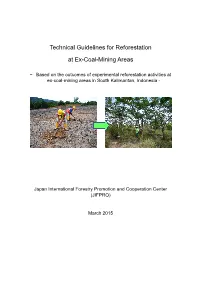
Technical Guidelines for Reforestation at Ex-Coal-Mining Areas - Based on the outcomes of experimental reforestation activities at ex-coal-mining areas in South Kalimantan, Indonesia - Japan International Forestry Promotion and Cooperation Center (JIFPRO) March 2015 Technical Guidelines for Reforestation at Ex-Coal-Mining Areas - Based on the outcomes of experimental reforestation activities at ex-coal-mining areas in South Kalimantan, Indonesia - Eiichiro Nakama, Seiichi Ohta, Yasuo Ohsumi, Tokunori Mori and Satohiko Sasaki Japan International Forestry Promotion and Cooperation Center Fakhrur Razie, Hamdani Fauzi and Mahrus Aryadi Lambung Mangkurat University, Indonesia Japan International Forestry Promotion and Cooperation Center March 2015 Foreword During the past decades, deforestation and forest degradation continues especially in developing countries. According to the report of the Food and Agriculture Organization of the United Nation (FAO), approximately 13 million hectors of global forests have been lost annually due to forest land conversion to other land uses, forest fires and natural disasters, while reforestation and natural regeneration account for an increase of approx. 7.8 million hectors of forest cover. This means the net loss of global forest is estimated at 5.2 million hectors. Adverse impacts of forest conversion to farmland can be minimized as far as the land is properly used and managed in a sustainable manner. However, in some cases, problem soils are exposed and abandoned as degraded land. Deforestation by mining is a big issue these years. Problem soils such as strong acid soils and/or too much heavy metal soils appear at the ex-mining areas. In some cases it is too difficult to reforestate. -

Title UTILIZATION of MARANTACEAE PLANTS
UTILIZATION OF MARANTACEAE PLANTS BY THE Title BAKA HUNTER-GATHERERS IN SOUTHEASTERN CAMEROON Author(s) HATTORI, Shiho African study monographs. Supplementary issue (2006), 33: Citation 29-48 Issue Date 2006-05 URL http://dx.doi.org/10.14989/68476 Right Type Departmental Bulletin Paper Textversion publisher Kyoto University African Study Monographs, Suppl. 33: 29-48, May 2006 29 UTILIZATION OF MARANTACEAE PLANTS BY THE BAKA HUNTER-GATHERERS IN SOUTHEASTERN CAMEROON Shiho HATTORI Graduate School of Asian and African Area Studies (ASAFAS), Kyoto University ABSTRACT The Baka hunter-gatherers of the Cameroonian rainforest use plants of the family Marantaceae for a variety of purposes, as food, in material culture, as “medicine” and as trading item. They account for as much as 40% of the total number of uses of plants in Baka material culture. The ecological background of such intensive uses in material culture reflects the abundance of Marantaceae plants in the African rainforest. This article describes the frequent and diversified uses of Marantaceae plants, which comprise a unique characteristic in the ethnobotany of the Baka hunter-gatherers and other forest dwellers in central Africa. Key Words: Ethnobotany; Baka hunter-gatherers; Marantaceae; Multi-purpose plants; Rainforest. INTRODUCTION The family Marantaceae comprises 31 genera and 550 species, and most of them are widely distributed in the tropics (Cabezas et al., 2005). The African flora of the Marantaceae are not especially rich in species (30-35 species) compared with those of South East Asia and South America, but the people living in the central African rainforest frequently use Matantaceae plants in a variety of ways (Tanno, 1981; Burkill, 1997; Terashima & Ichikawa, 2003). -

Artist Biography
Artist Donna ONG ⺩美清 Born Singapore Works Singapore Artist Biography __________________ ___________________________________________________________________________________ Year Education 2011 - 2012 MA Fine Arts, LASALLE College of the Arts, Singapore 2003 BA (Hons) Fine Art, Goldsmiths College, University of London, UK 1999 B.Sc. Architecture Bartlett Centre, University College London (UCL), UK __________________ ___________________________________________________________________________________ Year Selected Exhibitions 2017 Singapore: Inside Out Sydney, The Old Clare Hotel, Sydney, Australia After Utopia: Revisiting the Ideal in Asian Contemporary Art, Anne and Gordon Samstag Museum of Art, Adelaide, Australia The Tree as An Art Object, Wälderhaus Museum, Hamburg, Germany Art Stage Jakarta, FOST Gallery, Indonesia Art Stage Singapore, FOST Gallery, Singapore 2016 The Sharing Game: Exchange in Culture and Society, Kulturesymposium Weimar 2016, Galerie Eigenheim, Weimar, Germany For An Image, Faster Than Light, Yinchuan Biennale 2016, MoCA Yinchuan, China Five Trees Make A Forest, NUS Museum, Singapore* My Forest Has No Name, FOST Gallery, Singapore* 2015 After Utopia, Singapore Art Museum, Singapore The Mechanical Corps, Hartware MedienKunstVerein, Dortmund, Germany Prudential Eye Awards, ArtScience Museum, Singapore Prudential Singapore Eye, ArtScience Museum, Singapore 2014 Da Vinci: Shaping the Future, ArtScience Museum, Singapore Modern Love, Institute of Contemporary Arts Singapore, Singapore Bright S’pore(s), Primo Marella Gallery, -
The Evolutionary and Biogeographic Origin and Diversification of the Tropical Monocot Order Zingiberales
Aliso: A Journal of Systematic and Evolutionary Botany Volume 22 | Issue 1 Article 49 2006 The volutE ionary and Biogeographic Origin and Diversification of the Tropical Monocot Order Zingiberales W. John Kress Smithsonian Institution Chelsea D. Specht Smithsonian Institution; University of California, Berkeley Follow this and additional works at: http://scholarship.claremont.edu/aliso Part of the Botany Commons Recommended Citation Kress, W. John and Specht, Chelsea D. (2006) "The vE olutionary and Biogeographic Origin and Diversification of the Tropical Monocot Order Zingiberales," Aliso: A Journal of Systematic and Evolutionary Botany: Vol. 22: Iss. 1, Article 49. Available at: http://scholarship.claremont.edu/aliso/vol22/iss1/49 Zingiberales MONOCOTS Comparative Biology and Evolution Excluding Poales Aliso 22, pp. 621-632 © 2006, Rancho Santa Ana Botanic Garden THE EVOLUTIONARY AND BIOGEOGRAPHIC ORIGIN AND DIVERSIFICATION OF THE TROPICAL MONOCOT ORDER ZINGIBERALES W. JOHN KRESS 1 AND CHELSEA D. SPECHT2 Department of Botany, MRC-166, United States National Herbarium, National Museum of Natural History, Smithsonian Institution, PO Box 37012, Washington, D.C. 20013-7012, USA 1Corresponding author (KRESSJ@si.edu) ABSTRACT Zingiberales are a primarily tropical lineage of monocots. The current pantropical distribution of the order suggests an historical Gondwanan distribution, however the evolutionary history of the group has never been analyzed in a temporal context to test if the order is old enough to attribute its current distribution to vicariance mediated by the break-up of the supercontinent. Based on a phylogeny derived from morphological and molecular characters, we develop a hypothesis for the spatial and temporal evolution of Zingiberales using Dispersal-Vicariance Analysis (DIVA) combined with a local molecular clock technique that enables the simultaneous analysis of multiple gene loci with multiple calibration points. -
Revision of Marantaceae, with a New Generic Record and Notes on Naturalised and Commonly Cultivated Exotic Species
Phytotaxa 289 (3): 201–224 ISSN 1179-3155 (print edition) http://www.mapress.com/j/pt/ PHYTOTAXA Copyright © 2016 Magnolia Press Article ISSN 1179-3163 (online edition) http://dx.doi.org/10.11646/phytotaxa.289.3.1 Notes on Singaporean native Zingiberales II: revision of Marantaceae, with a new generic record and notes on naturalised and commonly cultivated exotic species MATTI A. NIISSALO1*, GILLIAN S. KHEW2, EDWARD L. WEBB1 & JANA LEONG-ŠKORNIČKOVÁ2* 1 Department of Biological Sciences, National University of Singapore, 14 Science Drive 4, Singapore, 117543, Republic of Singapore 2 Singapore Botanic Gardens, National Parks Board, 1 Cluny Road, Singapore 259569, Republic of Singapore * Corresponding authors: matti.niissalo@gmail.com, jana_skornickova@nparks.gov.sg Abstract An illustrated revision of Marantaceae in Singapore with an identification key and proposed national IUCN Red List as- sessments is presented here. In total three genera and four species are considered native to Singapore (Donax canniformis, Phrynium hirtum, Stachyphrynium parvum, and Stachyphrynium latifolium) representing 33 % of diversity currently known to occur in Peninsular Malaysia. Although the genus Phrynium Willdenow (1797: 1) was previously reported for Singapore based on the presence of P. villosulum, we show that this species is, contrary to previous accounts, not native but introduced. Newly reported Phrynium hirtum therefore represents a new native generic record for the country. We are changing the status of Schumannianthus benthamianus, previously considered native, to cultivated, as there are no historic or recent collections of this species. Non-native species commonly employed in Singapore streetscapes and parks are also briefly discussed and illustrated in this paper. -

Island 6 Art Collective
BOB SICK YUDHITA AGUNG Education 1991 - 1998 ISI, Yogyakarta, Indonesia “Speak Off”, organized by JogjaNews.Com, Jogja National Museum, Yogyakarta Solo Exhibition : 2010 “Power Wagon”, Jogja National Museum, Yogyakarta 2012 “I’m a Living Legend”, Srisasanti Gallery, Yogyakarta “Reach for the HeART – A Beginning”, Sin Sin Annex, Hong Kong “I’m a Living Legend”, Galeri Nasional Indonesia (Indonesian “Romansa 9satu”, Sankring Gallery, Yogyakarta National Gallery), Jakarta “Gusdurisme”, Langgeng Gallery, Magelang 2010 “Bobvarium”, Srisasanti Arthouse, Jakarta “Transfiguration”, Semarang Contemporary Art Gallery, Jakarta 2008 “Life is Beautiful”, Sin Sin Fine Art, Hong Kong Art District, Grand Indonesia, Jakarta “Sick Project”, Galeri Semarang, Semarang “Space & Images”, Ciputra World, Jakarta 2007 “Happy Birthday NIN”, Jogja National Museum, Yogyakarta 2009 “Borderless World”, organized by Srisasanti Gallery, Taman 2005 “New Kid on the Block”, Museum dan Tanah Liat, Yogyakarta Budaya Yogyakarta 2004 “Di Bawah Pohon Ketepang Di Atas Springbed”, Kedai Kebun “Hi June”, duo exhibition, Taman Budaya Yogyakarta, Forum, Yogyakarta Yogyakarta 2002 “Aku Cinta Bapakku”, LIP Yogyakarta, Yogyakarta “Reach For The Heart”, Sin-Sin Fine Art, Hong Kong 2001 “Sick Is Bliss”, Kedai Kebun Forum, Yogyakarta “In Rainbow”, Esa Sampoerna Art House, Surabaya 2000 “Meraih Kemenangan”, Millenium Gallery, Jakarta “Pesta Gagasan”, Arslonga Rumah Seni, Yogyakarta “Friendship Code”, Syang Gallery, Magelang, Central Java Group exhibition (selected): “Reform”, organized -

The Ecology and Conservation of the Critically Endangered Cross River Gorilla in Cameroon © 2012
The Ecology and Conservation of the Critically Endangered Cross River Gorilla in Cameroon By Sarah Cahill Sawyer A dissertation submitted in partial satisfaction of the requirements for the degree of Doctor of Philosophy in Environmental Science, Policy, and Management in the Graduate Division of the University of California, Berkeley Committee in Charge: Professor Justin Brashares, Chair Professor Steve Beissinger Professor William Lidicker Fall 2012 The Ecology and Conservation of the Critically Endangered Cross River Gorilla in Cameroon © 2012 By Sarah Cahill Sawyer ABSTRACT: The Ecology and Conservation of the Critically Endangered Cross River Gorilla in Cameroon By Sarah Cahill Sawyer Doctor of Philosophy in Environmental Science, Policy, and Management University of California, Berkeley Professor Justin Brashares, Chair The Cross River gorilla (Gorilla gorilla diehli; hereafter: CRG) is one of the world’s most endangered and least studied primates. CRG exist only in a patchy distribution in the southern portion of the Cameroon-Nigeria border region and may have as few as 300 individuals remaining, divided into 14 fragmented subpopulations. Though Western gorillas (Gorilla gorilla spp) probably once inhabited much greater ranges throughout West Africa, today CRG represent the most northern and western distribution of all gorillas and are isolated from Western lowland gorilla populations by more than 250 km. CRG have proved challenging to study and protect, and many of the remaining subpopulations currently exist outside of protected areas. Very little is known about where the various subpopulations range on the landscape or why they occur in a patchy distribution within seemingly intact habitat. Active efforts are currently underway to identify critical habitat for landscape conservation efforts to protect the CRG in this biodiversity hotspot but, to date, a lack of understanding of the relationship between CRG ecology and available habitat has hampered conservation endeavors. -

Keith Haring - the Journey of a Steve Chua Graffiti Artist 38 Information the Legend of Lichtenstein 44 out in the Streets
ISSUE 16 | FEB 2011 FEBRUARY 2011 / 1 Yisulang-Confabu Mar 2011 1/15/11 9:37 AM Page 1 C M Y CM MY CY CMY K 2 / THE POCKET ARTS GUIDE Composite C M Y CM MY CY CMY K FEBRUARY 2011 / 3 CONTENTS 12 34 17 13 C M Y 24 26 44 CM MY 12 COMING UP 17 SPOTLIGHT 50 INTERVIEW CY LAND-TA-MORPHOSIS — Artist in Focus - Farhad Hussain An Interview — What the CMY Second of the Trilogy: Castle :Phunk? Beyond a Mountain 12 K Dorit Feldman: A Solo Exhibition by Art Facet Glimpses: A Solo Exhibition by 26 COVER STORY 61 SINGAPORE BenCab ART MAP The Window Project 13 Pop! Back into the Future with Burton Morris Will Siber: Sculpture, Wall Object & Painting Solo Exhibition By Seah Kang Chui 不变 50 年 Unchanged For 50 64 DIRECTORIES Years 14 34 FEATURES Singapore Art Galleries Other Listings ‘No si hijomiono’o jabesi soré Gurerro Habulan – jajivo’ The Warrior of pop! 34 Tourist Spots Malaysia Art Guide Limelight Blossoms by Keith Haring - The Journey of a Steve Chua Graffiti artist 38 InFORMATION The Legend of Lichtenstein 44 Out in the Streets 4 / THE POCKET ARTS GUIDE C M Y CM MY CY CMY K FEBRUARY 2011 / 5 CONTENTS SPOTLIGHT INTERVIEW SINGAPORE ART MAP 6 / THE POCKET ARTS GUIDE C M Y CM MY CY CMY K FEBRUARY 2011 / 7 Issue #16 (February 2011) ISSN 1793-9739 / MICA (P) 252/09/2010 www.thepocketartsguide.com On the Cover Burton Morris Poparazzi Acrylic on canvas 91.4 x 91.4cm Editor-in-Chief Remo Notarianni / remo@thepocketartsguide.com Guest Editor Saskia Joosse / saskia@thepocketartsguide.com Art Director Amalina MN / ama@thepocketartsguide.com Contributors Bharti Lalwani Advertising Sales sales@thepocketartsguide.com General enquiries and feedback mktg@thepocketartsguide.com Submission of press releases pr@thepocketartsguide.com THE POCKET ARTS GUIDE PTE LTD (TPAG) 215 Henderson Road, #03-03, Henderson Industrial Park Singapore 048545 For advertising enquiries, please email sales@thepocketartsguide.com. -
Studies in Malesian Gentianaceae III: Cyrtophyllum Reapplied to the Fagraea Fragrans Alliance
Gardens’ Bulletin Singapore 64(2): 497–510. 2012 497 Studies in Malesian Gentianaceae III: Cyrtophyllum reapplied to the Fagraea fragrans alliance K.M. Wong1 and M. Sugumaran2 1Singapore Botanic Gardens, 1 Cluny Road, Singapore 259569 wkm2000@gmail.com 2Rimba Ilmu Botanic Garden, Institute of Biological Sciences, University of Malaya, 50603 Kuala Lumpur, Malaysia maran@um.edu.my ABSTRACT. Cyrtophyllum Reinw., one of several distinct lineages among the Fagraea complex, is the correct genus to which five species of Southeast Asian trees should be assigned, including the widespread F. fragrans. Cyrtophyllum minutiflorum K.M.Wong is a new species described here. Two new combinations are made: C. caudatum (Ridl.) K.M.Wong and C. wallichianum (Benth.) M.Sugumaran & K.M.Wong. Keywords. Cyrtophyllum, Fagraea fragrans, Gentianaceae, Malesia, Potalieae, Potaliinae, Southeast Asia Introduction The results of a molecular phylogenetic study of the Fagraea complex (Sugumaran & Wong 2012) demonstrated the distinctness of a number of generic lineages from Fagraea Thunb. s.s. (Wong & Sugumaran 2012). Among these, Cyrtophyllum Reinw. and Picrophloeus Blume were readily distinguished from Fagraea s.s., Limahlania K.M.Wong & M.Sugumaran and Utania G.Don because the first two genera have flowers with conspicuously exserted styles (typically more than 40% of their length) and filaments (greater than 70% of their length) (Sugumaran & Wong 2012). Also, Cyrtophyllum and Picrophloeus frequently have cymes bearing numerous small flowers (corollas narrow, the mouth often not more than 10 mm wide), compared to the other genera, which typically have larger flowers (corollas typically much wider) in variable numbers. However, Cyrtophyllum has axillary cymes and Aubréville’s tree architectural model, whereas Picrophloeus and the other three genera all have terminal cymes and consistently other architectural models (Scarrone’s in Picrophloeus and Fagraea s.s., Fagerlind’s in Limahlania, Roux’s in Utania) (Sugumaran & Wong 2012; Wong & Sugumaran 2012). -

Dr. Duke's Phytochemical and Ethnobotanical Databases Ehtnobotanical Plants for Ache(Head)
Dr. Duke's Phytochemical and Ethnobotanical Databases Ehtnobotanical Plants for Ache(Head) Ehnobotanical Plant Common Names Abrus precatorius Pois Rouge; Peonia De St Tomas; Jequerit; Paratella; Rakat; Liane Reglisse; To-Azuki; Hint Meyankoku; Cain Ghe; Gunchi; Reglisse; Graines Reglisse; Hung Tou; Ma Liao Tou; Weesboontje; Rosary Pea; Paternoster; Peonia Acacia farnesiana Esponjeira; Kembang bandira; Kambang japun; Kembang nagasiri; Cuji; Tusca Acacia pennata Rigot; Rembete; Willd. Acacia pseudointsia Akar koepah; Kelichi Acalypha cardiophylla Acalypha wilkesiana Achillea millefolium Civanpercemi; Schafgarbe; Yarrow; Rollike; Biranjasif; Rojmari; Tlalquequetzal; Millefolium; Rolleka; Milefolio; Millefoglio; Milenrama; Millefeuille; Duizendblad; Cickafarkkoro Achillea ptarmica Bottone D'Argento; Aksirikotu; Pyrethre Sauvage; Hierba Estornutatoria; Wiesen Bertram; Nieskruid; Sneezewort Achyranthes bidentata Niu Hsi Chiu; Soei in soei in taloen; Niu Hsi; Too-Inokozuti Achyranthes nodiflora Sajoer oedang; Kremri Acorus calamus Shui Ch'Ang Pu; Jeringau; Vacha; Kalmos; Acoro Aromatico; Calamo Aromatico; Acorus; Jerangau; Kaliraga; Sarango; Bach; Calmus; Kalmoes; Ganoeak; Jariangau; Calamus; Seki-Sho; Kalmus; Azakegeri; Acore Vrai; Djerango; Sho-Bu; Calomo Aromatico; Agri Turki; Doringo; Vaj; Ch'Ang P'U Chiu; Sweet Flag Adenia heterophylla Akar saut Adenostemma lavenia Daun tempel daging Agastache rugosa Agrimonia pilosa Kin-Mizu-Hiki Alchemilla woodii Alchornea cordifolia Aleurites moluccana Noyer Des Indes; Derekan; Cila Agaci; Pidekan; Avellano;