2021 Best in Real Estate Award
Total Page:16
File Type:pdf, Size:1020Kb
Load more
Recommended publications
-

The Atlanta Preservation Center's
THE ATLANTA PRESERVATION CENTER’S Phoenix2017 Flies A CELEBRATION OF ATLANTA’S HISTORIC SITES FREE CITY-WIDE EVENTS PRESERVEATLANTA.COM Welcome to Phoenix Flies ust as the Grant Mansion, the home of the Atlanta Preservation Center, was being constructed in the mid-1850s, the idea of historic preservation in America was being formulated. It was the invention of women, specifically, the ladies who came J together to preserve George Washington’s Mount Vernon. The motives behind their efforts were rich and complicated and they sought nothing less than to exemplify American character and to illustrate a national identity. In the ensuing decades examples of historic preservation emerged along with the expanding roles for women in American life: The Ladies Hermitage Association in Nashville, Stratford in Virginia, the D.A.R., and the Colonial Dames all promoted preservation as a mission and as vehicles for teaching contributive citizenship. The 1895 Cotton States and International Exposition held in Piedmont Park here in Atlanta featured not only the first Pavilion in an international fair to be designed by a woman architect, but also a Colonial Kitchen and exhibits of historic artifacts as well as the promotion of education and the arts. Women were leaders in the nurture of the arts to enrich American culture. Here in Atlanta they were a force in the establishment of the Opera, Ballet, and Visual arts. Early efforts to preserve old Atlanta, such as the Leyden Columns and the Wren’s Nest were the initiatives of women. The Atlanta Preservation Center, founded in 1979, was championed by the Junior League and headed by Eileen Rhea Brown. -

Subarea 5 Master Plan Update March 2021
ATLANTA BELTLINE SUBAREA 5 MASTER PLAN UPDATE MARCH 2021 CONTENTS 1. Executive Summary 1 1.1 Overview 2 1.2 Community Engagement 4 2. Context 13 2.1 What is the Atlanta BeltLine? 14 2.2 Subarea Overview 16 3. The Subarea Today 19 3.1 Progress To-Date 20 3.2 Land Use and Design/Zoning 24 3.3 Mobility 32 3.4 Parks and Greenspace 38 3.5 Community Facilities 38 3.6 Historic Preservation 39 3.7 Market Analysis 44 3.8 Plan Review 49 4. Community Engagement 53 4.1 Overall Process 54 4.2 Findings 55 5. The Subarea of the Future 59 5.1 Goals & Principles 60 5.2 Future Land Use Recommendations 62 5.3 Mobility Recommendations 74 5.4 Parks and Greenspace Recommendations 88 5.5 Zoning and Policy Recommendations 89 5.6 Historic Preservation Recommendations 92 5.7 Arts and Culture Recommendations 93 Image Credits Cover image of Historic Fourth Ward Park playground by Stantec. All other images, illustrations, and drawings by Stantec or Atlanta BeltLine, Inc. unless otherwise noted. EXECUTIVE SUMMARY - iv Atlanta BeltLine Subarea 5 Master Plan — March 2021 SECTION HEADER TITLE - SECTION SUBHEADER INFORMATION 1 EXECUTIVE SUMMARY 1 Report Title — Month, Year EXECUTIVE SUMMARY - OVERVIEW 1.1 EXECUTIVE SUMMARY 1.1.1 OVERVIEW Subarea 5 has seen more development activity Looking forward to the next ten years, this plan than any subarea along the Atlanta BeltLine update identifies a series of recommendations over the past decade. The previous subarea plan and strategic actions that build on prior growth to was adopted by City Council in 2009, the same ensure that future development is in keeping with year construction started on the first phase of the community’s collective vision of the future. -

ATLANTA CONSTITUTION Iurg, Clr
THE 'A ANT Ay CONSTITUT Dully *nd 0imd«r, carrier delivery. 13 cents vreetcly. Vol. XLVL—No. 279. ATLANTA, GA., SATURDAY MORNING, MAiRCBL 21; 1914.—TWELVE PAGES. Slagle copl» em t»e atrceta and «^ mewMtemdii, 5 c«nta. IDENTJFIESSUSPECTS IDENTIFIES SUSPECT TROOPS ARE MOVED Dallas Is Coming .to Shrine Convention DETECTIVE BURNS IN READINESS FOR GIVEN HOT ROAST TRAIN OF IN ULSTER BY Mil Harry Melville, the Bostal! Clash Between British Sol- Lawyer for Jim Conley Pic- Clerk, Says Perry Is Man] diers and Volunteer Forces, tures Detective as "Movie Who Sta> ~d Him When Aroused Over Home Rule, Picture, Stage Lecturing, He Refused to Give Up' Is Feared. Tangoing Sleuth." Money. LEADERS ON BOTH SIDES SAYS BURNS MUST AGREE $6,OOO REWARD OFFERED TRYING TO KEEP PEACE TO TERMS HE WILL MAKE FOR ARREST OF BANDITS "Whatever Happens, We Charge.of Conspiracy Made East Point Watchman Will See That Law and by Burns in Roasting Pri- Identifies Fields and Per- Order Are Observed," Says vate Detectives—Mysteri- ry as Suspects He Arrest- Attorney General. ous Telegram Sent Conley ed After Depot Safe Was "Detective "Burns in this matter will. Looted. -* London, March 20.—""War in Ulster" Photo by Price. .1 at least, be taught fchat he - is merely is the startling headline sensational Left to right. VG. C. Dngas, Dr. Harrison Cave, >C. F. Woods and C. W. Ferguson. a. '.private, detective', working- for his London newspapers are displaying in employers, 'private parties.' He Is not Price. •Harry B. Melville, the Postal clerk an I Photo even a citizen. -
OBJ (Application/Pdf)
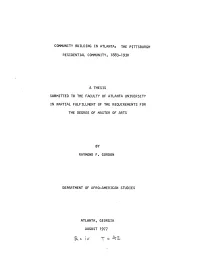
COMMUNITY BUILDING IN ATLANTA: THE PITTSBURGH / RESIDENTIAL COMMUNITY, 1883-1930 A THESIS SUBMITTED TO THE FACULTY OF ATLANTA UNIVERSITY IN PARTIAL FULFILLMENT OF THE REQUIREMENTS FOR THE DEGREE OF MASTER OF ARTS BY RAYMOND F. GORDON DEPARTMENT OF AFRO-AMERICAN STUDIES ATLANTA, GEORGIA AUGUST 1977 T - A-2. TABLE OF CONTENTS Page LIST OF TABLES iii LIST OF MAPS iv INTRODUCTION 1 Chapter I. GENERAL BACKGROUND—ATLANTA1S GROWTH DURING THE POST-RECONSTRUCTION ERA 2 II. THE PITTSBURGH RESIDENTIAL COMMUNITY: THE FORMATION OF A BLACK COMMUNITY, 1883-1930 10 III. THE INTERNAL DYNAMICS OF THE PITTSBURGH RESIDENTIAL COMMUNITY 23 CONCLUSION 37 BIBLIOGRAPHY 40 i i LIST OF TABLES Table Page 1. Pittsburgh Residential Community Population, 1883-1930 . 13 2. Pittsburgh Residential Community Migrant Popula¬ tion, 1900-1910 17 3. Pittsburgh Residential Community Occupational Structure, 1910 18 4. Pittsburgh Residential Community Occupational Structure, 1920 19 5. Pittsburgh Residential Community Occupational Structure, 1930 19 6. Pittsburgh Residential Community Black Property Owners 22 iii LIST OF MAPS Map Page 1. Atlanta's Black Communities 8 2. Residences Occupied by Blacks and Whites in the Pittsburgh Residential Community, 1890 14 3. Residences Occupied by Blacks and Whites in the Pittsburgh Residential Community, 1900 15 4. Residences Occupied by Blacks and Whites in the Pittsburgh Residential Community, 1910 16 5. Black Residential Areas, 1890 25 6. Black Residential Areas, 1920 26 7. The Pittsburgh Residential Community 30 INTRODUCTION The economic progress of Blacks in Atlanta's earliest periods of growth and development was the result of a vigorous drive on the part of leading black and white citizens to bring about a better working relation¬ ship between these two groups. -

Westward Expansion and Indian Removal
Unit 6: The New South SS8H7 Griffith-Georgia Studies THE BIG IDEA SS8H7: The student will evaluate key political, social, and economic changes that occurred in Georgia between 1877 and 1918. Evaluate- to make a judgment as to the worth or value of something; judge, assess Griffith-Georgia Studies SS8H7a SS8H7a: Evaluate the impact the Bourbon Triumvirate, Henry Grady, International Cotton Expositions, Tom Watson and the Populists, Rebecca Latimer Felton, The 1906 Race Riot, the Leo Frank Case, and the county unit system had on Georgia between 1877 and 1918 Evaluate- to make a judgment as to the worth or value of something; judge, assess Griffith-Georgia Studies Bourbon Triumvirate SS8H7a Bourbon Triumvirate- GA’s 3 most powerful politicians during the Post-Reconstruction Era. Brown They were… John B. Gordon Joseph E. Brown Alfred H. Colquitt Shared power between Colquitt the governor and senate seats from 1872-1890 Gordon Griffith-Georgia Studies John B. Gordon SS8H7a Father owned a coal mine and he worked there when the Civil war broke out. Gained notoriety in the war as a distinguished Confederate officer. Wounded 5 times Political leader Generally acknowledged as head of the Ku Klux Klan in GA Member of the Bourbon Triumvirate Served multiple terms in the U.S. Senate Governor of GA from 1886 to 1890 Griffith-Georgia Studies Joseph E. Brown SS8H7a Born in SC moved to GA Briefly attended Yale Became lawyer and businessman The Civil War governor of GA One of the most successful politicians in GA’s history. Member of the Bourbon Triumvirate Brown served as a U.S. -
Auburn Executive Summary.Indd
Central Atlanta Progress Atlanta Downtown Improvement District City of Atlanta EastsideEastside // AuburnAuburn FocusFocus AreaArea EXECUTIVEEXECUTIVE SUMMARYSUMMARY OctoberOctober 20042004 Prepared by: Eastside / Auburn Urban Collage, Inc. Prepared by: Urban Cooper Collage, Carry,Inc. in association URS Corp., with ZVA, ZHA, HPE, Verge Studios, Biscuit Studios and PEQ Cooper Carry, URS Corp., ZVA, ZHA, HPE, Verge Studios, Biscuit Studios and PEQ OVERVIEW / ISSUES Overview Sweet Auburn is the historical African-American heart of Atlanta, and Auburn Avenue is its Peachtree Street. In January through March of 2004, Sweet Auburn was studied as a part of the ‘Eastside / Auburn Avenue’ Focus Area, one of five such areas included in the “Imagine Downtown” planning and visioning process. An Eastside / Auburn Core Team of institutions, businesses, property owners and residents in the area was convened to review existing conditions, define issues for discussion, review plan products and prioritize implementation steps. In addition, one-on-one interviews were held with many of the stakeholders in the corridor and over 60 people participated in the Community Workshop held on December 9, 2003. Focus Area Context The Eastside/ Auburn Avenue Focus Area is located just east of Atlanta’s Central Business District. The Auburn corridor is approximately one mile long, anchored by a high-density commercial area around Peachtree Street on the west and the Martin Luther King Jr. National Historic Site (NHS) on the east. John Wesley Dobbs Avenue and Edgewood Avenue form the northern and southern boundaries of the Focus Area, which is about six blocks at its widest point where in jogs along Gilmore Street to include a part of Grady Hospital. -

Atlanta Beltline Redevelopment Plan
Atlanta BeltLine Redevelopment Plan PREPARED FOR The Atlanta Development Authority NOVEMBER 2005 EDAW Urban Collage Grice & Associates Huntley Partners Troutman Sanders LLP Gravel, Inc. Watercolors: Rebekah Adkins, Savannah College of Art and Design Acknowledgements The Honorable Mayor City of Atlanta The BeltLine Partnership Shirley C. Franklin, City of Atlanta Fulton County The BeltLine Tax Allocation District Lisa Borders, President, Feasibility Study Steering Commi�ee Atlanta City Council Atlanta Public Schools The Trust for Public Land Atlanta City Council Members: Atlanta Planning Advisory Board (APAB) The PATH Foundation Carla Smith (District 1) Neighborhood Planning Units (NPU) Friends of the BeltLine Debi Starnes (District 2) MARTA Ivory Young Jr. (District 3) Atlanta Regional Commission Cleta Winslow (District 4) BeltLine Transit Panel Natalyn Archibong (District 5) Anne Fauver (District 6) Howard Shook (District 7) Clair Muller (District 8) Felicia Moore (District 9) C. T. Martin (District 10) Jim Maddox (District 11) Joyce Sheperd (District 12) Ceasar Mitchell (Post 1) Mary Norwood (Post 2) H. Lamar Willis (Post 3) Contents 1.0 Summary 1 7.0 Types of Costs Covered by TAD Funding 2.0 Introduction 5 and Estimated TAD Bond Issuances 77 2.1 The BeltLine Concept 5 7.0.1 Workforce Housing 78 2.2 Growth and Development Context 5 7.0.2 Land Acquisition–Right-of-Way, 2.3 Historic Development 7 Greenspace 78 2.4 Feasibility Study Findings 8 7.0.3 Greenway Design and Construction 78 2.5 Cooperating Partners 9 7.0.4 Park Design and Construction -

Cleveland Avenue Corridor Study 2009
2009 City of Atlanta Department of Planning and Community Development Bureau of Planning CLEVELAND AVENUE CORRIDOR STUDY 2009 City of Atlanta Shirley Franklin, Mayor City Council Lisa Borders, Council President Carla Smith, District 1 Kwanza Hall, District 2 Ivory L. Young Jr., District 3 Cleta Winslow, District 4 Natalyn M. Archibong, District 5 Anne Fauver, District 6 Howard Shook, District 7 Clair Muller, District 8 Felicia Moore, District 8 C.T. Martin, District 10 Jim Maddox, District 11 Joyce Sheperd, District 12 Ceasar C. Mitchell, Post 1 At Large Mary Norwood, Post 2 At Large H. Lamar Willis, Post 3 At Large Department of Planning and Community Development James E. Shelby, Commissioner Bureau of Planning Charletta Wilson Jacks, Director Garnett Brown, Assistant Director 55 Trinity Ave, Suite 3350, Atlanta Ga 30303 404-330-6145 http://www.atlantaga.gov/government/planning/burofplanning.aspx P a g e | 2 CLEVELAND AVENUE CORRIDOR STUDY 2009 Project Team Garnett Brown, Bureau of Planning Jessica Lavandier, Bureau of Planning Flor Velarde, Bureau of Planning Jonathan Gelber, Bureau of Planning Alexandra Arkadieva, Bureau of Planning Jewelle Kennedy, Bureau of Planning Valencia Coar, Community Design Center Consultant Team Ken Bleakly, Bleakly Advisory Group JJG Funding Provided by Joyce Sheperd, District 12 The team would like to thank Rosel Fann Recreation Center for the use of the facilities as well as many of the stakeholders that participated in this study. P a g e | 3 CLEVELAND AVENUE CORRIDOR STUDY 2009 Table of Contents Introduction -
Atlanta Streetcar Corridor and Recommendations to Implement the Final Strategy
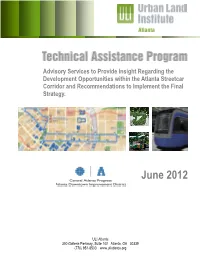
Advisory Services to Provide Insight Regarding the Development Opportunities within the Atlanta Streetcar Corridor and Recommendations to Implement the Final Strategy. June 2012 ULI Atlanta 300 Galleria Parkway, Suite 100 Atlanta, GA 30339 (770) 951-8500 www.uliatlanta.org Technical Assistance Program ULI – The Urban Land Institute ULI ATLANTA The Urban Land Institute (ULI) was established in 1936 and has over 30,000 members from more than 90 countries. It TAPS COMMITTEE MEMBERS is one of America’s most respected resources of infor- mation and knowledge on urban planning, growth and de- Robert Newcomer velopment. ULI is a non-profit research and education or- (Chair) ganization. Its mission is to provide leadership in the re- sponsible use of land and in creating and sustaining thriv- Constance Callahan ing communities worldwide. To encourage an open ex- (Vice Chair) change of ideas and sharing experiences, ULI membership represents the entire spectrum of land use and real estate Stephen Arms development disciplines, working in private enterprise and Kerry Blind public service. Among its members there are developers, builders, property owners, investors, architects, planners, Jan Bozeman public officials, brokers, appraisers, attorneys, engineers, John Cheek financiers, academics, students and marketing and brand Kevin Clark identity experts. Chris Hall Josh Herndon Steven Hinkle Sarah Kirsch ULI Atlanta Jerrold L. Miller With over 1,000 members throughout Georgia, Alabama Darryl Moss and Eastern Tennessee, ULI Atlanta is one of the largest William Norris District Councils of the Urban Land Institute. We bring to- Amanda Rhein gether leaders from across the fields of real estate and John Rhodes land use policy to exchange best practices and serve com- Jay Silverman munity needs. -

Atlanta Heritage Trails 2.3 Miles, Easy–Moderate
4th Edition AtlantaAtlanta WalksWalks 4th Edition AtlantaAtlanta WalksWalks A Comprehensive Guide to Walking, Running, and Bicycling the Area’s Scenic and Historic Locales Ren and Helen Davis Published by PEACHTREE PUBLISHERS 1700 Chattahoochee Avenue Atlanta, Georgia 30318-2112 www.peachtree-online.com Copyright © 1988, 1993, 1998, 2003, 2011 by Render S. Davis and Helen E. Davis All photos © 1998, 2003, 2011 by Render S. Davis and Helen E. Davis All rights reserved. No part of this publication may be reproduced, stored in a retrieval system, or transmitted in any form or by any means—electronic, mechanical, photocopy, recording, or any other—except for brief quotations in printed reviews, without prior permission of the publisher. This book is a revised edition of Atlanta’s Urban Trails.Vol. 1, City Tours.Vol. 2, Country Tours. Atlanta: Susan Hunter Publishing, 1988. Maps by Twin Studios and XNR Productions Book design by Loraine M. Joyner Cover design by Maureen Withee Composition by Robin Sherman Fourth Edition 10 9 8 7 6 5 4 3 2 1 Manufactured in August 2011 in Harrisonburg, Virgina, by RR Donnelley & Sons in the United States of America Library of Congress Cataloging in Publication Data Davis, Ren, 1951- Atlanta walks : a comprehensive guide to walking, running, and bicycling the area’s scenic and historic locales / written by Ren and Helen Davis. -- 4th ed. p. cm. Includes bibliographical references and index. ISBN 978-1-56145-584-3 (alk. paper) 1. Atlanta (Ga.)--Tours. 2. Atlanta Region (Ga.)--Tours. 3. Walking--Georgia--Atlanta-- Guidebooks. 4. Walking--Georgia--Atlanta Region--Guidebooks. 5. -

"The Case of Mary Phagan, 'A Story About the Story of a Murder'
"THE CASE OF MARY PHAGAN, 'A STORY ABOUT THE STORY OF A MURDER': CONSTRUCTING A CRIME" Regan V. Shelton Thesis submitted to the Faculty of the Virginia Polytechnic Institute and State University in partial fulfillment of the requirements for the degree of Master of Arts in History Dr. Kathleen Jones, Chair Dr. Beverly Bunch-Lyons Dr. Larry Schumsky December 13, 1999 Blacksburg, Virginia Keywords: Mary Phagan, Jim Conley, Leo Frank, homicide, gender and crime Copyright 1999, Regan Shelton "The Case of Mary Phagan, 'A Story About the Story of a Murder': Constructing a Crime" Regan V. Shelton (ABSTRACT) On April 27, 1913, the body of thirteen-year-old Mary Phagan was discovered in the basement of her workplace in Atlanta, Georgia. Over the course of the following two years, her employer, Leo Frank, would be tried and convicted for her murder. Another employee, Jim Conley, a black janitor originally implicated in the crime, provided the evidence used to convict Frank. In my thesis, I explain the multiple identities created to describe the victim and her accused murderer(s). Press reports, trial records, and secondary historical accounts of the crime all reveal a fascination with the young female victim and a desire to solve the mystery of her death. By examining personal identity as a cultural construction, I re-evaluate the manner in which we define and describe crime. Phagan's murder became a cautionary tale, a narrative of sexual danger within the model city of the New South. My thesis illustrates the importance of understanding murder as an event occurring within and shaped by a social context. -

Historic Structure Report: 506 Auburn Avenue, NE, Martin
National Park Service U.S. Department of the Interior Martin Luther King, Jr. National Historical Park Atlanta, Georgia 506 Auburn Avenue, NE Historic Structure Report September 2019 Cultural Resources, Partnerships and Science Division Southeast Region 506 Auburn Avenue, NE Martin Luther King, Jr. National Historical Park Atlanta, Georgia Historic Structure Report September 2019 Prepared by: Panamerican Consultants, Inc. 2390 Clinton Street Buffalo, New York 14227-1735 Wiss, Janney, Elstner Associates, Inc. 330 Pfingsten Road Northbrook, Illinois 60062 WFT Architects, PA 770 North State Street Jackson, Mississippi 39202 Prepared for: National Park Service Southeast Regional Office 100 Alabama Street SW Atlanta, Georgia 30303 Cultural Resources, Partnerships and Science Division Southeast Regional Office National Park Service 100 Alabama Street, SW Atlanta, Georgia 30303 (404) 507-5787 About the front cover: View of the 506 Auburn Avenue, NE, looking north, August 2017. This manuscript has been authored by Panamerican Consultants, Inc., with consultants Wiss, Janney, Elstner Associates, Inc., and WFT Architects, P.A., under Contract Number P16PC00097 with the National Park Service. The United States Government retains and the publisher, by accepting the article for publication, acknowledges that the United States Government retains a non-exclusive, paid-up, irrevocable, worldwide license to publish or reproduce the published form of this manuscript, or allow others to do so, for United States Government purposes. 506 Auburn Avenue, NE