The Constellation Coma Berenices Berenices Hair The
Total Page:16
File Type:pdf, Size:1020Kb
Load more
Recommended publications
-

Central Coast Astronomy Virtual Star Party May 15Th 7Pm Pacific
Central Coast Astronomy Virtual Star Party May 15th 7pm Pacific Welcome to our Virtual Star Gazing session! We’ll be focusing on objects you can see with binoculars or a small telescope, so after our session, you can simply walk outside, look up, and understand what you’re looking at. CCAS President Aurora Lipper and astronomer Kent Wallace will bring you a virtual “tour of the night sky” where you can discover, learn, and ask questions as we go along! All you need is an internet connection. You can use an iPad, laptop, computer or cell phone. When 7pm on Saturday night rolls around, click the link on our website to join our class. CentralCoastAstronomy.org/stargaze Before our session starts: Step 1: Download your free map of the night sky: SkyMaps.com They have it available for Northern and Southern hemispheres. Step 2: Print out this document and use it to take notes during our time on Saturday. This document highlights the objects we will focus on in our session together. Celestial Objects: Moon: The moon 4 days after new, which is excellent for star gazing! *Image credit: all astrophotography images are courtesy of NASA & ESO unless otherwise noted. All planetarium images are courtesy of Stellarium. Central Coast Astronomy CentralCoastAstronomy.org Page 1 Main Focus for the Session: 1. Canes Venatici (The Hunting Dogs) 2. Boötes (the Herdsman) 3. Coma Berenices (Hair of Berenice) 4. Virgo (the Virgin) Central Coast Astronomy CentralCoastAstronomy.org Page 2 Canes Venatici (the Hunting Dogs) Canes Venatici, The Hunting Dogs, a modern constellation created by Polish astronomer Johannes Hevelius in 1687. -
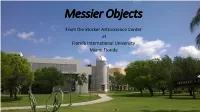
Messier Objects
Messier Objects From the Stocker Astroscience Center at Florida International University Miami Florida The Messier Project Main contributors: • Daniel Puentes • Steven Revesz • Bobby Martinez Charles Messier • Gabriel Salazar • Riya Gandhi • Dr. James Webb – Director, Stocker Astroscience center • All images reduced and combined using MIRA image processing software. (Mirametrics) What are Messier Objects? • Messier objects are a list of astronomical sources compiled by Charles Messier, an 18th and early 19th century astronomer. He created a list of distracting objects to avoid while comet hunting. This list now contains over 110 objects, many of which are the most famous astronomical bodies known. The list contains planetary nebula, star clusters, and other galaxies. - Bobby Martinez The Telescope The telescope used to take these images is an Astronomical Consultants and Equipment (ACE) 24- inch (0.61-meter) Ritchey-Chretien reflecting telescope. It has a focal ratio of F6.2 and is supported on a structure independent of the building that houses it. It is equipped with a Finger Lakes 1kx1k CCD camera cooled to -30o C at the Cassegrain focus. It is equipped with dual filter wheels, the first containing UBVRI scientific filters and the second RGBL color filters. Messier 1 Found 6,500 light years away in the constellation of Taurus, the Crab Nebula (known as M1) is a supernova remnant. The original supernova that formed the crab nebula was observed by Chinese, Japanese and Arab astronomers in 1054 AD as an incredibly bright “Guest star” which was visible for over twenty-two months. The supernova that produced the Crab Nebula is thought to have been an evolved star roughly ten times more massive than the Sun. -
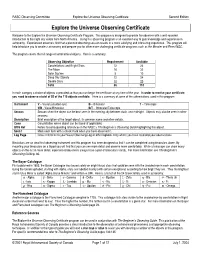
Explore the Universe Observing Certificate Second Edition
RASC Observing Committee Explore the Universe Observing Certificate Second Edition Explore the Universe Observing Certificate Welcome to the Explore the Universe Observing Certificate Program. This program is designed to provide the observer with a well-rounded introduction to the night sky visible from North America. Using this observing program is an excellent way to gain knowledge and experience in astronomy. Experienced observers find that a planned observing session results in a more satisfying and interesting experience. This program will help introduce you to amateur astronomy and prepare you for other more challenging certificate programs such as the Messier and Finest NGC. The program covers the full range of astronomical objects. Here is a summary: Observing Objective Requirement Available Constellations and Bright Stars 12 24 The Moon 16 32 Solar System 5 10 Deep Sky Objects 12 24 Double Stars 10 20 Total 55 110 In each category a choice of objects is provided so that you can begin the certificate at any time of the year. In order to receive your certificate you need to observe a total of 55 of the 110 objects available. Here is a summary of some of the abbreviations used in this program Instrument V – Visual (unaided eye) B – Binocular T – Telescope V/B - Visual/Binocular B/T - Binocular/Telescope Season Season when the object can be best seen in the evening sky between dusk. and midnight. Objects may also be seen in other seasons. Description Brief description of the target object, its common name and other details. Cons Constellation where object can be found (if applicable) BOG Ref Refers to corresponding references in the RASC’s The Beginner’s Observing Guide highlighting this object. -

Macedonian Kings, Egyptian Pharaohs the Ptolemaic Family In
Department of World Cultures University of Helsinki Helsinki Macedonian Kings, Egyptian Pharaohs The Ptolemaic Family in the Encomiastic Poems of Callimachus Iiro Laukola ACADEMIC DISSERTATION To be publicly discussed, by due permission of the Faculty of Arts at the University of Helsinki in auditorium XV, University Main Building, on the 23rd of September, 2016 at 12 o’clock. Helsinki 2016 © Iiro Laukola 2016 ISBN 978-951-51-2383-1 (paperback.) ISBN 978-951-51-2384-8 (PDF) Unigrafia Helsinki 2016 Abstract The interaction between Greek and Egyptian cultural concepts has been an intense yet controversial topic in studies about Ptolemaic Egypt. The present study partakes in this discussion with an analysis of the encomiastic poems of Callimachus of Cyrene (c. 305 – c. 240 BC). The success of the Ptolemaic Dynasty is crystallized in the juxtaposing of the different roles of a Greek ǴdzȅǻǽǷȏȄ and of an Egyptian Pharaoh, and this study gives a glimpse of this political and ideological endeavour through the poetry of Callimachus. The contribution of the present work is to situate Callimachus in the core of the Ptolemaic court. Callimachus was a proponent of the Ptolemaic rule. By reappraising the traditional Greek beliefs, he examined the bicultural rule of the Ptolemies in his encomiastic poems. This work critically examines six Callimachean hymns, namely to Zeus, to Apollo, to Artemis, to Delos, to Athena and to Demeter together with the Victory of Berenice, the Lock of Berenice and the Ektheosis of Arsinoe. Characterized by ambiguous imagery, the hymns inspect the ruptures in Greek thought during the Hellenistic age. -
Naming the Extrasolar Planets
Naming the extrasolar planets W. Lyra Max Planck Institute for Astronomy, K¨onigstuhl 17, 69177, Heidelberg, Germany wlyra@mpia.de Abstract and OGLE-TR-182 b, which does not help educators convey the message that these planets are quite similar to Jupiter. Extrasolar planets are not named and are referred to only In stark contrast, the sentence“planet Apollo is a gas giant by their assigned scientific designation. The reason given like Jupiter” is heavily - yet invisibly - coated with Coper- by the IAU to not name the planets is that it is consid- nicanism. ered impractical as planets are expected to be common. I One reason given by the IAU for not considering naming advance some reasons as to why this logic is flawed, and sug- the extrasolar planets is that it is a task deemed impractical. gest names for the 403 extrasolar planet candidates known One source is quoted as having said “if planets are found to as of Oct 2009. The names follow a scheme of association occur very frequently in the Universe, a system of individual with the constellation that the host star pertains to, and names for planets might well rapidly be found equally im- therefore are mostly drawn from Roman-Greek mythology. practicable as it is for stars, as planet discoveries progress.” Other mythologies may also be used given that a suitable 1. This leads to a second argument. It is indeed impractical association is established. to name all stars. But some stars are named nonetheless. In fact, all other classes of astronomical bodies are named. -
Have Pictures of the Constellations (Cygnus, Perseus, Corona Borelis, Cassiopeia, Orion, Big Dipper, and Virgo) on the Seminary Tables in Front
1. Gathering Activity : Have pictures of the constellations (Cygnus, Perseus, Corona Borelis, Cassiopeia, Orion, Big Dipper, and Virgo) on the seminary tables in front. Give each YW a chance to identify the constellation on a piece of paper. 2. Introduction : Before cell phones, GPS, satellites, or even maps, people navigated the globe by looking up to the heavens. Star constellations that we can see tonight have been around since before Christ’s birth. They have been a light and a standard to help people find their way home. This year the Mutual theme comes from Doctrine and Covenants 115:5 “Arise and shine forth that thy light may be a standard for the nations.” As children of God, we are being asked to be a standard, a light for people to find their way back to their Heavenly Father. Tonight as we introduce the YW program we are going to use stars and constellation to help teach and guide you about the Young Women’s program. 3. Young Women Motto and Logo: Just as stars shine brightly in the night time sky, the Young Women’s logo is a torch burning brightly. It is surrounded by the Young Woman Motto: “Stand for Truth and Righteousness”. The Moto invites all young women to make a commitment to hold up their light by being an example and remaining worthy to make and keep sacred covenants and receive the ordinances of the temple. When I think of the Young Woman’s motto, it makes me think of _____________________________________________________. 4. Young Women Theme/ Values Constellations were created to bring order to the night time chaos in the heavens. -

CONSTELLATION BOÖTES, the HERDSMAN Boötes Is the Cultivator Or Ploughman Who Drives the Bears, Ursa Major and Ursa Minor Around the Pole Star Polaris
CONSTELLATION BOÖTES, THE HERDSMAN Boötes is the cultivator or Ploughman who drives the Bears, Ursa Major and Ursa Minor around the Pole Star Polaris. The bears, tied to the Polar Axis, are pulling a plough behind them, tilling the heavenly fields "in order that the rotations of the heavens should never cease". It is said that Boötes invented the plough to enable mankind to better till the ground and as such, perhaps, immortalizes the transition from a nomadic life to settled agriculture in the ancient world. This pleased Ceres, the Goddess of Agriculture, so much that she asked Jupiter to place Boötes amongst the stars as a token of gratitude. Boötes was first catalogued by the Greek astronomer Ptolemy in the 2nd century and is home to Arcturus, the third individual brightest star in the night sky, after Sirius in Canis Major and Canopus in Carina constellation. It is a constellation of large extent, stretching from Draco to Virgo, nearly 50° in declination, and 30° in right ascension, and contains 85 naked-eye stars according to Argelander. The constellation exhibits better than most constellations the character assigned to it. One can readily picture to one's self the figure of a Herdsman with upraised arm driving the Greater Bear before him. FACTS, LOCATION & MAP • The neighbouring constellations are Canes Venatici, Coma Berenices, Corona Borealis, Draco, Hercules, Serpens Caput, Virgo, and Ursa Major. • Boötes has 10 stars with known planets and does not contain any Messier objects. • The brightest star in the constellation is Arcturus, Alpha Boötis, which is also the third brightest star in the night sky. -
The Dynamical State of the Coma Cluster with XMM-Newton?
A&A 400, 811–821 (2003) Astronomy DOI: 10.1051/0004-6361:20021911 & c ESO 2003 Astrophysics The dynamical state of the Coma cluster with XMM-Newton? D. M. Neumann1,D.H.Lumb2,G.W.Pratt1, and U. G. Briel3 1 CEA/DSM/DAPNIA Saclay, Service d’Astrophysique, L’Orme des Merisiers, Bˆat. 709, 91191 Gif-sur-Yvette, France 2 Science Payloads Technology Division, Research and Science Support Dept., ESTEC, Postbus 299 Keplerlaan 1, 2200AG Noordwijk, The Netherlands 3 Max-Planck Institut f¨ur extraterrestrische Physik, Giessenbachstr., 85740 Garching, Germany Received 19 June 2002 / Accepted 13 December 2002 Abstract. We present in this paper a substructure and spectroimaging study of the Coma cluster of galaxies based on XMM- Newton data. XMM-Newton performed a mosaic of observations of Coma to ensure a large coverage of the cluster. We add the different pointings together and fit elliptical beta-models to the data. We subtract the cluster models from the data and look for residuals, which can be interpreted as substructure. We find several significant structures: the well-known subgroup connected to NGC 4839 in the South-West of the cluster, and another substructure located between NGC 4839 and the centre of the Coma cluster. Constructing a hardness ratio image, which can be used as a temperature map, we see that in front of this new structure the temperature is significantly increased (higher or equal 10 keV). We interpret this temperature enhancement as the result of heating as this structure falls onto the Coma cluster. We furthermore reconfirm the filament-like structure South-East of the cluster centre. -

What Is an Ultra-Faint Galaxy?
What is an ultra-faint Galaxy? UCSB KITP Feb 16 2012 Beth Willman (Haverford College) ~ 1/10 Milky Way luminosity Large Magellanic Cloud, MV = -18 image credit: Yuri Beletsky (ESO) and APOD NGC 205, MV = -16.4 ~ 1/40 Milky Way luminosity image credit: www.noao.edu Image credit: David W. Hogg, Michael R. Blanton, and the Sloan Digital Sky Survey Collaboration ~ 1/300 Milky Way luminosity MV = -14.2 Image credit: David W. Hogg, Michael R. Blanton, and the Sloan Digital Sky Survey Collaboration ~ 1/2700 Milky Way luminosity MV = -11.9 Image credit: David W. Hogg, Michael R. Blanton, and the Sloan Digital Sky Survey Collaboration ~ 1/14,000 Milky Way luminosity MV = -10.1 ~ 1/40,000 Milky Way luminosity ~ 1/1,000,000 Milky Way luminosity Ursa Major 1 Finding Invisible Galaxies bright faint blue red Willman et al 2002, Walsh, Willman & Jerjen 2009; see also e.g. Koposov et al 2008, Belokurov et al. Finding Invisible Galaxies Red, bright, cool bright Blue, hot, bright V-band apparent brightness V-band faint Red, faint, cool blue red From ARAA, V26, 1988 Willman et al 2002, Walsh, Willman & Jerjen 2009; see also e.g. Koposov et al 2008, Belokurov et al. Finding Invisible Galaxies Ursa Major I dwarf 1/1,000,000 MW luminosity Willman et al 2005 ~ 1/1,000,000 Milky Way luminosity Ursa Major 1 CMD of Ursa Major I Okamoto et al 2008 Distribution of the Milky Wayʼs dwarfs -14 Milky Way dwarfs 107 -12 -10 classical dwarfs V -8 5 10 Sun M L -6 ultra-faint dwarfs Canes Venatici II -4 Leo V Pisces II Willman I 1000 -2 Segue I 0 50 100 150 200 250 300 -

The Imperial Cult and the Individual
THE IMPERIAL CULT AND THE INDIVIDUAL: THE NEGOTIATION OF AUGUSTUS' PRIVATE WORSHIP DURING HIS LIFETIME AT ROME _______________________________________ A Dissertation presented to the Faculty of the Department of Ancient Mediterranean Studies at the University of Missouri-Columbia _______________________________________________________ In Partial Fulfillment of the Requirements for the Degree Doctor of Philosophy _____________________________________________________ by CLAIRE McGRAW Dr. Dennis Trout, Dissertation Supervisor MAY 2019 The undersigned, appointed by the dean of the Graduate School, have examined the dissertation entitled THE IMPERIAL CULT AND THE INDIVIDUAL: THE NEGOTIATION OF AUGUSTUS' PRIVATE WORSHIP DURING HIS LIFETIME AT ROME presented by Claire McGraw, a candidate for the degree of doctor of philosophy, and hereby certify that, in their opinion, it is worthy of acceptance. _______________________________________________ Professor Dennis Trout _______________________________________________ Professor Anatole Mori _______________________________________________ Professor Raymond Marks _______________________________________________ Professor Marcello Mogetta _______________________________________________ Professor Sean Gurd DEDICATION There are many people who deserve to be mentioned here, and I hope I have not forgotten anyone. I must begin with my family, Tom, Michael, Lisa, and Mom. Their love and support throughout this entire process have meant so much to me. I dedicate this project to my Mom especially; I must acknowledge that nearly every good thing I know and good decision I’ve made is because of her. She has (literally and figuratively) pushed me to achieve this dream. Mom has been my rock, my wall to lean upon, every single day. I love you, Mom. Tom, Michael, and Lisa have been the best siblings and sister-in-law. Tom thinks what I do is cool, and that means the world to a little sister. -

M-53 Ngc – 5053
MONTHLY OBSERVER’S CHALLENGE Las Vegas Astronomical Society Compiled by: Roger Ivester, Boiling Springs, North Carolina & Fred Rayworth, Las Vegas, Nevada With special assistance from: Rob Lambert, Las Vegas, Nevada JUNE 2014 Messier 53 (M53)/NGC-5053 – Globular Cluster Pair In Coma Berenices Introduction The purpose of the observer’s challenge is to encourage the pursuit of visual observing. It is open to everyone that is interested, and if you are able to contribute notes, drawings, or photographs, we will be happy to include them in our monthly summary. Observing is not only a pleasure, but an art. With the main focus of amateur astronomy on astrophotography, many times people tend to forget how it was in the days before cameras, clock drives, and GOTO. Astronomy depended on what was seen through the eyepiece. Not only did it satisfy an innate curiosity, but it allowed the first astronomers to discover the beauty and the wonderment of the night sky. Before photography, all observations depended on what the astronomer saw in the eyepiece, and how they recorded their observations. This was done through notes and drawings and that is the tradition we are stressing in the observers challenge. By combining our visual observations with our drawings, and sometimes, astrophotography (from those with the equipment and talent to do so), we get a unique understanding of what it is like to look through an eyepiece, and to see what is really there. The hope is that you will read through these notes and become inspired to take more time at the eyepiece studying each object, and looking for those subtle details that you might never have noticed before. -
The Skyscraper 2009 05.Indd
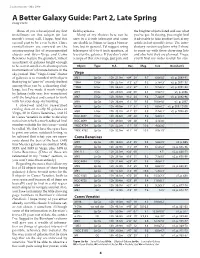
THE SKYSCRAPER • MAY 2009 A Better Galaxy Guide: Part 2, Late Spring Craig Cortis Those of you who enjoyed my first field eyepieces. the brighter objects listed and use what installment on this subject (in last Many of my choices here can be you’ve got. In closing, you might find month’s issue) will, I hope, find this seen in a 4-inch telescope and some it advisable to take another look at my second part to be even better. Three are doable in 50mm or larger binocu- article in last month’s issue. The intro- constellations are covered on the lars, but in general, I’d suggest using ductory section explains why I chose accompanying list of recommended telescopes of 6-to-8 inch aperture, at to come up with these observing lists objects and two—Virgo and Coma least for the galaxies. If you don’t own and also how they are planned. I hope Berenices-feature the grandest, richest a scope of that size range, just pick-out you’ll find my notes useful for star- assortment of galaxies bright enough to be seen in small-to-medium aperture Object Type R.A. Dec. Mag. Size Burnham’s instruments of all constellations in the sky, period. This “Virgo-Coma” cluster Virgo of galaxies is so crowded with objects M61 Sp Gx 12h 21.9m +04° 28’ 9.7 6.0x5.6’ v3, p. 2089-91 that trying to “zero-in” on only the best *M84 El Gx 12h 25.1m +12° 53’ 9.2 5.1x4.3’ v3, p.