Ar a Llan Poe Poem S
Total Page:16
File Type:pdf, Size:1020Kb
Load more
Recommended publications
-
Trauma and the Uncanny in Edgar Allan Poe's “Ligeia” and “The Fall Of
Trauma and the Uncanny in Edgar Allan Poe’s “Ligeia” and “The Fall of the House of Usher” Marita Nadal, Universidad de Zaragoza Abstract As a disorder of memory and time, trauma implies a crisis of representation, of history and truth. It remains in the mind like an intruder or a ghost, foregrounding the disjunction between the present and a primary experience of the past that can never be captured. Like trauma, the uncanny implies haunting, uncertainty, repe- tition, a tension between the known and the unknown, and the intrusive return of the past. Taking the characteristics of these concepts as the point of departure, this paper analyzes Poe’s Gothic tales “Ligeia” and “The Fall of the House of Usher,” and explores the close relationship between trauma and the uncanny in both of them. Thus the protagonists of these tales experience the desire to know and the fear of doing so—the basic dilemma at the heart of traumatic experience—and are haunted by memories of a remote and repressed past not recoverable by con- scious means but which determines their life in the present. The paper discusses trauma and the uncanny in the light of trauma theory, psychoanalysis, and Gothic criticism, pointing out the centrality of memory and the notion of origins. Keywords trauma, uncanny, Gothic, memory, origins What was it . which lay far within the pupils of my beloved? What was it? I was possessed with a passion to discover. —Edgar Allan Poe, “Ligeia” What was it that so unnerved me in the contemplation of the House of Usher? It was a mystery all insoluble. -
17 CHAPTER IV DATA ANALYSIS and INTERPRETATION in This
CHAPTER IV DATA ANALYSIS AND INTERPRETATION In this chapter, I discuss the findings and interpretations. The findings and interpretations answer the research questions stated in chapter I, where the objective of this study is to find out the words and phrases that represent Romanticism Era in Edgar Allan Poe‘s poems, Lenore and The Raven. To reach the objective, the words and phrases that show the Romanticism Era‘s characteristics in the poems are gathered and analyzed based on the five characteristics of Romanticism Era which also contain dark romanticism characteristics. They are: 1) imagination, 2) nature, 3) symbolism and myth, 4) intuition and subjectivity, and 5) individualism. All of those characteristics can present the characteristics of dark romanticism: dark, creepy, gloomy, and dreary tones. After gathering the words and phrases containing the characteristics, I found seven words and four phrases in The Raven and four words and four phrases in Lenore to analyze. The words and phrases that I found are words and phrases that attract me to analyze. There are a lot more words and phrases in The Raven and Lenore that can also represent both of the characteristics. They are worthy of discussion as they represent the five characteristics of Romanticism Era, especially the dark romanticism‘s characteristics. 17 4.1. Words and Phrases that Represent Romanticism Era’s Characteristics in The Raven In this section, I discuss my finding of words and phrases in the poem The Raven written by Edgar Allan Poe in 1845 (Parker, 2005, The Raven, pp. 143- 147). The words and phrases which I analyse gives information about the characteristics of the dark Romanticsm Era. -

ANALYSIS “Ligeia” (1838) Edgar Allan Poe (1809-1849) “With Her Name Drawn Equally out of Ivanhoe and “Christabel,'
ANALYSIS “Ligeia” (1838) Edgar Allan Poe (1809-1849) “With her name drawn equally out of Ivanhoe and “Christabel,’ Rowena we may fairly assume, is the living incarnation of English Romanticism…or English Transcendental thought cloaked in allegorical trappings. Yet in the narrator’s view, the lady of Tremaine was as destitute of Ligeia’s miraculous insights as of her stupendous learning and oracular gibberish. Conventional and dull, the blonde was simply another of those golden objects overcast by the leaden-grey window. Only in a moment ‘of his mental alienation’ did she seem to the narrator to be a fit ‘successor of the unforgotten Ligeia’; soon he came to loathe her ‘with a hatred belonging more to demon than to man.’ Rowena, in short, symbolizes an impoverished English Romanticism, as yet ‘unspiritualized’ by German cant. Consequently, she represents but a shallow pretense of Romanticism; and—on this point the text is admirably plain—it is a part of Poe’s joke to make her Romantic in nothing save her borrowed name.” Clark Griffith “Poe’s ‘Ligeia’ and the English Romantics” University of Toronto Quarterly 24 (1954) An introductory quotation asserts, contrary to Christianity, that God is “but a great will pervading all things” and that Man can resist death if his will is strong enough. Poe emphasizes this theme by repeating it twice in the story. A narrator not differentiated from Poe meets Ligeia in Germany, where gothic romanticism appealing to Poe’s sensibility was popular. He compares her to a “shadow.” Like other writers, Poe discovered through metaphor the psychological concept defined later by Carl Jung: the shadow represents the repressed self. -
Interactive Timeline
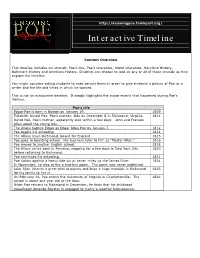
http://knowingpoe.thinkport.org/ Interactive Timeline Content Overview This timeline includes six strands: Poe’s Life, Poe’s Literature, World Literature, Maryland History, Baltimore History and American History. Students can choose to look at any or all of these strands as they explore the timeline. You might consider asking students to seek certain items in order to give students a picture of Poe as a writer and the life and times in which he worked. This is not an exhaustive timeline. It simply highlights the major events that happened during Poe’s lifetime. Poe’s Life Edgar Poe is born in Boston on January 19. 1809 Elizabeth Arnold Poe, Poe’s mother, dies on December 8 in Richmond, Virginia. 1811 David Poe, Poe’s mother, apparently dies within a few days. John and Frances Allen adopt the young boy. The Allans baptize Edgar as Edgar Allan Poe on January 7. 1812 Poe begins his schooling 1814 The Allans leave Richmond, bound for England. 1815 Poe goes to boarding school. His teachers refer to him as “Master Allan.” 1816 Poe moves to another English school. 1818 The Allans arrive back in America, stopping for a few days in New York City 1820 before returning to Richmond. Poe continues his schooling. 1821 Poe swims against a heavy tide six or seven miles up the James River. 1824 In November, he also writes a two-line poem. The poem was never published. John Allan inherits a great deal of money and buys a huge mansion in Richmond 1825 for his family to live in. -
Poe's Unreliable Narrator: the Reader As a Privileged Witness and The
Poe’s Unreliable Narrator: the Reader as a Privileged Witness and the Narrator´s Credibility1 El narrador poco fiable de Poe: el lector como testigo privilegiado y la credibilidad del narrador Francisco Javier Sánchez-Verdejo Pérez UNED fjsanchezverdejo@valdepenas.uned.es Recibido 8 de marzo de 2019 Aceptado 24 de marzo de 2020 Resumen Un narrador en quien no se puede confiar (preso de la locura, lleno de mentiras…) es una de las armas más poderosas que puede usar un autor. Como veremos, los efectos se multiplican cuando ese escritor es Edgar Allan Poe. Por otro lado, o además, si hay algo que pueda deleitar más que leer a Poe, eso es enseñar a Poe. Sus narradores, los que aparecen en historias como “The Tell-Tale Heart” o “The Black Cat”, ofrecen un ejemplo magnífico para nuestro proyecto. Mentalmente inestables, a pesar de sus (¿)pretendidas(?) intenciones de credibilidad, dichos narradores suelen alejarse subjetivamente de los hechos. Es por ello que estas historias formarán parte del corpus de narraciones que aquí presentamos. Palabras clave: Unreliable narrator, percepción, Edgar Allan Poe, credibilidad. 1 This contribution comes to light as a research carried out with several (under)graduate students. This research is included in a project designed in the form of cooperative work with students of different educational levels, and presented at a round table entitled "Edgar Allan Poe in the classroom: new proposals for teaching in the 21st century", in the I International EAPSA Conference, “Poe in the Age of Populism”, held in Valladolid between January 31st and February 2nd, 2018. The participating students are: - María Victoria Arenas Vela - María Belén Casado Rodrigo - Beatriz Garrido García - Rubén Pareja Pinilla 128 Verbeia 2020 ISSN 2444-1333 Año VI, Número 5, 128-150 Francisco Javier Sánchez-Verdejo Pérez Poe’s Unreliable Narrator: the Reader .. -
The Oedipus Myth in Edgar A. Poe's "Ligeia" and "The Fall of the House of Usher"
Iowa State University Capstones, Theses and Retrospective Theses and Dissertations Dissertations 1996 The ediO pus myth in Edgar A. Poe's "Ligeia" and "The alF l of the House of Usher" David Glen Tungesvik Iowa State University Follow this and additional works at: https://lib.dr.iastate.edu/rtd Part of the English Language and Literature Commons Recommended Citation Tungesvik, David Glen, "The eO dipus myth in Edgar A. Poe's "Ligeia" and "The alF l of the House of Usher"" (1996). Retrospective Theses and Dissertations. 16198. https://lib.dr.iastate.edu/rtd/16198 This Thesis is brought to you for free and open access by the Iowa State University Capstones, Theses and Dissertations at Iowa State University Digital Repository. It has been accepted for inclusion in Retrospective Theses and Dissertations by an authorized administrator of Iowa State University Digital Repository. For more information, please contact digirep@iastate.edu. The Oedipus myth in Edgar A. Poe's "Ligeia" and "The Fall of the House of Usher" by David Glen Tungesvik A thesis submitted to the graduate faculty in partial fulfillment of the requirements for the degree of MASTER OF ARTS Major: English (Literature) Major Professor: T. D. Nostwich Iowa State University Ames, Iowa 1996 Copyright © David Glen Tungesvik, 1996. All rights reserved. ii Graduate College Iowa State University This is to certify that the Masters thesis of David Glen Tungesvik has met the thesis requirements of Iowa State University Signatures have been redacted for privacy iii TABLE OF CONTENTS ABSTRACT ... .................................................................................................... iv INTRODUCTION ................................................................................................ 1 "LlGEIA" UNDISCOVERED ............................................................................... 9 THE LAST OF THE USHERS ......................................................................... -
Track Title 1 Tamerlane 2 Song 3 Dreams 4 Spirits Of
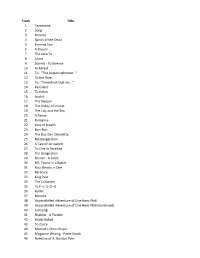
Track Title 1 Tamerlane 2 Song 3 Dreams 4 Spirits of the Dead 5 Evening Star 6 A Dream 7 The Lake To 8 Alone 9 Sonnet - To Science 10 Al Aaraaf 11 To - "The bowers whereat..." 12 To the River … 13 To - "I heed not that my..." 14 Fairyland 15 To Helen 16 Israfel 17 The Sleeper 18 The Valley of Unrest 19 The City and the Sea 20 A Paean 21 Romance 22 Loss of Breath 23 Bon-Bon 24 The Duc De L'Omelette 25 Metzengerstein 26 A Tale of Jerusalem 27 To One in Paradise 28 The Assignation 29 Silence - A Fable 30 MS. Found in a Bottle 31 Four Beasts in One 32 Bérénice 33 King Pest 34 The Coliseum 35 To F--s. S. O--d 36 Hymn 37 Morella 38 Unparallelled Adventure of One Hans Pfall 39 Unparallelled Adventure of One Hans Pfall (continued) 40 Lionizing 41 Shadow - A Parable 42 Bridal Ballad 43 To Zante 44 Maelzel's Chess Player 45 Magazine Writing - Peter Snook 46 Narritive of A. Gordon Pym 47 Narritive of A. Gordon Pym (continued) 48 Narritive of A. Gordon Pym (continued) 49 Narritive of A. Gordon Pym (continued) 50 Narritive of A. Gordon Pym (continued) 51 Mystification 52 Ligeia 53 How to Write a Blackwood Article 54 A Predicament 55 Why the Little Frechman Wears His Hand in a Sling 56 The Haunted Palace 57 Silence 58 The Devil in the Belfry 59 William Wilson 60 The Man that was Used Up 61 The Fall of the House of Usher 62 The Business Man 63 The Man of the Crowd 64 The Murders of the Rue Morgue 65 The Murders of the Rue Morgue (continued) 66 Eleonora 67 A Descent into the Maelstrom 68 The Island of the Fay 69 Never Bet the Devil Your Head 70 Three Sundays in a Week 71 The Conqueror Worm 72 Lenore 73 The Oval Portrait 74 The Masque of the Red Death 75 The Pit and the Pendulum 76 The Mystery of Marie Roget 77 The Mystery of Marie Roget (continued) 78 The Domain of Arnheim 79 The Gold-Bug 80 The Gold-Bug (continued) 81 The Tell-Tale Heart 82 The Black Cat 83 Raising the Wind (a.k.a. -

The Role of Evil in Edgar Allan Poe's Short Stories Tereza Macháčková
University of Pardubice Faculty of Arts and Philosophy The Role of Evil in Edgar Allan Poe’s Short Stories Tereza Macháčková Bachelor Thesis 2018 Prohlašuji: Tuto práci jsem vypracovala samostatně. Veškeré literární prameny a informace, které jsem v práci využila, jsou uvedeny v seznamu použité literatury. Byla jsem seznámena s tím, že se na moji práci vztahují práva a povinnosti vyplývající ze zákona č. 121/2000 Sb., autorský zákon, zejména se skutečností, že Univerzita Pardubice má právo na uzavření licenční smlouvy o užití této práce jako školního díla podle § 60 odst. 1 autorského zákona, a s tím, že pokud dojde k užití této práce mnou nebo bude poskytnuta licence o užití jinému subjektu, je Univerzita Pardubice oprávněna ode mne požadovat přiměřený příspěvek na úhradu nákladů, které na vytvoření díla vynaložila, a to podle okolností až do jejich skutečné výše. Beru na vědomí, že v souladu s § 47b zákona č. 111/1998 Sb., o vysokých školách a o změně a doplnění dalších zákonů (zákon o vysokých školách), ve znění pozdějších předpisů, a směrnicí Univerzity Pardubice č. 9/2012, bude práce zveřejněna v Univerzitní knihovně a prostřednictvím Digitální knihovny Univerzity Pardubice. V Pardubicích dne 18. 6. 2018 Tereza Macháčková ANNOTATION The thesis deals with the role of evil in Edgar Allan Poe’s short stories. The main points of the thesis are demonstrated on three short stories, The Imp of Perverse, The Cask of Amontillado and The Hop Frog. It analyses the behavior and personality of the main characters, the results of the analysis based on the philosophical view of evil and literary context and characterization of the genre. -

Edgar Allan Poe Simon & Schuster Classroom Activities for the Enriched Classic Edition of the Great Tales and Poems of Edgar Allan Poe
Simon & Schuster Classroom Activities For the Enriched Classic edition of The Great Tales and Poems of Edgar Allan Poe Simon & Schuster Classroom Activities For the Enriched Classic edition of The Great Tales and Poems of Edgar Allan Poe Each of the three activities includes: • NCTE standards covered • An estimate of the time needed • A complete list of materials needed • Step-by-step instructions • Questions to help you evaluate the results The curriculum guide and many other curriculum guides for Enriched Classics and Folger Shakespeare Library editions are available on our website, www.simonsaysteach.com. The Enriched Classic Edition of The Great Tales and Poems of Edgar Allan Poe includes: • An introduction that provides historical context and outlines the major themes of the work • Critical excerpts • Suggestions for further reading Also Available: More than fifty classic works are now available in the new Enriched Classic format. Each edition features: • A concise introduction that gives the reader important background information • A chronology of the author’s life and work • A timeline of significant events that provides the book’s historical context • An outline of key themes and plot points to help readers form their own interpretations • Detailed explanatory notes • Critical analysis, including contemporary and modern perspectives on the work • Discussion questions to promote lively classroom discussion • A list of recommended related books and films to broaden the reader’s experience Recent additions to the Enriched Classic series include: • Beowulf, Anonymous, ISBN 1416500375, $4.95 • The Odyssey, Homer, ISBN 1416500367, $5.95 • Dubliners, James Joyce, ISBN 1416500359, $4.95 • Oedipus the King, Sophocles, ISBN 1416500332, $5.50 • The Souls of Black Folks, W.E.B. -

View Fast Facts
FAST FACTS Author's Works and Themes: Edgar Allan Poe “Author's Works and Themes: Edgar Allan Poe.” Gale, 2019, www.gale.com. Writings by Edgar Allan Poe • Tamerlane and Other Poems (poetry) 1827 • Al Aaraaf, Tamerlane, and Minor Poems (poetry) 1829 • Poems (poetry) 1831 • The Narrative of Arthur Gordon Pym of Nantucket, North America: Comprising the Details of a Mutiny, Famine, and Shipwreck, During a Voyage to the South Seas; Resulting in Various Extraordinary Adventures and Discoveries in the Eighty-fourth Parallel of Southern Latitude (novel) 1838 • Tales of the Grotesque and Arabesque (short stories) 1840 • The Raven, and Other Poems (poetry) 1845 • Tales by Edgar A. Poe (short stories) 1845 • Eureka: A Prose Poem (poetry) 1848 • The Literati: Some Honest Opinions about Authorial Merits and Demerits, with Occasional Words of Personality (criticism) 1850 Major Themes The most prominent features of Edgar Allan Poe's poetry are a pervasive tone of melancholy, a longing for lost love and beauty, and a preoccupation with death, particularly the deaths of beautiful women. Most of Poe's works, both poetry and prose, feature a first-person narrator, often ascribed by critics as Poe himself. Numerous scholars, both contemporary and modern, have suggested that the experiences of Poe's life provide the basis for much of his poetry, particularly the early death of his mother, a trauma that was repeated in the later deaths of two mother- surrogates to whom the poet was devoted. Poe's status as an outsider and an outcast--he was orphaned at an early age; taken in but never adopted by the Allans; raised as a gentleman but penniless after his estrangement from his foster father; removed from the university and expelled from West Point--is believed to account for the extreme loneliness, even despair, that runs through most of his poetry. -

Edgar Allan Poe and Alan Parsons: All That We See Or Seem Is Nevermore
Brigham Young University BYU ScholarsArchive Student Works 2016-06-02 Edgar Allan Poe and Alan Parsons: All that We See or Seem is Nevermore Kimball R. Gardner Brigham Young University - Provo, kimballrg@aol.com Follow this and additional works at: https://scholarsarchive.byu.edu/studentpub Part of the English Language and Literature Commons BYU ScholarsArchive Citation Gardner, Kimball R., "Edgar Allan Poe and Alan Parsons: All that We See or Seem is Nevermore" (2016). Student Works. 161. https://scholarsarchive.byu.edu/studentpub/161 This Class Project or Paper is brought to you for free and open access by BYU ScholarsArchive. It has been accepted for inclusion in Student Works by an authorized administrator of BYU ScholarsArchive. For more information, please contact scholarsarchive@byu.edu, ellen_amatangelo@byu.edu. Gardner 1 Edgar Allan Poe and Alan Parsons: All That We See or Seem is Nevermore Kimball Gardner Since their beginnings in the mind of a brilliant, misunderstood man, the works of Edgar Allan Poe have captured the imaginations and fears of audiences throughout the world. After his death, when his popularity began to grow, Poe’s works became more widely read and studied by both scholars and authors. As technology began to advance in the twentieth century, his works began to be adapted into short films and later, feature-length films. And, in the late twentieth century, a young progressive rock group named the Alan Parsons Project offered their adaptation of several of Poe’s works. In this paper, I will discuss their work on “A Dream within a Dream” and “The Raven,” from their album Tales of Mystery and Imagination—Edgar Allan Poe and how their adaptation enhances Poe’s effect. -

Annabel Lee by Edgar Allan Poe
Name _______________________________________________ Date ____________________ Mod ___ Annabel Lee by Edgar Allan Poe It was many and many a year ago, In a kingdom by the sea, That a maiden there lived whom you may know By the name of Annabel Lee; And this maiden she lived with no other thought Than to love and be loved by me. I was a child and she was a child, In this kingdom by the sea; But we loved with a love that was more than love- I and my Annabel Lee; With a love that the winged seraphs of heaven Coveted her and me. And this was the reason that, long ago, In this kingdom by the sea, A wind blew out of a cloud, chilling My beautiful Annabel Lee; So that her highborn kinsman came And bore her away from me, To shut her up in a sepulchre In this kingdom by the sea. The angels, not half so happy in heaven, Went envying her and me- Yes!- that was the reason (as all men know, In this kingdom by the sea) That the wind came out of the cloud by night, Chilling and killing my Annabel Lee. But our love it was stronger by far than the love Of those who were older than we- Of many far wiser than we- And neither the angels in heaven above, Nor the demons down under the sea, Can ever dissever my soul from the soul Of the beautiful Annabel Lee. For the moon never beams without bringing me dreams Of the beautiful Annabel Lee; And the stars never rise but I feel the bright eyes Of the beautiful Annabel Lee; And so, all the night-tide, I lie down by the side Of my darling- my darling- my life and my bride, In the sepulchre there by the sea, In her tomb by the sounding sea.