The Great Sanitary Cheese How Sacramentans
Total Page:16
File Type:pdf, Size:1020Kb
Load more
Recommended publications
-

Music and the American Civil War
“LIBERTY’S GREAT AUXILIARY”: MUSIC AND THE AMERICAN CIVIL WAR by CHRISTIAN MCWHIRTER A DISSERTATION Submitted in partial fulfillment of the requirements for the degree of Doctor of Philosophy in the Department of History in the Graduate School of The University of Alabama TUSCALOOSA, ALABAMA 2009 Copyright Christian McWhirter 2009 ALL RIGHTS RESERVED ABSTRACT Music was almost omnipresent during the American Civil War. Soldiers, civilians, and slaves listened to and performed popular songs almost constantly. The heightened political and emotional climate of the war created a need for Americans to express themselves in a variety of ways, and music was one of the best. It did not require a high level of literacy and it could be performed in groups to ensure that the ideas embedded in each song immediately reached a large audience. Previous studies of Civil War music have focused on the music itself. Historians and musicologists have examined the types of songs published during the war and considered how they reflected the popular mood of northerners and southerners. This study utilizes the letters, diaries, memoirs, and newspapers of the 1860s to delve deeper and determine what roles music played in Civil War America. This study begins by examining the explosion of professional and amateur music that accompanied the onset of the Civil War. Of the songs produced by this explosion, the most popular and resonant were those that addressed the political causes of the war and were adopted as the rallying cries of northerners and southerners. All classes of Americans used songs in a variety of ways, and this study specifically examines the role of music on the home-front, in the armies, and among African Americans. -

An Analysis of Civil War Soldiers' Discussion of Free Time in Camp Madeline Norton Union College - Schenectady, NY
Union College Union | Digital Works Honors Theses Student Work 6-2014 Killing Time: An Analysis of Civil War Soldiers' Discussion of Free Time in Camp Madeline Norton Union College - Schenectady, NY Follow this and additional works at: https://digitalworks.union.edu/theses Part of the Military History Commons, Nonfiction Commons, and the United States History Commons Recommended Citation Norton, Madeline, "Killing Time: An Analysis of Civil War Soldiers' Discussion of Free Time in Camp" (2014). Honors Theses. 569. https://digitalworks.union.edu/theses/569 This Open Access is brought to you for free and open access by the Student Work at Union | Digital Works. It has been accepted for inclusion in Honors Theses by an authorized administrator of Union | Digital Works. For more information, please contact digitalworks@union.edu. Killing Time: An Analysis of Civil War Soldiers’ Discussion of Free Time in Camp By Madeline Norton Submitted in partial fulfillment of the requirements for Honors in the Department of History Department of History Union College March 2014 Contents Abstract……………………………………………………………………………………………iv Chapter One: Introduction………………………………………………………………….1 Chapter Two: Date Ordered Letters and Diaries………………………………...18 Chapter Three: Winter Encampments……………………………………………….35 Chapter Four: Officers and Infantry…………………………………………………..52 Chapter Five: Conclusion………………………………………………………………….67 Bibliography……………………………………………………………………………………72 Appendix…………………………………………………………………………………………79 iii NORTON, MADELINE Killing Time: An Analysis of Civil War Soldiers’ Discussion of Free Time in Camp While most Civil War history deals with a glorified and romanticized version of a soldier’s experience of war, the time a soldier spent combating the idleness of camp proved to be a more consuming battle. Though lacking in grandeur, how a soldier ‘killed time’ provides an important yet often overlooked insight into the camaraderie and culture of Civil War soldiers. -
Gaining Ground FINAL CONFORMED & ANNOTATED
Gaining Ground FINAL CONFORMED & ANNOTATED SCRIPT 3/20/12 GAINING GROUND 00:18 Opening scene: Aerial zoom out of empty lots JULIO HENRIQUEZ, V/O: When we moved here as a family, the whole community was just really devastated.1 LOWER THIRD: Boston DUDLEY NEIGHBORHOOD, 1980s Archival shots of devastation JOHN BARROS, V/O and O/C: The neighborhood was dealing with arson for profit, white flight from the city, uh, increase in crime and illegal dumping2. JULIO HENRIQUEZ, O/C and V/O: This vacant parcel here was just littered. And back of the house, that was a car graveyard. They used to steal cars and just dump ‘em there. CARLOS HENRIQUEZ, O/C and V/O: At nine or ten years old, all these blocks were vacant3, I was in the window, I would come home and if I was doing my homework, I might stop and take a break, and see a truck pull up to go dump a refrigerator and I would run out and I would write down the license plate number, give it to him to make sure people were cited for doing that. 01:10 Archival of protest march and community organizing 1 Medoff, Peter, and Holly Sklar. Streets of Hope: The Fall and Rise of an Urban Neighborhood. Boston, MA: South End Press, 1994. Print. 2 City of Boston Arson Prevention Commission, Report to the Boston Redevelopment Authority on the Status of Arson in Dudley Square, September 4, 1985, pp1-2. Print; Time.com. Education White Flight Continued. September 29, 1975. Web; Boston and Its Neighborhoods. -
African Americans Confront Lynching: Strategies of Resistance from The
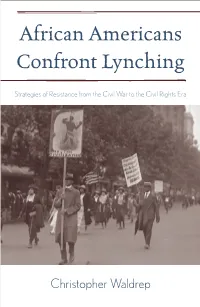
African Americans Confront Lynching Strategies of Resistance from the Civil War to the Civil Rights Era Christopher Waldrep StrategiesofResistance.indd 1 9/30/08 11:52:02 AM African Americans Confront Lynching The African American History Series Series Editors: Jacqueline M. Moore, Austin College Nina Mjagkij, Ball State University Traditionally, history books tend to fall into two categories: books academics write for each other, and books written for popular audiences. Historians often claim that many of the popu- lar authors do not have the proper training to interpret and evaluate the historical evidence. Yet, popular audiences complain that most historical monographs are inaccessible because they are too narrow in scope or lack an engaging style. This series, which will take both chronolog- ical and thematic approaches to topics and individuals crucial to an understanding of the African American experience, is an attempt to address that problem. The books in this series, written in lively prose by established scholars, are aimed primarily at nonspecialists. They fo- cus on topics in African American history that have broad significance and place them in their historical context. While presenting sophisticated interpretations based on primary sources and the latest scholarship, the authors tell their stories in a succinct manner, avoiding jargon and obscure language. They include selected documents that allow readers to judge the evidence for themselves and to evaluate the authors’ conclusions. Bridging the gap between popular and academic history, these books bring the African American story to life. Volumes Published Booker T. Washington, W.E.B. Du Bois, and the Struggle for Racial Uplift Jacqueline M. -

Wendell Phillips Wendell Phillips
“THE CHINAMAN WORKS CHEAP BECAUSE HE IS A BARBARIAN AND SEEKS GRATIFICATION OF ONLY THE LOWEST, THE MOST INEVITABLE WANTS.”1 For the white abolitionists, this was a class struggle rather than a race struggle. It would be quite mistaken for us to infer, now that the civil war is over and the political landscape has 1. Here is what was said of the Phillips family in Nathaniel Morton’s NEW ENGLAND’S MEMORIAL (and this was while that illustrious family was still FOB!): HDT WHAT? INDEX WENDELL PHILLIPS WENDELL PHILLIPS shifted, that the stereotypical antebellum white abolitionist in general had any great love for the welfare of black Americans. White abolitionist leaders knew very well what was the source of their support, in class conflict, and hence Wendell Phillips warned of the political danger from a successful alliance between the “slaveocracy” of the South and the Cotton Whigs of the North, an alliance which he termed “the Lords of the Lash and the Lords of the Loom.” The statement used as the title for this file, above, was attributed to Phillips by the news cartoonist and reformer Thomas Nast, in a cartoon of Columbia facing off a mob of “pure white” Americans armed with pistols, rocks, and sticks, on behalf of an immigrant with a pigtail, that was published in Harper’s Weekly on February 18, 1871. There is no reason to suppose that the cartoonist Nast was failing here to reflect accurately the attitudes of this Boston Brahman — as we are well aware how intensely uncomfortable this man was around any person of color. -

Kansas City and the Great Western Migration, 1840-1865
SEIZING THE ELEPHANT: KANSAS CITY AND THE GREAT WESTERN MIGRATION, 1840-1865 ___________________________________ A Dissertation presented to the Faculty of the Graduate School at the University of Missouri-Columbia _______________________________________________________________ In Partial Fulfillment of the Requirements for the Degree Doctor of Philosophy _______________________________________________________________ By DARIN TUCK John H. Wigger JULY 2018 © Copyright by Darin Tuck 2018 All Rights Reserved The undersigned, appointed by the dean of the Graduate School, have examined the dissertation entitled SEIZING THE ELEPHANT: KANSAS CITY AND THE GREAT WESTERN MIGRATION, 1840-1865 Presented by Darin Tuck, a candidate for the degree of doctor of philosophy, and hereby certify that, in their opinion, it is worthy of acceptance. __________________________________________________ Professor John Wigger __________________________________________________ Assoc. Professor Catherine Rymph __________________________________________________ Assoc. Professor Robert Smale __________________________________________________ Assoc. Professor Rebecca Meisenbach __________________________________________________ Assoc. Professor Carli Conklin To my mother and father, Ronald and Lynn Tuck My inspiration ACKNOWLEDGMENTS This dissertation was only possible because of the financial and scholarly support of the National Park Service’s National Trails Intermountain Region office. Frank Norris in particular served as encourager, editor, and sage throughout -
LCD Historic Sites and Programming/Event Assets 1. “Poe Returning to Boston”
LCD historic sites and programming/event assets 1. “Poe Returning to Boston” sculpture (unveiled October 5, 2014), corner of Charles and Boylston Streets. 2. The Colored American Magazine, 5 Park Square (address no longer exists but would be just where the The Trolley Shop and Leather World are situated). First monthly publication targeting an exclusively African American readership, 3. Grave of Charles Sprague, the banker-poet of Boston in the 1800s, Central Burying Ground on Boston Common off Boylston Street. 4. Ploughshares at Emerson College120 Boylston Street. Influential literary magazine. 5. Emerson College’s Colonial Theatre, 106 Boylston Street. Rodgers and Hammerstein literally wrote the title song to Oklahoma! in the lobby there and later won a special Pulitzer for the play. 6. The Long Path, stretching through the Common from the corner of Boylston and Tremont Streets to Joy Street, immortalized by Oliver Wendell Holmes in his Autocrat of the Breakfast Table. (Boston Common, the country’s oldest public park, is also a spot that Ralph Waldo Emerson grazed cows as a child. And Poe, who had a distaste for the transcendentalists, dismissed them as frogpondians, for the Common’s Frog Pond on which people ice skate during the winter.) 7. Fannie Farmer Cookbook, 174 Tremont Street (exact address no longer exists). Began as the Boston Cooking-School Cook Book. The Boston Cooking School stood at 174 Tremont. 8. Jacob Wirth Restaurant, 31 Stuart Street. Written about by poet Jack Kerouac. Patrons have also included Spencer for Hire writer Robert Parker. 9. Brattle Book Shop , 9 West Street. Specializes in used and rare books. -

John J. Montgomery Collection
http://oac.cdlib.org/findaid/ark:/13030/tf5j49n7wp No online items Inventory of John J. Montgomery Collection Processed by University Archives staff; machine-readable finding aid created by Xiuzhi Zhou University Archives Santa Clara University 500 El Camino Real Santa Clara, California 95053-0500 Phone: (408) 554-4117 Fax: (408) 554-5179 Email: amcmahon@mailer.scu.edu URL: http://www.scu.edu/archives © 1999 Santa Clara University. All rights reserved. Inventory of John J. Montgomery 1 Collection Inventory of John J. Montgomery Collection Collection: PP-Montgomery University Archives Santa Clara, California Contact Information: University Archives Santa Clara University 500 El Camino Real Santa Clara, California 95053-0500 Phone: (408) 554-4117 Fax: (408) 554-5179 Email: amcmahon@mailer.scu.edu URL: http://www.scu.edu/archives Processed by: University Archives staff Date completed: 1978 Updated: 1990, 1992, 1999 Encoded by: Xiuzhi Zhou © 1999 Santa Clara University. All rights reserved. Descriptive Summary Title: John J. Montgomery Collection Creator: Montgomery, John J. Extent: 6 cubic feet Repository: Santa Clara University Archives Santa Clara, CA 95053 Language: English. Access Santa Clara University permits public access to its archives within the context of respect for individual privacy, administrative confidentiality, and the integrity of the records. It reserves the right to close all or any portion of its records to researchers. The archival files of any office may be opened to a qualified researcher by the administrator of that office or his/her designee at any time. Archival collections may be used by researchers only in the Reading Room of the University Archives and may be photocopied only at the discretion of the archivist. -

The End of Slavery in West Virginia
W&M ScholarWorks Undergraduate Honors Theses Theses, Dissertations, & Master Projects 5-2011 It Took a War: The End of Slavery in West Virginia Mark Guerci College of William and Mary Follow this and additional works at: https://scholarworks.wm.edu/honorstheses Part of the History Commons Recommended Citation Guerci, Mark, "It Took a War: The End of Slavery in West Virginia" (2011). Undergraduate Honors Theses. Paper 381. https://scholarworks.wm.edu/honorstheses/381 This Honors Thesis is brought to you for free and open access by the Theses, Dissertations, & Master Projects at W&M ScholarWorks. It has been accepted for inclusion in Undergraduate Honors Theses by an authorized administrator of W&M ScholarWorks. For more information, please contact scholarworks@wm.edu. 0 It Took a War: The End of Slavery in West Virginia A thesis submitted in partial fulfillment of the requirements for the degree of Bachelor of Arts in History from the College of William and Mary by Mark Guerci Accepted for (Honors, High Honors, Highest Honors) Scott Nelson, Director Melvin Ely Clyde Haulman Williamsburg, VA April 14, 2011 1 Table of Contents Introduction………………………………………………………………………………2 Chapter I: It Takes But a Very Few Slaves…………………………………………...13 Chapter II: A House Divided, Pressured, and Radicalized………………………..…35 Chapter III: The Natural Consequences of a State of War…………………………..56 Conclusion……………………………………………………………………………….72 Bibliography……………………………………………………………………………..74 Maps…………………………………..………………………………………………….79 2 Introduction For many of Waitman Willey‘s constituents, the urgency was palpable. As frustration in the first year of the Civil War turned Northern opinion toward more drastic war measures, Virginians west of the Allegheny Mountains saw an opportunity to free themselves from a government in Richmond dominated by eastern slaveholders. -
Civil War Archives Index II A.5 2/8/2008
Civil War Archives Index II A.5 2/8/2008 This index was compiled on February 8, 2008 by Jennifer Vogel, a student intern from SUNY Potsdam. The purpose behind writing this new index is to update the original index and to make the index available online. Box 1: - Speeches, Public Service of Abraham Lincoln by Joseph H. Barrett, 1865 - The History of the Great Rebellion, Vol I by Thomas P. Kettell, 1865 Box 2: - The History of the Great Rebellion, Vol II by J.T. Headly, 1866 - A Personal History of Ulysses S. Grant by Albert D. Richardson, 1868 Box 3: - History of the Civil War in the United States by Sameul Schmucker, 1865 Box 4: - Peoples Pictorial Edition: The Blue and the Gray - A souvenir book of Harpers Ferry, West Virginia, 1906 - A History of the Conflicts during Lee’s Invasion and Battle of Gettysburg by Prof. J. Warren Ailbert, 1922 - Gettysburg Battlefield Views, a picture book, by W.H. Tipton - The Battlefield of Antietam by O.T. Reilly, 1906 - A Glimpse of Washington in 1892: a Grand Army Souvenir, 1892 - A Signal Song by A.B. Jerome, a song book owned by 1st Lieut. C. F. 16th Reg. NYV John A. Vance - The Perfect Tribute: a tribute to Abraham Lincoln by Mary Raymond Shipman Andrews, 1906 - New York State and the Civil War issues Sept 1961-Nov 1962 and Jan 1963 - The Council Assigned by Mary Raymond Shipman Andrews, 1912 Box 5: - The Solider’s Hymn Book (see attached index card for more information) - The New Testament (solider’s copy), 1864 - The New Testament (belonged to Frank Flint of S. -

1 History of the 118Th Pennsylvania Volunteers (Corn Exchange Regiment) from Their First Engagement at Antietam to Appomattox
History of the 118th Pennsylvania Volunteers (Corn Exchange Regiment) from their First Engagement at Antietam to Appomattox. Philadelphia: J. J. Smith, 1905. CHAPTER I. CAMP UNION. Resolutions of the Corn or Commercial Exchange— Organization of the Regiment — Interest taken in the Regiment by the Exchange — Letter from Governor Curtin, after Shepherdstown — Colonel Prevost — Camp Union— The First Guard — The Misfit — The Awkward Squad— Bacon, Hard Tack, and Salt Pork — The Battalion Drill — The Untrained Sentry — Absence without Leave — Roll Call — Rations — The Day's Work— Pranks— Divine Service—A Gift Dress Parade — Journey to Washington — The Soldier's Retreat — The Government Corral — Bivouac at Arlington Heights — Fort Albany— Enriched Water — The Meal Chest — Fort Corcoran 1 CHAPTER II ANTIETAM. The Regiment Brigaded— Colonel Barnes—" Comrades, Touch the Elbow " — The March from Fort Corcoran — Bivouac at Silver Springs — Diminution of Baggage—" Where is the I i8th ? "—Battle of " the Monocacy"— Sounds of Conflict — John Monteith— Charge upon the Hogs—" I Can't Eat a College "—Signs of War— Thirsty Soldiers— A Martial Display— Monument Hill— Moving Columns— The Army Loosened— The Battle — The Irish Brigade — Burnside's Charge— Horrors of War— An Uncomfortable Line — Sharp-Shooting — "Are There any Rebels About Here?" — Lee's Retreat —Carrying off the Wounded— Sharpsburg— Blackford's Ford . 25 CHAPTER III. SHEPHERDSTOWN. The Advance— Fording the Stream — Ascending the Bluff— Hanging Horses —Order to Retreat— Steady Behavior of the -
Volume 27 , Number 2
THE HUDSON RIVER VALLEY REVIEW A Journal of Regional Studies The Hudson River Valley Institute at Marist College is supported by a major grant from the National Endowment for the Humanities. Publisher Thomas S. Wermuth, Vice President for Academic Affairs, Marist College Editors Christopher Pryslopski, Program Director, Hudson River Valley Institute, Marist College Reed Sparling, Writer, Scenic Hudson Mark James Morreale, Guest Editor Editorial Board The Hudson River Valley Review Myra Young Armstead, Professor of History, (ISSN 1546-3486) is published twice Bard College a year by the Hudson River Valley Institute at Marist College. COL Lance Betros, Professor and Head, Department of History, U.S. Military James M. Johnson, Executive Director Academy at West Point Research Assistants Kim Bridgford, Professor of English, Gabrielle Albino West Chester University Poetry Center Gail Goldsmith and Conference Amy Jacaruso Michael Groth, Professor of History, Wells College Brian Rees Susan Ingalls Lewis, Associate Professor of History, State University of New York at New Paltz Hudson River Valley Institute Advisory Board Sarah Olson, Superintendent, Roosevelt- Peter Bienstock, Chair Vanderbilt National Historic Sites Margaret R. Brinckerhoff Roger Panetta, Professor of History, Dr. Frank Bumpus Fordham University Frank J. Doherty H. Daniel Peck, Professor of English, BG (Ret) Patrick J. Garvey Vassar College Shirley M. Handel Robyn L. Rosen, Associate Professor of History, Marjorie Hart Marist College Maureen Kangas Barnabas McHenry David Schuyler,