Indian Values in Oc Eo Culture Case Study – Go Thap, Dong Thap Province
Total Page:16
File Type:pdf, Size:1020Kb
Load more
Recommended publications
-
JUN 0 5 1992 U~T1an"R
MEANING IN ARCHITECTURE: AN INVESTIGATION OF THE INDIGENOUS ENVIRONMENT IN BANGLADESH SAIF-UL- HAQ Bachelor of Architecture Bangladesh University of Engineering and Technology Dhaka, 1986 Submitted to the Department of Architecture in partial fulfillment of the requirements for the degree Master of Science in Architecture Studies at the Massachusetts Institute of Technology June, 1992 @ Saif-ul- Haq, 1992 The author hereby grants to M.I.T. the permission to reproduce and distribute publicly copies of this thesis document in whole or in part. Sdnature of Author Department of Architecture May 08, 1992 Saif-tIf- Haq Certified by Visiting Professor of Architecture, 'Ihesis Supervisor Ronald Bentley Lewcock Accepted by I Chairman, I Ibebartmental Committee for Graduate Students Julian Beinart Rotch MASSACHUSETS INSTITUTE OF TECHNOLOGY JUN 0 5 1992 U~t1An"r- MEANING IN ARCHITECTURE: AN INVESTIGATION OF THE INDIGENOUS ENVIRONMENT IN BANGLADESH Saif-ul- Haq Submitted to the Department of Architecture in partial fulfillment of the requirements for the degree Master of Science in Architecture Studies at the Massachusetts Institute of Technology. June, 1992. ABSTRACT A meaningful environment forms a necessary and essential part of a meaningful existence. Meaning is an interpretive problem, and meaning in architecture is difficult to grasp. Theoretical insights into meaning have to be based on analysis of existing and historical environments. The history of great architecture is a description of man's search and discovery of meaning under different conditions. This, in turn, may be used to help improve today's understanding of architecture. This study is triggered by a fundamental need to understand the architecture of Bangladesh. -

A Study of the Early Vedic Age in Ancient India
Journal of Arts and Culture ISSN: 0976-9862 & E-ISSN: 0976-9870, Volume 3, Issue 3, 2012, pp.-129-132. Available online at http://www.bioinfo.in/contents.php?id=53. A STUDY OF THE EARLY VEDIC AGE IN ANCIENT INDIA FASALE M.K.* Department of Histroy, Abasaheb Kakade Arts College, Bodhegaon, Shevgaon- 414 502, MS, India *Corresponding Author: Email- fmachindra@yahoomail.com Received: December 04, 2012; Accepted: December 20, 2012 Abstract- The Vedic period (or Vedic age) was a period in history during which the Vedas, the oldest scriptures of Hinduism, were composed. The time span of the period is uncertain. Philological and linguistic evidence indicates that the Rigveda, the oldest of the Vedas, was com- posed roughly between 1700 and 1100 BCE, also referred to as the early Vedic period. The end of the period is commonly estimated to have occurred about 500 BCE, and 150 BCE has been suggested as a terminus ante quem for all Vedic Sanskrit literature. Transmission of texts in the Vedic period was by oral tradition alone, and a literary tradition set in only in post-Vedic times. Despite the difficulties in dating the period, the Vedas can safely be assumed to be several thousands of years old. The associated culture, sometimes referred to as Vedic civilization, was probably centred early on in the northern and northwestern parts of the Indian subcontinent, but has now spread and constitutes the basis of contemporary Indian culture. After the end of the Vedic period, the Mahajanapadas period in turn gave way to the Maurya Empire (from ca. -
Perfect Guru
Perfect Guru By H. H. Krishna Chaitanya Swami 1 Table of contents Introduction Chapter 1 Who can be called a guru? Chapter 2 Qualities and activities of guru. Chapter 3 Indra lost heaven by offending his spiritual master. Dedicated to His Divine Grace A.C. Bhaktivedanta Swami Srila Prabhupada and Bhakti Svarupa Damodara Swami Srila Sripada Introducion Introduction A guru is one who disseminates transcendental knowledge among his disciples with reference to distinction of matter, spirit and Supreme Spirit, Godhead. Many teachers have tried to be gurus, but not all of them could become a guru for want of necessary qualification. To be a guru, one must be able to protect his disciples from falling down into the repeated cycle of birth, death, old age, and disease by associating the disciple with God in yoga. Guru teaches mainstream yoga practices, given in the scriptures, which unites the disciple with the Supreme Lord. A Guru does not manifest magic, gold, siddhis. He neither watch TV serials nor digital movies, and certainly does none of the prohibited acts viz. eat betel nuts, smoke ganja, and travel for amusement, eat meat, drink alcohol, has close association with females, nor gamble. He cannot be identified from a long beard and curly long hair with golden turban, a clever disguise to attract the followers. The goal of a guru is not to render dry social services in the form of hospitals and schools unless it is strongly connected to the Supreme Lord Krishna. He does not wear gold and diamond ornaments on his body, does not dance with his female disciples. -

TACR: Viet Nam: Central Mekong Delta Region Connectivity Project
ADB TA 7045-VIE: Preparing the Central Mekong Delta Region Connectivity Project SMEC International Pty Ltd in association with Nippon Engineering Consultants Co Ltd and Thanh Cong Transport Engineering Consulting Company Final Report Annex 7 Environmental Impact Assessment January 2011 Environmental Impact Assessment Environmental Impact Assessment Project Number: TA 7045 VIE January 2011 Viet Nam: Central Mekong Delta Region Connectivity Project Components 1, 2 and 3 The Environmental Impact Assessment is a document of the borrower. The views expressed herein do not necessarily represent those of ADB’s Board of Directors, Management or staff, and may be preliminary in nature. Your attention is directed to the "Terms of Use" section of this website. This Environmental Impact Assessment forms part of the safeguards documents for ADB PPTA 7045-VIE. At the time of submission of this report in January 2011, the safeguard documents are still under ADB interdepartmental review and may be further revised in line with the ADB's loan processing requirements. The reader is cautioned to ensure they have the most recent version of these reports appropriate for their use. CURRENCY EQUIVALENTS (as at middle of 2010) United States Dollar – Vietnamese Dong USD1.00 = VND 19,000 ABBREVIATIONS ABBREVIATIONS AND ACRONYMS AADT Annual Average Daily Traffic ADB Asian Development Bank AIDS Acquired Immune Deficiency Syndrome ASEAN Association of Southeast Asian Nations BOD Biological Oxygen Demand CEP Commitment for Environmental Protection CMDRCP Central Mekong -
Sri Ramakrishna & His Disciples in Orissa
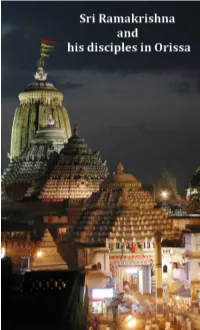
Preface Pilgrimage places like Varanasi, Prayag, Haridwar and Vrindavan have always got prominent place in any pilgrimage of the devotees and its importance is well known. Many mythological stories are associated to these places. Though Orissa had many temples, historical places and natural scenic beauty spot, but it did not get so much prominence. This may be due to the lack of connectivity. Buddhism and Jainism flourished there followed by Shaivaism and Vainavism. After reading the lives of Sri Chaitanya, Sri Ramakrishna, Holy Mother and direct disciples we come to know the importance and spiritual significance of these places. Holy Mother and many disciples of Sri Ramakrishna had great time in Orissa. Many are blessed here by the vision of Lord Jagannath or the Master. The lives of these great souls had shown us a way to visit these places with spiritual consciousness and devotion. Unless we read the life of Sri Chaitanya we will not understand the life of Sri Ramakrishna properly. Similarly unless we study the chapter in the lives of these great souls in Orissa we will not be able to understand and appreciate the significance of these places. If we go on pilgrimage to Orissa with same spirit and devotion as shown by these great souls, we are sure to be benefited spiritually. This collection will put the light on the Orissa chapter in the lives of these great souls and will inspire the devotees to read more about their lives in details. This will also help the devotees to go to pilgrimage in Orissa and strengthen their devotion. -

Modern-Baby-Names.Pdf
All about the best things on Hindu Names. BABY NAMES 2016 INDIAN HINDU BABY NAMES Share on Teweet on FACEBOOK TWITTER www.indianhindubaby.com Indian Hindu Baby Names 2016 www.indianhindubaby.com Table of Contents Baby boy names starting with A ............................................................................................................................... 4 Baby boy names starting with B ............................................................................................................................. 10 Baby boy names starting with C ............................................................................................................................. 12 Baby boy names starting with D ............................................................................................................................. 14 Baby boy names starting with E ............................................................................................................................. 18 Baby boy names starting with F .............................................................................................................................. 19 Baby boy names starting with G ............................................................................................................................. 19 Baby boy names starting with H ............................................................................................................................. 22 Baby boy names starting with I .............................................................................................................................. -

Document Title
Mission Report Destination management support – An Giang, Kien Giang & Can Tho ROBERT TRAVERS, DO DINH CUONG & HA THANH HAI DESTINATION MANAGEMENT AND DEVELOPMENT & HUMAN RESOURCES EXPERTS 18 FEBRUARY 2015 Programme No. DCI-ASIE/2010/21662 Executive summary ............................................................................................................. 5 1. Background ................................................................................................................. 10 1.1 Destination management ................................................................................... 10 1.2 Government mandate for regional destination management ......................... 10 1.3 Mekong Delta Tourism Strategy ........................................................................ 12 1.4 Review of current tourism development and marketing proposals ............... 19 1.4.1 Provincial tourism development strategy of An Giang ........................ 19 1.4.2 City tourism development strategy of Cam Tho ................................... 22 1.4.3 Provincial tourism development strategy of Kien Giang ..................... 24 1.5 Environmentally and Socially Responsible Tourism Capacity Development Programme .................................................................................. 27 2. Recent tourism performance in the region ............................................................... 28 2.1 Analysis of tourism performance ..................................................................... 28 2.2 Destination -
Panchadashee – 05 Mahavakya Vivekah
Swami Vidyaranya’s PANCHADASHEE – 05 MAHAVAKYA VIVEKAH Fixing the Meaning of the Great Sayings MODERN-DAY REFLECTIONS On a 13TH CENTURY VEDANTA CLASSIC by a South African Student TEXT Swami Gurubhaktananda 47.05 2018 A FOUNDATIONAL TEXT ON VEDANTA PHILOSOPHY PANCHADASHEE – An Anthology of 15 Texts by Swami Vidyaranyaji PART Chap TITLE OF TEXT ENGLISH TITLE No. No. Vers. 1 Tattwa Viveka Differentiation of the Supreme Reality 65 2 Maha Bhoota Viveka Differentiation of the Five Great Elements 109 3 Pancha Kosha Viveka Differentiation of the Five Sheaths 43 SAT: 4 Dvaita Viveka Differentiation of Duality in Creation 69 VIVEKA 5 Mahavakya Viveka Fixing the Meaning of the Great Sayings 8 Sub-Total A 294 6 Chitra Deepa The Picture Lamp 290 7 Tripti Deepa The Lamp of Perfect Satisfaction 298 8 Kootastha Deepa The Unchanging Lamp 76 CHIT: DEEPA 9 Dhyana Deepa The Lamp of Meditation 158 10 Nataka Deepa The Theatre Lamp 26 Sub-Total B 848 11 Yogananda The Bliss of Yoga 134 12 Atmananda The Bliss of the Self 90 13 Advaitananda The Bliss of Non-Duality 105 14 Vidyananda The Bliss of Knowledge 65 ANANDA: 15 Vishayananda The Bliss of Objects 35 Sub-Total C 429 WHOLE BOOK 1571 AN ACKNOWLEDGEMENT BY THE STUDENT/AUTHOR The Author wishes to acknowledge the “Home Study Course” offerred by the Chinmaya International Foundation (CIF) to students of Vedanta in any part of the world via an online Webinar service. These “Reflections” are based on material he has studied under this Course. CIF is an institute for Samskrit and Indology research, established in 1990 by Pujya Gurudev, Sri Swami Chinmayananda, with a vision of it being “a bridge between the past and the present, East and West, science and spirituality, and pundit and public.” CIF is located at the maternal home and hallowed birthplace of Adi Shankara, the great saint, philosopher and indefatigable champion of Advaita Vedanta, at Veliyanad, 35km north-east of Ernakulam, Kerala, India. -

Chandogya Upanishad 1.2.1: Once Upon a Time the Gods and the Demons, Both Descendants of Prajapati, Were Engaged in a Fight
A Preview “… Dr. Prasad’s collections of the two largest and most difficult to understand Upanishads make an in-road and gives access to the magnificent conclusions left by the ancient sages of India. This book gives us a view of the information which was divulged by those teachers. It is easy to read and understand and will encourage you to delve deeper into the subject matter.” CONTENTS 1. Chāndogya Upanishad……..…….…. 3 1. The big famine…………………………….…..... 6 2. The cart-man…………………………….………13 3 Satyakama Jabala and Sevā………………… 14 4. Fire teaches Upakosala…………….………… 15 Chāndogya 5. Svetaketu: five questions……………………. 18 and 6. Svetaketu: nature of sleep…………………... 22 7. That thou art, O Svetaketu………………….…23 Brihadāranyaka 8. Indra and virochana……………………….….. 29 Commentary…………………………...……..... 31 Upanishads End of Commenrary……………………....….. 55 Two large and difficult Upanishads are presented 2. Brihadāranyaka Upanishad …….…56 (without original Sanskrit verses) in simple modern English for those advanced students who have 9. Dialogue: Ajtsatru-Gargya……………...…. 61 read Bhagavad-Gita and other 9 Principal 10. Yajnavalkya and maitreyi ……………....…..63 Upanishads. Simpler important verses are 11. Meditation taught through horse’s head.. 65 12. Yajnavalkya: The best Vedic Scholar…… 66 printed in underlined-bold; comm- 13. Three ‘Da’ …………………………….…….…78 entaries from translators, references&Glossary. Commentary…………………………….……... 84 14. Each soul is dear to the other………...……90 By 15. The Wisdom of the Wise (Yagnavalkya)… 91 16. Gargi and the Imperishable ……………..…94 Swami Swahananda 17. Janaka and Yajnavalkya 1 ……………..…..95 and 18. Janaka and Yajnavalkya 2 …………..……..97 Swami Madhavananda et al. 19. The Process of Reincarnation…… …..… 100 Editor: Ramananda Prasad End of Commenrary …………….…..……….105 A Brief Sanskrit Glossary On page 844 of 908 of the pdf: www.gita-society.com/108Upanishads.pdf INTERNATIONAL GITA ***** Editor’s note: Most of the materials in this book are SOCIETY taken from the above webpage which does not have a Copyright mark. -

Part I the Religions of Indian Origin
Part I The Religions of Indian Origin MRC01 13 6/4/04, 10:46 AM Religions of Indian Origin AFGHANISTAN CHINA Amritsar Kedamath Rishikesh PAKISTAN Badrinath Harappa Hardwar Delhi Indus R. NEPAL Indus Civilization BHUTAN Mohenjo-daro Ayodhya Mathura Lucknow Ganges R. Pushkar Prayag BANGLADESH Benares Gaya Ambaji I N D I A Dakshineshwar Sidphur Bhopal Ahmadabad Jabalpur Jamshedpur Calcutta Dwarka Dakor Pavagadh Raipur Gimar Kadod Nagpur Bhubaneswar Nasik-Tryambak Jagannath Puri Bombay Hyderabad Vishakhapatnam Arabian Sea Panaji Bay of Bengal Tirupati Tiruvannamalai-Kaiahasti Bangalore Madras Mangalore Kanchipuram Pondicherry Calicut Kavaratti Island Madurai Thanjavar Hindu place of pilgrimage Rameswaram Pilgrimage route Major city SRI LANKA The Hindu cultural region 14 MRC01 14 6/4/04, 10:46 AM 1 Hinduism Hinduism The Spirit of Hinduism Through prolonged austerities and devotional practices the sage Narada won the grace of the god Vishnu. The god appeared before him in his hermitage and granted him the fulfillment of a wish. “Show me the magic power of your Maya,” Narada prayed. The god replied, “I will. Come with me,” but with an ambiguous smile on his lips. From the shade of the hermit grove, Vishnu led Narada across a bare stretch of land which blazed like metal under the scorching sun. The two were soon very thirsty. At some distance, in the glaring light, they perceived the thatched roofs of a tiny village. Vishnu asked, “Will you go over there and fetch me some water?” “Certainly, O Lord,” the saint replied, and he made off to the distant group of huts. When Narada reached the hamlet, he knocked at the first door. -

Practice of Karma Yoga
PRACTICE OF KARMA YOGA By SRI SWAMI SIVANANDA SERVE, LOVE, GIVE, PURIFY, MEDITATE, REALIZE Sri Swami Sivananda So Says Founder of Sri Swami Sivananda The Divine Life Society A DIVINE LIFE SOCIETY PUBLICATION Sixth Edition: 1995 (4,000 Copies) World Wide Web (WWW) Edition: 2001 WWW site: http://www.SivanandaDlshq.org/ This WWW reprint is for free distribution © The Divine Life Trust Society ISBN 81-7052-014-2 Published By THE DIVINE LIFE SOCIETY P.O. SHIVANANDANAGAR—249 192 Distt. Tehri-Garhwal, Uttaranchal, Himalayas, India. OM Dedicated to all selfless, motiveless, disinterested workers of the world who are struggling hard to get knowledge of the Self by purifying their minds, by getting Chitta Suddhi through Nishkama Karma Yoga OM PUBLISHERS’ NOTE The nectar-like teachings of His Holiness Sri Swami Sivananda Saraswati, the incomparable saint of the Himalayas, famous in song and legend, are too well-known to the intelligent public as well as to the earnest aspirant of knowledge Divine. Their aim and object is nothing but emancipation from the wheel of births and deaths through absorption of the Jiva with the supreme Soul. Now, this emancipation can be had only through right knowledge. It is an undisputed fact that it is almost a Herculean task for the man in the street, blinded as he is by worldly desires of diverse kinds, to forge his way to realisation of God. Not only is it his short-sightedness that stands in the way but innumerable other difficulties and obstacles hamper the progress onward towards the goal. He is utterly helpless until someone who has successfully trodden the path, comes to his aid or rescue, takes him by the hand, leads him safely through the inextricable traps and pitfalls of worldly temptation and desires, and finally brings him to his destination which is the crowning glory of the be-all and end-all of life, where all suffering ceases and all quest comes to an end. -

Dr. Babasaheb Ambedkar Writings & Speeches Vol. 4
Babasaheb Dr. B.R. Ambedkar (14th April 1891 - 6th December 1956) BLANK DR. BABASAHEB AMBEDKAR WRITINGS AND SPEECHES VOL. 4 Compiled by VASANT MOON Dr. Babasaheb Ambedkar : Writings and Speeches Vol. 4 First Edition by Education Department, Govt. of Maharashtra : October 1987 Re-printed by Dr. Ambedkar Foundation : January, 2014 ISBN (Set) : 978-93-5109-064-9 Courtesy : Monogram used on the Cover page is taken from Babasaheb Dr. Ambedkar’s Letterhead. © Secretary Education Department Government of Maharashtra Price : One Set of 1 to 17 Volumes (20 Books) : Rs. 3000/- Publisher: Dr. Ambedkar Foundation Ministry of Social Justice & Empowerment, Govt. of India 15, Janpath, New Delhi - 110 001 Phone : 011-23357625, 23320571, 23320589 Fax : 011-23320582 Website : www.ambedkarfoundation.nic.in The Education Department Government of Maharashtra, Bombay-400032 for Dr. Babasaheb Ambedkar Source Material Publication Committee Printer M/s. Tan Prints India Pvt. Ltd., N. H. 10, Village-Rohad, Distt. Jhajjar, Haryana Minister for Social Justice and Empowerment & Chairperson, Dr. Ambedkar Foundation Kumari Selja MESSAGE Babasaheb Dr. B.R. Ambedkar, the Chief Architect of Indian Constitution was a scholar par excellence, a philosopher, a visionary, an emancipator and a true nationalist. He led a number of social movements to secure human rights to the oppressed and depressed sections of the society. He stands as a symbol of struggle for social justice. The Government of Maharashtra has done a highly commendable work of publication of volumes of unpublished works of Dr. Ambedkar, which have brought out his ideology and philosophy before the Nation and the world. In pursuance of the recommendations of the Centenary Celebrations Committee of Dr.