Download Chem@Cam 59 Here
Total Page:16
File Type:pdf, Size:1020Kb
Load more
Recommended publications
-

Curriculum Vitae
CURRICULUM PETER HÄNGGI VITAE Lehrstuhl für Theoretische Physik I Universität Augsburg Universitätsstr. 1 D-86135 Augsburg PERSONAL DATA Place of Birth: Bärschwil, Switzerland Date of Birth: 29. November 1950 Nationality: Swiss Civil servant (Germany) I am married to Gerlinde Hänggi and we have one son named Alexander. home page: https://www.physik.uni-augsburg.de/theo1/hanggi/ EDUCATION 1970 Abitur (Matura) Math.-Nat. Gymnasium Basel 1970-1974 Studies of physics at the University of Basel, Switzerland B. Sc. 1972 University of Basel M. S. 1974 University of Basel PH. D. 1977 University of Basel MAJOR RESEARCH INTEREST Theoretical Statistical Mechanics and Quantum mechanics RESEARCH EXPERIENCE June 1986 - present Full Professor (Ordinarius, C4), University of Augsburg (Lehrstuhl für Theoretische Physik I) Sept. 1983 - Sept. 1987 Associate Professor, Polytechnic Institute of New York (with tenure), New York Sept. 1980 - Sept. 1983 Assistant Professor of Physics, Polytechnic Institute of New York, New York May 1979 - Sept. 1980 Postgraduate Research Associate, University of California, San Diego May 1978 - May 1979 Visiting Professor, University of Stuttgart, Germany April 1977 - April 1978 Research Associate, University of Illinois, Urbana-Champaign Jan. 1977 - April 1977 Research Associate, University of Basel, Switzerland PRIZES, HONORS & AWARDS 1970 Jacottet-Kung Prize, Basel, Switzerland 1977 Janggen-Pohn Prize, St. Gallen, Switzerland 1977 Max-Geldner Prize, Basel, Switzerland 1988 Fellow of the American Physical Society Sept. 1994 - Nov. 2009 Member of the Board of the German Physical Society (DPG) 1995 Nicolás Cabrera Professorship of the Universidad Autónoma de Madrid, Madrid Dec. 1997 - Dec. 2009 Boardmember of the regional section of the German Physical Society (Regionalverband Bayern e. -

Anne-Ruxandra Carvunis
Des protéines et de leurs interactions aux principes évolutifs des systèmes biologiques Anne-Ruxandra Carvunis To cite this version: Anne-Ruxandra Carvunis. Des protéines et de leurs interactions aux principes évolutifs des sys- tèmes biologiques. Médecine humaine et pathologie. Université de Grenoble, 2011. Français. NNT : 2011GRENS001. tel-00586614 HAL Id: tel-00586614 https://tel.archives-ouvertes.fr/tel-00586614 Submitted on 18 Apr 2011 HAL is a multi-disciplinary open access L’archive ouverte pluridisciplinaire HAL, est archive for the deposit and dissemination of sci- destinée au dépôt et à la diffusion de documents entific research documents, whether they are pub- scientifiques de niveau recherche, publiés ou non, lished or not. The documents may come from émanant des établissements d’enseignement et de teaching and research institutions in France or recherche français ou étrangers, des laboratoires abroad, or from public or private research centers. publics ou privés. THÈSE Pour obtenir le grade de DOCTEUR DE L’UNIVERSITÉ DE GRENOBLE Spécialité : MODELES, METHODES ET ALGORITHMES EN BIOLOGIE, SANTE ET ENVIRONNEMENT Arrêté ministériel : 7 août 2006 Présentée par Anne-Ruxandra CARVUNIS Thèse dirigée par Laurent TRILLING et codirigée par Nicolas THIERRY-MIEG et Marc VIDAL préparée au sein du Laboratoire du Professeur Marc Vidal et du laboratoire Techniques de l’Ingénierie Médicale et de la Complexité - Informatique, Mathématiques et Applications de Grenoble dans l’Ecole Doctorale Ingénierie pour la Santé, la Cognition et l’Environnement -

Feature Article
21502 J. Phys. Chem. B 2005, 109, 21502-21515 FEATURE ARTICLE The Mesoscopic Dynamics of Thermodynamic Systems D. Reguera and J. M. Rubı´* Departament de Fı´sica Fonamental, Facultat de Fı´sica, UniVersitat de Barcelona, Martı´ i Franque`s, 1, 08028-Barcelona, Spain J. M. G. Vilar Computational Biology Center, Memorial Sloan-Kettering Cancer Center, 307 East 63rd Street, New York, New York 10021 ReceiVed: June 1, 2005; In Final Form: September 1, 2005 Concepts of everyday use such as energy, heat, and temperature have acquired a precise meaning after the development of thermodynamics. Thermodynamics provides the basis for understanding how heat and work are related and the general rules that the macroscopic properties of systems at equilibrium follow. Outside equilibrium and away from macroscopic regimes, most of those rules cannot be applied directly. Here we present recent developments that extend the applicability of thermodynamic concepts deep into mesoscopic and irreversible regimes. We show how the probabilistic interpretation of thermodynamics together with probability conservation laws can be used to obtain Fokker-Planck equations for the relevant degrees of freedom. This approach provides a systematic method to obtain the stochastic dynamics of a system directly from its equilibrium properties. A wide variety of situations can be studied in this way, including many that were thought to be out of reach of thermodynamic theories, such as nonlinear transport in the presence of potential barriers, activated processes, slow relaxation phenomena, and basic processes in biomolecules, such as translocation and stretching. 1. Introduction reminiscent of nonequilibrium thermodynamics, by which to study fluctuations in nonlinear systems. -

Part I Officers in Institutions Placed Under the Supervision of the General Board
2 OFFICERS NUMBER–MICHAELMAS TERM 2009 [SPECIAL NO.7 PART I Chancellor: H.R.H. The Prince PHILIP, Duke of Edinburgh, T Vice-Chancellor: 2003, Prof. ALISON FETTES RICHARD, N, 2010 Deputy Vice-Chancellors for 2009–2010: Dame SANDRA DAWSON, SID,ATHENE DONALD, R,GORDON JOHNSON, W,STUART LAING, CC,DAVID DUNCAN ROBINSON, M,JEREMY KEITH MORRIS SANDERS, SE, SARAH LAETITIA SQUIRE, HH, the Pro-Vice-Chancellors Pro-Vice-Chancellors: 2004, ANDREW DAVID CLIFF, CHR, 31 Dec. 2009 2004, IAN MALCOLM LESLIE, CHR, 31 Dec. 2009 2008, JOHN MARTIN RALLISON, T, 30 Sept. 2011 2004, KATHARINE BRIDGET PRETTY, HO, 31 Dec. 2009 2009, STEPHEN JOHN YOUNG, EM, 31 July 2012 High Steward: 2001, Dame BRIDGET OGILVIE, G Deputy High Steward: 2009, ANNE MARY LONSDALE, NH Commissary: 2002, The Rt Hon. Lord MACKAY OF CLASHFERN, T Proctors for 2009–2010: JEREMY LLOYD CADDICK, EM LINDSAY ANNE YATES, JN Deputy Proctors for MARGARET ANN GUITE, G 2009–2010: PAUL DUNCAN BEATTIE, CC Orator: 2008, RUPERT THOMPSON, SE Registrary: 2007, JONATHAN WILLIAM NICHOLLS, EM Librarian: 2009, ANNE JARVIS, W Acting Deputy Librarian: 2009, SUSANNE MEHRER Director of the Fitzwilliam Museum and Marlay Curator: 2008, TIMOTHY FAULKNER POTTS, CL Director of Development and Alumni Relations: 2002, PETER LAWSON AGAR, SE Esquire Bedells: 2003, NICOLA HARDY, JE 2009, ROGER DERRICK GREEVES, CL University Advocate: 2004, PHILIPPA JANE ROGERSON, CAI, 2010 Deputy University Advocates: 2007, ROSAMUND ELLEN THORNTON, EM, 2010 2006, CHRISTOPHER FORBES FORSYTH, R, 2010 OFFICERS IN INSTITUTIONS PLACED UNDER THE SUPERVISION OF THE GENERAL BOARD PROFESSORS Accounting 2003 GEOFFREY MEEKS, DAR Active Tectonics 2002 JAMES ANTHONY JACKSON, Q Aeronautical Engineering, Francis Mond 1996 WILLIAM NICHOLAS DAWES, CHU Aerothermal Technology 2000 HOWARD PETER HODSON, G Algebra 2003 JAN SAXL, CAI Algebraic Geometry (2000) 2000 NICHOLAS IAN SHEPHERD-BARRON, T Algebraic Geometry (2001) 2001 PELHAM MARK HEDLEY WILSON, T American History, Paul Mellon 1992 ANTHONY JOHN BADGER, CL American History and Institutions, Pitt 2009 NANCY A. -
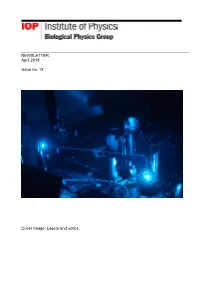
NEWSLETTER April 2018 Issue No. 12 Cover Image
NEWSLETTER April 2018 Issue no. 12 Cover Image: Lasers and optics. Contents Editorial 3. The committee In the April edition, we would like to provide the UK biophysics community with an introduction to the new 3. The Chair’s Commentary committee (with members old and new). We say a fond farewell to Prof. Jamie Hobbs (our previous chair) and a 4-5 Introducing the new welcome hello to Prof. Pietro Cicuta (our new chair). members of the committee There is a meeting report and some news of upcoming meeting. Enjoy reading, and I hope to see you at one of 6-8 Existing members of the the upcoming conferences! Committee 9-10. Meeting Reports: Professor Michelle Peckham Newsletter Editor 10-15 Upcoming Meetings & Other news Items For the newsletter should be e-mailed to m.peckham@leeds.ac.uk The Flagellar Motor. Courtesy oF 2 Biological Physics Group newsletter April 2018 The Committee Chair Members Pietro Cicuta Marisa Martin-Fernandez (cross representative with national facilities) Honorary Secretary Mark Wallace (cross representative with Susan Cox BBS) Rosalind Allen Honorary Treasurer Chiu Fan Lee (responsible for website) Tom Waigh Ewa Paluch Michelle Peckham (responsible for newsletter) New members: Peter Petrov AchilleFs Kapanidis Bartek Waclaw Andela Saric The Chair’s commentary Having played a part in the Biological Physics Group For a while, First as a committee member, then as Treasurer, I am honoured to Follow Jamie Hobbs as Chair oF the committee. Jamie did a terriFic job oF organising and directing us, and keeping us well connected to other societies and activities. -

Freeman Dyson, Professor Emeritus in the School of Natural Sciences, Is Always Full of Surprises (Page 1)
BRUCE M.WHITE BRUCE Fall 2012 Fall (page 5), and curbing and 5), (page , Visitor in the School of Mathematics , trace the seal’s origins and influences— and origins seal’s the trace , (page (page 1), borders controlling by Professor Elizabeth Bernstein Elizabeth , Professor Emeritus in the School of School Historical in the Emeritus , Professor Mina Teicher Professor Emeritus in the School of Natural Sciences, is Irving Lavin Irving (page 8). Truth and Beauty and Truth Marilyn Aronberg Lavin Aronberg Marilyn Michael Michael van van Walt Praag Freeman Dyson, The Institute Letter Eugene Kontorovich (page 5), curtailing sex trafficking by Member Member by trafficking sex curtailing 5), (page At At the Institute, scholars and scientists seek truth and question claims of it. Mathematicians have Mathematics, observes The power and complexity of collectivity are further explored in articles about resolving intrastateresolvingaboutarticles in explored furthercollectivity are complexityof and power The among themthe finalcouplet of“Ode John on Keats’s a Grecian Urn”—and articulate why and how its elements and design embody the rare and very modern of mission the (page Institute 6). “The rad- ical nature of Flexner’s twinning of science and humanism with truth and beauty arose in part the fromradical nature of his concept for a ‘modern’ writesuniversity,” Irving Lavin, “by which he meant a university devoted exclusively to the pursuit of higher learning for its own sake and without regard to practical value.” re- often and proof elegant most the find to compelled mathematics, in beauty by motivated been long ferring to mathematics as a form of art, writes to (up term absolute an to beauty equating itself, beauty of mathematics the explores Teicher 1). -
2 0 1 6 I N V E S T I T U
2016 INVESTITURE 2016 • MICHIGAN STATE UNIVERSITY MICHIGAN STATE 2016 INVESTITURE MICHIGAN STATE UNIVERSITY October 28, 2016 Michigan State University Auditorium A FORCE FOR CREATIVITY, DISCOVERY, AND LEARNING. Michigan State University has a legacy of being a dynamic, collaborative academic environment that prospective students and faculty are eager to join. We know that this distinctive environment is poised to generate a significant number of scientific breakthroughs as well as help students find their life’s work. It’s an environment where students, scholars, faculty, and researchers, through immeasurable creativity, discovery, and learning, will make seemingly impossible ideas possible and turn dreams into realities. Through the Empower Extraordinary campaign Michigan State University seeks to establish 100 new endowed chairs and fund important academic programs in order to retain and attract great thinkers and mentors. 1 The MSU INVESTITURE The Michigan State University investiture of 2016 celebrates MSU’s commitment to academic excellence and innovation by bestowing faculty recognition at the university level to those who hold endowed chair and professor positions. Today’s honorees, along with the entire faculty present at this inaugural event, are teachers and researchers whose work helps MSU to continue raising the bar on what we can achieve. The faculty who receive medallions today were appointed to positions funded during Empower Extraordinary, the campaign for MSU. As of October 1, 2016, 59 new endowed faculty positions have been created since the start of the campaign. 2 MSU BOARD OF TRUSTEES Joel I. Ferguson, Chairman Mitch Lyons, Vice Chairman Brian Breslin Dianne Byrum Melanie Foster Brian Mosallam George Perles Diann Woodard President Lou Anna K. -
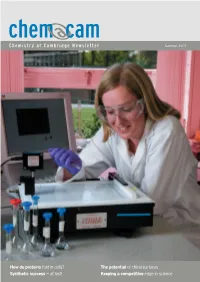
At Last! Keeping a Competitive Edge in Science As I See It
Summer 2007 How do proteins fold in cells? The potential of chiral surfaces Synthetic success — at last! Keeping a competitive edge in science As I see it... The UK pharmaceutical industry is, historically, a big success story for chemistry. Sarah Houlton talks to Richard Barker, director general of the Association of the British Pharmaceutical Industry , about competitiveness, government support and what the future holds for the sector How did you end up working in the or psychologists with people who could do of the pipeline in 10 to 12 years. This is not get - pharmaceutical industry? molecular biology. Our impression is that the ting any easier. I’m a chemist by background, and my DPhil in number of molecular biologists hasn’t risen at What that means is that we’re very interested biological NMR taught me that the most inter - all in recent years. So if we’re really going to see in any technology that will help predict which esting chemical problems are actually in biol - bioscience as a major driver of economic medicines will succeed and which will fail – ogy, and the greatest potential for technology is growth and prosperity in this country in the predictive medicine techniques like biomarkers in addressing the problems of biology in med - next decades we need to address these issues. and bioimaging are going to be increasingly icine. I continue to believe that is the case – We will be approaching both of the two used to winnow down the potentially viable some of the most fascinating science is to be departments who deal with education in the clinical candidates in the early stages. -
Biographical Sketch of Peter Hänggi
Biographical Sketch of Peter Hänggi Date of Birth: November 29-th, 1950, Bärschwil, Switzerland Address: Universität Augsburg, Institut für Physik Universitätsstrasse 1 D-86135 Augsburg, Germany E-mail: hanggi@physik.uni-augsburg.de Phone: +49-821-598-3250 Web: https://www.physik.uni-augsburg.de/theo1/hanggi/ Goggle Scholar: https://scholar.google.de/citations?hl=de&user=0Dt1AtUAAAAJ ResearcherID: B-4457-2008 Education 1970-1974: Studies of physics at the University of Basel, Switzerland April 1974: Diploma in physics, University of Basel Jan. 1977: PhD, Theoretical physics, University of Basel Professional Experience 1977-1978: Research Associate University of Illinois, Urbana, USA 1978-1979: Guest Professor, Universität Stuttgart 1979-1980: Postgraduate research associate, University of California, San Diego, USA 1980-1983: Assistant professor of physics, Polytechnic Institute of New York, New York, USA 1983-1987: Associate professor (with tenure), Polytechnic Institute of New York, New York, USA Since 1986: Professor (Ordinarius C4/W3) for Theoretical Physics (Emphasis: Statistical Physics), Institute of Physics, Universität Augsburg Scientific Interests Theoretical physics – Statistical Physics Dissipative quantum systems, physical biology, molecular electronics, Stochastic phenomena, nonlinear dynamics, control of quantum transport, Quantum information processing, Brownian motors, Relativistic Brownian motion and Relativistic Thermodynamics, Few body thermodynamics of cold atoms International Activities Editor-in-Chief: EPJ-B (2011-2016), Editor/Co-editor: Physical Review E (2003-2009), Europhysics Letters (1997-2010), New Journal of Physics (1998- 2008), Physica A, Physical Biology (2003-2011), Chemical Physics (1994- 2012),ChemPhysChem (2004-2011), Lecture Notes of Physics, EPJ-ST(Special Topics), Scientific Reports (Nature Publ. Group), Ukrainian J. Physics, Intern. Review of Electrical Eng., IREE, Intern. -

Career Pathway Tracker 35 Years of Supporting Early Career Research Fellows Contents
Career pathway tracker 35 years of supporting early career research fellows Contents President’s foreword 4 Introduction 6 Scientific achievements 8 Career achievements 14 Leadership 20 Commercialisation 24 Public engagement 28 Policy contribution 32 How have the fellowships supported our alumni? 36 Who have we supported? 40 Where are they now? 44 Research Fellowship to Fellow 48 Cover image: Graphene © Vertigo3d CAREER PATHWAY TRACKER 3 President’s foreword The Royal Society exists to encourage the development and use of Very strong themes emerge from the survey About this report science for the benefit of humanity. One of the main ways we do that about why alumni felt they benefited. The freedom they had to pursue the research they This report is based on the first is by investing in outstanding scientists, people who are pushing the wanted to do because of the independence Career Pathway Tracker of the alumni of University Research Fellowships boundaries of our understanding of ourselves and the world around the schemes afford is foremost in the minds of respondents. The stability of funding and and Dorothy Hodgkin Fellowships. This us and applying that understanding to improve lives. flexibility are also highly valued. study was commissioned by the Royal Society in 2017 and delivered by the Above Thirty-five years ago, the Royal Society The vast majority of alumni who responded The Royal Society has long believed in the Careers Research & Advisory Centre Venki Ramakrishnan, (CRAC), supported by the Institute for President of the introduced our University Research Fellowships to the survey – 95% of University Research importance of identifying and nurturing the Royal Society. -

Chemical Lecture Demonstrations: an Opportunity for Engagement Through Collections, Instruction, and Reference
This is an Accepted Manuscript of an article published by Taylor & Francis Group in Science & Technology Libraries on 11/21/2017, available online: https://www.tandfonline.com/doi/abs/10.1080/0194262X.2017.1389667 Chemical Lecture Demonstrations: An Opportunity for Engagement through Collections, Instruction, and Reference David E. Hubbard Science & Engineering Librarian and Associate Professor Texas A&M University Libraries College Station, TX 77843 Abstract: Chemical lecture demonstrations have been used as a pedagogical tool since at least the founding of chemistry as a discipline in the 1600s. This paper describes how science librarians can engage chemistry faculty and students through chemical lecture demonstrations. This paper describes chemical lecture demonstrations – including history and efficacy – and discusses how science librarians can engage chemistry faculty and students through collections, instruction, and reference in support of this pedagogy. In addition to outlining a research guide and lesson plan for chemical lecture demonstrations, this paper identifies chemical lecture demonstration monographs found in WorldCat® and analyzes the holdings of those monographs within the thirty- six-member Greater Western Library Alliance (GWLA) consortium. Introduction Chemical lecture demonstrations, which are lively displays of chemical principles to an audience of students or the general public, are an important pedagogical tool used to educate and engage. Monographs have been one of the major means to educate others on how to conduct these demonstrations. The purpose of this bibliographical investigation is to identify and examine chemical lecture demonstration monograph holdings within the thirty-six-member Greater Western Library Alliance (GWLA) consortium (Greater Western Library Alliance n.d.), and to describe local support for chemical lecture demonstrations through collections, instruction, and reference. -
A Microfluidic Device for the Hydrodynamic Immobilisation Of
Sensors and Actuators B 192 (2014) 36–41 Contents lists available at ScienceDirect Sensors and Actuators B: Chemical journal homepage: www.elsevier.com/locate/snb A microfluidic device for the hydrodynamic immobilisation of living ଝ fission yeast cells for super-resolution imaging a a,∗ b b c Laurence Bell , Ashwin Seshia , David Lando , Ernest Laue , Matthieu Palayret , c c Steven F. Lee , David Klenerman a Cambridge Nanoscience Centre, 11 J J Thomson Avenue, Cambridge CB3 0FF, United Kingdom b Department of Biochemistry, 80 Tennis Court Road, Cambridge CB2 1GA, United Kingdom c Department of Chemistry, Lensfield Road, Cambridge CB2 1EW, United Kingdom a r t i c l e i n f o a b s t r a c t Article history: We describe a microfluidic device designed specifically for the reversible immobilisation of Schizosac- Received 24 April 2013 charomyces pombe (Fission Yeast) cells to facilitate live cell super-resolution microscopy. Photo-Activation Received in revised form 16 August 2013 Localisation Microscopy (PALM) is used to create detailed super-resolution images within living cells with Accepted 1 October 2013 a modal accuracy of >25 nm in the lateral dimensions. The novel flow design captures and holds cells in a Available online 28 October 2013 well-defined array with minimal effect on the normal growth kinetics. Cells are held over several hours and can continue to grow and divide within the device during fluorescence imaging. Keywords: © 2013 The Authors. Published by Elsevier B.V. All rights reserved. Microfluidics Single cell analysis Hydrodynamic trapping PALM imaging Single molecule localisation microscopy 1.