11A 01-09 Kingdon-Women 20040516
Total Page:16
File Type:pdf, Size:1020Kb
Load more
Recommended publications
-
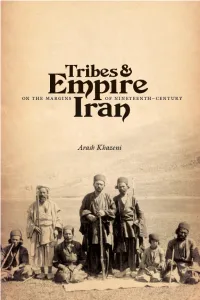
Tribes and Empire on the Margins of Nineteenth-Century Iran
publications on the near east publications on the near east Poetry’s Voice, Society’s Song: Ottoman Lyric The Transformation of Islamic Art during Poetry by Walter G. Andrews the Sunni Revival by Yasser Tabbaa The Remaking of Istanbul: Portrait of an Shiraz in the Age of Hafez: The Glory of Ottoman City in the Nineteenth Century a Medieval Persian City by John Limbert by Zeynep Çelik The Martyrs of Karbala: Shi‘i Symbols The Tragedy of Sohráb and Rostám from and Rituals in Modern Iran the Persian National Epic, the Shahname by Kamran Scot Aghaie of Abol-Qasem Ferdowsi, translated by Ottoman Lyric Poetry: An Anthology, Jerome W. Clinton Expanded Edition, edited and translated The Jews in Modern Egypt, 1914–1952 by Walter G. Andrews, Najaat Black, and by Gudrun Krämer Mehmet Kalpaklı Izmir and the Levantine World, 1550–1650 Party Building in the Modern Middle East: by Daniel Goffman The Origins of Competitive and Coercive Rule by Michele Penner Angrist Medieval Agriculture and Islamic Science: The Almanac of a Yemeni Sultan Everyday Life and Consumer Culture by Daniel Martin Varisco in Eighteenth-Century Damascus by James Grehan Rethinking Modernity and National Identity in Turkey, edited by Sibel Bozdog˘an and The City’s Pleasures: Istanbul in the Eigh- Res¸at Kasaba teenth Century by Shirine Hamadeh Slavery and Abolition in the Ottoman Middle Reading Orientalism: Said and the Unsaid East by Ehud R. Toledano by Daniel Martin Varisco Britons in the Ottoman Empire, 1642–1660 The Merchant Houses of Mocha: Trade by Daniel Goffman and Architecture in an Indian Ocean Port by Nancy Um Popular Preaching and Religious Authority in the Medieval Islamic Near East Tribes and Empire on the Margins of Nine- by Jonathan P. -
A Thousand and One Wives: Investigating the Intellectual History of the Exegesis of Verse Q 4:24
A THOUSAND AND ONE WIVES: INVESTIGATING THE INTELLECTUAL HISTORY OF THE EXEGESIS OF VERSE Q 4:24 A Dissertation submitted to the Faculty of the Graduate School of Arts and Sciences of Georgetown University in partial fulfillment of the requirements for the degree of Doctor of Philosophy in Arabic and Islamic Studies By Roshan Iqbal, M.Phil. Washington, DC July 15, 2015 Copyright 2015 by Roshan Iqbal All Rights Reserved ii A THOUSAND AND ONE WIVES: INVESTIGATING THE INTELLECTUAL HISTORY OF THE EXEGESIS OF VERSE Q 4:24 Roshan Iqbal, M.Phil. Thesis Adviser: Felicitas Opwis, Ph.D. ABSTRACT A Thousand and One Wives: Investigating the Intellectual History of the Exegesis of Verse 4:24 traces the intellectual legacy of the exegesis of Qur’an 4:24, which is used as the proof text for the permissibility of mut’a (temporary marriage). I ask if the use of verse 4.24 for the permissibility of mut’a marriage is justified within the rules and regulations of Qur’anic hermeneutics. I examine twenty Qur’an commentaries, the chronological span of which extends from the first extant commentary to the present day in three major Islamicate languages. I conclude that doctrinal self-identity, rather than strictly philological analyses, shaped the interpretation of this verse. As Western academia’s first comprehensive work concerning the intellectual history of mut’a marriage and sexual ethics, my work illustrates the power of sectarian influences in how scholars have interpreted verse 4:24. My dissertation is the only work in English that includes a plurality of voices from minor schools (Ibadi, Ashari, Zaidi, and Ismaili) largely neglected by Western scholars, alongside major schools, and draws from all available sub-genres of exegesis. -

One Odd Day PDF Book
ONE ODD DAY PDF, EPUB, EBOOK Doris Fisher,Dani Sneed,Karen Lee | 32 pages | 10 Sep 2007 | Arbordale Publishing | 9781934359334 | English | United States One Odd Day PDF Book Extinction Extinction event Holocene extinction Human extinction List of extinction events Genetic erosion Genetic pollution. At the death of 20th Imam Amir, one branch of the Mustaali faith claimed that he had transferred the Imamate to his son At-Tayyib Abu'l-Qasim, who was then two years old. One need not wait for any other Mahdi now. Li Hong. End times Apocalypticism. A hadith from [Ali] adds in this regard, "Mahdi will not appear unless one-third of the people are killed; another one-third die, and the remaining one-third survive. Guess which number of the following sequence is the odd one out. His name will be my name, and his father's name my father's name [9]. Get our free widgets. Since Sunnism has no established doctrine of Mahdi, compositions of Mahdi varies among Sunni scholars. November Learn how and when to remove this template message. But if you see something that doesn't look right, click here to contact us! Word of the Day vindicate. Home Maintenance. The term Mahdi does not occur in the Quran. Within a few years, the collection—including works by Vasily Kandinsky, Paul Klee and Marc Chagall —had outgrown the small space. Follow us. Gog and Magog Messianic Age. This article relies too much on references to primary sources. It is argued that one was to be born and rise within the dispensation of Muhammad, who by virtue of his similarity and affinity with Jesus, and the similarity in nature, temperament and disposition of the people of Jesus' time and the people of the time of the promised one the Mahdi is called by the same name. -

15 the Regions of Sind, Baluchistan, Multan
ISBN 978-92-3-103467-1 THE REGIONS OF SIND . 15 THE REGIONS OF SIND, BALUCHISTAN, MULTAN AND KASHMIR: THE HISTORICAL, SOCIAL AND ECONOMIC SETTING* N. A. Baloch and A. Q. Rafiqi Contents THE RULERS OF SIND, BALUCHISTAN AND MULTAN (750–1500) ....... 298 The cAbbasid period and the Fatimid interlude (mid-eighth to the end of the tenth century) ...................................... 298 The Period of the Ghaznavid and Ghurid Sultanates (eleventh and twelfth centuries) . 301 The era of the local independent states ......................... 304 KASHMIR UNDER THE SULTANS OF THE SHAH¯ MIR¯ DYNASTY ....... 310 * See Map 4, 5 and 7, pp. 430–1, 432–3, 437. 297 ISBN 978-92-3-103467-1 The cAbbasid period Part One THE RULERS OF SIND, BALUCHISTAN AND MULTAN (750–1500) (N. A. Baloch) From 750 to 1500, three phases are discernible in the political history of these regions. During the first phase, from the mid-eighth until the end of the tenth century, Sind, Baluchis- tan and Multan – with the exception of the interlude of pro-Fatimid ascendency in Mul- tan during the last quarter of the tenth century – all remained politically linked with the cAbbasid caliphate of Baghdad. (Kashmir was ruled, from the eighth century onwards, by the local, independent, originally non-Muslim dynasties, which had increasing political contacts with the Muslim rulers of Sind and Khurasan.) During the second phase – the eleventh and twelfth centuries – all these regions came within the sphere of influence of the powers based in Ghazna and Ghur. During the third phase –from the thirteenth to the early sixteenth century – they partly became dominions of the Sultanate of Delhi, which was in itself an extension into the subcontinent of the Central Asian power base. -
Islamic Art Pp001-025 21/5/07 08:53 Page 2
Spirit &Life Spirit & Life The creation of a museum dedicated to the presentation of Muslim ‘I have been involved in the field of development for nearly four decades. arts and culture – in all their historic, cultural and geographical Masterpieces of Islamic Art This engagement has been grounded in my responsibilities as Imam of diversity – is a key project of the Aga Khan Trust for Culture, one the Shia Ismaili Community, and Islam’s message of the fundamental of whose aims is to contribute to education in the fields of arts and from the Aga Khan Museum Collection unity of “din and dunya”, of spirit and life.’ culture. The developing political crises of the last few years have collections museum khan theaga from art ofislamic masterpieces revealed – often dramatically – the considerable lack of knowledge of His Highness the Aga Khan the Muslim world in many Western societies. This ignorance spans at the Annual Meeting of the EBRD all aspects of Islam: its pluralism, the diversity of interpretations Tashkent, 5 May 2003 within the Qur’anic faith, the chronological and geographical extent of its history and culture, as well as the ethnic, linguistic and social Spirit and Life is the title of an exhibition of over 160 masterpieces diversity of its peoples. of Islamic art from the Aga Khan Museum which will open in Toronto, Canada in 2009. This catalogue illustrates all the miniature For this reason, the idea of creating a museum of Muslim arts and paintings, manuscripts, jewellery, ceramics, wood panels and culture in Toronto as an eminently educational institution, with beams, stone carvings, metal objects and other art works in the the aim of informing the North American public of the diversity and exhibition, which spans over a thousand years of history and gives significance of Muslim civilisations naturally arose. -
PREFACE 1 . Said Amir Arjomand, the Shadow of God and the Hidden
N o t e s P REFACE 1 . S a i d A m i r A r jomand, The Shadow of God and the Hidden Imam; Religion, Political Order, and Social Change in Shi’ite Iran from the Beginning to 1890 (Chicago: The University of Chicago, 1984), 270. 1 THE STORY OF THE SHI’A 1 . H a m i d Enayat, “Shi’ism and Sunnism,” in Shi’ism: Doctrines, Thoughts, and Spiritualityy, ed. Seyyed Hossein Nasr (New York: State University of New York Press, 1988), 79–80; Rudi Matthee, “The Egyptian Opposition to the Iranian Revolution,” in Shi’ism and Social Protestt , eds. Juan R. I. Cole and Nikki R. Keddie (New Haven: Yale University Press, 1986), 248; Michael Axworthy, I ran, Empire of the Mind—A History from Zoroaster to the Present Day (London: Penguin Books, 2007), 201–203. 2 . A x w o r t hy, Iran, Empire of the Mindd, 178. 3 . Karen Barkey, “Islam and Toleration: Studying the Ottoman Imperial Model,” International Journal of Politics, Culture, and Societyy, vol. 19, no. 1/2 (December 2005), 10; Bruce Masters, “The Treaties of Erzurum ( 1823 and 1848) and the Changing Status of Iranians in the Ottoman,” Iranian Studiess , vol. 24, no. 1/4 (1991), 7–8; R. I. Cole and Moojan Momen, “Mafia, Mob and Shiism in Iraq: The Rebellion of Ottoman Karbala 1824–1843,” Past & Present , no. 112 (August 1986), 116; Juan R. I. Cole, “‘Indian Money’ and the Shi’i Shrine Cities of Iraq, 1786–1850,” Middle Eastern Studiess, vol. 22, no. 4 (October 1986), 470. -

Bab's Life Movements
CHRONOLOGY OF THE BÁB - WITH MAPS OF HIS TRAVELS Created and compiled by Duane K. Troxel for Wilmette Institute Course, The door of the Báb’s house in Shíráz. Nov. 2004-Feb. 2005. Máh-Kú 17 July 9, 1847 Chihríq 18 April 10, 1848 Tabríz 21 August, 1848 16 June, 1847 Urúmíyyih 20 July, 1848 19 July, 1848 22 Arrives back in Tabríz June 19, 1850. Executed, July 9, 1850. Tihrán Kulayn 15 March 29, 1847 Káshán 14 March 21, 1847 Karbilá 4 1840 Isfáhán Najaf 13 September, 1845 3 1840 Pilgrimage Shi’ih Shrines Daladi Shíráz 11 Jun 30, 1845 1 1819 Birth 5 1841 Marriage Búshihr 12 1845 2 1835 6 Oct 2/3, 1844 Left for Pilgrimage to Mecca & Medina. 10 1845 The Báb’s travels from birth to martyrdom. The numbers indicate the order in which His travels took place. The circled numbers are correlated with their red counterparts in the chronology following the maps. 1844 6 1844 7 9 1845 Arrived January 16. 1840 7 1844 Arrived sometime in 8 1844 December. Arrived Dec. 12. Announced He is Qá’im Dec. 20. CHRONOLOGY RELATED TO THE LIFE OF THE BÁB · 1778 Birth of Siyyid Muhammad Riday-i- · 1820 Birth of Khadijih Bagum (daughter of Shirazi, the father of the Bab. · 1818 Birth of Mulla Zaynu’l-Abidin (Zaynu’l- Mirza ‘Ali, a merchant of Shiraz), first wife of · 1783 Birth of Mirza ‘Abbas-i-Irivani, later Muqarrabin), Apostle of Baha’u’llah, in the Bab, in Shiraz. Prime Minister Haji Mirza Aqasi, in Mah-ku. -

Two Episodes from the Life of Bahá'u'lláh in Iran
Two Episodes from the Life of Bahá’u’lláh in Iran Moojan Momen Summary This article examines two episodes in the life of Bahá’u’lláh in Iran. The first involves an examination of the events, trajectory and timeline of Bahá’u’lláh's journeying between the end of the Conference of Badasht and His arrival at the shrine of Shaykh Tabarsí. There appear to be different versions of this among three sources: Nabíl's Narrative, the writings of Bahá’u’lláh and the writings of ‘Abdu’l-Bahá. This article attempts to examines these events more closely and come to a conclusion about what probably occurred. The second episode involves a close examination of a Tablet of Bahá’u’lláh which is interpreted as revealing fresh information about the experience of Bahá’u’lláh while in the Siyáh Chál. In the writing of history, it is frequently necessary to examine a number of sources about a particular event and come to a conclusion about what probably happened. This paper will focus on two episodes in the life of Bahá’u’lláh in Iran that require closer examination. In this study, use will primarily be made of passages from the writings of Bahá’u’lláh and ‘Abdu’l-Bahá, supported by other evidence. 140 Lights of Irfán vol. 20 A. The period between Bahá’u’lláh's departure from the Conference of Badasht until His Arrival at Shaykh Tabarsí The first episode to be dealt with is the question of Bahá’u’lláh’s activities between His departure from the Conference of Badasht until His visit to the Bábís at the shrine of Shaykh Tabarsí. -
Baha'ism in Iran
IOSR Journal Of Humanities And Social Science (IOSR-JHSS) Volume 9, Issue 2 (Mar. - Apr. 2013), PP 53-61 e-ISSN: 2279-0837, p-ISSN: 2279-0845. www.Iosrjournals.Org Baha’ism in Iran Ashaq Hussain Centre of Central Asian Studies, University of Kashmir, Hazratbal-190006 Abstract : During the early 19th century, a religious movement called Babism flourished in Persia though for a short period, i:e., 1844-1852. Its founder Mirza Ali Mohammad Shirazi proclaimed his station as that of the Mehdi to the Muslims. Afterwards Bab claimed Prophetic status. He abrogated Islamic law and instead promulgated a system of Babi law in his (Persian) Bayan. Although the Babi movement successfully established its network both in rural and urban settlements of Iran, and after the execution of Bab he became a prominent figure among Babis. Most of the Babis were exiled by the Qachar government to the Sunni Ottoman area in Iraq. It was in Iraq that Baha‟u‟llah proclaimed himself the Prophet Promised by Bab. Majority of the Babis believed him and entered into the new faith and became Baha‟is. This happened in 1863 after a decade of Bab‟s execution. He stated his own dispensation and wrote letters to many kings instigating them to establish peace. He tried a lot to make his laws compatible with the modern globalized world. To him “World is but one country and humankind its citizens”. So far as the relevance of the present study is concerned, its pros and cons need to be analyzed and evaluated objectively. Study of religion usually influences common people in so far as the legitimate force that operates behind the principles and ideals of religion are concerned. -

Religious and Social Life of Religious Minorities
RELIGIOUS AND SOCIAL LIFE OF RELIGIOUS MINORITIES A CASE STUDY OF BAHÁ’Í AND PARSI COMMUNITIES OF PAKISTAN Abdul Fareed 101-FU/PhD/F08 DEPARTMENT OF COMPARATIVE RELIGION FACULTY OF ISLAMIC STUDIES, INTERNATIONAL ISLAMIC UNIVERSITY ISLAMABAD RELIGIOUS AND SOCIAL LIFE OF RELIGIOUS MINORITIES A CASE STUDY OF BAHÁ’Í AND PARSI COMMUNITIES OF PAKISTAN A thesis submitted in partial fulfillment of the requirements for the degree of Doctorate of Philosophy (PhD) in Comparative Religion By Abdul Fareed Registration no. 101-FU/PhD/F08 Under the Supervision of Dr. Muhammad Imtiaz Zafar DEPARTMENT OF COMPARATIVE RELIGION FACULTY OF ISLAMIC STUDIES, INTERNATIONAL ISLAMIC UNIVERSITY ISLAMABAD ١ذو القعدة ١٤١٦ من الهجرة /Submitted on: August17, 2015 C.E Statement of Undertaking I Abdul Fareed Reg. No. 101/FU/PHD/F-08 and student of Ph.D. Comparative Religion, Faculty of Islamic Studies, International Islamic University Islamabad do hereby solemnly declare that the thesis entitled ‘ Religious and Social Life of the Religious Minorities: A case Study of Bahá’í and Parsi Communities of Pakistan’ submitted by me in partial fulfillment of the requirements for the Ph.D. is my original work, except where otherwise acknowledge in the text, and has not been submitted or published earlier and so not in future, be submitted by me for any degree this University or institution. Abdul Fareed APPROVAL It is certified that Mr. Abdul Fareed s/o Abdul Raheem Reg.No.101-FU/PhD/F08 has successfully defended his thesis titled: Religious and Social Life of the Religious Minorities: A case Study of Bahá’í and Parsi Communities of Pakistan in viva-voce examination held in the Department of Comparative Religion, Faculty of Islamic Studies( Usuluddin) , International Islamic University, Islamabad. -

Searching for May Maxwell: Bahá’Í Millennial Feminism, Transformative Identity & Globalism in the New World Order
Searching for May Maxwell: Bahá’í Millennial Feminism, Transformative Identity & Globalism in the new World Order Shaping Women’s Role in Early Bahá’i Culture 1898-1940 A Thesis Submitted to the College of Graduate Studies and Research in Partial Fulfillment of the Requirements for the Degree of Doctor of Philosophy in the Department of History University of Saskatchewan Saskatoon, SK, Canada By Selena M. Crosson © Copyright Selena M. Crosson, June 2013. All rights reserved. PERMISSION TO USE In presenting this thesis/dissertation in partial fulfillment of the requirements for a Postgraduate degree from the University of Saskatchewan, I agree that the Libraries of this University may make it freely available for inspection. I further agree that permission for copying of this thesis/dissertation in any manner, in whole or in part, for scholarly purposes may be granted by the professor or professors who supervised my thesis/dissertation work or, in their absence, by the Head of the Department or the Dean of the College in which my thesis work was done. It is understood that any copying or publication or use of this thesis/dissertation or parts thereof for financial gain shall not be allowed without my written permission. It is also understood that due recognition shall be given to me and to the University of Saskatchewan in any scholarly use which may be made of any material in my thesis/dissertation. DISCLAIMER Reference in this thesis/dissertation to any specific commercial products, process, or service by trade name, trademark, manufacturer, or otherwise, does not constitute or imply its endorsement, recommendation, or favoring by the University of Saskatchewan. -

The Bustan of Sa'di: an Illustrated Persian Manuscript Dated 850/1446
THE BUSTAN OF SA'Dl: AN ILLUSTRATED PERSIAN MANUSCRIPT DATED 850/1446 NORAH M. TITLEY and M. I. WALEY INTRODUCTION AMONG the notable items acquired in recent years by the Department of Oriental Manuscripts and Printed Books is a finely calligraphed and illuminated mid-fifteenth- century poetical manuscript in Persian (Or. 14237), containing three miniature paintings. ^ Despite their slightly damaged condition these miniatures are of particular significance for the study of what is an interesting phase in the stylistic development of Persian painting. They belong to a very small group, dating from the 1440s, in which elements associated with the style prevalent at Shiraz (in southern Persia) are intermingled with certain features characteristic of the work produced at Herat and Samarkand (in the north-east, and beyond the borders of modern Iran). Although in recent years several distinguished scholars have written on the Persian painting of this period,^ certain aspects of the subject merit further study; the style represented in Or. 14237 is one of them. Miss Titley's presentation and analysis of the miniatures in this manuscript, which follows, is a significant contribution towards this end. The text contained in the newly acquired manuscript is one of the best-known classics of Persian literature: the Bustdn (meaning 'Herb Garden' or 'Orchard') of Sa'dl of Shiraz {c.i2oo?-c.i2g2). The Bustdn is a poem comprising some 4,000 couplets in which Sa'dl skilfully and elegantly illustrates numerous maxims and ethical principles, using stories and anecdotes. Here, as also in Sa'di's equally celebrated Gulistdn^a. rather similar work, this time in prose interspersed with verses—it is sometimes difficult to distinguish fact from fiction.