Lebadeia & the Oracle of Trophonius
Total Page:16
File Type:pdf, Size:1020Kb
Load more
Recommended publications
-
Either a Daimon, Or a Hero, Or Perhaps a God:” Mythical Residents of Subterranean Chambers
Kernos Revue internationale et pluridisciplinaire de religion grecque antique 15 | 2002 Varia “Either a Daimon, or a Hero, or Perhaps a God:” Mythical Residents of Subterranean Chambers Yulia Ustinova Electronic version URL: http://journals.openedition.org/kernos/1385 DOI: 10.4000/kernos.1385 ISSN: 2034-7871 Publisher Centre international d'étude de la religion grecque antique Printed version Date of publication: 1 January 2002 ISSN: 0776-3824 Electronic reference Yulia Ustinova, « “Either a Daimon, or a Hero, or Perhaps a God:” Mythical Residents of Subterranean Chambers », Kernos [Online], 15 | 2002, Online since 21 April 2011, connection on 01 May 2019. URL : http://journals.openedition.org/kernos/1385 ; DOI : 10.4000/kernos.1385 Kernos Kemos 15 (2002), p. 267-288. "Either a Daimon, or a Hero, or Perhaps a God:" Mythical Residents of Subterranean Chambers In his list of seers who uttered gods' orders and messages to mortals not only when alive, but also after their death, Strabo1 mentions "...Amphiaraos, Trophonios, Orpheus, Musaios, and the god of the Getae, formerly Zalmoxis, a Pythagorean, who is in our time Dekaineos, the diviner of Byrebistas... ,,2 Aristides groups together Trophonios, Amphiaraos, Amphilochos and the Asclepiads.3 Celsus includes Zalmoxis, Mopsos, Amphilochos, Amphiaraos, and Trophonios in his register of mortals who died and were nevertheless worshiped, whieh makes Origen wonder, "whether one of these is either a daimon, or a hero, or perhaps a god, more active than mortals" (ft ècr'tt nç èv 'toîç 'tOtQU'tOlÇ Eï'tE 8atllcov Eï'tE llPcoÇ Eï'tE Kat 8E6ç, èVEPYéOv 't!Va lldÇova ft Ka'teX av8pco1tov;).4 The bewilderment of Origen 'is reasonable, given the elusiveness of these figures. -

The Catholic Biblical Quarterly Monograph Series 44 EDITORIAL BOARD Mark S
The Catholic Biblical Quarterly Monograph Series 44 EDITORIAL BOARD Mark S. Smith, Chairperson Lawrence E. Boadt, C.S.P. Richard J. Clifford, S.J. John J. Collins Frederick W. Danker Robert A. Di Vito Daniel J. Harrington, S.J. Ralph W. Klein Léo Laberge, O.M.I. Bruce J. Malina Pheme Perkins Eugene C. Ulrich Ronald D. Witherup, S.S. Studies in the Greek Bible Essays in Honor of Francis T. Gignac, S.J. EDITED BY Jeremy Corley and Vincent Skemp The Catholic Biblical Quarterly Monograph Series 44 © 2008 The Catholic Biblical Association of America, Washington, DC 20064 All rights reserved. No part of this book may be reproduced in any form or by any means without permission in writing from the Catholic Biblical Association of America. Produced in the United States of America Library of Congress Cataloging-in-Publication Data Studies in the Greek Bible : essays in honor of Francis T. Gignac, S.J. / edited by Jeremy Corley and Vincent Skemp. p. cm. — (The Catholic biblical quarterly monograph series ; 44) Includes bibliographical references and indexes. ISBN 0-915170-43-4 (alk. paper) 1. Bible. Greek—Versions—Septuagint. 2. Bible—Criticism, interpretation, etc. I. Gignac, Francis T. II. Corley, Jeremy. III. Skemp, Vincent T. M. BS38.S78 2008 220.6—dc22 2008026572 Contents FOREWORD Alexander A. Di Lella, O.F.M. ix INTRODUCTION Jeremy Corley and Vincent Skemp, editors xiii PART ONE GENESIS CREATION TRADITIONS 1 CREATION UNDER CONTROL: POWER LANGUAGE IN GENESIS :–: Jennifer M. Dines 3 GUARDING HEAD AND HEEL: OBSERVATIONS ON SEPTUAGINT GENESIS : C. T. Robert Hayward 17 “WHAT IS epifere?” GENESIS :B IN THE SAHIDIC VERSION OF THE LXX AND THE APOCRYPHON OF JOHN Janet Timbie 35 v vi · Contents PART TWO LATER SEPTUAGINTAL BOOKS 47 A TEXTUAL AND LITERARY ANALYSIS OF THE SONG OF THE THREE JEWS IN GREEK DANIEL :- Alexander A. -

God's Faithfulness to Promise
Abilene Christian University Digital Commons @ ACU ACU Brown Library Monograph Series Volume 1 2019 God’s Faithfulness to Promise: The orH tatory Use of Commissive Language in Hebrews David Ripley Worley Follow this and additional works at: https://digitalcommons.acu.edu/acu_library_books Part of the Biblical Studies Commons, Christianity Commons, and the Religious Thought, Theology and Philosophy of Religion Commons Recommended Citation Worley, David Ripley, "God’s Faithfulness to Promise: The orH tatory Use of Commissive Language in Hebrews" (2019). ACU Brown Library Monograph Series. Vol.1. https://digitalcommons.acu.edu/acu_library_books/1 This Book is brought to you for free and open access by Digital Commons @ ACU. It has been accepted for inclusion in ACU Brown Library Monograph Series by an authorized administrator of Digital Commons @ ACU. God’s Faithfulness to Promise The Hortatory Use of Commissive Language in Hebrews David Worley With a Bibliographical Addendum by Lee Zachary Maxey GOD’S FAITHFULNESS TO PROMISE The Hortatory Use of Commissive Language in Hebrews Yale University Ph.D. 1981 GOD’S FAITHFULNESS TO PROMISE The Hortatory Use of Commissive Language in Hebrews A Dissertation Presented to the Faculty of the Graduate School of Yale University in Candidacy for the Degree of Doctor of Philosophy By David Ripley Worley, Jr., May 1981 With a Bibliographical Addendum by Lee Zachary Maxey Copyright © 2019 Abilene Christian University All rights reserved. ISBN 978-0-359-30502-5 The open access (OA) ebook edition of this book is licensed under the following Creative Commons license: Creative Commons Attribution-NonCommercial-NoDerivatives 4.0 International Public License: https://creativecommons.org/licenses/by-nc-nd/4.0/legalcode ACU Brown Library Monograph Series titles are published by the Scholars Lab at the Abilene Christian University Library Open Access ebook editions of titles in this series are available for free at https://digitalcommons.acu. -
1 Name 2 Zeus in Myth
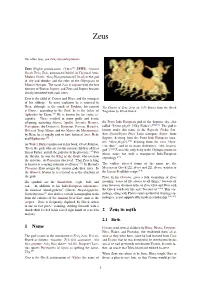
Zeus For other uses, see Zeus (disambiguation). Zeus (English pronunciation: /ˈzjuːs/[3] ZEWS); Ancient Greek Ζεύς Zeús, pronounced [zdeǔ̯s] in Classical Attic; Modern Greek: Δίας Días pronounced [ˈði.as]) is the god of sky and thunder and the ruler of the Olympians of Mount Olympus. The name Zeus is cognate with the first element of Roman Jupiter, and Zeus and Jupiter became closely identified with each other. Zeus is the child of Cronus and Rhea, and the youngest of his siblings. In most traditions he is married to Hera, although, at the oracle of Dodona, his consort The Chariot of Zeus, from an 1879 Stories from the Greek is Dione: according to the Iliad, he is the father of Tragedians by Alfred Church. Aphrodite by Dione.[4] He is known for his erotic es- capades. These resulted in many godly and heroic offspring, including Athena, Apollo, Artemis, Hermes, the Proto-Indo-European god of the daytime sky, also [10][11] Persephone (by Demeter), Dionysus, Perseus, Heracles, called *Dyeus ph2tēr (“Sky Father”). The god is Helen of Troy, Minos, and the Muses (by Mnemosyne); known under this name in the Rigveda (Vedic San- by Hera, he is usually said to have fathered Ares, Hebe skrit Dyaus/Dyaus Pita), Latin (compare Jupiter, from and Hephaestus.[5] Iuppiter, deriving from the Proto-Indo-European voca- [12] tive *dyeu-ph2tēr), deriving from the root *dyeu- As Walter Burkert points out in his book, Greek Religion, (“to shine”, and in its many derivatives, “sky, heaven, “Even the gods who are not his natural children address [10] [6] god”). -

Zeus in the Greek Mysteries) and Was Thought of As the Personification of Cyclic Law, the Causal Power of Expansion, and the Angel of Miracles
Ζεύς The Angel of Cycles and Solutions will help us get back on track. In the old schools this angel was known as Jupiter (Zeus in the Greek Mysteries) and was thought of as the personification of cyclic law, the Causal Power of expansion, and the angel of miracles. Price, John Randolph (2010-11-24). Angels Within Us: A Spiritual Guide to the Twenty-Two Angels That Govern Our Everyday Lives (p. 151). Random House Publishing Group. Kindle Edition. Zeus 1 Zeus For other uses, see Zeus (disambiguation). Zeus God of the sky, lightning, thunder, law, order, justice [1] The Jupiter de Smyrne, discovered in Smyrna in 1680 Abode Mount Olympus Symbol Thunderbolt, eagle, bull, and oak Consort Hera and various others Parents Cronus and Rhea Siblings Hestia, Hades, Hera, Poseidon, Demeter Children Aeacus, Ares, Athena, Apollo, Artemis, Aphrodite, Dardanus, Dionysus, Hebe, Hermes, Heracles, Helen of Troy, Hephaestus, Perseus, Minos, the Muses, the Graces [2] Roman equivalent Jupiter Zeus (Ancient Greek: Ζεύς, Zeús; Modern Greek: Δίας, Días; English pronunciation /ˈzjuːs/[3] or /ˈzuːs/) is the "Father of Gods and men" (πατὴρ ἀνδρῶν τε θεῶν τε, patḕr andrōn te theōn te)[4] who rules the Olympians of Mount Olympus as a father rules the family according to the ancient Greek religion. He is the god of sky and thunder in Greek mythology. Zeus is etymologically cognate with and, under Hellenic influence, became particularly closely identified with Roman Jupiter. Zeus is the child of Cronus and Rhea, and the youngest of his siblings. In most traditions he is married to Hera, although, at the oracle of Dodona, his consort is Dione: according to the Iliad, he is the father of Aphrodite by Dione.[5] He is known for his erotic escapades. -

Meg on the Moon Ebook Free Download
MEG ON THE MOON PDF, EPUB, EBOOK Helen Nicoll | 30 pages | 05 Jan 2006 | Penguin Books Ltd | 9780141382487 | English | London, United Kingdom Meg on the Moon PDF Book More Details Sign In Don't have an account? Lit is then tasked with capturing both Meg and Apollo. They make it to the surface and their destination. She reveals that she and Apollo plan to head out in the morning and the two are given gifts. Thanks for telling us about the problem. They find a room and she and Grover seal the entrance with tomato plants. For the past two days she, Apollo and Grover have wondered the labyrinth. They head there after trick three mercenaries into giving them their boat, Meg wants to kill them but they leave them ashore. They enter it in and go inside. She would not learn who he was or see him again until the daughter of Demeter was twelve. With the Yales on their tails, Meg enters the cave, her mind unprepared. About Helen Nicoll. Want to Read saving…. They drive to Santa Barbara in a school van and search Stears Wharf for hours. Enlarge cover. I hope so. Meg's Christmas In the morning she meets up with Apollo, Nico, and Will as they meet up with Argus to drive them to Brooklyn. After Apollo had been forced to live as a mortal for a third time, Meg saves him from a pair of muggers. As observed by Apollo, even for a child of Demeter one of the six oldest Olympians , Meg was a remarkably powerful demigod, enough to warrant constant supervision. -

Bulfinch's Mythology
Bulfinch's Mythology Thomas Bulfinch Bulfinch's Mythology Table of Contents Bulfinch's Mythology..........................................................................................................................................1 Thomas Bulfinch......................................................................................................................................1 PUBLISHERS' PREFACE......................................................................................................................3 AUTHOR'S PREFACE...........................................................................................................................4 STORIES OF GODS AND HEROES..................................................................................................................7 CHAPTER I. INTRODUCTION.............................................................................................................7 CHAPTER II. PROMETHEUS AND PANDORA...............................................................................13 CHAPTER III. APOLLO AND DAPHNEPYRAMUS AND THISBE CEPHALUS AND PROCRIS7 CHAPTER IV. JUNO AND HER RIVALS, IO AND CALLISTODIANA AND ACTAEONLATONA2 AND THE RUSTICS CHAPTER V. PHAETON.....................................................................................................................27 CHAPTER VI. MIDASBAUCIS AND PHILEMON........................................................................31 CHAPTER VII. PROSERPINEGLAUCUS AND SCYLLA............................................................34 -

Apollo and His Cult in the Geometric and Archaic Periods
Masaryk University Faculty of Arts Department of Archaeology and Museology Classical Archaeology Barbora Chabrečková Apollo and His Cult in the Geometric and Archaic Periods Bachelor's Diploma Thesis Supervisor: PhDr. Marie Pardyová, CSc. 2014 I hereby declare that this thesis is my own work, created with use of primary and secondary sources listed in the bibliography. …………………………… Author’s signature 2 Acknowledgement I would like to thank my supervisor PhDr. Marie Pardyová, CSc., for guidance, constructive criticism and all the valuable advice. And thank my mother, for endless support, encouragement, and patience. 3 Table of contents 1. Introduction ..................................................................................................................................... 5 2. Origin of the deity ........................................................................................................................... 7 2.1 Doric origin based on etymology of the name ........................................................................ 7 2.2 Mythological birth at Delos and its later significance ............................................................. 8 2.3 Hypothesis on Asian origin ................................................................................................... 10 2.3.1 Based on epithet Lykeios ............................................................................................... 10 2.3.2 Based on Hittite and Luwian sources ........................................................................... -

Thronosis in Ritual, Myth, and Iconography Radcliffe .G Edmonds III Bryn Mawr College, Redmonds@Brynmawr.Edu
Bryn Mawr College Scholarship, Research, and Creative Work at Bryn Mawr College Greek, Latin, and Classical Studies Faculty Research Greek, Latin, and Classical Studies and Scholarship 2006 To Sit in Solemn Silence? Thronosis in Ritual, Myth, and Iconography Radcliffe .G Edmonds III Bryn Mawr College, redmonds@brynmawr.edu Let us know how access to this document benefits ouy . Follow this and additional works at: http://repository.brynmawr.edu/classics_pubs Part of the Classics Commons Custom Citation Edmonds, Radcliffe .,G III. "To Sit in Solemn Silence? Thronosis in Ritual, Myth, and Iconography." American Journal of Philology 127, no. 3 (2006): 347-366. This paper is posted at Scholarship, Research, and Creative Work at Bryn Mawr College. http://repository.brynmawr.edu/classics_pubs/80 For more information, please contact repository@brynmawr.edu. Radcliffe G. Edmonds III To Sit in Solemn Silence? Thronosis in Ritual, Myth, and Iconography American Journal of Philology 127.3 (forthcoming September 2006) To Sit in Solemn Silence? Thronosis in Ritual, Myth, and Iconography* In Aristophanes' Clouds, the old man Strepsiades, who wishes to learn from Socrates how to cheat his creditors, is made to put on a wreath and to sit on a bed, while Socrates anoints him in preparation for the epiphany of the Cloud goddesses. The initiation of Strepsiades into the Phrontisterion of Socrates clearly draws upon mystery rituals familiar to Aristophanes' audience, but the debate over the exact rites parodied goes back to the scholia. Among modern scholars, -

UNIVERSITY of CALIFORNIA Los Angeles “A Fullness of Living Forces”: Viacheslav Ivanov's Poetics of Theurgy a Dissertation
UNIVERSITY OF CALIFORNIA Los Angeles “A Fullness of Living Forces”: Viacheslav Ivanov’s Poetics of Theurgy A dissertation submitted in partial satisfaction of the requirements for the degree Doctor of Philosophy in Slavic Languages and Literatures by Jeffrey T. Riggs 2018 © Copyright by Jeffrey T. Riggs 2018 ABSTRACT OF THE DISSERTATION “A Fullness of Living Forces”: Viacheslav Ivanov’s Poetics of Theurgy by Jeffrey T. Riggs Doctor of Philosophy in Slavic Languages and Literatures University of California, Los Angeles, 2018 Professor Ronald W. Vroon, Chair Developing poetry into a form of theurgy (“divine work,” from the Greek θεουργία) is perhaps the most heraldically proclaimed yet scantly defined preoccupation of the Russian Symbolist poet Viacheslav Ivanov (1866-1949). The Symbolist movement’s philosophical progenitor, Vladimir Solov’ev (1853-1900), sounded the clarion call for theurgic art in his treatise Crisis of Western Philosophy (1874), however the concept of theurgy dates to late antiquity, when the Neoplatonist philosophers Iamblichus (c. 245–c. 325 CE) and Proclus (412– 485 CE) posited theurgic ritual as superior to theological discourse. While it has been established that Ivanov followed Solov’evian paradigms in creating theurgic art, the Neoplatonic context of Ivanov’s engagement with theurgy has remained hitherto unexplored in Slavist scholarship. This dissertation argues for Neoplatonic theurgy as an active constituent in Ivanov’s poetics and theory of the symbol. Being an accomplished classical historian and philologist as ii well as a poet and theoretician, Ivanov incorporated both Solov’evian and Neoplatonic theurgic ideas into his highly allusive, richly symbolic, and archaically stylized poetry. Neoplatonism supplied Ivanov with a notion of the symbol as a conduit of divine mysteries, a mythopoetic device, and a functional element of ritual practice. -

Foundation Rituals and the Culture of Building in Ancient Greece
FOUNDATION RITUALS AND THE CULTURE OF BUILDING IN ANCIENT GREECE Gloria R. Hunt A dissertation submitted to the faculty of the University of North Carolina at Chapel Hill in partial fulfillment of the requirements for the degree of Doctor of Philosophy in the Department of Art. Chapel Hill 2006 Approved by Advisor: Donald C. Haggis Reader: Jaroslav Folda Reader: Robin F. Rhodes Reader: G. Kenneth Sams Reader: Mary C. Sturgeon ©2006 Gloria R. Hunt ii ABSTRACT GLORIA R. HUNT: Foundation Rituals and the Culture of Building in Ancient Greece (Under the direction of Donald C. Haggis) This dissertation examines the evidence for foundation rituals in post-Bronze Age Greece while investigating their function and meaning in ancient Greek culture. Foundation rituals are prescribed rites known throughout the ancient Mediterranean that marked the initiation of a buildings’ construction, usually with a combination of prayer, sacrifice, and the burial of foundation deposits containing offerings of various types and/or sacrificial material. These distinctive deposits were ritually interred during the beginning stages of construction, usually within the fabric of the structure itself. The discovery of foundation deposits in association with cult architecture from all over the ancient Greek world and from every historical period attests that foundation rituals were regular features of sacred building. This dissertation presents all published foundation deposits in their archaeological contexts and identifies patterns in placement, method of deposition, type of material deposited, and geographic distribution. Reconstructed from the archaeological evidence, ancient Greek foundation rituals are related to the broader history of foundation rituals in the ancient Mediterranean, especially to the traditions of Egypt and Mesopotamia. -

Divine Riddles: a Sourcebook for Greek and Roman Mythology March, 2014
Divine Riddles: A Sourcebook for Greek and Roman Mythology March, 2014 E. Edward Garvin, Editor What follows is a collection of excerpts from Greek literary sources in translation. The intent is to give students an overview of Greek mythology as expressed by the Greeks themselves. But any such collection is inherently flawed: the process of selection and abridgement produces a falsehood because both the narrative and meta-narrative are destroyed when the continuity of the composition is interrupted. Nevertheless, this seems the most expedient way to expose students to a wide range of primary source information. I have tried to keep my voice out of it as much as possible and will intervene as editor (in this Times New Roman font) only to give background or exegesis to the text. All of the texts in Goudy Old Style are excerpts from Greek or Latin texts (primary sources) that have been translated into English. Ancient Texts In the field of Classics, we refer to texts by Author, name of the book, book number, chapter number and line number.1 Every text, regardless of language, uses the same numbering system. Homer’s Iliad, for example, is divided into 24 books and the lines in each book are numbered. Hesiod’s Theogony is much shorter so no book divisions are necessary but the lines are numbered. Below is an example from Homer’s Iliad, Book One, showing the English translation on the left and the Greek original on the right. When citing this text we might say that Achilles is first mentioned by Homer in Iliad 1.7 (i.7 is also acceptable).