Download (2405Kb)
Total Page:16
File Type:pdf, Size:1020Kb
Load more
Recommended publications
-

Early Medieval Dykes (400 to 850 Ad)
EARLY MEDIEVAL DYKES (400 TO 850 AD) A thesis submitted to the University of Manchester for the degree of Doctor of Philosophy in the Faculty of Humanities 2015 Erik Grigg School of Arts, Languages and Cultures Contents Table of figures ................................................................................................ 3 Abstract ........................................................................................................... 6 Declaration ...................................................................................................... 7 Acknowledgments ........................................................................................... 9 1 INTRODUCTION AND METHODOLOGY ................................................. 10 1.1 The history of dyke studies ................................................................. 13 1.2 The methodology used to analyse dykes ............................................ 26 2 THE CHARACTERISTICS OF THE DYKES ............................................. 36 2.1 Identification and classification ........................................................... 37 2.2 Tables ................................................................................................. 39 2.3 Probable early-medieval dykes ........................................................... 42 2.4 Possible early-medieval dykes ........................................................... 48 2.5 Probable rebuilt prehistoric or Roman dykes ...................................... 51 2.6 Probable reused prehistoric -

Making a Canal Nelson's Victory at Trafalgar May Have Given Britain
Talk 4: Making a Canal Nelson’s victory at Trafalgar may have given Britain sea superiority, but it hardly affected Napoleon’s military position in continental Europe. Five years on and the Emperor could still marshal an army of half a million men for an invasion of Russia, but there he met with unparalleled defeat. After Borodino the largest and bloodiest battle of the Napoleonic wars, the invasion faltered and then turned into a terrible retreat. As snippets of news about the retreat from Moscow reached London Sir Thomas Bernard and Colonel John Drinkwater attended a small ceremony in Regents Park. We might imagine each man turned over a little soil before handing the spade to someone more adept in its use. Perhaps a few proprietors watched the event, wondering how long it would be before they could attend another ceremony, this time to celebrate the completion of the project in which they had invested. And also speculating as to how they might be affected by the demise of Napoleon. Anyone taking a cursory look at a map on which the line of the Regents Canal had been drawn might think construction would be as simple as digging the Grand Junction branch canal, but closer inspection of a cross sectional drawing showed it would be far more complicated. For a start three tunnels were needed. One was hardly bigger than a wide bridge, but the other two, the first at Maida Hill and the second at Islington, were substantial undertakings. Then there was the fall from Paddington to Limehouse, 86 feet in all, which would demand the construction of 12 locks. -
A Deterministic Method for Evaluating Block Stability on Masonry Spillways
Utah State University DigitalCommons@USU International Symposium on Hydraulic Structures May 16th, 12:10 PM A Deterministic Method for Evaluating Block Stability on Masonry Spillways Owen John Chesterton Mott MacDonald, john.chesterton@mottmac.com John G. Heald Mott MacDonald John P. Wilson Mott MacDonald Bently John R. Foster Mott MacDonald Bently Charlie Shaw Mott MacDonald See next page for additional authors Follow this and additional works at: https://digitalcommons.usu.edu/ishs Recommended Citation Chesterton, Owen (2018). A Deterministic Method for Evaluating Block Stability on Masonry Spillways. Daniel Bung, Blake Tullis, 7th IAHR International Symposium on Hydraulic Structures, Aachen, Germany, 15-18 May. doi: 10.15142/T3N64T (978-0-692-13277-7). This Event is brought to you for free and open access by the Conferences and Events at DigitalCommons@USU. It has been accepted for inclusion in International Symposium on Hydraulic Structures by an authorized administrator of DigitalCommons@USU. For more information, please contact digitalcommons@usu.edu. Author Information Owen John Chesterton, John G. Heald, John P. Wilson, John R. Foster, Charlie Shaw, and David E. Rebollo This event is available at DigitalCommons@USU: https://digitalcommons.usu.edu/ishs/2018/session2-2018/2 7th International Symposium on Hydraulic Structures Aachen, Germany, 15-18 May 2018 ISBN: 978-0-692-13277-7 DOI: 10.15142/T3N64T A Deterministic Method for Evaluating Block Stability on Masonry Spillways O.J. Chesterton1, J.G. Heald1, J.P. Wilson2, J.R. Foster2, C. Shaw2 & D.E Rebollo2 1Mott MacDonald, Cambridge, United Kingdom 2Mott MacDonald Bentley, Leeds, United Kingdom E-mail: john.chesterton@mottmac.com Abstract: Many early spillways and weirs in the United Kingdom were constructed or faced with masonry. -

An Irish Navvy: the Diary of an Exile Pdf, Epub, Ebook
AN IRISH NAVVY: THE DIARY OF AN EXILE PDF, EPUB, EBOOK Donall Macamhlaigh | 176 pages | 15 Jan 2014 | The Collins Press | 9781848891883 | English | Cork, Ireland An Irish Navvy: The Diary of an Exile PDF Book Enlarge cover. From the late s until his death in he combined the roles of full-time labourer and part-time writer, producing nine books in Irish as well as a wealth of journalism in both Irish and English. Gill Books. Sort order. Donall MacAmhlaigh kept a diary as he worked the sites, danced in Irish halls, drank in Irish pubs and lived the life of the roving Irish navvy. Readers also enjoyed. Gift wrap available. Latest Publications. Categories : births deaths 20th-century Irish people People from County Galway Irish-language writers Irish non-fiction writers Irish diarists Irish memoirists Irish Army soldiers 20th-century memoirists. View Product. Accurate chronicle of the Irish diaspora and the navvy experience. Elsewhere, for example in the. Hidden categories: CS1: Julian—Gregorian uncertainty EngvarB from March Articles with short description Short description matches Wikidata All articles with unsourced statements Articles with unsourced statements from August Church of Ireland Parish Registers are a genealogy goldmine. Like it or not, it was compulsory. Thanks for telling us about the problem. Irish Interest in based on one very simple idea: to bring the contents of any Irish bookshop to people everywhere, especially those outside Ireland who do not have the possibility of keeping abreast of new books published in Ireland. To ask other readers questions about An Irish Navvy , please sign up. -
Build a Canal a Literacy Resource
Build a Canal A Literacy Resource This downloadable self-directed resource has been developed for teachers and home-schoolers to Canals are great support the Build a Canal Learning places to write poems, Bundle and Workshop through Literacy. stories and songs! (canalrivertrust.org.uk/explorers/ learning-bundles/build-a-canal). It is aimed at Key Stage 1 & Key Stage 2 pupils. There are six stand-alone topics. Each one includes a lesson plan and an activity for pupils to use as you wish. Teachers and home-schoolers can use the certificate on canalrivertrust.org.uk/explorers/ learning-bundles/build-a-canal to give to pupils on completing the activities. © Erica Martin © Erica Martin The Oxford Canal Canal & River Trust — Explorers @CRTExplorers canalrivertrust.org.uk/explorers © Canal & River Trust is a charity registered with the Charity Commission no. 1146792 ⁄ May 2021 INTRODUCTION Main links to Literacy Key Stages 1 & 2 Contents This resource provides opportunities to: ACTIVITY 1 • articulate and communicate > TEACHERS ...................................................................................................... 1 ideas clearly for a range of audiences, > ........................................................................................................................2 styles, contexts and purposes PUPILS • improvise, devise and script ACTIVITY 2 drama, narrative and composition > TEACHERS .....................................................................................................4 • engage with wordplay, including -
Bog Records 2018B.Xlsx
Haematopus 178 records Oystercatcher ostralegusCommon migrant breeder/passage visitor Leeshaw Reservoir 10/01/18 1 Very early for this location marley hall farm 30/01/18 1 first this year Leeshaw Reservoir 18/02/18 8 returning birds Lower Laithe Reservoir 18/02/18 3 returning birds Lindley Wood Reservoir 22/02/18 54 Mach Ghyll reservoir 25/02/18 22 Silsden Keighley Bypass 10/03/18 22 Strid Wood 14/03/18 10 Mainly paired up Silsden Keighley Bypass 17/03/18 28 Silsden Keighley Bypass 19/03/18 20 Thruscross Reservoir 21/03/18 60 Ilkley Tennis Club 24/03/18 2 pair Thruscross Reservoir 01/04/18 67 flock Kex Gill 06/04/18 52 Glovershaw 19/04/18 4 two pairs Dowley Gap/Hirst wood 20/04/18 1 Unusual markings Keighley Moor Reservoir 04/05/18 breeding One on nest (3 eggs) Keighley Moor Reservoir 30/05/18 breeding First sighting of two chicks. Leeshaw Reservoir 15/06/18 3 Pair and juvenile Strid Wood 27/06/18 4 2 adults, 2 young Doe Park Reservoir 03/07/18 1 leucistic Pluvialis apricaria 124 records Golden Plover Resident breeder/passage and winter visitor Middleton Moor 20/01/18 100 Mach Ghyll reservoir 26/01/18 300 Barden Scale 04/02/18 100+ Middleton Moor 04/02/18 715 Mach Ghyll reservoir 17/02/18 200 Leeshaw Reservoir 25/02/18 c150 Moorside Lane Oxenhope 03/03/18 82 Leeshaw Reservoir 06/03/18 c100 Barden Fell 11/03/18 2 A pair piping and in full view in grassy patch at Gledstones. -

Washburn Heritage Centre Archive Handlist
WASHBURN HERITAGE CENTRE ARCHIVE HANDLIST The WHC Archive is a specialist collection of photographs, film, video and sound recordings, documents, memorabilia and ephemera relevant to the History, Heritage and Environment of the Washburn Valley. Our work to catalogue the collections is ongoing and this handlist will change as more of our current collections are catalogued. Please email us if you have a specific enquiry not covered by this handlist. The General Collections include: DOC Documents held by the centre either virtually and/or physically EX Past Exhibition panels PRI printed materials held in the centre RES Research materials including documents and notes on: RESVAR-Vernacular Architecture RESSOC-Social History RESNAT-The Natural World RESIND- Industry RESCHU- Churches and Chapels RESARCH-Archaeology RESWAT-Waterways and Bridges MAP Digital images of maps of the area including ordnance survey maps. PHO Photographs on various themes of interest to the local area including: PHOCHUR-churches and chapels PHOHIST- general history PHONAT-the natural World PHOHIST-general history () PHOWAR-War PHOLIP-Landscape, Industry and Places () PHOWHC-General events at Washburn Heritage centre, including the building and opening of the Centre VID - series of OHP films including: War memories, Water and leisure, Working wood, working Washburn, Haymaking-Washburn Show, Schools, Memories Day-launch of the OHP WHC-Opening Ceremony. · The special collections include: ARCH and - PHOFEW Fewston Assemblage-the archaeology reports and images of the finds PHOALH Alex Houseman Collection- images of the Washburn valley donated by Alex Houseman Ruth Brown Collection - includes images of the local area and a scrapbook of PHOBRO information on the Tuly and Peel families. -

Landscape Character Assessment Current
CURRENT LANDSCAPE CHARACTER ASSESSMENT CONTENTS CONTENTS 02 PREFACE 04 1.0 INTRODUCTION 06 1.1 Appointment and Brief 06 1.2 Northamptonshire Environmental Characterisation Process 06 1.3 Landscape Characterisation in Practice 06 1.4 Northamptonshire Current Landsacape Character Assessment 07 1.5 Approach and Methodology 07 1.6 The Scope and Context of the Study 08 1.7 Parallel Projects and Surveys 08 1.8 Structure of the Report 09 2.0 EVOLUTION OF THE LANDSCAPE 10 2.1 Introduction 10 Physical Influences 2.2 Geology and Soils 10 2.3 Landform 14 2.4 Northamptonshire Physiographic Model 14 2.5 Hydrology 15 2.6 Land Use and Land Cover 16 2.7 Woodland and Trees 18 2.8 Biodiversity 19 2.85 Summary 22 2.9 Buildings and Settlement 23 2.10 Boundaries 25 2.11 Communications and Infrastructure 26 2.12 Historic Landscape Character 28 3.0 NORTHAMPTONSHIRE’S CURRENT LANDSCAPE CHARACTER 29 Cowpasture Spinney, Rolling Ironstone Valley Slopes 3.1 Introduction 29 3.2 Landscape Character Types and Landscape Character Areas 30 3.3 Landscape Character Type and Area Boundary Determination 30 CURRENT LANDSCAPE CHARACTER ASSESSMENT 2 CONTENTS 4.0 GLOSSARY 187 4.1 Key Landscape Character Assessment Terms 187 4.2 Other Technical Terms 187 4.3 Abbreviations 189 5.0 REFERENCES 190 6.0 ACKNOWLEDGEMENTS 191 APPENDICES View over arable land, Limestone Plateau Appendix 1 Data Sets Used in the Northamptonshire Current Landscape Character Assessment Appendix 2 Example of Digital Field Survey Forms Appendix 3 Field Work Prompts Sheets and Mapping Prompts Sheet Appendix -

Local Environment Agency Plan
£TA - /nIoSttvA - &©;x. "2_ local environment agency plan NIDD AND WHARFE CONSULTATION REPORT JUNE 1997 YOUR VIEW S The Nidd and Wharfe Local Environment Agency Plan Consultation Report is the Agency's initial analysis of the status of the environment in this area and the issues that we believe need to be addressed. We would like to hear your views: • Have w e identified all the major issues? • Have we identified realistic proposals for action? • Do you have any comments to make regarding the plan in general? During the consultation period for this report the Agency would be pleased to receive any comments in writing to : The Nidd and Wharfe Environment Planner The Environment Agency North East Region Coverdale House Amy Johnson Way York Y 0 3 4UZ All comments must be received by 30 September 1997. All comments received on the Consultation Report will b e considered in preparing the next phase of the process, the Action Plan. This Action Plan will focus on updating section 4 of this Consultation Report by turning the proposals into actions, but the remainder of this Report will not necessarily be rewritten. Note: Whilst every effort has been made to ensure the accuracy of information in this report it may contain some errors or omissions which we shall be pleased to note. The Structure of this Consultation Report This Consultation Report is divided into two parts, Part I and Part II. A brief description of each can be found below. PARTI Consists of an introduction to the Agency, an overview of the Nidd and Wharfe area, key partnerships the Agency has with other bodies and proposals we feel will address the important environmental issues in the area. -
Article References January 2020 | Volume 71 No 987
Article References January 2020 | Volume 71 No 987 Page 4 - Peterborough Narrow Gauge – Looking Back, 50 Years on Bibliography Colquhoun, D, Stewien, R & Thomas, NSW Rail Transport Museum, Sydney A, Proceed to Peterborough, ARHS (SA 1970. NSW Digest, various issues 1969–1970. Division), Adelaide, 1970. Attenborough, P, Diesel Profiles ALCO Fearnside, GH, All stations west: the story of Evans, J, Proceed to Wilmington, Railmac DL541: The New South Wales 45 and the Sydney–Perth standard gauge railway, Publications, Elizabeth SA, 2010. South Australian 600 Classes, Eveleigh Haldane, Sydney, 1970. Western Endeavour: a guide to the Press, Matraville, 1998. transcontinental standard gauge railway, Personal records and recollections. Page 9 - Living Conditions of Railway Workers and their Families at the Mullet Creek Railway Construction Camp, 1883-1889 Bibliography Project: prehistoric archaeological the Study of Labour History, 2007, pp. studies’, unpublished report prepared 25–43. Primary Sources for the State Rail Authority of NSW, Rowe, Denis, ‘The robust navvy: the NSW Teachers’ Rolls 1869-1908, NSW State 1985. railway construction worker in Archives and Records, 1994/202. Garner, Bill, Born in a Tent: how camping northern New South Wales, 1854-1894’, Galbally, Ann and Gray, Anne (eds), makes us Australian, Sydney, UNSW Labour History, no. 39, 1980, pp. 28–46. Letters from Smike: the letters of Arthur Press, 2013. Singleton, C. C., ‘The short north: Streeton, 1890-1943, Melbourne, Oxford Gunn, John, Along parallel lines: a history the Sydney-Newcastle link railway University Press, 1989. of the railways of New South Wales, – Hawkesbury River–Gosford’, The Tabuteau, Philippe (ed.) Agnes Fagan’d Melbourne University Press, 1989. -
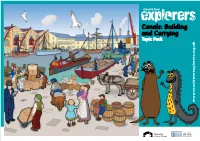
Canals: Building and Carrying – Page 1 Why Were Canals Built? Chapter 1
Canals: Building and Carrying Topic Pack www.canalriverexplorers.org.uk Working in partnership with: Contents Chapter 1 Chapter 4 Appendices Why were canals built? 2 Bridges 22 Appendix A – Toll records 43 Who designed and paid for the canals? 3 Tunnels 25 Appendix B – Plan of motor boat 44 Where were canals built? 4 Aqueducts 27 Appendix C – Plan of butty 45 Canals that weren’t built 6 Locks 28 Appendix D – Standedge Tunnel 46 Lock alternatives 29 Chapter 2 Dry docks 31 Types of waterway 7 Wharves and warehouses 32 How were canals built? 8 Waterway furniture 33 Navvies 9 Associated buildings 34 Other workers involved in the construction 10 Chapter 5 Chief engineers and other A–Z of cargoes 35 significant people 11 Memories of carrying 36 Tools 14 Loading boats 37 Why was water such a big problem? 15 Tolls 38 This pack provides Chapter 3 Chapter 6 a good starting point to Building boats 16 Changing Waterways 39 find out about the people Types of boats 17 Maintenance 40 who lived and worked Who owned the boats? 20 Day-to-day work 41 on the canals! The parts of a boat 21 Fascinating Facts 2009 42 Always remember to stay SAFE near water – Stay Away From the Edge. Introduction This is the second in our series of topic packs about the waterways. I thoroughly enjoyed writing the first pack ‘Life on the English Waterways’ and this has given me a fantastic opportunity to research the structural side of waterways. The pack explores the design, production and technology used in waterways in England, Scotland and Wales over the years. -

3.20 Down Manchester,” L.N.E.R
No. 9 The “3.20 Down Manchester,” L.N.E.R. First published in the Meccano Magazine September 1927 It was something of a shock to the well-established London and North Western and Great Northern Railways when the Midland signified its intention of extending its ramified system southward to its own terminus in London and, as an earnest of the intention, ran a line through Bedford to Hitchin and monopolised a large share of the Great Northern main line into King’s Cross until its own St. Pancras Station was ready in 1868. Still more of a surprise, perhaps, was given to all these three companies when, nearly at the close of last century, in the face of determined opposition, the Manchester, Sheffield and Lincolnshire Railway obtained Parliamentary powers to do exactly the same thing. Prior to the opening of the “London Extension” in 1899, the Manchester, Sheffield and Lincolnshire was an important system crossing the country from Cleethorpes and Grimsby in the east, through Sheffield and Barnsley to Manchester in the west, with a share in the large joint railway known as the Cheshire Lines Committee, and important interests in North Wales, its southernmost tentacle extended to Annesley, near Nottingham. The powers obtained enabled the M.S. and L. Company to prolong this line southward through Nottingham, Leicester and Rugby to a 1 junction with the London Metropolitan Railway, which had advanced northward to a point beyond Aylesbury. As a result of this vastly important development the provincial railway required a new name, and included in the Parliamentary powers was the authority to change its name from Manchester, Sheffield and Lincolnshire to the imposing title of “Great Central” Railway.