The Exhibits from the Ricordi Archive
Total Page:16
File Type:pdf, Size:1020Kb
Load more
Recommended publications
-
Libretto Nabucco.Indd
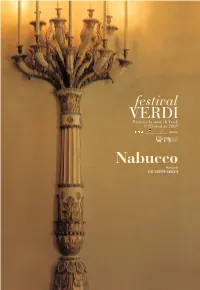
Nabucco Musica di GIUSEPPE VERDI major partner main sponsor media partner Il Festival Verdi è realizzato anche grazie al sostegno e la collaborazione di Soci fondatori Consiglio di Amministrazione Presidente Sindaco di Parma Pietro Vignali Membri del Consiglio di Amministrazione Vincenzo Bernazzoli Paolo Cavalieri Alberto Chiesi Francesco Luisi Maurizio Marchetti Carlo Salvatori Sovrintendente Mauro Meli Direttore Musicale Yuri Temirkanov Segretario generale Gianfranco Carra Presidente del Collegio dei Revisori Giuseppe Ferrazza Revisori Nicola Bianchi Andrea Frattini Nabucco Dramma lirico in quattro parti su libretto di Temistocle Solera dal dramma Nabuchodonosor di Auguste Anicet-Bourgeois e Francis Cornu e dal ballo Nabucodonosor di Antonio Cortesi Musica di GIUSEPPE V ERDI Mesopotamia, Tavoletta con scrittura cuneiforme La trama dell’opera Parte prima - Gerusalemme All’interno del tempio di Gerusalemme, i Leviti e il popolo lamen- tano la triste sorte degli Ebrei, sconfitti dal re di Babilonia Nabucco, alle porte della città. Il gran pontefice Zaccaria rincuora la sua gente. In mano ebrea è tenuta come ostaggio la figlia di Nabucco, Fenena, la cui custodia Zaccaria affida a Ismaele, nipote del re di Gerusalemme. Questi, tuttavia, promette alla giovane di restituirle la libertà, perché un giorno a Babilonia egli stesso, prigioniero, era stato liberato da Fe- nena. I due innamorati stanno organizzando la fuga, quando giunge nel tempio Abigaille, supposta figlia di Nabucco, a comando di una schiera di Babilonesi. Anch’essa è innamorata di Ismaele e minaccia Fenena di riferire al padre che ella ha tentato di fuggire con uno stra- niero; infine si dichiara disposta a tacere a patto che Ismaele rinunci alla giovane. -

VIVA VERDI a Small Tribute to a Great Man, Composer, Italian
VIVA VERDI A small tribute to a great man, composer, Italian. Giuseppe Verdi • What do you know about Giuseppe Verdi? What does modern Western society offer everyday about him and his works? Plenty more than you would think. • Commercials with his most famous arias, such as “La donna e` nobile”, from Rigoletto, are invading the air time of television… • Movies and cartoons have also plenty of his arias… What about stamps from all over the world carrying his image? • There are hundreds of them…. and coins and medals… …and banknotes? Well, those only in Italy, that I know of…. Statues of him are all over the world… ….and we have Verdi Squares and Verdi Streets And let’s not forget the many theaters with his name… His operas even became comic books… • Well, he was a famous composer… but it’s that the only reason? Let’s look into that… Giuseppe Fortunino Francesco Verdi Born Joseph Fortunin François Verdi on October 10, 1813 in a village near Busseto, in Emilia Romagna, at the time part of the First French Empire. He was therefore born French! Giuseppe Verdi He was refused admission by the Conservatory of Milan because he did not have enough talent… …that Conservatory now carries his name. In Busseto, Verdi met Antonio Barezzi, a local merchant and music lover, who became his patron, financed some of his studies and helped him throughout the dark years… Thanks to Barezzi, Verdi went to Milano to take private lessons. He then returned to his town, where he became the town music master. -
Verdi and Milan Transcript
Verdi and Milan Transcript Date: Monday, 14 May 2007 - 12:00AM VERDI AND MILAN Professor Roger Parker This talk is about Verdi and Milan, and is in three acts, with a brief prelude and even briefer postlude. You may like to know that, as with most of Verdi's operas, the last act is quite a bit shorter than the first two. Prelude When the eighteen-year-old Verdi moved from provincial Busseto, a town near Parma, to Milan in June 1832, to complete his musical training privately after having been rejected from the Milan Conservatory, he must have felt keenly the change in cultural climate. From a small town in which his reputation had been as a promising church musician, and whose inhabitants he later reviled for their parochialism and petty jealousies, he transferred to one of Italy's major capital cities, an international operatic centre with a rich tradition of intellectual and cultural achievement. At the heart of this culture, and at the heart of the city, stood the Teatro alla Scala, one of the two or three major theatres in Italy. Much later in life Verdi recalled his lessons in Milan as extremely formal and academic: in particular he recalled no reference to the music of the present. But his recollections were written in 1871, some forty years after the events described, and they tell us more about the then-aging Verdi's reactions to an Italy increasingly influenced by 'foreign' opera composers (in particular Meyerbeer and Wagner) than it does about the reality of his own student experiences. -

Donizetti Operas and Revisions
GAETANO DONIZETTI LIST OF OPERAS AND REVISIONS • Il Pigmalione (1816), libretto adapted from A. S. Sografi First performed: Believed not to have been performed until October 13, 1960 at Teatro Donizetti, Bergamo. • L'ira d'Achille (1817), scenes from a libretto, possibly by Romani, originally done for an opera by Nicolini. First performed: Possibly at Bologna where he was studying. First modern performance in Bergamo, 1998. • Enrico di Borgogna (1818), libretto by Bartolomeo Merelli First performed: November 14, 1818 at Teatro San Luca, Venice. • Una follia (1818), libretto by Bartolomeo Merelli First performed: December 15, 1818 at Teatro San Luca,Venice. • Le nozze in villa (1819), libretto by Bartolomeo Merelli First performed: During Carnival 1820-21 at Teatro Vecchio, Mantua. • Il falegname di Livonia (also known as Pietro, il grande, tsar delle Russie) (1819), libretto by Gherardo Bevilacqua-Aldobrandini First performed: December 26, 1819 at the Teatro San Samuele, Venice. • Zoraida di Granata (1822), libretto by Bartolomeo Merelli First performed: January 28, 1822 at the Teatro Argentina, Rome. • La zingara (1822), libretto by Andrea Tottola First performed: May 12, 1822 at the Teatro Nuovo, Naples. • La lettera anonima (1822), libretto by Giulio Genoino First performed: June 29, 1822 at the Teatro del Fondo, Naples. • Chiara e Serafina (also known as I pirati) (1822), libretto by Felice Romani First performed: October 26, 1822 at La Scala, Milan. • Alfredo il grande (1823), libretto by Andrea Tottola First performed: July 2, 1823 at the Teatro San Carlo, Naples. • Il fortunate inganno (1823), libretto by Andrea Tottola First performed: September 3, 1823 at the Teatro Nuovo, Naples. -
TUTTO VERDI 2013 TV P Rogram
TV P ROGRAM 2013 CELebrating VERDI'S 200TH birthday ctober O O ctober 2013 ROGRAM TUTTO VERDI TV P Tutto Verdi – one of the most ambitious opera projects ever – is UNITEL CLASSICA’s exclusive highlight this October, celebrating Verdi’s 200th birthday on October 10. Enjoy as a world TV premiere Giuseppe Verdi‘s complete operatic works and his Requiem in High Definition and with Surround Sound. All 26 operas, which were produced in coproduction with the Verdi Festival, the Teatro Regio di Parma and the Teatro Verdi di Busseto are presented in chronological order, giving the viewer the unique chance to discover the grand composers musical development as well as the musical and historical influences he was under. On the birthday itself the great composer is honored with the broadcast of his Requiem in a special open air concert starring D’Arcangelo, Grigolo, De Young and Di Giacomo. The L.A. Philharmonic are conducted by no less than Gustavo Dudamel. Richard Wagner is born Giuseppe Verdi is born as Giuseppe Fortunino Francesco on 10 October 1813 in Le Roncole, a village near Busseto on 23 May in Leipzig 1813 (Parma), as son of the merchant Carlo Giuseppe Verdi and his wife Luigia Uttini. Congress of Vienna 1815 Premiere of Beethoven’s First engagement as organist in Le Roncole at the age of nine 1824 1822 Symphony No.9 Verdi moves to Busseto to Antonio Barezzi, a local merchant and president of the Philharmonic Society and supporter Wagner composes 1831 of Verdi’s musical ambitions. He gets engaged with Barezzi’s daughter Margherita. -

Ricordi Archive Expands Its Collaboration with Dolce & Gabbana
PRESS RELEASE Ricordi Archive Expands Its Collaboration with Dolce & Gabbana • Historical motifs from Verdi operas grace unique pieces of the new Alta Sartoria collection Milan, January 31, 2017 – Dolce & Gabbana has expanded its collaboration with the Archivio Storico Ricordi in Milan and has incorporated numerous historical illustrations from famous Verdi operas in its new Alta Sartoria collection. The motifs from works including Falstaff, Rigoletto, Otello and Don Carlos grace – as reproductions or reinterpretations of the originals – unique pieces that Dolce & Gabbana unveiled last weekend at Milan’s Teatro alla Scala. Dolce & Gabbana, which is one of the main supporters of the Teatro alla Scala opera house, gave its creativity free rein and replicated motifs from the Ricordi Archive on select pieces from its men’s collection. The Archivio Storico Ricordi contains documents and artifacts from 200 years of Italian opera history, including valuable original manuscripts by Giuseppe Verdi and Giacomo Puccini, numerous stage designs, and costume drawings. In 2016, the archive, which is part of the Bertelsmann group, had first licensed ornamental and floral illustrations from the world of Opera to Dolce & Gabbana, albeit on a much smaller scale. Karin Schlautmann, Head of Bertelsmann Corporate Communications and responsible for the Ricordi Archive, said: “For the Archivio Storico Ricordi, this licensing cooperation is a wonderful opportunity to keep the musical treasures of yore alive and allow them to serve as inspiration for contemporary creatives and artists. It also is a perfect example for how Bertelsmann as the archive’s owner ensures an inflow of funds in a respectful scope. All earnings from license agreements go towards preserving the archive for posterity.” The Archivio Storico Ricordi has been part of Bertelsmann since 1994 and is seen as one of the world's most valuable privately owned music collections. -

Roberto Devereux
GAETANO DONIZETTI roberto devereux conductor Opera in three acts Maurizio Benini Libretto by Salvadore Cammarano, production Sir David McVicar after François Ancelot’s tragedy Elisabeth d’Angleterre set designer Sir David McVicar Saturday, April 16, 2016 costume designer 1:00–3:50 PM Moritz Junge lighting designer New Production Paule Constable choreographer Leah Hausman The production of Roberto Devereux was made possible by a generous gift from The Sybil B. Harrington Endowment Fund The presentation of Donizetti’s three Tudor queen operas this season is made possible through a generous grant from Daisy Soros, general manager in memory of Paul Soros and Beverly Sills Peter Gelb music director James Levine Co-production of the Metropolitan Opera principal conductor Fabio Luisi and Théâtre des Champs-Élysées 2015–16 SEASON The seventh Metropolitan Opera performance of GAETANO DONIZETTI’S This performance roberto is being broadcast live over The Toll Brothers– devereux Metropolitan Opera International Radio Network, sponsored by Toll Brothers, conductor America’s luxury Maurizio Benini homebuilder®, with generous long-term in order of vocal appearance support from sar ah (sar a), duchess of not tingham The Annenberg Elīna Garanča Foundation, The Neubauer Family queen eliz abeth (elisabet ta) Foundation, the Sondra Radvanovsky* Vincent A. Stabile Endowment for lord cecil Broadcast Media, Brian Downen and contributions from listeners a page worldwide. Yohan Yi There is no sir walter (gualtiero) r aleigh Toll Brothers– Christopher Job Metropolitan Opera Quiz in List Hall robert (roberto) devereux, e arl of esse x today. Matthew Polenzani This performance is duke of not tingham also being broadcast Mariusz Kwiecien* live on Metropolitan Opera Radio on a servant of not tingham SiriusXM channel 74. -

Bertelsmann Brings Treasures from the Archivio Storico Ricordi to Spain for the First Time
PRESS RELEASE Bertelsmann Brings Treasures from the Archivio Storico Ricordi to Spain for the First Time • The exhibition “The Making of Verdi’s Otello – A Glimpse into the Archivio Storico Ricordi” will take place at Madrid’s Teatro Real from September 15th to October 3rd on the occasion of the theater’s bicentennial • Unique pieces of Italian opera history are fundamental to understanding the opera’s genesis and creative process • Their Majesties King Felipe VI and Queen Letizia, members of the Spanish government, CEOs of the biggest Spanish companies, and personages from the cultural world are expected at Teatro Real • Thomas Rabe: “Bertelsmann is taking responsibility for the restoration and digitization of important testimonies to opera history” Madrid, September 12, 2016 – For the first time, unique pieces of Italian opera history from the Bertelsmann-owned Archivio Storico Ricordi in Milan will be on display at an exhibition in Spain. The international media group is opening the archive, which houses one of the world's most valuable music collections in private hands, to provide one of the highlights of the Teatro Real of Madrid’s bicentennial celebrations. “The making of Verdi’s Otello – A Glimpse into the Archivio Storico Ricordi” exhibition features original scores, librettos, selected correspondence, sets, and costume designs for Otello, and illustrates the creative collaboration between the music publisher Giulio Ricordi, and the celebrated composer Giuseppe Verdi. Otello is widely represented in the Archivio Storico Ricordi, which contains the most relevant and richest series of historical documents related to the masterpiece, including the autograph in Verdi’s own hand. -

15, Mezzo-Soprano Denes Van Parys, Piano
SCHOOL OF MUSIC SENIOR RECITAL JENNIFER ANN MAYER ’15, MEZZO-SOPRANO DENES VAN PARYS, PIANO SUNDAY, MARCH 8, 2015 SCHNEEBECK CONCERT HALL 5 P.M. “Esurientes implevit bonis” ...................................................... Johann Sebastian Bach from Magnificat (1685–1750) “Lobe, Zion, deinen Gott” from Cantata No. 190 From Zwei Gesänge, Opus 91 ............................................................Johannes Brahms Geistliches Wiegenlied (1833–1897) with Forrest D. Walker, viola Nuit d’étoiles ........................................................................................ Claude Debussy (1862–1918) Le Spectre de la Rose ..............................................................................Hector Berlioz from Les Nuits d’Été (1803–1869) “Faites-lui mes aveux” ..........................................................................Charles Gounod from Faust (1818–1893) INTERMISSION From Sea Pictures, Opus 37 ...................................................................... Edward Elgar Where Corals Lie (1857–1934) Sabbath Morning at Sea “Lullaby” .......................................................................................... Gian Carlo Menotti from The Consul (1911–2007) “Il segreto per esser felici” ................................................................Gaetano Donizetti from Lucrezia Borgia (1797–1848) A reception will follow the recital in School of Music, Room 106. VOCALIST JENNIFER ANN MAYER ’15, mezzo-soprano, is double-majoring in music and communication studies. She studies voice -

Fly, Thought, on Golden Wings
Fly, thought, on golden wings Rose Marie Boudeguer Yerkovic Director, Research Services MONTHLY STRATEGY REPORT July 2015 Monthly Strategy Report. July 2015 Fly, thought, on golden wings “It is said that success requires talent, hard work, and an embrace of the opportunities that arise. But equally as important is the ability to overcome defeat. This month’s story is a tale of triumph, like many others in fields as diverse as art, sport, and business”. The young man sheepishly opened the immense door of the audition room and entered. Opposite him, the three examiners from the Conservatory leered with curiosity and suspicion. They had never assessed someone so old. He played two pieces, but his fate was sealed after the first. The examiners were appalled at the curvature of his back and the way in which he rested his fingers on the keyboard. The second piece was an original composition to which the examiners paid no attention. They had already made their decision. “We are sorry, your technique is unsatisfactory and nineteen is too old to correct it,” they said. “But I don’t want to be a pianist,” he protested, “I want to be a composer.” Sixty-six years later, the same man received a letter from the Ministry of Culture suggesting his name grace the Conservatory. “If you didn’t want me when I was young, you shan’t have me old,” he responded. But ultimately the Milan Conservatory prevailed, changing its name to the Giuseppe Verdi Conservatory of Music. Verdi was born on 10 October 1813 in a small town near the city of Busseto, in the Duchy of Parma. -

Nini, Bloodshed, and La Marescialla D'ancre
28 Nini, bloodshed, and La marescialla d’Ancre Alexander Weatherson (This article originally appeared in Donizetti Society Newsletter 88 (February 2003)) An odd advocate of so much operatic blood and tears, the mild Alessandro Nini was born in the calm of Fano on 1 November 1805, an extraordinary centre section of his musical life was to be given to the stage, the rest of it to the church. It would not be too disrespectful to describe his life as a kind of sandwich - between two pastoral layers was a filling consisting of some of the most bloodthirsty operas ever conceived. Maybe the excesses of one encouraged the seclusion of the other? He began his strange career with diffidence - drawn to religion his first steps were tentative, devoted attendance on the local priest then, fascinated by religious music - study with a local maestro, then belated admission to the Liceo Musicale di Bologna (1827) while holding appointments as Maestro di Cappella at churches in Montenovo and Ancona; this stint capped,somewhat surprisingly - between 1830 and 1837 - by a spell in St. Petersburg teaching singing. Only on his return to Italy in his early thirties did he begin composing in earnest. Was it Russia that introduced him to violence? His first operatic project - a student affair - had been innocuous enough, Clato, written at Bologna with an milk-and-water plot based on Ossian (some fragments remain), all the rest of his operas appeared between 1837 and 1847, with one exception. The list is as follows: Ida della Torre (poem by Beltrame) Venice 1837; La marescialla d’Ancre (Prati) Padua 1839; Christina di Svezia (Cammarano/Sacchero) Genova 1840; Margarita di Yorck [sic] (Sacchero) Venice 1841; Odalisa (Sacchero) Milano 1842; Virginia (Bancalari) Genova 1843, and Il corsaro (Sacchero) Torino 1847. -
The Worlds of Rigoletto: Verdiâ•Žs Development of the Title Role in Rigoletto
Florida State University Libraries Electronic Theses, Treatises and Dissertations The Graduate School 2008 The Worlds of Rigoletto Verdi's Development of the Title Role in Rigoletto Mark D. Walters Follow this and additional works at the FSU Digital Library. For more information, please contact lib-ir@fsu.edu THE FLORIDA STATE UNIVERSITY COLLEGE OF MUSIC THE WORLDS OF RIGOLETTO VERDI’S DEVELOPMENT OF THE TITLE ROLE IN RIGOLETTO By MARK D. WALTERS A Treatise submitted to the College of Music in partial fulfillment of the requirements for the degree of Doctor of Music Degree Awarded: Spring Semester, 2008 The members of the Committee approve the Treatise of Mark D. Walters defended on September 25, 2007. Douglas Fisher Professor Directing Treatise Svetla Slaveva-Griffin Outside Committee Member Stanford Olsen Committee Member The Office of Graduate Studies has verified and approved the above named committee members. ii I would like to dedicate this treatise to my parents, Dennis and Ruth Ann Walters, who have continually supported me throughout my academic and performing careers. iii ACKNOWLEDGEMENTS I would like to express my gratitude to Professor Douglas Fisher, who guided me through the development of this treatise. As I was working on this project, I found that I needed to raise my levels of score analysis and analytical thinking. Without Professor Fisher’s patience and guidance this would have been very difficult. I would like to convey my appreciation to Professor Stanford Olsen, whose intuitive understanding of musical style at the highest levels and ability to communicate that understanding has been a major factor in elevating my own abilities as a teacher and as a performer.