Capillaria Plectropomi N. Sp. (Nematoda: Capillariidae)
Total Page:16
File Type:pdf, Size:1020Kb
Load more
Recommended publications
-

Gastrointestinal Helminthic Parasites of Habituated Wild Chimpanzees
Aus dem Institut für Parasitologie und Tropenveterinärmedizin des Fachbereichs Veterinärmedizin der Freien Universität Berlin Gastrointestinal helminthic parasites of habituated wild chimpanzees (Pan troglodytes verus) in the Taï NP, Côte d’Ivoire − including characterization of cultured helminth developmental stages using genetic markers Inaugural-Dissertation zur Erlangung des Grades eines Doktors der Veterinärmedizin an der Freien Universität Berlin vorgelegt von Sonja Metzger Tierärztin aus München Berlin 2014 Journal-Nr.: 3727 Gedruckt mit Genehmigung des Fachbereichs Veterinärmedizin der Freien Universität Berlin Dekan: Univ.-Prof. Dr. Jürgen Zentek Erster Gutachter: Univ.-Prof. Dr. Georg von Samson-Himmelstjerna Zweiter Gutachter: Univ.-Prof. Dr. Heribert Hofer Dritter Gutachter: Univ.-Prof. Dr. Achim Gruber Deskriptoren (nach CAB-Thesaurus): chimpanzees, helminths, host parasite relationships, fecal examination, characterization, developmental stages, ribosomal RNA, mitochondrial DNA Tag der Promotion: 10.06.2015 Contents I INTRODUCTION ---------------------------------------------------- 1- 4 I.1 Background 1- 3 I.2 Study objectives 4 II LITERATURE OVERVIEW --------------------------------------- 5- 37 II.1 Taï National Park 5- 7 II.1.1 Location and climate 5- 6 II.1.2 Vegetation and fauna 6 II.1.3 Human pressure and impact on the park 7 II.2 Chimpanzees 7- 12 II.2.1 Status 7 II.2.2 Group sizes and composition 7- 9 II.2.3 Territories and ranging behavior 9 II.2.4 Diet and hunting behavior 9- 10 II.2.5 Contact with humans 10 II.2.6 -

F. Moravec: Trichinelloid Nematodes Parasitic in Cold-Blooded Vertebrates
FOLIA PARASITOLOGICA 49: 24, 2002 F. Moravec: Trichinelloid Nematodes Parasitic in Cold-blooded Vertebrates. Academia, Praha, 2001. ISBN 80-200-0805-5, hardback, 430 pp., 138 figs. Price CZK (Czech crowns) 395.00. The author of this monograph, Dr. František Moravec, their synonymy, description with illustrations, data on hosts, DrSc., of the Institute of Parasitology, Academy of Sciences locations, distribution and biology. The original comments on of the Czech Republic, České Budějovice (South Bohemia) is the nomenclature history, synonymy, morphological variabil- one of the world’s foremost authorities on parasitic nema- ity, differentiation and other aspects are indeed very valuable. todes, whose numerous classic papers and monographs on the In this way, the author assesses in detail 78 nematode species systematics and biology of this important parasite group are from fish, l5 from amphibians and 22 from reptiles. both well-known and internationally recognised. Consequently, the above conception, based on Moravec’s The content being assessed is devoted to morphology, (1982) originally modified classification system of capil- systematics, taxonomy and to other aspects of the parasite-host lariids, is used in the present book. The text of the book is relations within the large group of trichinelloid (mainly supplemented with a parasite-host list containing 347 fish, 47 capillariid) nematodes that parasitise cold-blooded animals on amphibian and 55 reptile species. The bibliography included a world-wide scale. The monograph contains detailed contains 669 citations of the literature sources. information on the methods of studying these parasites, their The monograph as a whole is of a high standard, much morphology, systematic value of individual features and on enhanced by good graphics and layout. -

Syn. Capillaria Plica) Infections in Dogs from Western Slovakia
©2020 Institute of Parasitology, SAS, Košice DOI 10.2478/helm20200021 HELMINTHOLOGIA, 57, 2: 158 – 162, 2020 Case Report First documented cases of Pearsonema plica (syn. Capillaria plica) infections in dogs from Western Slovakia P. KOMOROVÁ1,*, Z. KASIČOVÁ1, K. ZBOJANOVÁ2, A. KOČIŠOVÁ1 1University of Veterinary Medicine and Pharmacy in Košice, Institute of Parasitology, Komenského 73, 041 81 Košice, Slovakia, *E-mail: petronela.komorova@uvlf.sk; 2Lapvet - Veterinary Clinic, Osuského 1630/44, 851 03 Bratislava, Slovakia Article info Summary Received November 12, 2019 Three clinical cases of dogs with Pearsonema plica infection were detected in the western part of Accepted February 20, 2020 Slovakia. All cases were detected within fi ve months. Infections were confi rmed after positive fi ndings of capillarid eggs in the urine sediment in following breeds. The eight years old Jack Russell Terrier, one year old Italian Greyhound, and eleven years old Yorkshire terrier were examined and treated. In one case, the infection was found accidentally in clinically healthy dog. Two other patients had nonspecifi c clinical signs such as apathy, inappetence, vomiting, polydipsia and frequent urination. This paper describes three individual cases, including the case history, clinical signs, examinations, and therapies. All data were obtained by attending veterinarian as well as by dog owners. Keywords: Urinary capillariasis; urine bladder; bladder worms; dogs Introduction prevalence in domestic dog population is unknown. The occur- rence of P. plica in domestic dogs was observed and described Urinary capillariasis caused by Pearsonema plica nematode of in quite a few case reports from Poland (Studzinska et al., 2015), family Capillariidae is often detected in wild canids. -
Academic Paper on “Restricting the Size of Groupers (Serranidae
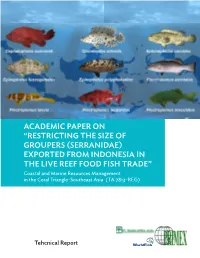
ACADEMIC PAPER ON “RESTRICTING THE SIZE OF GROUPERS (SERRANIDAE) EXPORTED FROM INDONESIA IN THE LIVE REEF FOOD FISH TRADE” Coastal and Marine Resources Management in the Coral Triangle-Southeast Asia (TA 7813-REG) Tehcnical Report ACADEMIC PAPER ON RESTRICTING THE SIZE OFLIVE GROUPERS FOR EXPORT ACADEMIC PAPER ON “RESTRICTING THE SIZE OF GROUPERS (SERRANIDAE) EXPORTED FROM INDONESIA IN THE LIVE REEF FOOD FISH TRADE” FINAL VERSION COASTAL AND MARINE RESOURCES MANAGEMENT IN THE CORAL TRIANGLE: SOUTHEAST ASIA, INDONESIA, MALAYSIA, PHILIPPINES (TA 7813-REG) ACADEMIC PAPER ON RESTRICTING THE SIZE OFLIVE GROUPERS FOR EXPORT Page i FOREWORD Indonesia is the largest exporter of live groupers for the live reef fish food trade. This fisheries sub-sector plays an important role in the livelihoods of fishing communities, especially those living on small islands. As a member of the Coral Triangle Initiative (CTI), in partnership with the Asian Development Bank (ADB) under RETA [7813], Indonesia (represented by a team from Hasanuddin University) has compiled this academic paper as a contribution towards sustainable management of live reef fish resources in Indonesia. Challenges faced in managing the live grouper fishery and trade in Indonesia include the ongoing activities and practices which damage grouper habitat; the lack of protection for grouper spawning sites; overfishing of groupers which have not yet reached sexual maturity/not reproduced; and the prevalence of illegal and unreported fishing for live groupers. These factors have resulted in declining wild grouper stocks. The Aquaculture sector is, at least as yet, unable to replace or enable a balanced wild caught fishery, and thus there is still a heavy reliance on wild-caught groupers. -

Review and Meta-Analysis of the Environmental Biology and Potential Invasiveness of a Poorly-Studied Cyprinid, the Ide Leuciscus Idus
REVIEWS IN FISHERIES SCIENCE & AQUACULTURE https://doi.org/10.1080/23308249.2020.1822280 REVIEW Review and Meta-Analysis of the Environmental Biology and Potential Invasiveness of a Poorly-Studied Cyprinid, the Ide Leuciscus idus Mehis Rohtlaa,b, Lorenzo Vilizzic, Vladimır Kovacd, David Almeidae, Bernice Brewsterf, J. Robert Brittong, Łukasz Głowackic, Michael J. Godardh,i, Ruth Kirkf, Sarah Nienhuisj, Karin H. Olssonh,k, Jan Simonsenl, Michał E. Skora m, Saulius Stakenas_ n, Ali Serhan Tarkanc,o, Nildeniz Topo, Hugo Verreyckenp, Grzegorz ZieRbac, and Gordon H. Coppc,h,q aEstonian Marine Institute, University of Tartu, Tartu, Estonia; bInstitute of Marine Research, Austevoll Research Station, Storebø, Norway; cDepartment of Ecology and Vertebrate Zoology, Faculty of Biology and Environmental Protection, University of Lodz, Łod z, Poland; dDepartment of Ecology, Faculty of Natural Sciences, Comenius University, Bratislava, Slovakia; eDepartment of Basic Medical Sciences, USP-CEU University, Madrid, Spain; fMolecular Parasitology Laboratory, School of Life Sciences, Pharmacy and Chemistry, Kingston University, Kingston-upon-Thames, Surrey, UK; gDepartment of Life and Environmental Sciences, Bournemouth University, Dorset, UK; hCentre for Environment, Fisheries & Aquaculture Science, Lowestoft, Suffolk, UK; iAECOM, Kitchener, Ontario, Canada; jOntario Ministry of Natural Resources and Forestry, Peterborough, Ontario, Canada; kDepartment of Zoology, Tel Aviv University and Inter-University Institute for Marine Sciences in Eilat, Tel Aviv, -

From Skin of Red Snapper, Lutjanus Campechanus (Perciformes: Lutjanidae), on the Texas–Louisiana Shelf, Northern Gulf of Mexico
J. Parasitol., 99(2), 2013, pp. 318–326 Ó American Society of Parasitologists 2013 A NEW SPECIES OF TRICHOSOMOIDIDAE (NEMATODA) FROM SKIN OF RED SNAPPER, LUTJANUS CAMPECHANUS (PERCIFORMES: LUTJANIDAE), ON THE TEXAS–LOUISIANA SHELF, NORTHERN GULF OF MEXICO Carlos F. Ruiz, Candis L. Ray, Melissa Cook*, Mark A. Grace*, and Stephen A. Bullard Aquatic Parasitology Laboratory, Department of Fisheries and Allied Aquacultures, College of Agriculture, Auburn University, 203 Swingle Hall, Auburn, Alabama 36849. Correspondence should be sent to: ash.bullard@auburn.edu ABSTRACT: Eggs and larvae of Huffmanela oleumimica n. sp. infect red snapper, Lutjanus campechanus (Poey, 1860), were collected from the Texas–Louisiana Shelf (28816036.5800 N, 93803051.0800 W) and are herein described using light and scanning electron microscopy. Eggs in skin comprised fields (1–5 3 1–12 mm; 250 eggs/mm2) of variously oriented eggs deposited in dense patches or in scribble-like tracks. Eggs had clear (larvae indistinct, principally vitelline material), amber (developing larvae present) or brown (fully developed larvae present; little, or no, vitelline material) shells and measured 46–54 lm(x¼50; SD 6 1.6; n¼213) long, 23–33 (27 6 1.4; 213) wide, 2–3 (3 6 0.5; 213) in eggshell thickness, 18–25 (21 6 1.1; 213) in vitelline mass width, and 36–42 (39 6 1.1; 213) in vitelline mass length with protruding polar plugs 5–9 (7 6 0.6; 213) long and 5–8 (6 6 0.5; 213) wide. Fully developed larvae were 160–201 (176 6 7.9) long and 7–8 (7 6 0.5) wide, had transverse cuticular ridges, and were emerging from some eggs within and beneath epidermis. -
Demography of a Large Grouper, Epinephelus Fuscoguttatus, from Australia’S Great Barrier Reef: Implications for Fishery Management
MARINE ECOLOGY PROGRESS SERIES Vol. 307: 259–272, 2006 Published January 24 Mar Ecol Prog Ser Demography of a large grouper, Epinephelus fuscoguttatus, from Australia’s Great Barrier Reef: implications for fishery management Rachel J. Pears1, 2,*, J. Howard Choat1, Bruce D. Mapstone2, 3, Gavin A. Begg2 1School of Marine Biology, and 2CRC Reef Research Centre, James Cook University, Queensland 4811, Australia 3Antarctic Climate and Ecosystems CRC, University of Tasmania, Private Bag 80, Tasmania 7001, Australia ABSTRACT: Epinephelus fuscoguttatus is widespread throughout the Indo-Pacific and features strongly in regional fisheries, including the live reef fish trade. We investigated age-specific demo- graphic and reproductive characteristics of E. fuscoguttatus from the Great Barrier Reef, Australia, and examined implications for resource management. Age, growth, longevity, and the relationships between size or age and female sexual maturity and the recruitment of males into the study popula- tion were examined. Age validation using both oxytetracycline marking and edge-type analysis demonstrated that a single annulus formed each year. This grouper is long-lived (>40 yr) and relatively slow-growing. The size and age distributions of the sexes strongly suggested protogynous hermaphroditism. Histological data suggested infrequent spawning in small mature females. Females contribute very little to reproductive output until about 566 mm fork length and 9 yr of age. Larger females make important reproductive contributions during their 30+ yr reproductive lifespan. Their relatively long lifespan, restriction of males to large size groups, and the disproportionate contribution of large females to reproduction have important implications for the harvest of E. fuscoguttatus. For example, current Queensland size regulations are poorly matched to the spe- cies’ biology because they do not protect the reproductive elements of populations. -

A Study of the Nematode Capillaria Boehm!
A STUDY OF THE NEMATODE CAPILLARIA BOEHM! (SUPPERER, 1953): A PARASITE IN THE NASAL PASSAGES OF THE DOG By CAROLEE. MUCHMORE Bachelor of Science Oklahoma State University Stillwater, Oklahoma 1982 Master of Science Oklahoma State University Stillwater, Oklahoma 1986 Submitted to the Faculty of the Graduate College of the Oklahoma State University, in partial fulfillment of the requirements for the Degree of DOCTOR OF PHILOSOPHY May, 1998 1ht>I~ l qq ~ 1) t-11 q lf). $ COPYRIGHT By Carole E. Muchmore May, 1998 A STUDY OF THE NEMATODE CAPILLARIA BOEHM!. (SUPPERER, 1953): APARASITE IN THE NASAL PASSAGES OF THE DOG Thesis Appro~ed: - cl ~v .L-. ii ACKNOWLEDGMENTS My first and most grateful thanks go to Dr. Helen Jordan, my major adviser, without whose encouragement and vision this study would never have been completed. Dr. Jordan is an exceptional individual, a dedicated parasitologist, indefatigable and with limitless integrity. Additional committee members to whom I owe many thanks are Dr. Carl Fox, Dr. John Homer, Dr. Ulrich Melcher, Dr. Charlie Russell. - Dr. Fox for assistance in photographing specimens. - Dr. Homer for his realistic outlook and down-to-earth common sense approach. - Dr. Melcher for his willingness to help in the intricate world of DNA technology. - Dr. Charlie Russell, recruited from plant nematology, for fresh perspectives. Thanks go to Dr. Robert Fulton, department head, for his gracious support; Dr. Sidney Ewing who was always able to provide the final word on scientific correctness; Dr. Alan Kocan for his help in locating and obtaining specimens. Special appreciation is in order for Dr. Roger Panciera for his help with pathology examinations, slide preparation and camera operation and to Sandi Mullins for egg counts and helping collect capillarids from the greyhounds following necropsy. -
Helminths of Mustelids (Mustelidae) in Lithuania
BIOLOGIJA. 2014. Vol. 60. No. 3. P. 117–125 © Lietuvos mokslų akademija, 2014 Helminths of mustelids (Mustelidae) in Lithuania Dovilė Nugaraitė, This study provides new faunistic data for helminths of muste lids in Lithuania. Twentyfive mustelids were examined for hel Vytautas Mažeika*, minths: 2 pine martens (Martes martes), 4 stone martens (Mar tes foina), 9 American minks (Neovison vison) and 10 European Algimantas Paulauskas polecats (Mustela putorius). Nine taxa of the parasitic worms were found: trematodes Isthmiophora melis (Schrank, 1788) and Stri Faculty of Natural Sciences, gea strigis (Schrank, 1788) mesocercaria, cestodes Mesocestoides Vytautas Magnus University, lineatus Goeze, 1782 and Cestoda g. sp. and nematodes Eucoleus Vileikos str. 8, aerophilus (Creplin, 1839), Aonchotheca putorii (Rudolphi, 1819), LT-44404 Kaunas, Lithuania Crenosoma schachmatovae Kontrimavičius, 1969, Molineus pa tens (Rudolphi, 1845) and Nematoda g. sp. The biggest infection parameters were detected for flukes Isthmiophora melis and Stri gea strigis mesocercaria in American mink and European pole cat. In most cases the distribution of helminths in populations of mustelids was aggregated (s2/A > 1). Key words: mustelids, helminths, Lithuania INTRODUCTION melis (recorded under name Euparyphium me lis) were found. Both pine marten and Eurasian In Lithuania pine marten (Martes martes), stone badger were infected by nematodes Aonchotheca marten (Martes foina), stoat (Mustela erminea), putorii (recorded under name Capillaria putorii) least weasel (Mustela nivalis), European pole and Filaroides martis. Only Eurasian badger cat (Mustela putorius), American mink (Neovi was parasitized by cestode Mesocestoides linea son vison), Eurasian badger (Meles meles) and tus and nematodes Trichinella spiralis and Unci European otter (Lutra lutra) are found. -

Nor Hawani Salikin
Characterisation of a novel antinematode agent produced by the marine epiphytic bacterium Pseudoalteromonas tunicata and its impact on Caenorhabditis elegans Nor Hawani Salikin A thesis in fulfilment of the requirements for the degree of Doctor of Philosophy School of Biological, Earth and Environmental Sciences Faculty of Science August 2020 Thesis/Dissertation Sheet Surname/Family Name : Salikin Given Name/s : Nor Hawani Abbreviation for degree as give in the University : Ph.D. calendar Faculty : UNSW Faculty of Science School : School of Biological, Earth and Environmental Sciences Characterisation of a novel antinematode agent produced Thesis Title : by the marine epiphytic bacterium Pseudoalteromonas tunicata and its impact on Caenorhabditis elegans Abstract 350 words maximum: (PLEASE TYPE) Drug resistance among parasitic nematodes has resulted in an urgent need for the development of new therapies. However, the high re-discovery rate of antinematode compounds from terrestrial environments necessitates a new repository for future drug research. Marine epiphytic bacteria are hypothesised to produce nematicidal compounds as a defence against bacterivorous predators, thus representing a promising, yet underexplored source for antinematode drug discovery. The marine epiphytic bacterium Pseudoalteromonas tunicata is known to produce a number of bioactive compounds. Screening genomic libraries of P. tunicata against the nematode Caenorhabditis elegans identified a clone (HG8) showing fast-killing activity. However, the molecular, chemical and biological properties of HG8 remain undetermined. A novel Nematode killing protein-1 (Nkp-1) encoded by an uncharacterised gene of HG8 annotated as hp1 was successfully discovered through this project. The Nkp-1 toxicity appears to be nematode-specific, with the protein being highly toxic to nematode larvae but having no impact on nematode eggs. -

Urinary Capillariosis in Six Dogs from Italy
Open Veterinary Journal, (2016), Vol. 6(2): 84-88 ISSN: 2226-4485 (Print) Case Report ISSN: 2218-6050 (Online) DOI: http://dx.doi.org/10.4314/ovj.v6i2.3 Submitted: 26/01/2016 Accepted: 19/05/2016 Published: 13/06/2016 Urinary capillariosis in six dogs from Italy A. Mariacher1,2,*, F. Millanta2, G. Guidi2 and S. Perrucci2 1Istituto Zooprofilattico Sperimentale delle Regioni Lazio e Toscana, Viale Europa 30, 58100 Grosseto, Italy 2Dipartimento di Scienze Veterinarie, Viale delle Piagge 2, 56124 Pisa, Italy Abstract Canine urinary capillariosis is caused by the nematode Pearsonema plica. P. plica infection is seldomly detected in clinical practice mainly due to diagnostic limitations. This report describes six cases of urinary capillariosis in dogs from Italy. Recurrent cystitis was observed in one dog, whereas another patient was affected by glomerular amyloidosis. In the remaining animals, the infection was considered an incidental finding. Immature eggs of the parasite were observed with urine sediment examination in 3/6 patients. Increased awareness of the potential pathogenic role of P. plica. and clinical disease presentation could help identify infected animals. Keywords: Cystitis, Dog, Glomerular amyloidosis, Urinary capillariosis. Introduction Urinary capillariosis in dogs is caused by Pearsonema lower urinary tract maladies, both in domestic (Rossi plica (Trichurida, Capillariidae), a nematode that et al., 2011; Basso et al., 2014) and wild carnivores infects domestic and wild carnivores worldwide. (Fernández-Aguilar et al., 2010; -

1. Dewi Shinta Ahmad 19389-63048-1-CE 56-60
Aceh Journal of Animal Science (2021) 6 (2): 34 - 38 Aceh Journal of Animal Science Journal homepage: www.jurnal.unsyiah.ac.id/AJAS A preliminary study on the size structure and sex ratio of orange-spotted grouper (Epinephelus coioides Hamilton, 1822) harvested from Kwandang Bay, Sulawesi Sea, Indonesia Dewi Shinta Achmad1,*, Muh. Saleh Nurdin2, Indri Afriani Yasin1, Merita Ayu Indrianti1, Meity M Mokoginta1, Fahrullah1, Dewa Oka Suparwata1, Yusriyah Atikah Gobel1, Moh. Muchlis Djibran1, Susan Mokoolang1 1 Faculty of Science and Technology Muhammadiyah University of Gorontalo, Gorontalo Province, Indonesia. 2 Faculty of Animal Husbandry and Fishery Tadulako University, Central Sulawesi Province, Indonesia. ARTICEL INFO ABSTRACT Keywords: Orange-spotted grouper is one of the coral reef fish has the economic value and exploited by local fisherman. Information about the Kwandang Bay size structure and sex ratio are urgent to formulate a policy for sustainability. This research aims to analyze the size structure and Orange-Spotted Grouper sex ratio of the orange-spotted grouper in Kwandang Bay. The research was conducted from December 2016 to November 2017. Sex Rasio Sampling is carried out twice a month for one year. The total sample of orange-spotted grouper used for the analysis of the sex ratio Size was 149 individuals. Sample of orange-spotted grouper collected from fish landed and middlemen (grouper traders) at the Kwandang Fishing Port. Data analysis applying chi-square. The results show that males bigger than females. The sex ratio of orange-spotted Received: 9 January 2021 grouper is 87.25 % female, 7.38 % male, and 5.37 % hermaphrodites. Orange-spotted grouper dominated by females and undergoes Accepted: 16 March 2021 a gonad differentiation to male (protogynous hermaphrodite).