Press Release for Yankees Century Published by Houghton Mifflin
Total Page:16
File Type:pdf, Size:1020Kb
Load more
Recommended publications
-

BA MSS 17 NY Yankees Financial Records
Collection Number BA MSS 17 Title American League Base Ball Club of New York Records Inclusive Dates 1913-1950 Abstract Records of the American League Base Ball Club of New York and its minor league affiliates, consists almost exclusively of business and financial records, some of which date back to the earliest days of the Yankees organization. This unique collection provides information about the business and financial practices of a highly successful professional sports organization over a period of almost forty years. The collection consists of bound volumes including ledgers, cash books, trial balances, insurance policies, contract record books, contract record file cards, vouchers and invoices, journals, and other business records. The teams with the strongest coverage in the collection are the New York Yankees, Newark Bears, and Norfolk Tars. The collection also includes Yankee Stadium diaries from 1936, 1938, and 1940, which document fan injuries, ejections, and arrests at the stadium. Among the topics covered in the collection are: player salaries, including major players such as Babe Ruth, Lou Gehrig, and Joe DiMaggio; player transactions, including payments on the purchase of Babe Ruth’s contract from the Boston Red Sox in 1919; gate receipts, both home and away; general business practices; advertising and promotions; concessions; scouting expenses; and travel expenses. Also of interest in the collection is a small amount of material on the Negro Leagues. The Kansas City, Newark, New York, and Norfolk series have documentation on the use of ballparks for the play of Negro Leagues games, including dates, team names, and rent paid. Provenance Donated by the American League Base Ball Club of New York in 1955 and 1970. -

Boston Baseball Dynasties: 1872-1918 Peter De Rosa Bridgewater State College
Bridgewater Review Volume 23 | Issue 1 Article 7 Jun-2004 Boston Baseball Dynasties: 1872-1918 Peter de Rosa Bridgewater State College Recommended Citation de Rosa, Peter (2004). Boston Baseball Dynasties: 1872-1918. Bridgewater Review, 23(1), 11-14. Available at: http://vc.bridgew.edu/br_rev/vol23/iss1/7 This item is available as part of Virtual Commons, the open-access institutional repository of Bridgewater State University, Bridgewater, Massachusetts. Boston Baseball Dynasties 1872–1918 by Peter de Rosa It is one of New England’s most sacred traditions: the ers. Wright moved the Red Stockings to Boston and obligatory autumn collapse of the Boston Red Sox and built the South End Grounds, located at what is now the subsequent calming of Calvinist impulses trembling the Ruggles T stop. This established the present day at the brief prospect of baseball joy. The Red Sox lose, Braves as baseball’s oldest continuing franchise. Besides and all is right in the universe. It was not always like Wright, the team included brother George at shortstop, this. Boston dominated the baseball world in its early pitcher Al Spalding, later of sporting goods fame, and days, winning championships in five leagues and build- Jim O’Rourke at third. ing three different dynasties. Besides having talent, the Red Stockings employed innovative fielding and batting tactics to dominate the new league, winning four pennants with a 205-50 DYNASTY I: THE 1870s record in 1872-1875. Boston wrecked the league’s com- Early baseball evolved from rounders and similar English petitive balance, and Wright did not help matters by games brought to the New World by English colonists. -

Bronx Bombers
BRONX BOMBERS BY ERIC SIMONSON CONCEIVED BY FRAN KIRMSER DRAMATISTS PLAY SERVICE INC. BRONX BOMBERS Copyright © 2014, Eric Simonson All Rights Reserved CAUTION: Professionals and amateurs are hereby warned that performance of BRONX BOMBERS is subject to payment of a royalty. It is fully protected under the copyright laws of the United States of America, and of all countries covered by the International Copyright Union (including the Dominion of Canada and the rest of the British Commonwealth), and of all countries covered by the Pan-American Copyright Convention, the Universal Copyright Convention, the Berne Convention, and of all countries with which the United States has reciprocal copyright relations. All rights, including without limitation professional/amateur stage rights, motion picture, recitation, lecturing, public reading, radio broadcasting, television, video or sound recording, all other forms of mechanical, electronic and digital reproduction, transmission and distribution, such as CD, DVD, the Internet, private and file-sharing networks, information storage and retrieval systems, photocopying, and the rights of translation into foreign languages are strictly reserved. Particular emphasis is placed upon the matter of readings, permission for which must be secured from the Author’s agent in writing. The English language stock and amateur stage performance rights in the United States, its territories, possessions and Canada for BRONX BOMBERS are controlled exclusively by DRAMATISTS PLAY SERVICE, INC., 440 Park Avenue South, New York, NY 10016. No professional or nonprofessional performance of the Play may be given without obtaining in advance the written permission of DRAMATISTS PLAY SERVICE, INC., and paying the requisite fee. Inquiries concerning all other rights should be addressed to Creative Artists Agency, 405 Lexington Avenue, 19th Floor, New York, NY 10174. -

After One of the Worst Starts Ever to a Baseball Career, John J. Mcgraw Became a Sports Legend As a Champion Player and Manager in the Early 20Th Century
After one of the worst starts ever to a baseball career, John J. McGraw became a sports legend as a champion player and manager in the early 20th century. John Joseph McGraw was born in Truxton, Cortland County, on April 7, 1873. His relationship with his father grew strained after John’s mother and four siblings died during an epidemic in the winter of 1884-5. John left home while still in school, where he starred on the baseball team. Obsessed with the game, he spent the money he earned from odd jobs on baseball equipment and rulebooks. In 1890, John decided to make a career of baseball. He started out earning $5 a game for the Truxton Grays. When the Grays’ manager took over the Olean franchise of the New York-Penn League, John became his third baseman. He committed eight Library of Congress, Prints and Photographs Division [reproduction errors in his rst game with Olean. After six games, he number LC-DIG-ggbain-34093] was cut from the team. McGraw kept trying. He played shortstop for Wellsville in the Western New York League and showed skill as a hitter and baserunner. After the 1890 season, McGraw joined the American All-Stars, a team that toured the southern states and Cuba during the winter. In 1891, a team of All-Stars and Florida players challenged the Cleveland Spiders of the American Association, one of the era’s two major leagues, to a spring-training exhibition game. Cleveland won, but McGraw got three hits in ve at-bats. Coverage of the game in The Sporting News inspired several teams to offer McGraw contracts. -
Go-Go to Glory
Durable Lollar found niche as White Sox anchor, run-producer By John McMurray Soft spoken and self-effacing, Sherman Lollar provided a strong defensive presence be-hind the plate during his 12 seasons with the Chicago White Sox. An All-Star catcher in seven seasons of his 18-year major-league career, Lollar won the first three American League Gold Glove awards from 1957 through 1959. Although he was not known as a power hitter, Lollar hit 155 career home runs and collected 1,415 hits. He also produced one of the White Sox’ few bright moments in the 1959 World Series apart from their Game One victory, a two-out, three-run homer that tied Game Four in the seventh inning. (Unfortunately the Sox lost that game, 5-4.) Even though Lollar played well and received awards during the 1950s, he did not receive as much national recognition as fellow catcher Yogi Berra, who won three Most Valuable Player awards. As Red Gleason wrote in The Saturday Evening Post in 1957, “It is the fate of some illustrious men to spend a career in the shadow of a contemporary. Adlai Stevenson had his Dwight Eisenhower. Lou Gehrig had his Babe Ruth. Bob Hope had his Bing Crosby. And Sherman Lollar has his Yogi Berra.” John Sherman Lollar Jr. was born on August 23, 1924, in Durham, Arkansas. His father, John Sherman Lollar Sr., had been a semipro baseball player and was a veteran of World War I. When Lollar Jr. was three years old, he moved with his family to Fayetteville, Arkansas, where his parents opened a grocery store. -
Christy Mathewson Was a Great Pitcher, a Great Competitor and a Great Soul
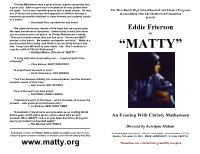
“Christy Mathewson was a great pitcher, a great competitor and a great soul. Both in spirit and in inspiration he was greater than his game. For he was something more than a great pitcher. He was The West Ranch High School Baseball and Theatre Programs one of those rare characters who appealed to millions through a in association with The Mathewson Foundation magnetic personality attached to clean honesty and undying loyalty present to a cause.” — Grantland Rice, sportswriter and friend “We need real heroes, heroes of the heart that we can emulate. Eddie Frierson We need the heroes in ourselves. I believe that is what this show you’ve come to see is all about. In Christy Mathewson’s words, in “Give your friends names they can live up to. Throw your BEST pitches in the ‘pinch.’ Be humble, and gentle, and kind.” Matty is a much-needed force today, and I believe we are lucky to have had him. I hope you will want to come back. I do. And I continue to reap the spirit of Christy Mathewson.” “MATTY” — Kerrigan Mahan, Director of “MATTY” “A lively visit with a fascinating man ... A perfect pitch! Pure virtuosity!” — Clive Barnes, NEW YORK POST “A magnificent trip back in time!” — Keith Olbermann, FOX SPORTS “You’ll be amazed at Matty, his contemporaries, and the dramatic baseball events of their time.” — Bob Costas, NBC SPORTS “One of the year’s ten best plays!” — NATIONAL PUBLIC RADIO “Catches the spirit of the times -- which includes, of course, the present -- with great spirit and theatricality!” -– Ira Berkow, NEW YORK TIMES “Remarkable! This show is as memorable as an exciting World Series game and it wakes up the echoes about why we love An Evening With Christy Mathewson baseball. -

Santa Fe New Mexican, 06-07-1913 New Mexican Printing Company
University of New Mexico UNM Digital Repository Santa Fe New Mexican, 1883-1913 New Mexico Historical Newspapers 6-7-1913 Santa Fe New Mexican, 06-07-1913 New Mexican Printing company Follow this and additional works at: https://digitalrepository.unm.edu/sfnm_news Recommended Citation New Mexican Printing company. "Santa Fe New Mexican, 06-07-1913." (1913). https://digitalrepository.unm.edu/sfnm_news/3818 This Newspaper is brought to you for free and open access by the New Mexico Historical Newspapers at UNM Digital Repository. It has been accepted for inclusion in Santa Fe New Mexican, 1883-1913 by an authorized administrator of UNM Digital Repository. For more information, please contact disc@unm.edu. 1 ! SANTA 2LWWJlaWl V W SANTA FE, NEW MEXICO, SATURDAY, JUNE 7, 191J. JVO. 95 WOULD INVOLVE PRESIDlNT D0RMAN THE SQUEALERS. CONFERENCE OF ! SENDS GREETINGS GOVERNORS THE CHAMBER OF COMMERCE HAS A COMPREHENSIVE FOLDER PRIN- WILSON TED SEND TO THE BROTHERHOOD CLOSES OF AMERICAN YEOMEN, CALLING REPUBLICAN SENATORS STILL INS-SIS- T ATTENTION TO SANTA FE S WILL DRAFT ADDRESS TO PUBLIC THAT PRESIDENT IS USING LAND OFFICE COMMISSIONER MORE INFLUENCE FOR TARIFF TALLMAN AND A. A. JONES PRO-- i If the smoker and lunch given by THAN ANYONE ELSE. MISE HELP OF THE the chamber of commerce brought forth nothing else, the issuing of WILSON IS LOBBYING greetings to the supreme conclave of the Brotherhood of American Yeoman, FOR THE PEOPLE Betting forth some of the facts re- PROSPECTORS WILL garding Santa Fe and its remarkable climate was worth accomplishment. BE ENCOURAGED Washington, D. C, June 7. -

Congressional Record—Senate S2783
March 16, 1999 CONGRESSIONAL RECORD Ð SENATE S2783 RECOGNIZING AND HONORING JOE Mayor Guiliani arranged a parade from consider ourselves extremely lucky for DIMAGGIO the Battery to City Hall. Joe was in knowing such a man, particularly in Mr. COCHRAN. Mr. President, I ask the lead car; I was to follow. As we this age of pampered sports heroes, unanimous consent that the Senate waited to get started, I went up to him, when ego and self-importance often proceed to the immediate consider- introduced myself and told of having overshadow what is occurring on the ation of S. Res. 63, introduced earlier watched him at the Stadium these field. Even I, who resented DiMaggio today by Senators MOYNIHAN, LOTT, many years ago. ``But I have to tell for displacing my hero Gehrig, have and others. you,'' I added, ``Lou Gehrig was my come to realize that there will never be The PRESIDING OFFICER. Without hero.'' another like Joseph Paul DiMaggio. objection, it is so ordered. The clerk ``He was my hero, too,'' said Joe. I ask unanimous consent that the Well, Joe, too, was a hero to many will report. March 9, 1999, New York Times edi- people. Few have embodied the Amer- The bill clerk read as follows:. torial and George F. Will's op-ed in the ican dream or created a more enduring Washington Post on Joe DiMaggio be A resolution (S. Res. 63) recognizing and legend than ``Joltin'' Joe DiMaggio. honoring Joe DiMaggio. printed in the RECORD. And fewer have carried themselves, There being no objection, the mate- The Senate proceeded to consider the both on and off the field, with the pride rial was ordered to be printed in the resolution. -
Fact Or Fiction? Name: Below Is a Biography On
Fact or Fiction? Name: _________________________ Below is a biography on Amelia Earhart. On the following page is a chart with ten statements. Indicate whether each statement is fact or fiction. Bad Behavior George Herman "Babe Ruth" was born February 6, 1895, in Baltimore, Maryland. His parents owned a saloon near the current site of Camden Yards in Baltimore. They were of German descent and taught him to speak German fluently. George was actually somewhat of a petty criminal as a young boy. By age seven he was already involved in drinking alcohol and chewing tobacco. Because he was too difficult for his parents to control, George was sent away to a catholic school. It was here, where Brother Matthias taught him baseball. As a teenager, George became the team's catcher and then pitcher. Unusual Talent At the age of 19 Jack Dunn, a scout for the Orioles discovered George's baseball talents. He was promptly signed to pitch for the Orioles. After performing well as a pitcher and a batter for the Orioles during spring training, George made the team. Because he was such a young talent, he earned the nickname "Babe". On April 22, 1914, Babe pitched a shutout against the Buffalo Bisons in his Major-League debut. Because the Orioles were in poor financial shape, Jack Dunn was forced to sell off his best players. Babe was sold to the Boston Red Sox in 1914 for an amount between $20,000 and $35,000. Called up to the Majors After pitching for the Red Sox minor league club in Providence, Rhode Island, Babe was called up to the majors permanently toward the end of the 1914 baseball season. -

An Analysis of the American Outdoor Sport Facility: Developing an Ideal Type on the Evolution of Professional Baseball and Football Structures
AN ANALYSIS OF THE AMERICAN OUTDOOR SPORT FACILITY: DEVELOPING AN IDEAL TYPE ON THE EVOLUTION OF PROFESSIONAL BASEBALL AND FOOTBALL STRUCTURES DISSERTATION Presented in Partial Fulfillment of the Requirements for the Degree Doctor of Philosophy in the Graduate School of The Ohio State University By Chad S. Seifried, B.S., M.Ed. * * * * * The Ohio State University 2005 Dissertation Committee: Approved by Professor Donna Pastore, Advisor Professor Melvin Adelman _________________________________ Professor Janet Fink Advisor College of Education Copyright by Chad Seifried 2005 ABSTRACT The purpose of this study is to analyze the physical layout of the American baseball and football professional sport facility from 1850 to present and design an ideal-type appropriate for its evolution. Specifically, this study attempts to establish a logical expansion and adaptation of Bale’s Four-Stage Ideal-type on the Evolution of the Modern English Soccer Stadium appropriate for the history of professional baseball and football and that predicts future changes in American sport facilities. In essence, it is the author’s intention to provide a more coherent and comprehensive account of the evolving professional baseball and football sport facility and where it appears to be headed. This investigation concludes eight stages exist concerning the evolution of the professional baseball and football sport facility. Stages one through four primarily appeared before the beginning of the 20th century and existed as temporary structures which were small and cheaply built. Stages five and six materialize as the first permanent professional baseball and football facilities. Stage seven surfaces as a multi-purpose facility which attempted to accommodate both professional football and baseball equally. -

American Hercules: the Creation of Babe Ruth As an American Icon
1 American Hercules: The Creation of Babe Ruth as an American Icon David Leister TC 660H Plan II Honors Program The University of Texas May 10, 2018 H.W. Brands, P.h.D Department of History Supervising Professor Michael Cramer, P.h.D. Department of Advertising and Public Relations Second Reader 2 Table of Contents Abstract……………………………………………………………………………………...Page 3 Introduction………………………………………………………………………………….Page 5 The Dark Ages…………………………………………………………………………..…..Page 7 Ruth Before New York…………………………………………………………………….Page 12 New York 1920………………………………………………………………………….…Page 18 Ruth Arrives………………………………………………………………………………..Page 23 The Making of a Legend…………………………………………………………………...Page 27 Myth Making…………………………………………………………………………….…Page 39 Ruth’s Legacy………………………………………………………………………...……Page 46 Conclusion………………………………………………………………………………….Page 57 Exhibits…………………………………………………………………………………….Page 58 Bibliography……………………………………………………………………………….Page 65 About the Author……………………………………………………………………..……Page 68 3 “When the legend becomes fact, print the legend” -The Man Who Shot Liberty Valance “I swing big, with everything I’ve got. I hit big or I miss big. I like to live as big as I can” -Babe Ruth 4 Abstract Like no other athlete before or since, Babe Ruth’s popularity has endured long after his playing days ended. His name has entered the popular lexicon, where “Ruthian” is a synonym for a superhuman feat, and other greats are referred to as the “Babe Ruth” of their field. Ruth’s name has even been attached to modern players, such as Shohei Ohtani, the Angels rookie known as the “Japanese Babe Ruth”. Ruth’s on field records and off-field antics have entered the realm of legend, and as a result, Ruth is often looked at as a sort of folk-hero. This thesis explains why Ruth is seen this way, and what forces led to the creation of the mythic figure surrounding the man. -

YANKEES at RED SOX
YANKEES at RED SOX 100 YEARS OF THE YANKEES AT FENWAY PARK January 3,1920: The Yankees purchase the contract of Babe Ruth from the Boston Red Sox for $125,000 and a $350,000 loan against the mortgage on Fenway Park . Box Score from First Game September 28, 1923: The Yankees record 30 hits in a 24-4 win over Boston at Fenway at Fenway Park Park… the hit total remains the most in a nine-inning game in Yankees franchise history, April 20, 1912 while the 24 runs mark the second-most ever by the club in a road game and they’re most ever at Fenway Park . September 8, 1925: At Fenway Park, Babe Ruth hits his 300th career home run off Buster Ross in a 7-4 Yankees victory . June 23, 1927: In an 11-4 Yankees win at Fenway Park, Lou Gehrig becomes the first player in franchise history to hit 3HR in a single game against the Red Sox… the feat would be matched by Mark Teixeira on May 8, 2010 at Fenway Park . September 5, 1927: The Yankees lose, 12-11, in 18 innings at Fenway Park in the second- longest road game in franchise history (in terms of innings played)… was the first game of a doubleheader… the Yankees scored two runs in the top of the ninth to send it to extras… both teams scored three runs in the 17th inning… Red Sox pitcher Red Ruffing threw 15 .0 innings in the start . September 24, 1929: At Babe Ruth Day at Fenway Park, the Yankees win, 5-3, with Ruth going 2-for-3 with a double .