(Bombus Vosnesenskii ) in British Columbia
Total Page:16
File Type:pdf, Size:1020Kb
Load more
Recommended publications
-
BCBUA Areas - 2019
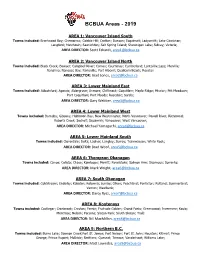
BCBUA Areas - 2019 AREA 1: Vancouver Island South Towns included: Brentwood Bay; Chemainus; Cobble Hill; Crofton; Duncan; Esquimalt; Ladysmith; Lake Cowichan; Langford; Metchosin; Saanichton; Salt Spring Island; Shawnigan Lake; Sidney; Victoria; AREA DIRECTOR: Scott Eckardt, area1@bcbua.ca AREA 2: Vancouver Island North Towns included: Black Creek; Bowser; Campbell River; Comox; Courtenay; Cumberland; Lantzville;Lazo; Merville; Nanaimo; Nanoose Bay; Parksville; Port Alberni; Qualicum Beach; Royston AREA DIRECTOR: Brad Jones, area2@bcbua.ca AREA 3: Lower Mainland East Towns included: Abbotsford; Agassiz; Aldergrove; Anmore; Chilliwack; Coquitlam; Maple Ridge; Mission; Pitt Meadows; Port Coquitlam; Port Moody; Rosedale; Sardis; AREA DIRECTOR: Gary Webber, area3@bcbua.ca AREA 4: Lower Mainland West Towns included: Burnaby; Gibsons; Halfmoon Bay; New Westminster; North Vancouver; Powell River; Richmond; Roberts Creek; Sechelt; Squamish; Vancouver; West Vancouver; AREA DIRECTOR: Michael Yamaguchi, area4@bcbua.ca AREA 5: Lower Mainland South Towns included: Cloverdale; Delta; Ladner; Langley; Surrey; Tsawwassen; White Rock; AREA DIRECTOR: Brad Woof, area5@bcbua.ca AREA 6: Thompson Okanagan Towns included: Canoe; Celista; Chase; Kamloops; Merritt; Revelstoke; Salmon Arm; Sicamous; Sorrento; AREA DIRECTOR: Mark Wright, area6@bcbua.ca AREA 7: South Okanagan Towns included: Coldstream; Enderby; Kaleden; Kelowna; Lumby; Oliver; Peachland; Penticton; Rutland; Summerland; Vernon; Westbank; AREA DIRECTOR: Darcy Rysz, area7@bcbua.ca AREA 8: Kootenays Towns included: Castlegar; Cranbrook; Creston; Fernie; Fruitvale Golden; Grand Forks; Greenwood; Invermere; Kaslo; Montrose; Nelson; Parsons; Slocan Park; South Slocan; Trail; AREA DIRECTOR: Bill MacMillan, area8@bcbua.ca AREA 9: Northern B.C. Towns included: Burns Lake; Dawson Creek;Fort St. James; Fort Nelson; Fort St. John; Houston; Kitimat; Prince George; Prince Rupert; McBride; Smithers; Quesnel; Terrace; Vanderhoof; Williams Lake; AREA DIRECTOR: Matt Lowndes, area9@bcbua.ca . -
Conceptual Design Documentation
Appendix A: Conceptual Design Documentation APPENDIX A Conceptual Design Documentation June 2019 A-1 APPENDIX A: CONCEPTUAL DESIGN DOCUMENTATION The environmental analyses in the NEPA and CEQA documents for the proposed improvements at Oceano County Airport (the Airport) are based on conceptual designs prepared to provide a realistic basis for assessing their environmental consequences. 1. Widen runway from 50 to 60 feet 2. Widen Taxiways A, A-1, A-2, A-3, and A-4 from 20 to 25 feet 3. Relocate segmented circle and wind cone 4. Installation of taxiway edge lighting 5. Installation of hold position signage 6. Installation of a new electrical vault and connections 7. Installation of a pollution control facility (wash rack) CIVIL ENGINEERING CALCULATIONS The purpose of this conceptual design effort is to identify the amount of impervious surface, grading (cut and fill) and drainage implications of the projects identified above. The conceptual design calculations detailed in the following figures indicate that Projects 1 and 2, widening the runways and taxiways would increase the total amount of impervious surface on the Airport by 32,016 square feet, or 0.73 acres; a 6.6 percent increase in the Airport’s impervious surface area. Drainage patterns would remain the same as both the runway and taxiways would continue to sheet flow from their centerlines to the edge of pavement and then into open, grassed areas. The existing drainage system is able to accommodate the modest increase in stormwater runoff that would occur, particularly as soil conditions on the Airport are conducive to infiltration. Figure A-1 shows the locations of the seven projects incorporated in the Proposed Action. -
Community Plan
TOWN OF LAKE COWICHAN OFFICIAL COMMUNITY PLAN Bylaw No. 910-2011 A Bylaw to adopt the Official Community Plan. WHEREAS Section 876 of the Local Government Act provides that a local government may adopt and amend one or more official community plans to guide decisions on planning and land use management; AND WHEREAS Section 875 of the Local Government Act provides that a local government may have a community plan prepared or revised and such plans shall be expressed in writing and my include plans, maps, tables or other graphic material and shall include statements and map designations for the area covered by the plan; AND WHEREAS In accordance with the Local Government Act, the Council has undertaken the necessary consultations and other steps required for the adoption of the new official community plan.; NOW THEREFORE, the Council of the Town of Lake Cowichan in open meeting assembled enacts as follows: 1. This bylaw may be cited for all purposes as “Town of Lake Cowichan Official Community Plan Bylaw No. 910-2011”. 2. For the purpose of expressing the policies for the development of the Town of Lake Cowichan, the Municipal Council hereby adopts the Town of Lake Cowichan Official Community Plan and the plan maps and appendices, marked Schedule “A”, which shall be an integral part of this bylaw. 3. If any section, subsection, sentence, clause or phrase contained within this bylaw is, for any reason, held to be invalid by the decision of any Court of competent jurisdiction, the invalid portion shall be severed and the decision that it is invalid shall not affect the validity of the remainder of the bylaw. -
A Sustainable Development Strategy for the District of Sooke – July 2008
A SSUSTAINABLE DDEVELOPMENT SSTRATEGY FOR THE DDISTRICT OF SSOOKE TABLE OF CONTENTS Introduction.................................................................................................... 3 A COMMUNITY AT A THRESHOLD OF THE 21ST CENTURY.................................................. 3 THE ROLE OF THIS STRATEGY .......................................................................................... 4 CONTROL OVER CHANGE................................................................................................... 5 EIGHT PILLARS OF SUSTAINABLE DEVELOPMENT............................................................. 5 CREATING THIS STRATEGY................................................................................................ 5 A SHARED VISION FOR A SUSTAINABLE FUTURE.............................................................. 6 PRIORITIES......................................................................................................................... 6 Strategy #1: Create neighbourhood centres and a downtown waterfront that are compact and complete.................................................................... 8 Strategy #2: Develop a transportation system that provides viable opportunities for non-automobile transportation and transit use. ......... 11 Strategy #3: Support low-impact, energy-efficient, healthy buildings in which to live, work and play. ...................................................................... 15 Strategy #4: Celebrate cultural and ecological assets through the management -

Global Trends in Bumble Bee Health
EN65CH11_Cameron ARjats.cls December 18, 2019 20:52 Annual Review of Entomology Global Trends in Bumble Bee Health Sydney A. Cameron1,∗ and Ben M. Sadd2 1Department of Entomology, University of Illinois, Urbana, Illinois 61801, USA; email: sacamero@illinois.edu 2School of Biological Sciences, Illinois State University, Normal, Illinois 61790, USA; email: bmsadd@ilstu.edu Annu. Rev. Entomol. 2020. 65:209–32 Keywords First published as a Review in Advance on Bombus, pollinator, status, decline, conservation, neonicotinoids, pathogens October 14, 2019 The Annual Review of Entomology is online at Abstract ento.annualreviews.org Bumble bees (Bombus) are unusually important pollinators, with approx- https://doi.org/10.1146/annurev-ento-011118- imately 260 wild species native to all biogeographic regions except sub- 111847 Saharan Africa, Australia, and New Zealand. As they are vitally important in Copyright © 2020 by Annual Reviews. natural ecosystems and to agricultural food production globally, the increase Annu. Rev. Entomol. 2020.65:209-232. Downloaded from www.annualreviews.org All rights reserved in reports of declining distribution and abundance over the past decade ∗ Corresponding author has led to an explosion of interest in bumble bee population decline. We Access provided by University of Illinois - Urbana Champaign on 02/11/20. For personal use only. summarize data on the threat status of wild bumble bee species across bio- geographic regions, underscoring regions lacking assessment data. Focusing on data-rich studies, we also synthesize recent research on potential causes of population declines. There is evidence that habitat loss, changing climate, pathogen transmission, invasion of nonnative species, and pesticides, oper- ating individually and in combination, negatively impact bumble bee health, and that effects may depend on species and locality. -

In Northeastern Oregon
Northwest Science Notes The purpose of Notes is to publish papers typically less than five pages long. No specific format or content is required for articles published as Notes, but all will be peer-reviewed and must be scientifically credible. Authors may contact the Editor about the suitability of manuscripts for this section. Sujaya Rao1, William P. Stephen, Department of Crop and Soil Science, Oregon State University, Corvallis, Oregon 97331 Chiho Kimoto, Department of Fisheries and Wildlife, Oregon State University, Corvallis, Oregon 97331 and Sandra J. DeBano, Department of Fisheries and Wildlife, Hermiston Agricultural Research and Extension Center, Oregon State University, Hermiston, Oregon 97838. The Status of the ‘Red-Listed’ Bombus occidentalis (Hymenoptera: Apiformes) in Northeastern Oregon Abstract The western bumble bee, Bombus occidentalis, is included on the red list of bees by The Xerces Society. It was once a common bumble bee west of the Cascades but in the late 1990s it experienced a dramatic decline along coastal regions. The cause was speculated to be due to the introduction of pathogens from captive-bred bumble bees used for pollination of greenhouse crops. In extensive surveys conducted in western and southern Oregon, 10 individuals have been recorded since 2000. In this note, we report the collection of 49 individual B. occidentalis over two years in the Zumwalt Prairie Preserve of northeastern Oregon. This finding shows that B. occidentalis persists in northeastern regions of the Pacific Northwest, either because of geographic isolation from or potential resistance to the pathogens that decimated populations in the western part of the region. Further research is needed to determine its occurrence in other regions of its historical range to assess the extent of its decline. -

Cowichan Valley Trail Brochure (2021)
FLIP FOR MAP FOR FLIP treaded tires are highly recommended. recommended. highly are tires treaded Kinsol Trestle. Surface conditions vary so cyclists should note that that note should cyclists so vary conditions Surface Trestle. Kinsol reconnects with your start point in Duncan. Duncan. in point start your with reconnects south through forests and rural farmland before arriving at the Historic Historic the at arriving before farmland rural and forests through south Ganges. Catch another ferry from Vesuvius to Crofton and a short ride ride short a and Crofton to Vesuvius from ferry another Catch Ganges. Glenora Trails Head Park on Robertson Road. The trail route travels travels route trail The Road. Robertson on Park Head Trails Glenora from Swartz Bay, the route meanders along roads to the village of of village the to roads along meanders route the Bay, Swartz from This popular cycling and equestrian route starts and finishes at at finishes and starts route equestrian and cycling popular This Difficulty: Difficulty: Saanich Peninsula. After a quick ferry connection to Saltspring Island Island Saltspring to connection ferry quick a After Peninsula. Saanich Easy Distance: Distance: before connecting with the Lochside Trail and heading north up the the up north heading and Trail Lochside the with connecting before 26 km return km 26 ROUTE B — Glenora Trails Head Park to Kinsol Trestle Kinsol to Park Head Trails Glenora — B ROUTE route continues on the Galloping Goose Regional Trail into Victoria Victoria into Trail Regional Goose Galloping the on continues route dropping into Langford, along the Sooke Hills Wilderness Trail. The The Trail. -

The Western Bumble Bee Was Once Commonly Found N R in the Western United States and Canada
Thanks to Dr. Robbin Thorp, UC Davis. UC Thorp, Robbin Dr. to Thanks Guide developed and illustrated by Elaine Evans, The Xerces Society. Xerces The Evans, Elaine by illustrated and developed Guide Bombus appositus Bombus Bombus morrisoni Bombus Funding for bumble bee conservation provided by the CS Fund. CS the by provided conservation bee bumble for Funding Bombus melanopygus Bombus Bombus bifarius Bombus Visit www.xerces.org/bumblebees for more information. more for www.xerces.org/bumblebees Visit Bombus occidentalis Bombus , please contact bumblebees@xerces.org contact please , find you If FOR INVERTEBRATE CONSERVATION INVERTEBRATE FOR S X T OCIETY ERCES HE B. occidentalis B. populations. remaining will use this information to promote conservation of of conservation promote to information this use will www.xerces.org/bumblebees Society and scientists studying bumble bee decline decline bee bumble studying scientists and Society will help document their current range. The Xerces Xerces The range. current their document help will P h o in recent years. Your efforts to search for this bee bee this for search to efforts Your years. recent in t o b y D e Found in the mountains and northern areas northern and mountains the in Found r Columbia to central California have nearly disappeared disappeared nearly have California central to Columbia r Bombus huntii Bombus mixtus Bombus i c k D historic range, but populations from southern British British southern from populations but range, historic i t c h still be found in northern and eastern parts of their their of parts eastern and northern in found be still b u United States and Canada. -

DIRECTORS & ALTERNATES Drafted: January 15, 2008
COWICHAN VALLEY REGIONAL DISTRICT 2008 BOARD OF DIRECTORS & ALTERNATES Drafted: January 15, 2008 City of Duncan KENT, Phil Res: 732-4009 CADORETTE, Ray 748-7066 c/o: Box 820 City Hall: 746-6126 2897 Philip Street Duncan, BC V9L 3Y2 Duncan, BC V9L 2A6 District of LEFEBURE, Jon Mun. Hall: 746-3122 HAYWOOD, Dave 748-7585 North Cowichan 10029 Beach Drive Res: 246-2636 6260 Lower Chippewa Chemainus, BC V0R 1K1lefebure@northcowichan.bc.ca Duncan, BC V9L 5P9 District of HARTMANN, Ruth Res: 748-7775 MURRAY, Anne cell: 710-0920 1055 Herd Road North Cowichan Mun. Hall: 746-3100 hartcouncil@cvrd.bc.ca Duncan, BC V9L 5W9 District of SEYMOUR, George Res: 746-0920 HAILEY, Melissa 715-0080 1885 Sandra Place North Cowichan 6529 Genoa Bay Road Duncan, BC V9L 5Y3 info@georgeseymour.ca Duncan, BC V9L 5A4 Town of HUTCHINS, Robert Town Hall: 245-6403 CHRISTENSON, Jan 245-7380 Ladysmith c/o Town of Ladysmith, PO Box 220, Stn. Main Fax: 245-6411 378 Dogwood Driver Ladysmith, BC V9G 1A2 rhutchins@shaw.ca Ladysmith, BC V9G 1T7 Town of PEAKE, Jack Chair Office: 746-2500 FOSTER, Pat 749-3730 Lake Cowichan c/o Town of Lake Cowichan, PO Box 860 Town Hall: 749-6681 PO Box 81 Lake Cowichan, BC VOR 2GO chairperson@cvrd.bc.ca Res: 749-6178 Lake Cowichan, BC V0R 2G0 jpeake@town.lakecowichan.bc.ca Area A WALKER, Mike Res: 743-6727 HARRISON, Brian 743-2244 Bus: 748-7545 767 Frayne Road Mill Bay / Malahat 2424 Huckleberry Road Mill Bay, BC V0R 2P4 md.walker@shaw.ca Bus Fax: 748-7525 Mill Bay, BC V0R 2P4 Area B COSSEY, Ken Bus: 743-1336 DHEENSAW, Terry 743-9949 Shawnigan -

The Conservation Status of Bumble Bees of Canada, the USA, and Mexico
The Conservation Status of Bumble Bees of Canada, the USA, and Mexico Scott Hoffman Black, Rich Hatfield, Sarina Jepsen, Sheila Colla and Rémy Vandame Photo: Clay Bolt Importance of Bumble Bees There are 57 bumble bee species in Canada, US and Mexico. Hunt’s bumble bee; Bombus huntii , Photo: Clay Bolt Importance of Bumble Bees Important pollinator of many crops. Bombus sandersoni , Sanderson’s bumble bee Photo: Clay Bolt Importance of Bumble Bees Keystone pollinator in ecosystems. Yelllowheaded bumble bee, Bombus flavifrons Photo: Clay Bolt Bumble Bee Extinction Risk Assessment Network of 75+ bumble bee experts & specialists worldwide Goal: global bumble bee extinction risk assessment using consistent criteria Bumble Bee Extinction Risk Assessment IUCN Red List Criteria for Evaluating Extinction Risk • Used a database of 250,000+ specimen records (created from multiple data providers and compiled by Leif Richardson for Bumble Bees of North America) • Evaluate changes between recent (2002-2012) and historic (pre-2002): • Range (Extent of Occurrence) • Relative abundance • Persistence (50 km x 50 km grid cell occupancy) Sources: Hatfield et al. 2015 Bumble Bee Extinction Risk Assessment IUCN Red List Criteria for Evaluating Extinction Risk • Analyses informed application of Red List Categories; BBSG members provided review • This method was then adapted applied to South American and Mesoamerican bumble bees. Sources: Hatfield et al. 2015 Bumble Bee Extinction Risk Assessment Trilateral Region 6 4 5 28% of bumble bees Critically Endangered in Canada, the Endangered United States, and 7 Vulnerable Mexico are in an IUCN Threatened Near Threatened Category Least Concern 3 Data Deficient 32 Sources: Hatfield et al. -
Floral Resource Competition Between Honey Bees and Wild Bees: Is There Clear Evidence and Can We Guide Management and Conservation?
See discussions, stats, and author profiles for this publication at: https://www.researchgate.net/publication/325627761 Floral Resource Competition Between Honey Bees and Wild Bees: Is There Clear Evidence and Can We Guide Management and Conservation? Article in Environmental Entomology · June 2018 DOI: 10.1093/ee/nvy077 CITATIONS READS 12 603 4 authors, including: Victoria Wojcik Pollinator Partnership 11 PUBLICATIONS 72 CITATIONS SEE PROFILE All content following this page was uploaded by Victoria Wojcik on 19 June 2018. The user has requested enhancement of the downloaded file. Environmental Entomology, XX(X), 2018, 1–12 doi: 10.1093/ee/nvy077 Pollinator Ecology and Management Review Floral Resource Competition Between Honey Bees and Wild Bees: Is There Clear Evidence and Can We Guide Management and Conservation? Victoria A. Wojcik,1 Lora A. Morandin, Laurie Davies Adams, and Kelly E. Rourke Pollinator Partnership, 423 Washington Street, 5th floor, San Francisco, CA 94111, and 1Corresponding author, e-mail: vw@pollinator.org Subject Editor: Gloria DeGrandi-Hoffman Received 31 October 2017; Editorial decision 2 May 2018 Abstract Supporting managed honey bees by pasturing in natural landscapes has come under review due to concerns that honey bees could negatively impact the survival of wild bees through competition for floral resources. Critique and assessment of the existing body of published literature against our criteria focussing on studies that can support best management resulted in 19 experimental papers. Indirect measures of competition examining foraging patterns and behavior yielded equivocal results. Direct measures of reproduction and growth were investigated in only seven studies, with six indicating negative impacts to wild bees from the presence of managed honey bees. -

An Abstract of the Thesis Of
AN ABSTRACT OF THE THESIS OF Sarah A. Maxfield-Taylor for the degree of Master of Science in Entomology presented on March 26, 2014. Title: Natural Enemies of Native Bumble Bees (Hymenoptera: Apidae) in Western Oregon Abstract approved: _____________________________________________ Sujaya U. Rao Bumble bees (Hymenoptera: Apidae) are important native pollinators in wild and agricultural systems, and are one of the few groups of native bees commercially bred for use in the pollination of a range of crops. In recent years, declines in bumble bees have been reported globally. One factor implicated in these declines, believed to affect bumble bee colonies in the wild and during rearing, is natural enemies. A diversity of fungi, protozoa, nematodes, and parasitoids has been reported to affect bumble bees, to varying extents, in different parts of the world. In contrast to reports of decline elsewhere, bumble bees have been thriving in Oregon on the West Coast of the U.S.A.. In particular, the agriculturally rich Willamette Valley in the western part of the state appears to be fostering several species. Little is known, however, about the natural enemies of bumble bees in this region. The objectives of this thesis were to: (1) identify pathogens and parasites in (a) bumble bees from the wild, and (b) bumble bees reared in captivity and (2) examine the effects of disease on bee hosts. Bumble bee queens and workers were collected from diverse locations in the Willamette Valley, in spring and summer. Bombus mixtus, Bombus nevadensis, and Bombus vosnesenskii collected from the wild were dissected and examined for pathogens and parasites, and these organisms were identified using morphological and molecular characteristics.