Quaderno Culturale
Total Page:16
File Type:pdf, Size:1020Kb
Load more
Recommended publications
-

It 2.007 Vc Italian Films On
1 UW-Madison Learning Support Services Van Hise Hall - Room 274 rev. May 3, 2019 SET CALL NUMBER: IT 2.007 VC ITALIAN FILMS ON VIDEO, (Various distributors, 1986-1989) TYPE OF PROGRAM: Italian culture and civilization; Films DESCRIPTION: A series of classic Italian films either produced in Italy, directed by Italian directors, or on Italian subjects. Most are subtitled in English. Individual times are given for each videocassette. VIDEOTAPES ARE FOR RESERVE USE IN THE MEDIA LIBRARY ONLY -- Instructors may check them out for up to 24 hours for previewing purposes or to show them in class. See the Media Catalog for film series in other languages. AUDIENCE: Students of Italian, Italian literature, Italian film FORMAT: VHS; NTSC; DVD CONTENTS CALL NUMBER Il 7 e l’8 IT2.007.151 Italy. 90 min. DVD, requires region free player. In Italian. Ficarra & Picone. 8 1/2 IT2.007.013 1963. Italian with English subtitles. 138 min. B/W. VHS or DVD.Directed by Frederico Fellini, with Marcello Mastroianni. Fellini's semi- autobiographical masterpiece. Portrayal of a film director during the course of making a film and finding himself trapped by his fears and insecurities. 1900 (Novocento) IT2.007.131 1977. Italy. DVD. In Italian w/English subtitles. 315 min. Directed by Bernardo Bertolucci. With Robert De niro, Gerard Depardieu, Burt Lancaster and Donald Sutherland. Epic about friendship and war in Italy. Accattone IT2.007.053 Italy. 1961. Italian with English subtitles. 100 min. B/W. VHS or DVD. Directed by Pier Paolo Pasolini. Pasolini's first feature film. In the slums of Rome, Accattone "The Sponger" lives off the earnings of a prostitute. -

9 Nicola Longo, Per Andrea Gareffi 11
INDICE Rino Caputo, Habent sua fata libelli, ancora una volta! 9 Nicola Longo, Per Andrea Gareffi 11 IN PROSA E IN VERSI Eraldo Affinati, Ipatti dell'abisso 17 Edoardo Albinati, Sulle rovine 23 Claudio Damiani, Ad Andrea Gareffi, vero maestro 29 Milo De Angelis, Nella notte umana 31 Eugenio De Signoribus, All'amico distante 33 Paolo Febbraro, Sisifo 37 Marco Lodoli, Ilfreddo 39 Marco Lucchesi, Fiera trasparenza 41 Dante Maffia, Urbe 45 Valerio Magrelli, Le pastorelle pornografiche: divertimento alla maniera di Watteau 49 l'Iio Pecora, Ad Andrea Gareffi 51 Alessandro Piperno, Per Andrea G. L'inizio di un romando che non pubblicherò mai 53 Aurelio Picca, Andrea Gareffi è 61 Andrés Sànchez Robayna, En la tumba de Stéphane ÌAallarmé 65 STUDI Nicola Longo, Inferno, II, 88-89: «temer si dee di sole quelle cose / c'hannopotenza difare altrui male / de l'altre no ché non sonpaurose» 69 Luigi Surdich, L'ombra di Dante e le ombre dei peccatori 87 6 Indice Marco Ariani, Metafore della luce e mistica imperiale nella Monarchia di Dante Ili Carmen F. Bianco Valdés, Ì.M epifania amorosa en las Rimas de Giovanni Boccaccio ! 143 Marcello Ciccuto, Momo fra i libri di Alberti e Facio 159 Arnaldo Bruni, Per il teatro di Machiavelli: ragioni della scrittura e lascito alla modernità 169 Paolo Procaccioli, Da novella a exemplum a inciso. Nota sui destini testuali del Grasso legnaiuolo tra Quattro e Cinquecento 181 Tommaso Mozzati, Fe Cene del Lasca, il party più esclusivo. La traditone festiva a Firenze nel Cinquecento, tra allestimenti d'artista e memorie letterarie 197 Gian Mario Anselmi, Francesco Guicciardini tra storiografia, narra zione ed esperienza politica 221 Pasquale Guaragnella, Proverbi e sentente ne Lo Cunto de li cunti di Giambattista Basile 231 ; Guido Baldassarri, Vincenzo Monti e II Bardo della Selva Nera 257 Vincenzo De Caprio, Ossian, Acerbi e un 'immagine della Finlandia 293 Rino Caputo, Dello svolgimento del Risorgimento italiano: dalla lettera tura per la storia : 313 Gianni Venturi, Ah!.. -
![Vérité Intime / Mia Madre De Nanni Moretti]](https://docslib.b-cdn.net/cover/7601/v%C3%A9rit%C3%A9-intime-mia-madre-de-nanni-moretti-147601.webp)
Vérité Intime / Mia Madre De Nanni Moretti]
Document generated on 09/27/2021 7:16 p.m. Ciné-Bulles Vérité intime Mia Madre de Nanni Moretti Frédéric Bouchard Dossier Diffusion du cinéma d’auteur Volume 34, Number 3, Summer 2016 URI: https://id.erudit.org/iderudit/82723ac See table of contents Publisher(s) Association des cinémas parallèles du Québec ISSN 0820-8921 (print) 1923-3221 (digital) Explore this journal Cite this review Bouchard, F. (2016). Review of [Vérité intime / Mia Madre de Nanni Moretti]. Ciné-Bulles, 34(3), 49–49. Tous droits réservés © Association des cinémas parallèles du Québec, 2016 This document is protected by copyright law. Use of the services of Érudit (including reproduction) is subject to its terms and conditions, which can be viewed online. https://apropos.erudit.org/en/users/policy-on-use/ This article is disseminated and preserved by Érudit. Érudit is a non-profit inter-university consortium of the Université de Montréal, Université Laval, and the Université du Québec à Montréal. Its mission is to promote and disseminate research. https://www.erudit.org/en/ CRITIQUES même s’il frôle la satire, n’est qu’un prétexte pour mieux exposer la sensibilité de Moretti. À l’évidence, lorsque Huggins révèle son triste secret à Margherita, c’est un sentiment de compassion et d’empathie qui se développe chez elle à l’égard du capricieux comédien. Bien que moins bouleversant que La Chambre du fils (2001), où la perte du fils bousculait profondément l’unité familiale, Mia Madre parvient néanmoins à toucher et à imprégner les esprits. La conclusion, lumineuse, effectue un beau travail de mémoire en célébrant la carrière d’ensei Mia Madre gnante de la mère de Margherita à travers de Nanni Moretti les témoignages d’anciens élèves. -
Tmgm1de3.Pdf
Melissa G. Moyer ANALYSIS OF CODE-SWITCHING IN GIBRALTAR Tesi doctoral dirigida per la Dra. Aránzazu Usandizaga Departament de Filologia Anglesa i de Germanística Universitat Autònoma de Barcelona 1992 To Jesús, Carol, and Robert ACKNOWLEDGMENTS The ¡dea of studying Gibraltar was first suggested to me by José Manuel Blecua in 1987 when I returned from completing a master's degree in Linguistics at Stanford University. The summer of that year I went back to California and after extensive library searches on language and Gibraltar, I discovered that little was known about the linguistic situation on "The Rock". The topic at that point had turned into a challenge for me. I immediately became impatient to find out whether it was really true that Gibraltarians spoke "a funny kind of English" with an Andalusian accent. It was José Manuel Blecua's excellent foresight and his helpful guidance throughout all stages of the fieldwork, writing, and revision that has made this dissertation possible. Another person without whom this dissertation would not have been completed is Aránzazu (Arancha) Usandizaga. As the official director she has pressured me when I've needed pressure, but she has also known when to adopt the role of a patient adviser. Her support and encouragement are much appreciated. I am also grateful to the English Department at the Universitat Autònoma de Barcelona chaired by Aránzazu Usandizaga and Andrew Monnickendam who granted me several short leaves from my teaching obligations in order to carry out the fieldwork on which this research is based. The rest of the English Department gang has provided support and shown their concern at all stages. -

The Troubadours
The Troubadours H.J. Chaytor The Project Gutenberg EBook of The Troubadours, by H.J. Chaytor This eBook is for the use of anyone anywhere at no cost and with almost no restrictions whatsoever. You may copy it, give it away or re-use it under the terms of the Project Gutenberg License included with this eBook or online at www.gutenberg.net Title: The Troubadours Author: H.J. Chaytor Release Date: May 27, 2004 [EBook #12456] Language: English and French Character set encoding: ASCII *** START OF THIS PROJECT GUTENBERG EBOOK THE TROUBADOURS *** Produced by Ted Garvin, Renald Levesque and the Online Distributed Proofreading Team. THE TROUBADOURS BY REV. H.J. CHAYTOR, M.A. AUTHOR OF "THE TROUBADOURS OF DANTE" ETC. Cambridge: at the University Press 1912 _With the exception of the coat of arms at the foot, the design on the title page is a reproduction of one used by the earliest known Cambridge printer, John Siberch, 1521_ PREFACE This book, it is hoped, may serve as an introduction to the literature of the Troubadours for readers who have no detailed or scientific knowledge of the subject. I have, therefore, chosen for treatment the Troubadours who are most famous or who display characteristics useful for the purpose of this book. Students who desire to pursue the subject will find further help in the works mentioned in the bibliography. The latter does not profess to be exhaustive, but I hope nothing of real importance has been omitted. H.J. CHAYTOR. THE COLLEGE, PLYMOUTH, March 1912. CONTENTS PREFACE CHAP. I. INTRODUCTORY II. -

Ein Film Von NANNI MORETTI MIT MARGHERITA
Ein Film von NANNI MORETTI MIT MARGHERITA BUY - JOHN TURTURRO GIULIA LAZZARINI - NANNI MORETTI BEATRICE MANCINI AB 17. DEZEMBER IM KINO 2 Dauer: 106 min Presse: http://www.frenetic.ch/espace-pro/details//++/id/969 Pressebetreuung DISTRIBUTION Rike Radtke FRENETIC FILMS prochaine sa Bachstrasse 9 • 8038 Zürich Tel. 044 488 44 24 Tel. 044 488 44 00 • Fax 044 488 44 11 rike.radtke@prochaine.ch www.frenetic.ch SYNOPSIS Margherita hat es nicht leicht. Während sie sich um ihre alte Mutter Sorgen macht, muss sie als Regisseurin am Set ihres neusten Films ihre Autorität behaupten. Sie plagt sich mit den Launen des extra aus den USA eingeflogenen Hauptdarstellers (John Turturro) herum, wird von der pubertierenden Tochter vor den Kopf gestossen und ihr Bruder, gespielt von Nanni Moretti, ist mit seinen gut gemeinten, aber unnötigen Ratschlägen auch nicht immer die grosse Hilfe. GESPRÄCH MIT NANNI MORETTI Ist die von Margherita Buy in MIA MADRE gespielte Figur Ihr Double? Ich habe nie daran gedacht, die Hauptrolle meines Filmes zu spielen. Ich mache das schon seit einiger Zeit nicht mehr und ich bin auch froh darüber. Früher amüsierte es mich, heute habe ich nicht mehr die fixe Idee, meine Figur in jedem Film zu konstruieren. Ich habe immer eine Frau und eine Regisseurin vor Augen gehabt. Und dass diese Frau von Margherita Buy gespielt werden musste, hat einen einfachen Grund: Ein Film mit Margherita Buy in der Hauptrolle wird besser sein als einer mit mir in der Hauptrolle… Sie spielt viel besser als ich! Margherita hat das ganze Gewicht der Arbeit auf ihren Schultern getragen: Bei 70 Drehtagen war sie nur einen Tag abwesend – für eine Szene, die ich schliesslich wegeschnitten habe. -

Cahiers D'études Italiennes, 32 | 2021
Cahiers d’études italiennes 32 | 2021 Femmes aux multiples talents : entre littérature et d’autres pratiques intellectuelles et artistiques Anna Banti da «Paragone» all’«Approdo letterario». Venticinque anni di critica cinematografica d’autrice Anna Banti de « Paragone » à « L’Approdo letterario ». Vingt‑cinq ans de critique cinématographique d’auteure Anna Banti from “Paragone” to “L’Approdo letterario”. Twenty‑Five Years of Female Cinematographic Criticism Sara Da Ronch Edizione digitale URL: https://journals.openedition.org/cei/8897 DOI: 10.4000/cei.8897 ISSN: 2260-779X Editore UGA Éditions/Université Grenoble Alpes Edizione cartacea ISBN: 978-2-37747-257-4 ISSN: 1770-9571 Notizia bibliografica digitale Sara Da Ronch, «Anna Banti da «Paragone» all’«Approdo letterario». Venticinque anni di critica cinematografica d’autrice», Cahiers d’études italiennes [Online], 32 | 2021, online dal 01 mars 2021, consultato il 16 septembre 2021. URL: http://journals.openedition.org/cei/8897 ; DOI: https://doi.org/ 10.4000/cei.8897 Questo documento è stato generato automaticamente il 16 septembre 2021. © ELLUG Anna Banti da «Paragone» all’«Approdo letterario». Venticinque anni di critic... 1 Anna Banti da «Paragone» all’«Approdo letterario». Venticinque anni di critica cinematografica d’autrice Anna Banti de « Paragone » à « L’Approdo letterario ». Vingt‑cinq ans de critique cinématographique d’auteure Anna Banti from “Paragone” to “L’Approdo letterario”. Twenty‑Five Years of Female Cinematographic Criticism Sara Da Ronch 1. Introduzione 1 La rivalutazione del ruolo dell’intellettualità femminile all’interno della tradizione letteraria italiana è una tendenza in atto già da alcuni decenni, specie per quanto riguarda un secolo così vivo e fecondo qual è stato il Novecento. -
On the Source of the Infinitive in Romance-Derived Pidgins and Creoles
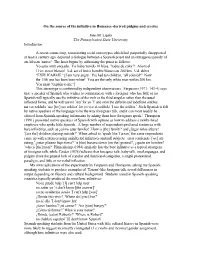
On the source of the infinitive in Romance-derived pidgins and creoles John M. Lipski The Pennsylvania State University Introduction A recent comic strip, resuscitating racial stereotypes which had purportedly disappeared at least a century ago, depicted a dialogue between a Spanish priest and an outrageous parody of an African `native.' The latter begins by addressing the priest as follows: Yo estar muy enojado. Yo haber tenido 10 hijos, "todos de color"! Ahora el 11vo. nacer blanco! Ud. ser el único hombre blanco en 200 km. Ud. deber "EXPLICARME." [I am very angry. I've had ten children, "all colored!" Now the 11th one has been born white! You are the only white man within 200 km. You must "explain to me."] This stereotype is confirmed by independent observations. Ferguson (1971: 143-4) says that `a speaker of Spanish who wishes to communicate with a foreigner who has little or no Spanish will typically use the infinitive of the verb or the third singular rather than the usual inflected forms, and he will use mi `my' for yo `I' and omit the definite and indefinite articles: mi ver soldado `me [to-] see soldier' for yo veo al soldado `I see the soldier.' Such Spanish is felt by native speakers of the language to be the way foreigners talk, and it can most readily be elicited from Spanish-speaking informants by asking them how foreigners speak.' Thompson (1991) presented native speakers of Spanish with options as how to address a newly-hired employee who spoke little Spanish. A large number of respondents preferred sentences with bare -

Vita Da Strega Gli Anni D’Oro Del Premio, Nel Racconto Fotografico Di Carlo Riccardi
MUSEO NAZIONALE ETRUSCO DI VILLA GIULIA Vita da Strega Gli anni d’oro del Premio, nel racconto fotografico di Carlo Riccardi Anteprima dal 29 giugno 2018 – In mostra dal 7 luglio al 30 settembre 2018 Museo Nazionale Etrusco di Villa Giulia Piazzale di Villa Giulia, 9 – Roma Le storie e i personaggi del Premio Strega nelle foto dell’Archivio Riccardi per la prima volta rivivono al Museo Nazionale Etrusco di Villa Giulia, la storica sede della finale della prestigiosa competizione. Un pezzo di vita italiana, un pezzo della vita culturale italiana, che anno dopo anno, dal 1947, vede in campo i maggiori scrittori italiani: è il Premio Strega. E “Vita da Strega” è l’evento che svela la storia del riconoscimento letterario italiano più ambito attraverso le straordinarie foto, alcune inedite, dell’Archivio Riccardi. Indirizzo: Piazzale di Villa Giulia, 9 - 00196 – Roma tel. +39 06 3226571; fax +39 06 3202010 Mail e sito web: mn-etru.comunicazione@beniculturali.it; www.villagiulia.beniculturali.it Orario: dal martedì alla domenica 9.00 - 20.00, lunedì chiuso. Ticket: intero € 8,00; ridotto € 4,00; Abbonamento per ingressi illimitati da 3 mesi (intero € 12,00; ridotto: € 6,00), 6 mesi (intero € 16,00; ridotto: € 8,00); 12 mesi (intero € 24,00; ridotto: € 12,00). GRATUITO per gli aventi diritto e per tutti LA PRIMA DOMENICA DEL MESE @VillaGiuliaRm museoetruscovillagiulia Etruschannel Clicca sui loghi per accedere direttamente ai nostri canali social MUSEO NAZIONALE ETRUSCO DI VILLA GIULIA L’appuntamento è fissato all’interno della Sala della Fortuna, al Museo Nazionale Etrusco di Villa Giulia, Piazzale di Villa Giulia, 9 a Roma, venerdì 29 giugno dalle ore 10.00. -

Cultura I Forum Dell'espresso
01/07/2018 diffusione:236776 Pag. 82 N.27 - 1 luglio 2018 tiratura:348760 La proprietà intellettuale è riconducibile alla fonte specificata in testa pagina. Il ritaglio stampa da intendersi per uso privato Cultura I forum dell’Espresso 01/07/2018 diffusione:236776 Pag. 82 N.27 - 1 luglio 2018 tiratura:348760 La proprietà intellettuale è riconducibile alla fonte specificata in testa pagina. Il ritaglio stampa da intendersi per uso privato Illustrazione di Ettore Viola Caccia allo a cura di SABINA MINARDI foto di Augusto Casasoli Il capolavoro che non c’è. Lo strapotere dei grandi editori. Le alleanze per vincere, alla vigilia del più prestigioso, e feroce, premio letterario. Specchio dell’Italia L’Espresso 1 luglio 2018 83 01/07/2018 diffusione:236776 Pag. 82 N.27 - 1 luglio 2018 tiratura:348760 La proprietà intellettuale è riconducibile alla fonte specificata in testa pagina. Il ritaglio stampa da intendersi per uso privato Cultura I forum dell’Espresso ome sta l’editoria italiana? Abbiamo utilizzato la finale del premio Strega per parlarne, e per discutere dei libri in gara e di ciò C che rappresentano in questa esta- te 2018: non certo una stagione qualunque, ma un tempo molto particolare dal pun- to di vista politico, sociale, civile. Con la scrittrice Elvira Seminara, il critico Alberto Asor Rosa, lo scrittore Paolo Di Paolo, l’editore Gian Arturo Fer- rari, per anni al vertice del Gruppo Mondadori, interlocutori non direttamente coin- che di gruppo o di casa editrice?), tra che ci sia un percorso di riappropriazione volti nella sfida, alla vigilia del più pre- giurati di lungo corso che storcono il di anni di fragilità a noi prossimi. -

Italian-Spanish Contact in Early 20Th Century Argentina
Ennis, Juan Antonio Italian-Spanish Contact in Early 20th Century Argentina Journal of language contact 2015, vol. 8, nro. 1, p. 112-145 Ennis, J. (2015). Italian-Spanish Contact in Early 20th Century Argentina. Journal of language contact, 8 (1), 112-145. En Memoria Académica. Disponible en: http://www.memoria.fahce.unlp.edu.ar/art_revistas/pr.9987/pr.9987.pdf Información adicional en www.memoria.fahce.unlp.edu.ar Esta obra está bajo una Licencia Creative Commons Atribución-NoComercial 4.0 Internacional https://creativecommons.org/licenses/by-nc/4.0/ journal of language contact 8 (2015) 112-145 brill.com/jlc Italian-Spanish Contact in Early 20th Century Argentina Juan Antonio Ennis conicet/Universidad de La Plata juanennis@conicet.gov.ar Abstract This article attempts to provide a general approach to the exceptional language contact situation that took place in Argentina from the end of the 19th century until the first decades of the 20th century, in which an enormous immigration flow drastically modified the sociolinguistic landscape. This was most evident in urban environments—and among them especially the Buenos Aires area—and led the local ruling elites to set up a complex and massive apparatus for the nationalisation of the newcomers, which included a language shift in the first stage. Given that the majority of immigrants came from Italy, the most widespread form of contact was that between the local varieties of Spanish and the Italian dialects spoken by the immigrants, which led to the creation of a contact variety called Cocoliche that arose, lived then perished. Although this contact variety did not survive the early years, at least not as a full- fledged variety, the history of its emergence and the ways in which it can be studied today nevertheless make it an object of special interest for research perspectives ori- ented around the question of the early years of language contact. -

As Andalusia
THE SPANISH OF ANDALUSIA Perhaps no other dialect zone of Spain has received as much attention--from scholars and in the popular press--as Andalusia. The pronunciation of Andalusian Spanish is so unmistakable as to constitute the most widely-employed dialect stereotype in literature and popular culture. Historical linguists debate the reasons for the drastic differences between Andalusian and Castilian varieties, variously attributing the dialect differentiation to Arab/Mozarab influence, repopulation from northwestern Spain, and linguistic drift. Nearly all theories of the formation of Latin American Spanish stress the heavy Andalusian contribution, most noticeable in the phonetics of Caribbean and coastal (northwestern) South American dialects, but found in more attenuated fashion throughout the Americas. The distinctive Andalusian subculture, at once joyful and mournful, but always proud of its heritage, has done much to promote the notion of andalucismo within Spain. The most extreme position is that andaluz is a regional Ibero- Romance language, similar to Leonese, Aragonese, Galician, or Catalan. Objectively, there is little to recommend this stance, since for all intents and purposes Andalusian is a phonetic accent superimposed on a pan-Castilian grammatical base, with only the expected amount of regional lexical differences. There is not a single grammatical feature (e.g. verb cojugation, use of preposition, syntactic pattern) which separates Andalusian from Castilian. At the vernacular level, Andalusian Spanish contains most of the features of castellano vulgar. The full reality of Andalusian Spanish is, inevitably, much greater than the sum of its parts, and regardless of the indisputable genealogical ties between andaluz and castellano, Andalusian speech deserves study as one of the most striking forms of Peninsular Spanish expression.