MAI Journal Vol.2 2 Pages 105-120 Carpenter.Pdf
Total Page:16
File Type:pdf, Size:1020Kb
Load more
Recommended publications
-

What Best Explains the Discrimination Against the Chinese in New Zealand, 1860S-1950S?
Journal of New Zealand Studies What Best Explains the Discrimination Against the Chinese? What Best Explains the Discrimination Against the Chinese in New Zealand, 1860s-1950s? MILES FAIRBURN University of Canterbury Dominating the relatively substantial literature on the history of the Chinese in New Zealand is the story of their mistreatment by white New Zealanders from the late 1860s through to the 1950s.1 However, the study of discrimination against the Chinese has now reached something of an impasse, one arising from the strong tendency of researchers in the area to advance their favourite explanations for discrimination without arguing why they prefer these to the alternatives. This practice has led to an increase in the variety of explanations and in the weight of data supporting the explanations, but not to their rigorous appraisal. In consequence, while researchers have told us more and more about which causal factors produced discrimination they have little debated or demonstrated the relative importance of these factors. As there is no reason to believe that all the putative factors are of equal importance, knowledge about the causes is not progressing. The object of this paper is to break the impasse by engaging in a systematic comparative evaluation of the different explanations to determine which one might be considered the best. The best explanation is, of course, not perfect by definition. Moreover, in all likelihood an even better explanation will consist of a combination of that best and one or more of the others. But to find the perfect explanation or a combination of explanations we have to start somewhere. -

Epithermal Gold Mines
Mine Environment Life-cycle Guide: epithermal gold mines Authors JE Cavanagh1, J Pope2, R Simcock1, JS Harding3, D Trumm2, D Craw4, P Weber5, J Webster-Brown6, F Eppink1 , K Simon7 1 Manaaki Whenua – Landcare Research 2 CRL Energy 3 School of Biological Sciences, University of Canterbury 4 School of Geological Sciences, University of Otago 5 O’Kane Consulting 6 Waterways Centre 7 School of Environment, University of Auckland © Landcare Research New Zealand Ltd and CRL Energy Ltd 2018 This information may be copied or reproduced electronically and distributed to others without limitation, provided Landcare Research New Zealand Limited and CRL Energy Limited are acknowledged as the source of information. Under no circumstances may a charge be made for this information without the express permission of Landcare Research New Zealand Limited and CRL Energy Limited. ACKNOWLEDGEMENTS The Mine Environment Life-cycle Guide series extends the New Zealand Minerals Sector Environmental Framework previously developed by Landcare Research (as Contract Report LC2033), CRL Energy, and the Universities of Canterbury and Otago, in conjunction with end-users including the Department of Conservation, the West Coast Regional Council, Environment Southland, Solid Energy, OceanaGold, Francis Mining, Bathurst Resources, Newmont, Waikato Regional Council, and the Tui Mine Iwi Advisory Group. Contributors to the previous framework also included Craig Ross. The Mine Environment Life-cycle Guide has been developed with input from end-users including the Department of Conservation, Straterra, West Coast Regional Council, Waikato Regional Council, Northland Regional Council, New Zealand Coal and Carbon, OceanaGold, Bathurst Resources, Solid Energy New Zealand, Tui Mine Iwi Advisory Group – in particular Pauline Clarkin, Ngātiwai Trust Board, Ngāi Tahu, and Minerals West Coast. -
General Distribution and Characteristics of Active Faults and Folds in the Clutha and Dunedin City Districts, Otago
General distribution and characteristics of active faults and folds in the Clutha and Dunedin City districts, Otago DJA Barrell GNS Science Consultancy Report 2020/88 April 2021 DISCLAIMER This report has been prepared by the Institute of Geological and Nuclear Sciences Limited (GNS Science) exclusively for and under contract to Otago Regional Council. Unless otherwise agreed in writing by GNS Science, GNS Science accepts no responsibility for any use of or reliance on any contents of this report by any person other than Otago Regional Council and shall not be liable to any person other than Otago Regional Council, on any ground, for any loss, damage or expense arising from such use or reliance. Use of Data: Date that GNS Science can use associated data: March 2021 BIBLIOGRAPHIC REFERENCE Barrell DJA. 2021. General distribution and characteristics of active faults and folds in the Clutha and Dunedin City districts, Otago. Dunedin (NZ): GNS Science. 71 p. Consultancy Report 2020/88. Project Number 900W4088 CONTENTS EXECUTIVE SUMMARY ...................................................................................................... IV 1.0 INTRODUCTION ........................................................................................................1 1.1 Background .....................................................................................................1 1.2 Scope and Purpose .........................................................................................5 2.0 INFORMATION SOURCES ........................................................................................7 -

Pam Plumbly @ Art+Object Rare Book Auction
PAM PLUMBLY @ ART+OBJECT RARE BOOK AUCTION TUESDAY 14th DECEMBER at 12 noon 301 222 120 300 160 129 ART+OBJECT Rare Books, Maps, Ephemera and Early Photographs Features an important collection of early New Zealand and Maori Histories AUCTION Tuesday14th December, 2010, at 12 noon. 3 Abbey Street Newton Auckland 1145 VIEWING TIMES Sunday 12th December 11.00am - 4.00pm Monday 13th December 9.00am - 5.00pm Tuesday 14th December - viewing morning of sale. BUYER’S PREMIUM Buyers shall pay to Pam Plumbly @ART+PBJECT a premium of 15% of the hammer price plus GST of 15% on the premium only. contact All inquiries to: Pam Plumbly - Rare book consultant at Art+Object Phones - Office 09 378 1153, Mobile 021 448200 Art + Object 09 354 4646 3 Abbey St, Newton, Auckland. books@trevorplumbly.co.nz www.artandobject.co.nz www.trevorplumbly.co.nz Consignments are now invited for the next rare book auction to be held at ART+OBJECT in March 2011 Front cover features; Lot No. 273 - Andersen, Johannes C. , Maori Music Back cover features; Lot No. 145 - Buller, Walter Lawry, A History of the Birds of New Zealand 148 251 166 250 123 244 ABSENTEE BID FORM auction TUESDAY 14TH DECEMBER 2010 PAM PLUMBLy@ART&OBJEct This completed and signed form authorizes PAM PLUMBLY@ART+OBJECT to bid at the above mentioned auction or the following lots up to the prices indicated below. These bids are to be executed at the lowest price levels possible. We are glad to execute buying commissions on behalf of buyers unable to attend the sale but regret we cannot accept open bids. -

Vincent Pike Was Born in Shepton Mallet, Somersetshire, England, on 4 February 1827, the Son of James and Mary Pike
Vincent Pike was born in Shepton Mallet, Somersetshire, England, on 4 February 1827, the son of James and Mary Pike. His father was a tinman. Little is known of Vincent's early life other than that he was a linen draper when, in the parish of Trinity, St Philip and Jacob, Bristol, on 7 September 1846, he married Frances Elizabeth Renwick, daughter of Thomas Renwick, a hatter. They were to have a family of four sons and one daughter. The spelling of the surname was altered to 'Pyke' soon after the marriage. The Pykes emigrated to South Australia in 1851, then moved to Victoria where Vincent mined for gold at Mt Alexander until 1853 when he opened a store at Montgomery Hill, Forest Creek, Castlemaine. An effective advocate of miners' rights, in 1855 Pyke was elected as a representative for Castlemaine district in the Legislative Council; with H. S. Chapman he urged the introduction of election by ballot. In 1856 he was elected to represent Castlemaine Boroughs in the new Legislative Assembly, and in 1857 was appointed Victoria's emigration agent in England; a change of government meant that Pyke never took up the position. In late 1859 he became warden and magistrate at Sandhurst, Bendigo. Resigning in 1860, Pyke was again elected to represent Castlemaine Boroughs, and subsequently held the offices of commissioner of trade and customs, commissioner of public works, president of the Board of Lands and Works, and several other civil service positions. In 1862, for reasons of both health and finance, Pyke arrived in Otago, New Zealand, where on 26 May the provincial government appointed him a commissioner charged with organising a goldfields department. -

Otago Conservancy
A Directory of Wetlands in New Zealand OTAGO CONSERVANCY Sutton Salt Lake (67) Location: 45o34'S, 170o05'E. 2.7 km from Sutton and 8 km from Middlemarch, Straith-Tari area, Otago Region, South Island. Area: 3.7 ha. Altitude: 250 m. Overview: Sutton Salt Lake is a valuable example of an inland or athalassic saline lake, with a considerable variety of saline habitats around its margin and in adjacent slightly saline boggy depressions. The lake is situated in one of the few areas in New Zealand where conditions favour saline lakes (i.e. where precipitation is lower than evaporation). An endemic aquatic animal, Ephydrella novaezealandiae, is present, and there is an interesting pattern of vegetation zonation. Physical features: Sutton Salt Lake is a natural, inland or athalassic saline lake with an average depth of 30 cm and a salinity of 15%. The lake has no known inflow or outflow. The soils are saline and alkaline at the lake margin (sodium-saturated clays), and surrounded by yellow-grey earths and dry subdygrous Matarae. The parent material is loess. Shallow boggy depressions exist near the lake, and there is a narrow fringe of salt tolerant vegetation at the lake margin. Algal communities are present, and often submerged by lake water. The average annual rainfall is about 480 mm, while annual evaporation is about 710 mm. Ecological features: Sutton Salt Lake is one of only five examples of inland saline habitats of botanical value in Central Otago. This is the only area in New Zealand which is suitable for the existence of this habitat, since in general rainfall is high, evaporation is low, and endorheic drainage systems are absent. -

Queenstown Lakes District Plan Review, Chapter 26: Historic Heritage
DISTRICT PLAN REVIEW CHAPTER 26: HISTORIC HERITAGE SUBMISSION TO THE QUEENSTOWN LAKES DISTRICT COUNCIL 23 OCTOBER 2015 1. BACKGROUND TO IPENZ The Institution of Professional Engineers New Zealand (IPENZ) is the lead national professional body representing the engineering profession in New Zealand. It has approximately 16,000 Members, and includes a cross-section of engineering students, practising engineers, and senior Members in positions of responsibility in business. IPENZ is non-aligned and seeks to contribute to the community in matters of national interest giving a learned view on important issues, independent of any commercial interest. As the lead engineering organisation in New Zealand, IPENZ has responsibility for advocating for the protection and conservation of New Zealand’s engineering heritage. IPENZ manages a Heritage Register and a Heritage Record for engineering items throughout New Zealand. The IPENZ Engineering Heritage Register has criteria and thresholds similar to Category 1 historic places on Heritage New Zealand’s New Zealand Heritage List/Rārangi Kōrero. Items on our Register have been assessed as being engineering achievements of outstanding or special heritage significance. IPENZ is still populating the Register. The IPENZ Engineering Heritage Record includes histories of industrial and engineering items around New Zealand, and is also subject to ongoing improvements and additions. 2. GENERAL COMMENTS 2.1 INTRODUCTION The scheduling of heritage places in the District Plans of local authorities is an important mechanism that IPENZ supports because of our objective of promoting the protection, preservation and conservation of New Zealand’s engineering heritage. The Queenstown Lakes District has a very rich heritage and in particular has a wealth of industrial and engineering heritages sites because of the area’s early mining, agricultural and pastoral history and its challenging topography. -

1274 the NEW ZEALAND GAZETTE. [No
1274 THE NEW ZEALAND GAZETTE. [No. 38 MILITARY AREA No. 12 (INVERCARGILL)-continued. MILITARY AREA No. 12 (INVERCARGILL)-continued. 267348 Robertson, Alexander Fraser, railway employee, Tahakopa, 376237 Shanks, John (jun.), farm-manager, Warepa, South Otago. South Otago. 060929 Shanks, Stuart, farm hand, Waikana, Ferndale Rural 281491 Robertson, Alexander William, shepherd, "Warwick Delivery, Gore. Downs," Otapiri Rural Delivery, Winton. 397282 Sharp, Charles, farmer, Tuapeka Mouth. 257886 Robertson, Alfred Roy, labourer, 152 Spay St., Invercargill. 426037 Shaw, Ivan Holden, paper-mill employee, Oakland St., 203202 Robertson, Douglas Belgium, labourer, Roxburgh. Mataura. 262523 Robertson, Eric James, farmer, Heddon Bush Rural Deli very, 282484 Shaw, John, N.Z.R. employee, care of New Zealand Railways, Winton. Milton, South Otago. 151974 Robertson, Francis William, Ellis Rd., care of Public 421302 Shaw, William Martin, farm hand, Orepuki. W arks, W aikiwi, Invercargill. 066560 Shearer, George, quarryman, care of G. Hawkins, \Vinton. 097491 Robertson, James Ian, wool-sorter, Awarua Plains Post 116926 Sheat, Robert Davy, teamster, Moneymore Rural Delivery, office, Southland. Milton. 423543 Robertson, Menzie Athol, labourer, Woodend, Southland.- 253436 Shedden, Allen Miller, coal-trucker, Nightcaps. 298971 Robertson, Robert Alexander, dairy-farmer, Wright's Bush 252526 Sheddan, Maurice, farm labourer, Gore, \Vail,aka Rural Gladfield Rural Delivery, Invercargill. Delivery. 294830 Robertson, Struan Malcolm, labourer, Awarua Plains, 283883 Sheddan, Robert Bruce, farm hand, Scott's Gap, Otautau Southland. Rural Delivery. 431165 Robertson, Tasman Harrie, labourer, 215 Bowmont St., 010254 Sheehan, Walter, general labourer, Te Tipua Rural Delivery, Invercargill. Gore. 247092 Robertson, William Douglas, fisherman, Half-moon Bay, 280428 Sheehan, Walter James, farm hand, Te Tua, Riverton Rural Stewart Island. -

A Brief History of Mining at the Bendigo Historic Reserve (PDF, 591K)
A Brief History of Mining at the Bendigo Historic Reserve PETER BRISTOW Historic Alluvial gold was discovered in Bendigo creek in the latter part Resources Officer of 1862 as a result of the rush to the Dunstan area in September Otago Conservancy 1862. By 1863 about 150 miners had pegged out claims along the August 1997 creek. Some claims were rich and yielded 15–50 ounces a week (Parcell 1976:123). One of these alluvial miners, Thomas Logan, began to prospect on the lower slopes of Dunstan range; searching Peter Bristow died for the quartz reefs that gave rise to the gold in the creek. Logan suddenly in 2003 found a clearly defined reef and was able to produce samples of while still working for quartz with gold clearly showing. But despite this he was unable the conservancy. to interest other miners in his discovery. Quartz mining required a lot of capital to be successful and the alluvial miners of Bendigo All photos by Matthew Sole did not have the money required (Duff 1978:73). unless otherwise credited. Remains of Bendigo Gully Hotel, O’Donnell’s store and butchery which served miners for almost 40 years. Bendigo Creek Historic Reserve. It wasn’t until 1865 when the mining surveyor Coates made an official report on the Bendigo quartz reefs that interest was taken in Logan’s discovery. A group of wealthy Dunedin businessmen formed the Bendigo Quartz Mining Company and applied for a 16 ½ acre lease along Logan’s reef. Two miners were employed to sink a shaft on the reef and by June 1866 half a ton of stone had been raised and sent to Dunedin for testing. -
A Framework for Preventing Water Quality Impacts on Streams from Mining
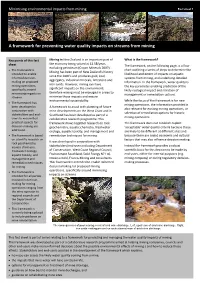
Minimising environmental impacts from mining Fact sheet 1 A framework for preventing water quality impacts on streams from mining Key points of this fact Mining in New Zealand is an important part of What is the framework? the economy being valued at $1.5B/year, sheet The framework, on the following page, is a flow excluding petroleum (Crown Minerals 2007). The framework is chart outlining a series of steps to determine the Mining has been part of New Zealand’s history intended to enable likelihood and extent of impacts on aquatic since the 1800’s and produces gold, coal, informed decision‐ systems from mining, and underlying detailed aggregates, industrial minerals, limestone and making on proposed information. In the framework, water quality is iron sands. However, mining can have mining operations, the key parameter enabling prediction of the significant impacts on the environment; specifically around likely ecological impact and selection of therefore mining must be managed in a way to minimising impacts on management or remediation options. streams. minimise those impacts and ensure environmental sustainability. While the focus of the framework is for new The framework has mining operations, the information provided is been developed in A framework to assist with planning of future also relevant for existing mining operations, or conjunction with mine developments on the West Coast and in selection of remediation options for historic stakeholders and end‐ Southland has been developed as part of a mining operations. users to ensure that collaborative research programme. This practical aspects for framework draws together research on rock The framework does not establish explicit decision‐making are geochemistry, aquatic chemistry, freshwater ‘acceptable’ water quality criteria because these addressed. -

Voyages & Travel 1515
Voyages & Travel CATALOGUE 1515 MAGGS BROS. LTD. Voyages & Travel CATALOGUE 1515 MAGGS BROS. LTD. CONTENTS Africa . 1 Egypt, The Near East & Middle East . 22 Europe, Russia, Turkey . 39 India, Central Asia & The Far East . 64 Australia & The Pacific . 91 Cover illustration; item 48, Walters . Central & South America . 115 MAGGS BROS. LTD. North America . 134 48 BEDFORD SQUARE LONDON WC1B 3DR Telephone: ++ 44 (0)20 7493 7160 Alaska & The Poles . 153 Email: travel@maggs.com Bank Account: Allied Irish (GB), 10 Berkeley Square London W1J 6AA Sort code: 23-83-97 Account Number: 47777070 IBAN: GB94 AIBK23839747777070 BIC: AIBKGB2L VAT number: GB239381347 Prices marked with an *asterisk are liable for VAT for customers in the UK. Access/Mastercard and Visa: Please quote card number, expiry date, name and invoice number by mail, fax or telephone. EU members: please quote your VAT/TVA number when ordering. The goods shall legally remain the property of the seller until the price has been discharged in full. © Maggs Bros. Ltd. 2021 Design by Radius Graphics Printed by Page Bros., Norfolk AFRICA Remarkable Original Artworks 1 BATEMAN (Charles S.L.) Original drawings and watercolours for the author’s The First Ascent of the Kasai: being some Records of service Under the Lone Star. A bound volume containing 46 watercolours (17 not in vol.), 17 pen and ink drawings (1 not in vol.), 12 pencil sketches (3 not in vol.), 3 etchings, 3 ms. charts and additional material incl. newspaper cuttings, a photographic nega- tive of the author and manuscript fragments (such as those relating to the examination and prosecution of Jao Domingos, who committed fraud when in the service of the Luebo District). -

CATLINS BUSH and BEACH 24Th Feb. – 3Rd March 2018
CAT CATLINS BUSH AND B EACH CATLINS BUSH AND BEACH Goldfields Cavalcade to Owaka th rd 24 Feb. – 3 March 2018 Gold in the Catlins? Absolutely! Untold tonnes of gold has been washed down the Clutha River (both from it’s present day location and multi- previous routes) on the Catlins north-eastern boundary. Also the Mataura river on its west boundary used to drain the Wakatipu basin and is fed into from the Nokomai. This has resulted in the beaches of the Catlins being quite literally sprinkled in gold! Many a claim has been staked and money and infrastructure invested to acquire this treasure. However by the time the gold made it all the way to the coast from the mountains of origin and tides and currents transported it up and down the coast, only the finest of specks remain. The gold is there to be sure! But the effort put in for the quantities returned is just not sustainable. Energy put into ship building and logging initially was far more profitable. As elsewhere, farming was where the real wealth was to be gained. Today tourism is a key player also in the development and sustainability of the thriving Catlins region. You have probably been here for a look-see before? Come again on the Goldfields Cavalcade and discover some truly hidden gems! Organised by the Otago Goldfields Heritage Trust PO Box 91, Cromwell, New Zealand Cavalcade Coordinator: Terry Davis. Office - 03 445 0111, Cell - 021 284 6844 e-mail terry@cavalcade.co.nz web www.cavalcade.co.nz To register: Complete the enclosed registration form, the two declarations and return with full payment to: OGHT, PO Box 91, Cromwell.