The State of the Egyptian Revolution
Total Page:16
File Type:pdf, Size:1020Kb
Load more
Recommended publications
-
Latin America's Authoritarian Drift
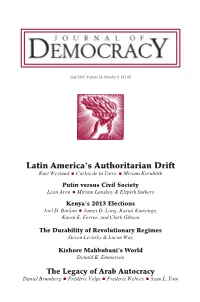
July 2013, Volume 24, Number 3 $12.00 Latin America’s Authoritarian Drift Kurt Weyland Carlos de la Torre Miriam Kornblith Putin versus Civil Society Leon Aron Miriam Lanskoy & Elspeth Suthers Kenya’s 2013 Elections Joel D. Barkan James D. Long, Karuti Kanyinga, Karen E. Ferree, and Clark Gibson The Durability of Revolutionary Regimes Steven Levitsky & Lucan Way Kishore Mahbubani’s World Donald K. Emmerson The Legacy of Arab Autocracy Daniel Brumberg Frédéric Volpi Frederic Wehrey Sean L. Yom Transforming The arab World’s ProTecTion-rackeT PoliTics Daniel Brumberg Daniel Brumberg is codirector of the Democracy and Governance Stud- ies program at Georgetown University and senior program officer at the Center for Conflict Management of the U.S. Institute of Peace. Despite the setbacks, conflicts, and violence that the Arab world has endured since the mass rebellions of early 2011, we can at least thank Egyptian heart surgeon turned television satirist Bassem Youssef for giving beleaguered democrats everywhere reason to smile. Even as prosecutors accused him of a host of “crimes”—including insulting the president and Islam itself—Youssef continued to lampoon the govern- ment. Taking a page from the previous regime’s playbook, prosecutors insisted that the courts were acting independently and that citizens rath- er than state officials had brought the charges. Invoking this ridiculous rationale, the police compelled Youssef to review tapes of his show in order to explain his jokes to his unamused interrogators. 1 Does this Kafkaesque tale leave any room for optimism? Watching an unchecked security apparatus regularly operate beyond the reach of a problematic legal system to harass journalists, some Egyptian writers argue that the very idea of transition is a hoax. -

Dr. Amal Mahmoud Salem's CV
FACULTY FULL NAME AMAL MAHMOUD HUSSEIN SALEM POSITION Professor of Bioinformatics and Molecular Virology Personal Data Nationality |Egyptian Date of Birth |12/1/1968 Department |Biology Official Email | amhsalem@iau.edu.sa Language Proficiency Language Read Write Speak Arabic Excellent Excellent Excellent English Excellent Excellent Excellent French Excellent Good Very good Academic Qualifications (Beginning with the most recent) Date Academic Degree Place of Issue Address 1990 BSc Cairo University Egypt 1994 MSc Cairo University-ORSTOM Egypt-France 2001 PhD Cairo University-CIRAD Egypt-France PhD, Master or Fellowship Research Title: (Academic Honors or Distinctions) PhD Biological and molecular characteristics of maize yellow stripe virus and its relationship with the leafhopper vector Master Characterization and serology of the leafhopper-borne maize yellow stripe tenuivirus in Egypt Fellowship Virus characterization and diagnosis, ORSTOM (Egypt-French project) Fellowship Molecular characterization and Bioinformatics analysis of MYSV (CIRAD Montpellier, France) Fellowship Bioinformatics analysis of CTV and its population structure (University of Davis-California, USA) Professional Record: (Beginning with the most recent) Job Rank Place and Address of Work Date Professor Imam Abdulrahman Bin Faisal Saudi Arabia 25-9-2019 Univ. Associate trainer certified by IBCT 19-9-2018 Associate professor Imam Abdulrahman Bin Faisal Saudi Arabia 3-1-2017 Univ. Head of Bioinformatics Dept. GEBRI-Sadat Univ. Egypt 2015-2016 Director manger Alkhwarizmi Center for Egypt 2013 Bioinformatics, Egypt 1 Associate professor GEBRI-Sadat Univ. Egypt 2012 Assistant professor GEBRI-Sadat Univ. Egypt 2005 Lecturer GEBRI-Sadat Univ. Egypt 2002 Post-Doc fellow UC-Davis USA 2001 Assistant lecturer Plant protection ins. Ministry of Egypt 1998 agric. -

New Voices, New Directions
at Brookings Project on U.S. Relations with the Islamic World Saban Center for Middle East Policy at Brookings May 29-31, 2012 • Doha, Qatar 1775 Massachusetts Avenue, NW Washington, DC 20036 www.brookings.edu/about/projects/islamic-world NEW VOICES, NEW DIRECTIONS at Brookings WELCOME Ahlan Wa Sahlan! On behalf of the Brookings Project on U.S. Relations with the Islamic World, housed within the Saban Center for Middle East Policy, we welcome you to the ninth annual U.S.- Islamic World Forum. In partnership with the State of Qatar, Brookings convenes this Fo- rum annually under the gracious auspices of H.R.H. Sheikh Hamad bin Khalifa Al-Thani, the Emir of Qatar. After a successful Forum convened for the first time in Washington, D.C. last year, we are pleased to be back in Doha. Last year, we met in the midst of the “Arab Awakening”—the dramatic changes that con- STEERING COMMITTEE tinue to transform the Middle East and North Africa. From Tunisia to Egypt to Yemen, ordinary citizens have made possible extraordinary political and social changes. This year, we examine the impact of, and continuing challenges posed by, these changes, not just for STEPHEN R. GRAND Fellow and Director the Arab world, but also for Muslim communities around the globe, including in South Project on U.S. Relations and Southeast Asia—as well as their strategic implications for the United States. with the Islamic World During our three days together, we have arranged a variety of formats for candid dialogue MARTIN INDYK and engagement: Vice President and Director -
Salafists Scuttle Bid to Appoint Elbaradei As PM
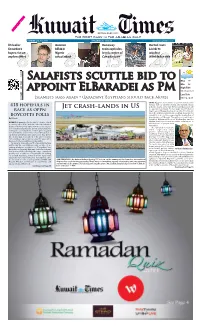
SUBSCRIPTION SUNDAY, JULY 7, 2013 SHAABAN 28, 1434 AH www.kuwaittimes.net US leaker Gunmen Runaway Bartoli routs Snowden’s kill 42 in train explodes, Lisicki to hopes rise on Nigeria levels center of win first asylum8 offers school attack8 Canada15 town Wimbledon20 title Salafists scuttle bid to Max 48º Min 35º appoint ElBaradei as PM High Tide 00:20 & 10:20 Low Tide Islamists mass again • Qaradawi: Egyptians should back Morsi 05:01& 18:37 40 PAGES NO: 15862 150 FILS CAIRO: Egyptian state television said the interim prime 418 hopefuls in minister had not yet been chosen, after named officials Jet crash-lands in US and state media earlier said Mohamed ElBaradei would race as oppn be appointed yesterday. The late-night report followed Egypt’s second biggest Islamist group, which had initially backed a military-led political roadmap to guide the boycotts polls country to new elections, opposing the nomination of liberal politician ElBaradei. The military ousted Islamist By B Izzak President Mohamed Morsi on Wednesday, and his Muslim Brotherhood movement has led protests in KUWAIT: Registration for the July 27 election closed which dozens of people have yesterday after 418 candidates filed nomination been killed. papers including only eight women as the opposi- The Tamarod movement, tion remained steadfast by almost completely boy- which engineered mass cotting the second polls in a row in protest against protests culminating in the the amendment of the electoral law. Withdrawal of overthrow of Morsi, had earlier candidacy will remain open until seven days before announced the appointment of the election day, or on July 19. -

Hosni Mubarak and the Future of Democracy in Egypt
Hosni Mubarak and the Future of Democracy in Egypt Hosni Mubarak and the Future of Democracy in Egypt Alaa Al-Din Arafat HOSNI MUBARAK AND THE FUTURE OF DEMOCRACY IN EGYPT Copyright © Alaa Al-Din Arafat, 2009. All rights reserved. First published in hardcover as The Mubarak Leadership and Future of Democracy in Egypt in 2009 by PALGRAVE MACMILLAN® in the United States—a division of St. Martin’s Press LLC, 175 Fifth Avenue, New York, NY 10010. Where this book is distributed in the UK, Europe and the rest of the world, this is by Palgrave Macmillan, a division of Macmillan Publishers Limited, registered in England, company number 785998, of Houndmills, Basingstoke, Hampshire RG21 6XS. Palgrave Macmillan is the global academic imprint of the above compa- nies and has companies and representatives throughout the world. Palgrave® and Macmillan® are registered trademarks in the United States, the United Kingdom, Europe and other countries. ISBN 978-0-230-33813-5 ISBN 978-1-137-06753-1 (eBook) DOI 10.1057/9781137067531 Library of Congress Cataloging-in-Publication Data ‘Arafat, ‘Ala’ al-Din. Hosni Mubarak and the future of democracy in Egypt / Alaa Al-Din Arafat. p. cm. Pbk. ed. of: The Mubarak leadership and future of democracy in Egypt. New York : Palgrave Macmillan, 2009. With a new preface. Includes bibliographical references. ISBN 978–0–230–33813–5 (alk. paper) 1. Mubarak, Muhammad Husni, 1928– 2. Mubarak, Gamal. 3. Egypt—Politics and government—1981– 4. Egypt—Politics and government—1970–1981. 5. Hizb al-Watani al-Dimuqrati (Egypt)— History. 6. Political leadership—Egypt—History. -

Effects of American Pop Culture on the Political Stability of the Arab Spring! Mina Alsadoon
Santa Clara University Scholar Commons Advanced Writing: Pop Culture Intersections Student Scholarship 9-2-2019 Effects of American Pop Culture on the political stability of the Arab Spring! Mina Alsadoon Follow this and additional works at: https://scholarcommons.scu.edu/engl_176 Part of the American Popular Culture Commons, English Language and Literature Commons, Film and Media Studies Commons, and the Nonfiction Commons Recommended Citation Alsadoon, Mina, "Effects of American Pop Culture on the political stability of the Arab Spring!" (2019). Advanced Writing: Pop Culture Intersections. 35. https://scholarcommons.scu.edu/engl_176/35 This Research Paper is brought to you for free and open access by the Student Scholarship at Scholar Commons. It has been accepted for inclusion in Advanced Writing: Pop Culture Intersections by an authorized administrator of Scholar Commons. For more information, please contact rscroggin@scu.edu. 1 Santa Clara University Scholar Commons Advanced Writing: Pop Culture Intersections Student Scholarship 02-9-2019 Effects of American Pop Culture on the political stability of the Arab Spring! Mina Alsadoon Santa Clara University, MAlsadoon@scu.edu 2 Mina Alsadoon ENGL 106 Dr. Hendricks 28 August 2019 Effects of American Pop Culture on the political stability of the Arab Spring! "Mr. President... people have become like animals... We are living like dogs." (El General,2010) Powerful and strong words from a young Tunisian rapper his real unknown name is Hamada Ben Amor, his most famous song Rais Le Bled It was released at the end of 2010 when El General was attacking in it the former president Zine al-Abidine Ben Ali directly and his regime. -

News Coverage Prepared For: the European Union Delegation to Egypt
News Coverage prepared for: The European Union delegation to Egypt . Disclaimer: “This document has been produced with the financial assistance of the European Union. The contents of this document are the sole responsibility of authors of articles and under no circumstances be regarded as reflecting the position of IPSOS or the European Union.” 1 . Thematic Headlines Domestic Scene Shafiq and Morsi Trade Barbs Political Parties Still Failing on Constituent Assembly Criteria Egyptian Expatriates Start Voting in Runoff Tahrir Protests Urge Unity against Regime Leftovers 11 Political Powers Call for “Revolutionary Trials” of Regime Remnants Court to Rule in Political Isolation Law within Days Protesters Rescue Girl from Rape in Tahrir Square Beheira March Demands Sacking Prosecutor General Protesters in Port Said Hurl Stones on Security Forces MB Refuses Presidential Council Idea Morsi Campaign Denies American Nationality Claims Shafiq: I Represent the Civil Country Tahrir Square against MB MB Sabotages Shafiq’s Premises during Demonstrations Travel Ban Still Imposed on Adli’s Six Aides Clinton is Ready to “Help” Egypt The Revolution Victims’ Families Consider Resorting to the International Court The Revolution Justice SCAF Discusses the Constituent Assembly with the Advisory Council Shafiq Approves the “Document of the Pledge” In the Aftermath of the Trial Al-Baradei Approves a Presidential Council Day 19 of the Revolution Expatriate Votes The Muslim Brotherhood Rejects the Presidential Council Al-Nour Party’s -

The Muslim Brotherhood Fol- Lowing the “25 Janu- Ary Revolution”
Maria Dolores Algora Weber CEU San Pablo University THE MUSLIM BROTHERHOOD FOL- LOWING THE “25 JANU- ARY REVOLUTION”: FROM THE IDEALS OF THE PAST TO THE POLITICAL CHAL- LENGES OF THE PRESENT In the framework of the Arab Spring, as the wave of social mobilisation of 2011 has come to be known, the revolutions in Tunisia and Egypt marked the beginning of a process which has deeply transformed the re- ality of many countries in the Arab World. In Egypt, the events that took place in Tahrir Square not only put an end to President Mubarak's dic- tatorship, but also paved the way for new political actors, among which the Muslim Brotherhood has played a key role. During the subsequent transition, the Brotherhood gained control of the National Assembly and positioned their leader, Mohamed Mursi, as the new President. The present debate is focused on the true democratic vocation of this move- ment and its relationship with the other social forces inside Egypt and beyond. This article intends to address these issues. To that end, it begins with an explanation as to the ideological and political evolution of the Muslim Brotherhood and its internal changes brought about by the end of the previous regime, closing with an analysis of its transnational influ- ence and the possible international aftermaths. Islam, Islamism, Muslim Brotherhood, Egypt, Arab Spring 181 INTRODUCTION n 2011, a wave of social mobilisations took place in various Arab countries and which came to be known as the “Arab Spring”. This name is undoubtedly an at- tempt to draw a comparison between the historic process that unfolded in Europe Iin the mid-nineteenth century and the events that have taken place in the Arab World. -

Monopolizing Power Egypt’S Political Parties Law
January 2007 Number 1 Monopolizing Power Egypt’s Political Parties Law I. Introduction and Recommendations...................................................................... 1 II. The Political Parties Law ......................................................................................3 III. The 2005 Amendments to the Law...................................................................... 6 IV. The Political Parties Law in Practice ................................................................... 8 V. International Law and Egypt’s Parties Law ......................................................... 14 I. Introduction and Recommendations On January 6, 2007, Abu al-`Ila Madi, a 48-year-old activist from Cairo, will plead his case before Egypt’s Supreme Administrative Court. He has appeared in the court dozens of times over the past 10 years. His purpose is to try once again to register the Wasat (Centrist) Party and begin campaigning under its name. Registering a new political party should be a transparent and apolitical bureaucratic procedure, and in many countries it is.1 In Egypt, however, in practice it is the government, and the party of government, that determine which other parties will be recognized and which will not. The result is the routine denial of applications for registration of new political parties through the use of criteria set forth in the political parties law2 that are open to subjective and arbitrary application. Madi’s struggle to gain legal recognition for the Wasat Party illustrates the deleterious effects of the law on prospective political parties, and the manner in which the government and the ruling National Democratic Party (NDP) exercise unfettered discretion to deny such parties their lawful participation in the country’s political life. If President Hosni Mubarak is to make good on his promise to “enshrine the liberties of the citizen and reinvigorate political parties,”3 the Egyptian government must reform the parties law and cease obstructing the establishment and effective participation of political parties. -

Egypt Presidential Election Observation Report
EGYPT PRESIDENTIAL ELECTION OBSERVATION REPORT JULY 2014 This publication was produced by Democracy International, Inc., for the United States Agency for International Development through Cooperative Agreement No. 3263-A- 13-00002. Photographs in this report were taken by DI while conducting the mission. Democracy International, Inc. 7600 Wisconsin Avenue, Suite 1010 Bethesda, MD 20814 Tel: +1.301.961.1660 www.democracyinternational.com EGYPT PRESIDENTIAL ELECTION OBSERVATION REPORT July 2014 Disclaimer This publication is made possible by the generous support of the American people through the United States Agency for International Development (USAID). The contents are the responsibility of Democracy International, Inc. and do not necessarily reflect the views of USAID or the United States Government. CONTENTS CONTENTS ................................................................ 4 MAP OF EGYPT .......................................................... I ACKNOWLEDGMENTS ............................................. II DELEGATION MEMBERS ......................................... V ACRONYMS AND ABBREVIATIONS ....................... X EXECUTIVE SUMMARY.............................................. 1 INTRODUCTION ........................................................ 6 ABOUT DI .......................................................... 6 ABOUT THE MISSION ....................................... 7 METHODOLOGY .............................................. 8 BACKGROUND ........................................................ 10 TUMULT -

Egypt Imprisons Nonviolent Student Activist for Terrorism
Snapshot – The Wrong Target: Egypt Imprisons Nonviolent Student Activist For Terrorism SUMMARY On October 15, Andrew Nasif, an Egyptian university student and leftist opposition party member, became the first Coptic Christian to be sent to prison under the country’s draconian anti-terrorism law. The court ruled that Andrew promoted terrorist acts through Facebook posts, flyers, and petitions calling for political and economic rights. Andrew’s lawyer describes his conviction as “truly frivolous” and “literally completely empty” of any evidence showing that he was involved in calling for violence. His case is the latest example of how the Egyptian authorities punish peaceful dissent as “terrorism,” while the problem of actual violent militancy in Egypt grows worse. Genuine security in Egypt will come not through blanket repression, but through the rule of law, rights, justice, and strong and accountable institutions. To read this snapshot as a PDF, click here. INTRODUCTION On October 15, the Zagazig Criminal Court in al-Sharqia Governorate in Egypt’s Delta region sentenced Andrew Nasif Noshi Saleeb to five years in prison for violating Law 94 of 2015, the anti- terrorism law.[1] The judge ruled that 23-year-old Andrew, a business student at Zagazig University, had promoted terrorism through pro-democracy pamphlets, posts on Facebook, and a petition opposing President Abdel Fattah al-Sisi’s economic policies. Andrew’s conviction is only the latest example of how the Egyptian authorities are using terrorism as a pretext to repress citizens who have nothing to do with the country’s violent Islamist extremist threat, but who speak out against rising authoritarianism, injustice, and economic hardship. -
Arab Uprisings and Armed Forces: Between Openness and Resistance
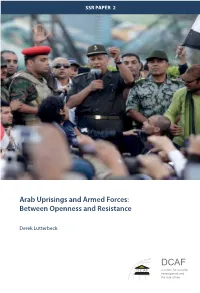
SSR PAPER 2 Arab Uprisings and Armed Forces: Between Openness and Resistance Derek Lutterbeck DCAF DCAF a centre for security, development and the rule of law SSR PAPER 2 Arab Uprisings and Armed Forces Between Openness and Resistance Derek Lutterbeck DCAF The Geneva Centre for the Democratic Control of Armed Forces (DCAF) is an international foundation whose mission is to assist the international community in pursuing good governance and reform of the security sector. The Centre develops and promotes norms and standards, conducts tailored policy research, identifies good practices and recommendations to promote democratic security sector governance, and provides in‐country advisory support and practical assistance programmes. SSR Papers is a flagship DCAF publication series intended to contribute innovative thinking on important themes and approaches relating to security sector reform (SSR) in the broader context of security sector governance (SSG). Papers provide original and provocative analysis on topics that are directly linked to the challenges of a governance‐driven security sector reform agenda. SSR Papers are intended for researchers, policy‐makers and practitioners involved in this field. ISBN 978‐92‐9222‐180‐5 © 2011 The Geneva Centre for the Democratic Control of Armed Forces EDITORS Alan Bryden & Heiner Hänggi PRODUCTION Yury Korobovsky COPY EDITOR Cherry Ekins COVER IMAGE © Suhaib Salem/Reuters The views expressed are those of the author(s) alone and do not in any way reflect the views of the institutions referred to or