Dance, Physicality, and Social Mobility in Jane Austen's Persuasion
Total Page:16
File Type:pdf, Size:1020Kb
Load more
Recommended publications
-

Prof. M. J. Koncen's Quadrille Call Book and Ball-Room Guide
Library of Congress Prof. M. J. Koncen's quadrille call book and ball-room guide ... PROF. M. J. KONCEN'S QUADRILLE CALL BOOK AND BALL ROOM GUIDE. Prof. M. J. KONCEN'S QUADRILLE CALL BOOK AND Ball Room Guide. TO WHICH IS ADDED A SENSIBLE GUIDE TO ETIQUETTE AND DEPORTMENT. IN THE BALL AND ASSEMBLY ROOM. LADIES TOILET, GENTLEMAN'S, DRESS, ETC. ETC. AND GENERAL INFORMATION FOR DANCERS. 15 9550 Containing all the Latest Novelties, together with old fashioned and Contra Dances, giving plain directions for Calling and Dancing all kinds of Square and Round Dances, including the most Popular Figures of the “GERMAN.” LIBRARY OF CONGRESS COPYRIGHT. 20 1883 No 12047-0 CITY OF WASHINGTON. ST. LOUIS: PRESS OF S. F. BREARLEY & CO., 309 Locust Street. (1883). Entered according to Act of Congress, in the year of 1883, by MATHIAS J. KONCEN. in the Office of the Librarian of Congress, at Washington, D. C CONTENTS. Preface 5–6 Etiquette of the Ball Room 7–10 Prof. M. J. Koncen's quadrille call book and ball-room guide ... http://www.loc.gov/resource/musdi.109 Library of Congress Etiquette of Private Parties 10–12 Etiquette of Introduction 12–13 Ball Room Toilets 13–14 Grand March 15–17 On Calling 17 Explanation of Quadrille Steps 17–20 Formation of Square Dances 21–22 Plain Quadrille 22–23 The Quadrille 23–25 Fancy Quadrille Figures 25–29 Ladies Own Quadrille 29–30 National Guard Quadrille 30–32 Prof. Koncen's New Caledonia Quadrille 32–33 Prairie Queen Quadrille 33–35 Prince Imperial 35–38 Irish Quadrille 39–40 London Polka Quadrille 40–42 Prof. -

LGBTQIAP+ ETIQUETTE GUIDE and GLOSSARY of TERMS Co-Authored by Luca Pax, Queer Asterisk and the Vibrant Staff (2016, 2017)
LGBTQIAP+ ETIQUETTE GUIDE and GLOSSARY OF TERMS Co-authored by Luca Pax, Queer Asterisk and The Vibrant Staff (2016, 2017). www.queerasterisk.com www.bevibrant.com Sex, gender, and sexuality can be complicated subjects, and are deeply personal. Sex is comprised of our primary and secondary sex characteristics, anatomy, and chromosomes, and is separate from gender identity or expression. Gender identity can be described as an innermost understanding of self, and gender expression is how we embody or communicate who we are to the world. Sexual orientation is who we choose to be close with, and how. Sex does not always inform gender, and gender does not always inform sexuality. None of these categories exists solely on a continuum of male to female, or masculine to feminine, and people have non-binary genders and sexualities, as well as intersex, agender, and asexual identities. People with sex, gender, or sexuality identities that dominant society regards as “normative,” i.e. male or female, cisgender, or heterosexual, may have not actively thought much about how they define or claim their identities, because they have not had to. Many people whose identities are marginalized by society experience erasure and invisibility because they are seen as non- normative. This glossary of terms related to sex, gender, and sexuality is neither exhaustive nor absolute. Language and concepts of identity are constantly evolving, and often differ amongst intersections of race, class, age, etc. Many of these terms, as well as the communities that use them are White-centered. Everyone has a right to self-define their identities and have access to validating terminology that others will use to respect who they are. -

The History of Square Dance
The History of Square Dance Swing your partner and do-si-do—November 29 is Square Dance Day in the United States. Didn’t know this folksy form of entertainment had a holiday all its own? Then it’s probably time you learned a few things about square dancing, a tradition that blossomed in the United States but has roots that stretch back to 15th-century Europe. Square dance aficionados trace the activity back to several European ancestors. In England around 1600, teams of six trained performers—all male, for propriety’s sake, and wearing bells for extra oomph—began presenting choreographed sequences known as the morris dance. This fad is thought to have inspired English country dance, in which couples lined up on village greens to practice weaving, circling and swinging moves reminiscent of modern-day square dancing. Over on the continent, meanwhile, 18th- century French couples were arranging themselves in squares for social dances such as the quadrille and the cotillion. Folk dances in Scotland, Scandinavia and Spain are also thought to have influenced square dancing. When Europeans began settling England’s 13 North American colonies, they brought both folk and popular dance traditions with them. French dancing styles in particular came into favor in the years following the American Revolution, when many former colonists snubbed all things British. A number of the terms used in modern square dancing come from France, including “promenade,” “allemande” and the indispensable “do-si-do”—a corruption of “dos-à-dos,” meaning “back-to-back.” As the United States grew and diversified, new generations stopped practicing the social dances their grandparents had enjoyed across the Atlantic. -

Be Square Caller’S Handbook
TAble of Contents Introduction p. 3 Caller’s Workshops and Weekends p. 4 Resources: Articles, Videos, etc p. 5 Bill Martin’s Teaching Tips p. 6 How to Start a Scene p. 8 American Set Dance Timeline of Trends p. 10 What to Call It p. 12 Where People Dance(d) p. 12 A Way to Begin an Evening p. 13 How to Choreograph an Evening (Programming) p. 14 Politics of Square Dance p. 15 Non-White Past, Present, Future p. 17 Squeer Danz p. 19 Patriarchy p. 20 Debby’s Downers p. 21 City Dance p. 22 Traveling, Money, & Venues p. 23 Old Time Music and Working with Bands p. 25 Square Dance Types and Terminology p. 26 Small Sets p. 27 Break Figures p. 42 Introduction Welcome to the Dare To Be Square Caller’s handbook. You may be curious about starting or resuscitating social music and dance culture in your area. Read this to gain some context about different types of square dancing, bits of history, and some ideas for it’s future. The main purpose of the book is to show basic figures, calling techniques, and dance event organizing tips to begin or further your journey as a caller. You may not be particularly interested in calling, you might just want to play dance music or dance more regularly. The hard truth is that if you want trad squares in your area, with few ex- ceptions, someone will have to learn to call. There are few active callers and even fewer surviving or revival square dances out there. -
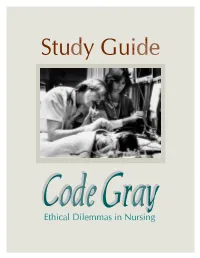
Code Gray.Pub
Written by Christine Mitchell, RN, FAAN and Ben Achtenberg with a historical commentary by Susan Reverby, PhD and assistance from Joan Sawyer and Karen Wolf, RN, MS Contents INTRODUCTION ....................................................................................... 3 Background ............................................................................................3 Synopsis of the Film ..............................................................................3 Suggested Uses .......................................................................................4 Scheduling ..............................................................................................4 FILM AS A TOOL FOR DISCUSSION .......................................................4 WHAT IS NURSING ETHICS? ...................................................................5 GLOSSARY ...................................................................................................5 SOME GENERAL DISCUSSION QUESTIONS ........................................6 CASE 1: BENEFICENCE ............................................................................7 Description of the Case .........................................................................7 The Principle: Beneficence ...................................................................7 Questions for Discussion ......................................................................8 CASE 2: AUTONOMY ................................................................................9 Description -
Arbitrator Resource Guide for Virtual Hearings Table of Contents Introduction
FINRA Dispute Resolution Services Arbitrator Resource Guide for Virtual Hearings Table of Contents Introduction ............................................................................................................................................ 2 Getting Started ........................................................................................................................................ 2 What You Need ................................................................................................................................... 2 Additional Considerations for Virtual Hearings ........................................................................................ 2 Fairness and Impartiality...................................................................................................................... 2 Confidentiality and Security ................................................................................................................. 2 Technology Challenges ........................................................................................................................ 3 Preparing for the Virtual Hearing ............................................................................................................. 3 Note to the Chairperson ...................................................................................................................... 3 Commencing the Virtual Hearing ............................................................................................................ -
The Scotch Connection and Almack's Dance Assembly
“Calling the Tune and Leading a Merry Dance” Part 2 - The Scotch Connection and Almack’s Peter Ellis Despite the waning of the Country Dance it is thanks to Thomas Wilson for his extensive compilation over the early 1800s that many figures are referenced. Bear in mind however the commoners were generally illiterate so the dancing master publications were of no use to them. It is likely the simpler folk dances survived with the rural folk and that some of the modern figures may have worked their way into the repertoire via servant staff being called upon to make up numbers in the country mansions of the landed gentry. It is also likely solo dancing as well as loosely connected couple participation was popular, certainly the Irish had their step- dance and jig, the Scots their native reel and the English various hornpipes and their own step-dances. Keep in mind also the situation could be quite different between the upper class becoming bored with the mundane formalities and the lower class enjoying simpler but livelier forms of country dancing. Certainly country dances continued to thrive more so in Scotland and Ireland alongside the newer quadrilles, waltzes and polkas as they came on the scene. England in contrast seemed to quickly abandon its Country Dance except for Sir Roger de Coverley and an occasional new country dance such as Circassian Circle or Spanish Waltz over preference for the latest fashions with quadrilles and couple dances. But then the Country Dance was old and tired in England, it was a relatively new introduction to Scotland and Ireland and was able to develop incorporating native style and stepping. -

Creolizing Contradance in the Caribbean
Peter Manuel 1 / Introduction Contradance and Quadrille Culture in the Caribbean region as linguistically, ethnically, and culturally diverse as the Carib- bean has never lent itself to being epitomized by a single music or dance A genre, be it rumba or reggae. Nevertheless, in the nineteenth century a set of contradance and quadrille variants flourished so extensively throughout the Caribbean Basin that they enjoyed a kind of predominance, as a common cultural medium through which melodies, rhythms, dance figures, and per- formers all circulated, both between islands and between social groups within a given island. Hence, if the latter twentieth century in the region came to be the age of Afro-Caribbean popular music and dance, the nineteenth century can in many respects be characterized as the era of the contradance and qua- drille. Further, the quadrille retains much vigor in the Caribbean, and many aspects of modern Latin popular dance and music can be traced ultimately to the Cuban contradanza and Puerto Rican danza. Caribbean scholars, recognizing the importance of the contradance and quadrille complex, have produced several erudite studies of some of these genres, especially as flourishing in the Spanish Caribbean. However, these have tended to be narrowly focused in scope, and, even taken collectively, they fail to provide the panregional perspective that is so clearly needed even to comprehend a single genre in its broader context. Further, most of these pub- lications are scattered in diverse obscure and ephemeral journals or consist of limited-edition books that are scarcely available in their country of origin, not to mention elsewhere.1 Some of the most outstanding studies of individual genres or regions display what might seem to be a surprising lack of familiar- ity with relevant publications produced elsewhere, due not to any incuriosity on the part of authors but to the poor dissemination of works within (as well as 2 Peter Manuel outside) the Caribbean. -

Your Guide to Business Gift Etiquette Reduce Your Holiday Hosting Risk
November–December 2019 Your guide to Charitable business gift gift giving etiquette Your holiday Reduce your business rush holiday hosting survival guide risk Best holiday quiz ever! From the f irm A season of giving… ere we are at the tail end of the year. And that • A new take on milk and cookies—If your family H means it’s time to get things wrapped up so wants to serve up something a little different for you can breathe easy and enjoy this special season. Santa or just enjoy a seasonal sweet treat, dive Be sure to check out our year-end tips to help you. into our recipes. Then it’s time to unwrap some holiday cheer, starting Of course, business doesn’t completely stop at with everything this issue has to offer…including the holidays, and you probably have more than these holiday goodies: a few work-related gatherings and gifts on your • ’Tis the season for giving to friends, family and list. To help you get through everything as grace- coworkers. We keep you updated on the most fully as possible, check out our holiday etiquette current charitable giving and gift rules. for business. • Hosting tips to ensure everyone can enjoy Wishing you a wonderful holiday season! holiday cheer safely. • Take your guests for a trip around the globe Sincerely, this holiday with our festive quiz. Your trusted advisors 2 | NOVEMBER–DECEMBER 2019 In this issue November–December 2019 Features 4 4 • Your guide to business gift etiquette ’Tis the season for generosity and showing others appreciation. -
Medical Ethics in Peacetime and Wartime: the Case for a Better Understanding
International Review of the Red Cross (2013), 95 (889), 189–213. Violence against health care doi:10.1017/S1816383113000775 Medical ethics in peacetime and wartime: the case for a better understanding Vivienne Nathanson Vivienne Nathanson qualified in medicine at the University of London in 1978. She is Director of Professional Activities at the British Medical Association, and is responsible for public health, human rights, medical ethics, international affairs, medical education, and many other areas. She writes and lectures extensively on ethics, human rights, and public health, contributing chapters to books and e-learning resources on the same areas. She is currently an honorary Professor in the School for Health at the University of Durham. She was recently called as an expert witness to the public enquiry into the death in UK custody of Baha Mousa, and to the public enquiry into the use of contaminated blood products in Scotland (the Penrose Enquiry). Abstract Health-care workers face ethical dilemmas in their decision-making in every clinical intervention they make. In times of armed conflict the decisions may be different, and the circumstances can combine to raise ethical tensions. This article looks at the tensions in peacetime and in times of armed conflict and examines the types of cases that doctors and other health-care workers will face. It also discusses the common ethical decision-making framework and the role of communication within both clinical care and ethical analysis. © icrc 2014 189 V. Nathanson Keywords: ethical dilemma, ethical analysis, decision making, consent, confidentiality, communication, trust. Health-care workers worldwide follow the same ethical codes and principles, developed to protect patients from abuse and to make clear the limits that those professionals will apply to their decision-making. -
Catalog of Services Consulting Services Learning & Development Workshops
Catalog of Services Consulting Services Learning & Development Workshops For more information: Florida Institute of Government University of Central Florida College of Community Innovation (407) 882-3960 and Education www.iog.ucf.edu 12443 Research Parkway, Ste. 402 iog@ucf.edu Orlando, FL 32826-3282 Mari Rains, Director MariRains@ucf.edu Consulting & Technical Assistance Services Did you know that in addition to offering Training & Development Workshops the UCF Institute of Government also offers consulting services? Technical Assistance Services: Charter review Advisory Board Training Community Visioning/Strategic planning Meeting facilitation services Citizen Surveys Records management plans IT plans Tree inventories Process Improvement Performance Measurement & Benchmarking Conference Planning & Coordination HR, OD & Talent Management Services: HR Compliance Audits Developing or revising employee policy manuals, procedures, & managers’ handbooks Updating job descriptions Designing hiring procedures, including recruitment, interviewing & selection Developing performance appraisal systems Establishing performance coaching & improvement systems Investigating employee complaints & grievances Mediation & interventions between supervisors & staff Employee Morale/Climate Surveys Conducting Exit Interviews Succession Planning Leadership Assessments Team Assessments Leadership Coaching Competency Modeling Career Pathing Organization Development Change Management Strategies Facilitating Strategic Planning Sessions: -
Research Within the District
Instruction AR 6162.8(a) RESEARCH WITHIN THE DISTRICT Criteria and Guidelines for Approval of Research Studies 1. Criteria for approval of research studies within the district include the following: The research study should: a. Have the potential of immediate or ultimate value to the district. Research which offers no apparent benefit to the district at some level cannot be supported. b. Not disrupt or significantly interfere with student instructional duties and teaching or other staff duties. c. Be devoid of any procedure or element that might cause confusion, or interfere with student learning. d. Avoid duplication of existing data or literature and address relevant educational problems or issues. 2. In addition, the following guidelines must be met: a. Proposed research should be acceptable to the local community. Research which may be perceived as infringing on privacy, wasteful of money or resources, destructive or inhumane, or detrimental to community values would be unacceptable. b. The researcher must agree in writing to follow district procedures in conducting research. c. The district reserves the right to withhold permission to conduct research within the district. Further, the district may at any time terminate, disallow, or disapprove of any research or research procedure involving district personnel, students, or other district resources. d. No individual assessment/testing may be conducted with students without first obtaining informed student/parental consent in writing. This means the parent must be told what test(s) will be administered, what information will be obtained, why the test(s) will be administered, and what will be done with the results. In the case of federally funded projects requiring Federal Wide Assurance, all eight elements of the Informed Consent procedure must be met prior to review and approval.** AR 6162.8(b) RESEARCH WITHIN THE DISTRICT (continued) e.