Paris Et Vienne and Its Swedish Translation
Total Page:16
File Type:pdf, Size:1020Kb
Load more
Recommended publications
-
French Waterways: Highlights of Burgundy, Beaujolais & Provence
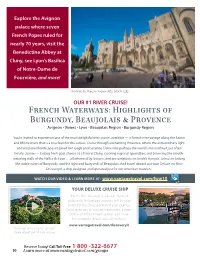
Explore the Avignon palace where seven French Popes ruled for nearly 70 years, visit the Benedictine Abbey at Cluny, see Lyon’s Basilica of Notre-Dame de Fourvière, and more! The Palais des Popes in Avignon dates back to 1252. OUR #1 RIVER CRUISE! French Waterways: Highlights of Burgundy, Beaujolais & Provence Avignon • Viviers • Lyon • Beaujolais Region • Burgundy Region You’re invited to experience one of the most delightful river cruises available — a French river voyage along the Saône and Rhône rivers that is a true feast for the senses. Cruise through enchanting Provence, where the extraordinary light and unspoiled landscapes inspired Van Gogh and Cezanne. Delve into perhaps the world’s most refined, yet often hearty cuisine — tasting fresh goat cheese at a farm in Cluny, savoring regional specialties, and browsing the mouth- watering stalls of the Halles de Lyon . all informed by lectures and presentations on la table français. Join us in tasting the noble wines of Burgundy, and the light and fruity reds of Beaujolais. And travel aboard our own Deluxe ms River Discovery II, a ship designed and operated just for our American travelers. WATCH OUR VIDEO & LEARN MORE AT: www.vantagetravel.com/fww15 Additional Online Content YOUR DELUXE CRUISE SHIP Facebook The ms River Discovery II, a 5-star ship built exclusively for Vantage travelers, will be your home for the cruise portion of your journey. Enjoy spacious, all outside staterooms, a state- of-the-art infotainment system, and more. For complete details, visit our website. www.vantagetravel.com/discoveryII View our online video to learn more about our #1 river cruise. -

22. on Some Prehistoric Antiquities in the Departments of the Vienne and the Charente, France Author(S): A
22. On Some Prehistoric Antiquities in the Departments of the Vienne and the Charente, France Author(s): A. L. Lewis Source: Man, Vol. 14 (1914), pp. 40-42 Published by: Royal Anthropological Institute of Great Britain and Ireland Stable URL: http://www.jstor.org/stable/2788949 Accessed: 27-06-2016 15:25 UTC Your use of the JSTOR archive indicates your acceptance of the Terms & Conditions of Use, available at http://about.jstor.org/terms JSTOR is a not-for-profit service that helps scholars, researchers, and students discover, use, and build upon a wide range of content in a trusted digital archive. We use information technology and tools to increase productivity and facilitate new forms of scholarship. For more information about JSTOR, please contact support@jstor.org. Wiley, Royal Anthropological Institute of Great Britain and Ireland are collaborating with JSTOR to digitize, preserve and extend access to Man This content downloaded from 134.117.10.200 on Mon, 27 Jun 2016 15:25:31 UTC All use subject to http://about.jstor.org/terms No. 22.J MAN. [1914. Archaeology: France. Lewis. On Some Prehistoric Antiquities in the Departments of the qq Vienne and the Oharente, France. By A. L. Lewis, Offcier dAcademie. The following particulars were collected by me while a4ttending the meeting of the Congres Prehistorique de France, held at Angouleme in August 1912, at which I had the honour of representing the Royal Anthropological Institute by request of tlle Council. lThere is a fine dolmen very near to Poitiers ; it is called the "Pierre Levee." and tramears run from the Holtel de Ville past the prison, at the back of which the dolmen stands in a garden at the corner of two roads. -
VIENNE Les Clés D’Un Succès
La ville se transforme VIENNE Les clés d’un succès Eugen Antalovsky Jana Löw La ville se transforme VIENNE 1 VIENNE Les clés d’un succès Eugen Antalovsky Jana Löw Vienne : Les clés d’un succès © Banque européenne d’investissement, 2019 Tous droits réservés. Toutes les questions relatives aux droits et aux autorisations doivent être transmises à l’adresse suivante : publications@eib.org. Les observations, interprétations et conclusions sont celles des auteurs et ne reflètent pas nécessairement les vues de la Banque européenne d’investissement. Abonnez-vous à notre bulletin électronique à l’adresse www.bei.org/sign-up. pdf: QH-06-18-217-FR-N ISBN 978-92-861-3873-7 doi:10.2867/900584 eBook: QH-06-18-217-FR-E ISBN 978-92-861-3875-1 doi:10.2867/92067 4 La ville se transforme VIENNE Naguère capitale périphérique déclinante, ancien avant-poste de la guerre froide, Vienne est désormais régulièrement plébiscitée dans les enquêtes mondiales sur la qualité de vie. Voici comment la capitale autrichienne a retourné à son avantage une série de handicaps économiques et géopolitiques. Introduction Au milieu des années 80, lorsque Vienne présenta son premier plan d’aménagement, la municipalité pensait que sa démographie était sur le déclin et entrevoyait de graves difficultés pour son économie. Mais les transformations géopolitiques amenèrent une nouvelle vague d’immigration vers la ville, qui dut s’adapter rapidement et concevoir de nouvelles initiatives. Un vent nouveau souffla sur l’aménagement urbain. La remarquable croissance démographique de Vienne sous l’effet des migrations se déroula en trois phases : • de 1989 à 1993, un rapide accroissement ; • de 2000 à 2006, une nouvelle augmentation ; • depuis 2010, un accroissement vif et régulier d’environ 22 000 personnes par an, en moyenne. -

Language Planning and Textbooks in French Primary Education During the Third Republic
Rewriting the Nation: Language Planning and Textbooks in French Primary Education During the Third Republic By Celine L Maillard A dissertation submitted in partial fulfillment of the requirements for the degree of Doctor of Philosophy University of Washington 2019 Reading Committee: Douglas P Collins, Chair Maya A Smith Susan Gaylard Ana Fernandez Dobao Program Authorized to Offer Degree: Department of French and Italian Studies College of Arts and Sciences ©Copyright 2019 Céline L Maillard University of Washington Abstract Rewriting the Nation: Language Planning and Textbooks in French Primary Education During the Third Republic Celine L Maillard Chair of the Supervisory Committee: Douglas P Collins Department of French and Italian Studies This research investigates the rewriting of the nation in France during the Third Republic and the role played by primary schools in the process of identity formation. Le Tour de la France par deux enfants, a textbook written in 1877 by Augustine Fouillée, is our entry point to illustrate the strategies used in manufacturing French identity. We also analyze other texts: political speeches from the revolutionary era and from the Third Republic, as well as testimonies from both students and teachers written during the twentieth century. Bringing together close readings and research from various fields – history, linguistics, sociology, and philosophy – we use an interdisciplinary approach to shed light on language and national identity formation. Our findings underscore the connections between French primary education and national identity. Our analysis also contends that national identity in France during the Third Republic was an artificial construction and demonstrates how otherness was put in the service of populism. -
Publication of a Communication of Approval of a Standard Amendment to a Product Specification for a Name in the Wine Sector Refe
10.2.2020 EN Offi cial Jour nal of the European Union C 44/15 Publication of a communication of approval of a standard amendment to a product specification for a name in the wine sector referred to in Article 17(2) and (3) of Commission Delegated Regulation (EU) 2019/33. (2020/C 44/07) This communication is published in accordance with Article 17(5) of Commission Delegated Regulation (EU) 2019/33 (1). COMMUNICATING THE APPROVAL OF A STANDARD AMENDMENT ‘Coteaux de Saumur’ PDO-FR-A0179-AM01 Date of communication: 13 November 2019 DESCRIPTION OF AND REASONS FOR THE APPROVED AMENDMENT 1. Geographical name ‘Supplementary geographical name’ has been reduced to ‘geographical name’ in Chapter I points II and XII(2)(b). A number of the product specifications for Loire Valley wines allow the use of what is known as the ‘eponymous geographical designation’ — ‘Val de Loire’ — to refer to this wider region. The use of this term on wine labels is subject to specific rules laid down in those product specifications. As the term ‘supplementary geographical name’ is also used in some cases to denote smaller geographical units with more restrictive production conditions, the word ‘supplementary’ has been removed in order to prevent confusion. Point 9 of the Single Document, ‘Further conditions’, has been amended accordingly. 2. Geographical area The passage concerning the geographical area now reads as follows: All stages of production must take place in the geographical area, which spans the territories of the following municipalities, based on the 2018 -

Luggage Allowance Luggage Allowance
From 1st April 2017 to 31st March 2018 LUGGAGE ALLOWANCE Fee per KG above allowance (TTC) 5KG – dimensions 115cm (length + width + depth) for the following flights Paris/Halifax/Paris Paris/Oujda/Paris Dublin/Halifax/Dublin Bastia/Oujda/Bastia Paris/Dublin/Paris Paris/Chlef/Paris HAND LUGGAGE Paris/Alger/Paris All charters flights 10 Kg – dimensions 115cm (largeur + longeur + hauteur) for the following flights Bordeaux/Vienne/Bordeaux Paris/Calvi/Paris Toulouse/Vienne/Toulouse Paris/Bastia/Paris CHECKED IN LUGGAGE 15KG unless otherwise stated by Tour Operator 11 € $16 CAN £9 GBP Europe 15KG CHECKED IN LUGGAGE : Algeria / Morocco 20kg 11 € $16 CAN N/A Regular Flights Canada 20KG (Economy) 25KG (Economy Premium) ASL Airlines France Purchase online ASL website : 5KG (regular flights only) 15 € $22 CAN N/A LUGGAGE ALLOWANCE for INFANTS (less than 2 years old) Fee per KG above allowance (TTC) HAND LUGGAGE 3KG - unless stated otherwise by Tour Operator 5 KG – included Push-chair, Car seat, Cosy unless otherwise CHECKED IN LUGGAGE 11 € $16 CAN £9 GBP stated by Tour Operator UNACCOMPANIED MINORS - 4 years old to 11 years old 50 € $74 CAN £40 GBP SPECIAL LUGGAGE Fee per Flight (TTC) GOLF BAGS Labelled "Fragile" 30 € $44 CAN £24 GBP Tires deflated - pedals removed or fixed inwards, handlebars BICYCLE 60 € $88 CAN £48GBP fixed sideways. Packed in appropriate bag. Cylinders must be empty. Pressure-sensitive devices may need special packaging: please refer to manufacturer for advice. Spear- DIVING EQUIPMENT guns must be unloaded and spear packed separately. -

The Member States and Regions Referred to Respectively In
No L 13/14 Official Journal of the European Communities 21 . 1 . 93 COMMISSION DECISION of 21 December 1992 recording the compliance by certain Member States or regions with the requirements relating to brucellosis (B. melitensis) and according them the status of a Member State or region officially free of the disease (93/52/EEC) THE COMMISSION OF THE EUROPEAN COMMUNITIES, HAS ADOPTED THIS DECISION : Having regard to the Treaty establishing the European Economic Community, Article 1 Having regard to Council Directive 91 /68/EEC of The Member States and regions referred to respectively in 28 January 1991 on animal health conditions governing Annexes I and II satisfy the conditions laid down in intra-Community trade on ovine and caprine animals ^), Directive 91 /68/EEC, Annex A, Chapter 1 .II ( 1 ) (b). and in particular Annex A, Chapter 1 .II thereof, Whereas, in the United Kingdom, Ireland, the Nether Article 2 lands, Belgium, Luxembourg, the Federal Republic of Germany and certain regions in France, brucellosis (B. The Member States and regions referred to respectively in melitensis) has been a notifiable disease for at least five Annexes I and II are recognized as officially free of years ; whereas no case has been confirmed officially there brucellosis (B. melitensis). for at least five years and vaccination has been banned there for at least three years ; whereas it should therefore be put on record that they comply with the conditions Article 3 laid down in Annex A, Chapter 1 .II ( 1 ) (b); This Decision is addressed to the Member States. Whereas, in addition, the Member States or regions referred to above undertake to satisfy the provisions laid down in Annex A, Chapter 1.II (2); whereas, conse quently, the Member States and regions in question Done at Brussels, 21 December 1992. -

European Commission Summary Report of The
EUROPEAN COMMISSION HEALTH AND FOOD SAFETY DIRECTORATE-GENERAL sante.ddg2.g.001(2016)313891 SUMMARY REPORT OF THE STANDING COMMITTEE ON PLANTS, ANIMALS, FOOD AND FEED HELD IN BRUSSELS ON 12 JANUARY 2016 (Section Animal Health & Welfare) CIRCABC Link: https://circabc.europa.eu/w/browse/d36ff9ae-0fd1-41e0-8ee0-8fec085e3c37 A.01 Outcome of the evaluation procedure of eradication, control and surveillance programmes submitted by Member States for Union financial contribution for 2016 and following years: list of the programmes technically approved and final amount allocated to each programme. Information, as per Article 13 of EU Regulation 652/2014, to the Member States on the list of national programmes technically approved and EU co-financing amount allocated to each programme for 2016. Only few clarifications have been requested by some Member States that very welcome the finalisation of the procedure. The Commission reminded the Member States that the final approval of the veterinary programmes for 2016 will be by means of grant Decisions that have to be signed by the Commission's Authorised Officer by 31 January (and then the grants will be sent to Member States). A.02 Information from Germany on low pathogenic influenza in poultry. The German representative reported on an outbreak of low pathogenic avian influenza of the subtype H5N2 confirmed on 7 December 2015 in a mixed poultry (chicken, ducks, geese) holding in the commune of Cham, Land Bavaria. All poultry was stamped out and disposed of. A 1-km restricted zone was established around the infected holding and numerous contact holdings were investigated, all revealing negative results. -

Rapport Vienne Nature
Inventaires des Amphibiens et des Reptiles de la Vienne Synthèse des connaissances au 31/12/2016 Janvier 2017 Inventaires des Amphibiens et des Reptiles de la Vienne Synthèse des connaissances au 31/12/2016 Janvier 2017 Coordination et rédaction Miguel GAILLEDRAT Lucie TEXIER Vienne Nature Société de Protection de la Nature et de l’Environnement dans la Vienne 14 rue Jean Moulin – 86240 Fontaine le Comte Tél. 05 49 88 99 04 - Fax. 08 26 99 86 21 E-mail. vienne.nature@wanadoo.fr www.vienne-nature.asso.fr Inventaire des Amphibiens et Reptiles de la Vienne Synthèse des connaissances au 31/12/2016 SOMMAIRE SOMMAIRE ...................................................................................................................................................................... 1 LISTE DES FIGURES ET TABLEAUX .................................................................................................................................. 3 LISTE DES FIGURES ................................................................................................................................... 3 LISTE DES TABLEAUX ................................................................................................................................. 3 PREAMBULE .................................................................................................................................................................... 4 LES AMPHIBIENS ............................................................................................................................................................ -

Wittenberg Influences on the Reformation in Scandinavia by Simo Heininen, Otfried Czaika
Wittenberg Influences on the Reformation in Scandinavia by Simo Heininen, Otfried Czaika Wittenberg was the most important source of inspiration for the Reformation in both of the Scandinavian kingdoms, the Danish kingdom and the Swedish kingdom. In both kingdoms, the authorities played a defining role in the Reformation, though it proceeded very differently in these two Early Modern states. The Reformation became securely established most quickly – both politically and in terms of church law – in the Danish core territory. Sweden, on the other hand, was de facto already a Lutheran country before 1550, though it did not become Lutheran de jure also until the last decade of the 16th century. Particularly in the peripheral parts of Scandinavia (especially Norway and Iceland), the Reformation went hand in hand with closer political integration in Scandinavia and it was therefore adopted rather reluctantly by the population. TABLE OF CONTENTS 1. Political Background 2. Denmark 3. Norway and Iceland 4. Sweden 5. Finland 6. Conclusion 7. Appendix 1. Sources 2. Bibliography 3. Notes Indices Citation Political Background From 1397, the kingdoms of Denmark, Norway and Sweden were united in a personal union (the so-called Kalmar Union) under Danish control (ᇄ Media Link #ab). In the early-16th century, the union was approaching its end. There were increasing tensions between Denmark and Sweden, the latter being governed by regents from the House of Sture. In November 1520, Christian II of Denmark (1481–1559) (ᇄ Media Link #ac), the last union king, was crowned for a second time in Stockholm. After the coronation festivities had been concluded, a heresy trial was staged with the help of the Archbishop of Uppsala and the accused were the supporters of the Sture party. -

How the British Have Made Southwest France Their Home the Local News.France@Thelocal.Com @Thelocalfrance
How the British have made southwest France their home The Local news.france@thelocal.com @thelocalfrance 6 October 2017 08:26 CEST+02:00 brits in france Share this article Photo: AFP The Nouvelle-Aquitaine region of western and southwest France is home to the most Brits of all France's regions. Here’s a breakdown of how they have made the region, or at least part of it, their home. Nouvelle-Aquitaine was recently formed when the government redrew the administrative map of France, bringing together the old regions of Aquitaine, Poitou- Charentes and Limousin. The super-region stretches from the Spanish border in the southwest up the Atlantic coast to La Rochelle and deep into central France to take in the departments of Correze and Creuse. It includes departments,that have long been associated with migrating British citizens, such as Dordogne (Dordogneshire to many), and Charente. The Numbers: There are some 39,000 British citizens living in the giant Nouvelle-Aquitaine region, a new report from French statistics agency INSEE reveals. That represents 0.7 percent of the region's overall population and means that after the Portuguese, Brits represent the second biggest community of foreigners. Those 39,000 represent 26 percent of the 150,000 Brits officially registered as living in France. That makes Nouvelle-Aquitaine the region of France that is home to the most Brits. In second place is neighbouring Occitanie, which is home to 25,500 Brits, and in third place is the greater Paris region of Ile-de-France where 19,500 Brits have set up home. -
“Our Swedish Moses and Saviour”: the Use of Biblical Leaders As Power Legitimization in Reformation Sweden
Martin Berntson Chapter 8 “Our Swedish Moses and Saviour”: The Use of Biblical Leaders as Power Legitimization in Reformation Sweden The Vasa-regime that seized royal power in the kingdom of Sweden during the early sixteenth century was in urgent need of a power legitimization that could both corre- spond to well-known traditional symbols and narratives but also at the same time le- gitimize the new regime and its adherence to the Lutheran Reformation. The use of Old Testament kings and leaders such as David, Jehoshaphat, Joseph, and Moses could thereby function as typologies relating to the Jerusalem Code. However, through relating these Old Testament kings with their responsibility for the peoples’ spiritual needs and with their distinctive biblical foundation, the Jerusalem Code was trans- formed and adjusted to early modern Lutheran political culture, emphasizing the king’s responsibility for the Church and for the people’s spiritual well-being and the lack of biblical foundation for the Catholic sacramental culture (for example, mass in Latin, pilgrimage, and the use of sacramentals). It could also be argued that the fre- quent use of figures such as Moses and Joseph was a significant part of the Jerusalem Code in Sweden, signifying both the importance of humility and God’s providence in the secular government. Introduction In the kingdom of Sweden the introduction of the Reformation coincided with a na- tional political revolution. The process towards establishing a national Protestant church was to a large extent governed by the political and economic needs of King Gustav Vasa (r. 1523–60) whose regime marked Sweden’s leave-taking from the Note: This article has been presented as a paper at the Sixteenth Century Society Conference in Bruges in August 2016 and it has also been discussed at a workshop at the Norwegian School of Theology in Oslo in September 2017.