Science, Categorization, and Naming in H.P. Lovecraft's Fiction
Total Page:16
File Type:pdf, Size:1020Kb
Load more
Recommended publications
-

Searchers After Horror Understanding H
Mats Nyholm Mats Nyholm Searchers After Horror Understanding H. P. Lovecraft and His Fiction // Searchers After Horror Horror After Searchers // 2021 9 789517 659864 ISBN 978-951-765-986-4 Åbo Akademi University Press Tavastgatan 13, FI-20500 Åbo, Finland Tel. +358 (0)2 215 4793 E-mail: forlaget@abo.fi Sales and distribution: Åbo Akademi University Library Domkyrkogatan 2–4, FI-20500 Åbo, Finland Tel. +358 (0)2 -215 4190 E-mail: publikationer@abo.fi SEARCHERS AFTER HORROR Searchers After Horror Understanding H. P. Lovecraft and His Fiction Mats Nyholm Åbo Akademis förlag | Åbo Akademi University Press Åbo, Finland, 2021 CIP Cataloguing in Publication Nyholm, Mats. Searchers after horror : understanding H. P. Lovecraft and his fiction / Mats Nyholm. - Åbo : Åbo Akademi University Press, 2021. Diss.: Åbo Akademi University. ISBN 978-951-765-986-4 ISBN 978-951-765-986-4 ISBN 978-951-765-987-1 (digital) Painosalama Oy Åbo 2021 Abstract The aim of this thesis is to investigate the life and work of H. P. Lovecraft in an attempt to understand his work by viewing it through the filter of his life. The approach is thus historical-biographical in nature, based in historical context and drawing on the entirety of Lovecraft’s non-fiction production in addition to his weird fiction, with the aim being to suggest some correctives to certain prevailing critical views on Lovecraft. These views include the “cosmic school” led by Joshi, the “racist school” inaugurated by Houellebecq, and the “pulp school” that tends to be dismissive of Lovecraft’s work on stylistic grounds, these being the most prevalent depictions of Lovecraft currently. -

Martial Arts
Stock #37-2614 COVER ART INTERIOR ART CONTENTS Bob Stevlic Greg Hyland JupiterImages FROM THE EDITOR . 3 HARDCORE . 4 by Stephen Dedman N HIS THE THREE BROTHERS I T SCHOOLS OF MARTIAL ARTS . 13 by Alan Leddon ISSUE FIGHT WHILE IN FLIGHT . 17 by Kelly Pedersen The righteous battle never ends – certainly not with this, the Martial Arts issue of Pyramid. With two new adventures, eight INSTANT TOURNAMENT. 21 new styles for GURPS Martial Arts, and other dojo-powered delights, this issue is sure to have something to add punch to THE GROOM OF your two-fisted campaigns. THE SPIDER PRINCESS . 24 Heroes need to get Hardcore in a modern-day adventure by J. Edward Tremlett centered on illegal (and immoral) underground fighting. Do the PCs have the guts and skill to break up this operation? RANDOM THOUGHT TABLE: NO BLOOD, What started as a school of martial arts run by three broth- NO GUTS, NO PROBLEM!. 35 ers has splintered into three different schools – each with its by Steven Marsh, Pyramid Editor own focus. Sadly, although the schools teach effective skills, they do not teach particularly honorable ones . Learn the ODDS AND ENDS . 37 secrets of this family business, plus three GURPS Martial Arts styles, in The Three Brothers School of Martial Arts. APPENDIX Z: Many martial-arts students have been criticized for having THE CRUMBLING GROUND . 38 their heads in the clouds, but Fight While in Flight shows the other side of this admonition. These five GURPS Martial Arts ABOUT GURPS . 40 styles are designed for fighters looking to make best use of their ability to fly, jump, or aerially maneuver. -

The Nemedian Chroniclers #24 [AE17]
REHeapa Autumnal Equinox 2017 THE RISE OF THE NEW HYBORIAN LEGION, PART TWO By Lee A. Breakiron As we saw last time, the Robert E. Howard United Press Association (REHupa) was the first amateur press association (apa) dedicated to that author. Its founder, Tim C. Marion, started it in 1972 when he was 13 and edited it through the first 19 of its bimonthly Mailings, but left afterward since he was ultimately more interested in fan activities than Howard as a literary figure. Before that, discontent with his leadership and with the real dearth of worthwhile essays and critiques during the early years led to future literary critic Don Herron and others to leave and create The Hyperborian League (THL) apa in October, 1975. Its official editor (OE) was Herron and it was “devoted to the creative discussion of authors Clark Ashton Smith and Robert E. Howard and their works,” though material on other fantasy writers and poets was welcomed. Herron said he spelled the name of the apa “Hyperborian” rather than “Hyperborean” because he wanted to emphasize the fact that it was devoted to both CAS (whence Hyperborean) and REH (whence Hyborian). It would still be occasionally misspelled, even on covers. Its official organ document was titled “Skull & Sandalwood,” suggested by REH’s “Skull-Face” and CAS’s Sandalwood. The fanzines composing the quarterly Mailings were at first stapled by the contributors and left so by the OE, who collected them and mailed them out to the current individual members. He also distributed some copies to libraries, sent “speculative” (“spec”) copies to recruit prospective members, and sold remaining ones to defray postage costs. -

Lovecraft Research Paper Final Draft
Nagelvoort 1 Chris Nagelvoort Professor Walsh Humanities Core H1CS 13 June 2020 Becoming Anti-Human: How Lovecraftian Horror Philosophically Deconstructs Otherness The most horrifying monster is change. Having the comfort and consistency of normality be thrust into the foreign landscape of difference can be petrifying. The dormant mind can lose its sense of self, security, and, worst of all, control. In the horror genre, this is no different. Monsters are frightening because of the difference they impose on us and our identity. Imagining a world ruled by a zombie apocalypse or a ravenous vampire feasting at night may seem unobtrusive, but when the rabid ghoul trespasses the border of detached fiction into the interior of one’s identity, the cliche skeleton seems almost an afterthought. Much more terrifying than the grotesqueness or typicality of these horror villains is how they can turn one’s sense of self and control inside out. It invites the elusive glance inward, asking the subject to wonder if their pillars of psychological safety—identity, family, belief system, home—are very safe at all. This fear of something different is compartmentalized by the psyche as something so alien, so invasive, that it must be something Other. This effect is explored by the stories of Howard Philips Lovecraft, a horror writer whose stories are so bizarre that the average reader is stripped of all their preconceptions about reality and even their sense of self. This special subgenre of horror was pioneered by Lovecraft and is famously called “Lovecraftian horror” but is well known today as cosmic horror: A mesh of horror and science fiction that “erodes presumptions about the nature of reality” (Cardin 273). -

Neocosmicism: God and the Void
Neocosmicism: God and the Void Ellen Greenham Bachelor of Arts in General Studies Graduate Diploma in Humanities with Honours (English) Master of Arts (English) This thesis is presented for the degree of Doctor of Philosophy of Murdoch University 2013 Declaration I declare that this thesis is my own account of my research and contains as its main content work which has not previously been submitted for a degree at any tertiary education institution ............................................................ Abstract Through the use of selected works by Philip K. Dick, Robert Heinlein, Frank Herbert and H.P. Lovecraft, this thesis explores the question of what it means to be human in the universe when occidental cosmologies no longer align with the universe they seek to describe. Within its view of the universe, H.P. Lovecraft’s philosophy of cosmicism offers the human creature an answer to this question, but in doing so also limits that creature to an isolated life ending in madness or death within an indifferently cold universe. While this thesis seeks to demonstrate the validity of cosmicism as a lens through which to critically interrogate science fiction texts; it more importantly endeavours to address cosmicism’s inherent limitations as a philosophy of the human creature’s place in the universe. This is done by developing neocosmicism as an outgrowth of cosmicism that offers an alternate experience of the universe and a revitalisation of the human creature’s relationship with the universe. By recognising the significant shift in the human creature’s understanding of the universe – from a Cartesian view to a Quantum view within a broader post-modern context – neocosmicism is developed as an interrogative philosophy that provides a framework for opening up a critical space in which to explore alternatives to modernity’s questions rather than offering mere reactions or polarising oppositions. -

Machen, Lovecraft, and Evolutionary Theory
i DEADLY LIGHT: MACHEN, LOVECRAFT, AND EVOLUTIONARY THEORY Jessica George A thesis submitted in partial fulfilment of the requirements for the award of Doctor of Philosophy School of English, Communication and Philosophy Cardiff University March 2014 ii Abstract This thesis explores the relationship between evolutionary theory and the weird tale in the late nineteenth and early twentieth centuries. Through readings of works by two of the writers most closely associated with the form, Arthur Machen (1863-1947) and H. P. Lovecraft (1890-1937), it argues that the weird tale engages consciously, even obsessively, with evolutionary theory and with its implications for the nature and status of the “human”. The introduction first explores the designation “weird tale”, arguing that it is perhaps less useful as a genre classification than as a moment in the reception of an idea, one in which the possible necessity of recalibrating our concept of the real is raised. In the aftermath of evolutionary theory, such a moment gave rise to anxieties around the nature and future of the “human” that took their life from its distant past. It goes on to discuss some of the studies which have considered these anxieties in relation to the Victorian novel and the late-nineteenth-century Gothic, and to argue that a similar full-length study of the weird work of Machen and Lovecraft is overdue. The first chapter considers the figure of the pre-human survival in Machen’s tales of lost races and pre-Christian religions, arguing that the figure of the fairy as pre-Celtic survival served as a focal point both for the anxieties surrounding humanity’s animal origins and for an unacknowledged attraction to the primitive Other. -
God and the Void
Neocosmicism: God and the Void Ellen Greenham Bachelor of Arts in General Studies Graduate Diploma in Humanities with Honours (English) Master of Arts (English) This thesis is presented for the degree of Doctor of Philosophy of Murdoch University 2013 Declaration I declare that this thesis is my own account of my research and contains as its main content work which has not previously been submitted for a degree at any tertiary education institution ............................................................ Abstract Through the use of selected works by Philip K. Dick, Robert Heinlein, Frank Herbert and H.P. Lovecraft, this thesis explores the question of what it means to be human in the universe when occidental cosmologies no longer align with the universe they seek to describe. Within its view of the universe, H.P. Lovecraft’s philosophy of cosmicism offers the human creature an answer to this question, but in doing so also limits that creature to an isolated life ending in madness or death within an indifferently cold universe. While this thesis seeks to demonstrate the validity of cosmicism as a lens through which to critically interrogate science fiction texts; it more importantly endeavours to address cosmicism’s inherent limitations as a philosophy of the human creature’s place in the universe. This is done by developing neocosmicism as an outgrowth of cosmicism that offers an alternate experience of the universe and a revitalisation of the human creature’s relationship with the universe. By recognising the significant shift in the human creature’s understanding of the universe – from a Cartesian view to a Quantum view within a broader post-modern context – neocosmicism is developed as an interrogative philosophy that provides a framework for opening up a critical space in which to explore alternatives to modernity’s questions rather than offering mere reactions or polarising oppositions. -

Exhibition Hall
exhibition hall 15 the weird west exhibition hall - november 2010 chris garcia - editor, ariane wolfe - fashion editor james bacon - london bureau chief, ric flair - whooooooooooo! contact can be made at journeyplanet@gmail.com Well, October was one of the stronger months for Steampunk in the public eye. No conventions in October, which is rare these days, but there was the Steampunk Fortnight on Tor.com. They had some seriously good stuff, including writing from Diana Vick, who also appears in these pages, and myself! There was a great piece from Nisi Shawl that mentioned the amazing panel that she, Liz Gorinsky, Michael Swanwick and Ann VanderMeer were on at World Fantasy last year. Jaymee Goh had a piece on Commodification and Post-Modernism that was well-written, though slightly troubling to me. Stephen Hunt’s Steampunk Timeline was good stuff, and the omnipresent GD Falksen (who has never written for us!) had a couple of good piece. Me? I wrote an article about how Tomorrowland was the signpost for the rise of Steampunk. You can read it at http://www.tor.com/blogs/2010/10/goodbye-tomorrow- hello-yesterday. The second piece is all about an amusement park called Gaslight in New Orleans. I’ll let you decide about that one - http://www.tor.com/blogs/2010/10/gaslight- amusement. The final one all about The Cleveland Steamers. This much attention is a good thing for Steampunk, especially from a site like Tor.com, a gateway for a lot of SF readers who aren’t necessarily a part of fandom. -

Bram Stoker Award Is Awarded by the Horror Writers Association for “Superior Achievement” in Horror Writing
1 The Midnight Society Kaitlin Conner Readers’ Advisory Librarian, NoveList Gregg Winsor Reference Librarian, Johnson County Library, Kansas Autumn Winters Recommendations Lead, NoveList 2 libraryreads.org 3 Speculative Fiction Science Fiction Fantasy Horror What if our scientific theories are real? What if magic or magical creatures exist? What if our nightmares are real? 4 The Pull of the Grave 5 6 “It shows us that the control we believe we have is purely illusory, and that every moment we teeter on chaos and oblivion.” -Clive Barker Introduction to “Scared Stiff: Tales of Sex and Death” by Ramsey Campbell, 1987. 7 ‘Visceral’ Fiction 8 History of the Genre 9 Gothic Horror in the 18th Century A significant amount of horror fiction of this era was marketed towards a female audience, a typical scenario being a resourceful female menaced in a gloomy castle. 1764 1796 1797 10 19th Century Horror The gothic tradition turns to the genre modern readers call horror and many foundational characters are born. 1818 1839 1886 1897 11 Early 20th Century Pulp Fiction Pulp magazines emerged to give more genre writers an outlet. H.P. Lovecraft, Ray Bradbury, and Robert Bloch, among many others, published stories in magazines. 1928 1931 1937 12 Pre-Modern Era The real-life horrors of World War II and the looming paranoia and menace of the Cold War usher in a new generation as horror novels gain mainstream acceptability. 1954 1959 1967 1974 13 14 NoveList Appeals and Themes 15 Menacing Suspenseful Bleak Creepy Brooding Gruesome Atmospheric Compelling Darkly Strong female humorous Flawed Menacing Disturbing Intensifying Flawed Moody Violent 16 Cursed! Possessed! Trapped! P l Childhood trauma o Don’t go in there! t Evil transformations Witchcraft and the occult Zombie apocalypse 17 Trapped! Think isolated cabins, Arctic research bases, submarines, graves, or elevators. -
From Rolling to Reading an Analysis of the Adaptation of Narrative Between Role-Playing Games and Novels
From Rolling to Reading An Analysis of the Adaptation of Narrative Between Role-Playing Games and Novels Nikolai Bjädefors Butler 5/17/2018 Lunds universitet Nikolai Bjädefors Butler Masterprogram Litteratur – kultur - medier LIVR07 Handledare Alexander Bareis 2018-05-29 Table of Contents Introduction ............................................................................................................................2 Background – What is a Role-Playing Game? .....................................................................4 Purpose and Problem ..........................................................................................................6 Literature ............................................................................................................................8 Method ............................................................................................................................. 10 Analysis ............................................................................................................................... 11 From Rulings to Readings................................................................................................. 11 From Players to Print ........................................................................................................ 19 From Metagaming to Metafiction ..................................................................................... 23 From Page to Table.......................................................................................................... -
``Mathematics'' and ``Physics'' in the Science of Harmonics
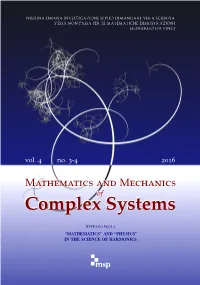
NISSUNA UMANA INVESTIGAZIONE SI PUO DIMANDARE VERA SCIENZIA S’ESSA NON PASSA PER LE MATEMATICHE DIMOSTRAZIONI LEONARDO DA VINCI vol. 4 no. 3-4 2016 Mathematics and Mechanics of Complex Systems STEFANO ISOLA “MATHEMATICS” AND “PHYSICS” IN THE SCIENCE OF HARMONICS msp MATHEMATICS AND MECHANICS OF COMPLEX SYSTEMS Vol. 4, No. 3-4, 2016 dx.doi.org/10.2140/memocs.2016.4.213 ∩ MM “MATHEMATICS” AND “PHYSICS” IN THE SCIENCE OF HARMONICS STEFANO ISOLA Some aspects of the role that the science of harmonics has played in the history of science are discussed in light of Russo’s investigation of the history of the concepts of “mathematics” and “physics”. 1. The rambling route of the ancient scientific method In several places in Russo’s writings on the history of science, one can find en- lightening discussions about the meanings of the concepts of “physics” and “math- ematics”, along with the particular notions of truth involved in them; see, e.g., [58, Chapter 6.6; 60, Chapter 15; 56; 57]. Both terms derive from the Greek: the original meaning of the former was the investigation of everything that lives, grows or, more generally, comes into existence, whereas the latter referred to all that is studied, thus deriving its meaning not from its content but from its method. In the Hellenistic period, the term “physics” continued to be used to indicate that sector of philosophy that addressed nature (the other sectors being ethics and logic), thus corresponding to what came to be called “natural philosophy” in modern times. On the other hand, the term “mathematics” was used to indicate all the disciplines (including geometry, arithmetic, harmonics, astronomy, optics, mechanics, hydro- statics, pneumatics, geodesy and mathematical geography) that shared the same method of investigation, based on the construction of theories by which “theorems” are proved, leaning on explicitly stated initial assumptions. -

New Zealand Number 114 Summer 2014 Skeptic
New Zealand Number 114 Summer 2014 Skeptic Mathematics and Pseudoscience A mathematician’s experiences with mathematical cranks The TPP and its Impact on the NZ Health Sector ACC and Acupuncture Mark Hanna investigates skeptics.nz New Zealand Skeptics CONTENTS ABOUT US 3 Editorial The New Zealand Skeptics form a network of New Zealanders including 4 Newsfront scientists, health professionals, teachers, magicians and many others from all walks of life. Members have 6 Letters a variety of religious faiths, economic beliefs and political leanings, but are all 7 Mathematics and Pseudoscience interested in examining what objective Steven Galbraith writes about his experiences scientific support there is for claims with mathematical cranks of such things as psychic abilities, alternative health practices, creationism and other areas where science, pseudo- 12 The Trans-Pacific Partnership and science and shonky science interact. its Impact on the NZ Health Sector 14 A tribute to Warwick Don CONTRIBUTIONS Contributions are welcome and should be 15 BioBlog by Alison Campbell sent to: P.O. Box 30501 17 Science-Based Healthcare Lower Hutt Mark Hanna investigates the ACC and 5040 acupuncture email: editor@skeptics.nz Deadline for next issue: 21 Complaining Cheat Sheet 10 April 2015 23 Science-Based Medicine Letters for the Forum may be edited Steven Novella talks about the latest bogeyman as space requires – up to 250 words is preferred. 26 Infectious Thoughts by Siouxsie Wiles Please indicate the publication and date of all clippings for Newsfront. 27 The Humanist Material supplied by email or CD is 28 The Loose Change Range appreciated. Luke Oldfield discusses the art of engaging with a ‘Non-Opinion’ Permission is given to other non-profit skeptical organisations to reprint material from this publication, provided the author 30 Skeptacular! by Mark Maultby and NZ Skeptic Inc.