Goodonpaper.Info #20 | NOV 2016 NEW RELEASES FROM
Total Page:16
File Type:pdf, Size:1020Kb
Load more
Recommended publications
-

Summer 2011 Issue 36
Express Summer 2011 Issue 36 Portrait of a Survivor by Thomas Ország-Land John Sinclair by Dave Russell Four Poems from Debjani Chatterjee MBE Per Ardua Ad Astra by Angela Morkos Featured Artist Lorraine Nicholson, Broadsheet and Reviews Our lastest launch: www.survivorspoetry.org ©Lorraine Nicolson promoting poetry, prose, plays, art and music by survivors of mental distress www.survivorspoetry.org Announcing our latest launch Survivors’ Poetry website is viewable now! Our new Survivors’ Poetry {SP} webite boasts many new features for survivor poets to enjoy such as; the new videos featuring regular performers at our London events, mentees, old and new talent; Poem of the Month, have your say feedback comments for every feature; an incorporated bookshop: www.survivorspoetry.org/ bookshop; easy sign up for Poetry Express and much more! We want you to tell us what you think? We hope that you will enjoy our new vibrant place for survivor poets and that you enjoy what you experience. www.survivorspoetry.org has been developed with the kind support of all the staff, board of trustess and volunteers. We are particularly grateful to Judith Graham, SP trustee for managing the project, Dave Russell for his development input and Jonathan C. Jones of www.luminial.net whom built the website using Wordpress, and has worked tirelessly to deliver a unique bespoke project, thank you. Poetry Express Survivors’ Poetry is a unique national charity which promotes the writing of survivors of mental 2 – Dave Russell distress. Please visit www.survivorspoetry. com for more information or write to us. A Survivor may be a person with a current or 3 – Simon Jenner past experience of psychiatric hospitals, ECT, tranquillisers or other medication, a user of counselling services, a survivor of sexual abuse, 4 – Roy Birch child abuse and any other person who has empathy with the experiences of survivors. -
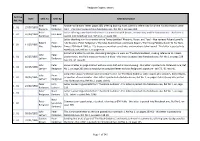
Redgrove Papers: Letters
Redgrove Papers: letters Archive Date Sent To Sent By Item Description Ref. No. Noel Peter Answer to Kantaris' letter (page 365) offering back-up from scientific references for where his information came 1 . 01 27/07/1983 Kantaris Redgrove from - this letter is pasted into Notebook one, Ref No 1, on page 365. Peter Letter offering some book references in connection with dream, mesmerism, and the Unconscious - this letter is 1 . 01 07/09/1983 John Beer Redgrove pasted into Notebook one, Ref No 1, on page 380. Letter thanking him for a review in the Times (entitled 'Rhetoric, Vision, and Toes' - Nye reviews Robert Lowell's Robert Peter 'Life Studies', Peter Redgrove's 'The Man Named East', and Gavin Ewart's 'The Young Pobbles Guide To His Toes', 1 . 01 11/05/1985 Nye Redgrove Times, 25th April 1985, p. 11); discusses weather-sensitivity, and mentions John Layard. This letter is pasted into Notebook one, Ref No 1, on page 373. Extract of a letter to Latham, discussing background work on 'The Black Goddess', making reference to masers, John Peter 1 . 01 16/05/1985 pheromones, and field measurements in a disco - this letter is pasted into Notebook one, Ref No 1, on page 229 Latham Redgrove (see 73 . 01 record). John Peter Same as letter on page 229 but with six and a half extra lines showing - this letter is pasted into Notebook one, Ref 1 . 01 16/05/1985 Latham Redgrove No 1, on page 263 (this is actually the complete letter without Redgrove's signature - see 73 . -
Download a PDF File of the Index for Volume 40
Aindex to Volume 40 – 2018 Compiled by H.e. Knox Z INDEX Index of Authors: books reviewed are listed by author, with the title in italics and the reviewer’s name in brackets, followed by the issue number. Index of Reviewers: books reviewed are listed by reviewer, with the author’s name after the title. Subject Index: the subject is followed by the title and author of the book discussed, with the reviewer’s name in brackets. ‘Corres.’ refers to letters sent to the editor in response to the article listed, and printed in subsequent issues. Index of Original Contributions: all articles which are not strictly book reviews (features, diaries, poems, short stories) are listed here, as well as appearing in the index of authors. Index of Authors Adam, G.: Dark Side of the Boom: The Excesses of the Art Berlin, L.: Cixin Liu: Market in the 21st Century. (Abrahamian, A.A.) 40.9 Evening in Paradise: More Stories. (Lockwood, P.) 40.23 Translator Liu, K. Adams, M.: Ælfred’s Britain: War and Peace in the Viking Age. Welcome Home: A Memoir with Selected Photographs. The Dark Forest. (Richardson, N.) 40.3 (Shippey, T.) 40.9 (Lockwood, P.) 40.23 Death’s End. (Richardson, N.) 40.3 Ahmed, S.: Living a Feminist Life. (Rose, J.) 40.4 Bermant, A.: Margaret Thatcher and the Middle East. The Three-Body Problem. (Richardson, N.) 40.3 Akomfrah, J.: Mimesis: African Soldier. (Harding, J.) 40.23 (Wheatcroft, G.) 40.17 The Wandering Earth. (Richardson, N.) 40.3 Alderton, D.: Everything I Know about Love. -

165Richard.Pdf
165 165 c2001 Richard Caddel Basil Basil Bunting : An Introduction to to a Northern Modernist Poet : The Interweaving Voices of Oppositional Poetry Richard Richard Caddel I'd I'd like to thank the Institute of Oriental and Occidental Studies for inviting me to give this this presentation, and for their generosity in sustaining me throughout this fellowship. I have have to say that I feel a little intimidated by my task here, which is to present the work of of a poet who is still far from well known in his own country, and who many regard as not not an easy poet (is there such a thing?) in an environment to which both he and I are foreign. foreign. This is my first visit to your country, and Bunting, though he travelled widely throughout throughout his life, never came here. That's a pity, because early in his poetic career he made what I consider to be a very effective English poem out of the Japanese prose classic, classic, Kamo no Chomei's Hojoki (albeit from an Italian tranlation, rather than the original) original) and I think he had the temperament to have enjoyed himself greatly here. I'm I'm going to present him, as much as possible, in his own words, often using recordings of him reading. He read well, and his poetry has a direct physical appeal which makes my task task of presenting it a pleasure, and I hope this approach will be useful for you as well. But first a few introductory words will be necessary. -

The Concept of Irony in Ian Mcewan's Selected Literary Works
Univerzita Palackého v Olomouci Filozofická fakulta Katedra anglistiky a amerikanistiky Bc. Eva Mádrová Concept of Irony in Ian McEwan’s Selected Literary Works Diplomová práce PhDr. Libor Práger, Ph.D. Olomouc 2013 Prohlašuji, že jsem tuto diplomovou práci na téma “Concept of Irony in Ian McEwan’s Selected Literary Works” vypracovala samostatně pod odborným dohledem vedoucího práce a uvedla jsem všechny použité podklady a literaturu. V Olomouci dne Podpis I would like to thank my supervisor PhDr. Libor Práger, Ph.D. for his assistance during the elaboration of my diploma thesis, especially for his valuable advice and willingness. Table of contents Introduction 6 1. Ian McEwan 7 2. Methodology: Analysing irony 8 2.1 Interpreter, ironist and text 8 2.2 Context and textual markers 10 2.3 Function of irony 11 2.4 Postmodern perspective 12 3. Fiction analyses 13 3.1 Atonement 13 3.1.1 Family reunion ending as a trial of trust 13 3.1.2 The complexity of the narrative: unreliable narrator and metanarrative 14 3.1.3 Growing up towards irony 17 3.1.4 Dramatic encounters and situations in a different light 25 3.2 The Child in Time 27 3.2.1 Loss of a child and life afterwards 27 3.2.2 The world through Stephen Lewis’s eyes 27 3.2.3 Man versus Universe 28 3.2.4 Contemplation of tragedy and tragicomedy 37 3.3 The Innocent 38 3.3.1 The unexpected adventures of the innocent 38 3.3.2 The single point of view 38 3.3.3 The versions of innocence and virginity 40 3.3.4 Innocence in question 48 3.4 Amsterdam 50 3.4.1 The suicidal contract 50 3.4.2 The multitude -
CHAPTER I INTRODUCTION A. Background of the Study Love In
CHAPTER I INTRODUCTION A. Background of the Study Love in the Time of Cholera is a film that was directed by England director, Mike Newell, which in screen writer is Ronald Harwood and Gabriel Garcia Marquez, then producer by Scott Steindorff and editor by Mick Audsley. It was released in November 16, 2007 in English and there is some filming location at Cartagena (Colombia), London (UK) and Twickenham Film Studios, England (UK). Information about box office from imdb.com that budget Love in the Time of Cholera movie $45,000,000 (estimated) while in opening weekend $1,924,860 (USA) 852 screens and RUR 346,488 (Russia) 3 screens. The category of this film is drama romance in 139 minute of duration of this film. Love in the Time of Cholera was production by New Line Cinema, Stone Village Pictures, Grosvenor Park Media. Mike Newell is one of famous director. Mike Newell was born on March 28, 1942 in St. Albans, Hertfordshire, England. He was raised the son of amateur actors who exposed him early in life to the theatrical world. After receiving his education from St. Albans School, he attended the University of Cambridge, where he majored in English. Following his graduation in the early 1960s, Newell joined Granada Television as a 1 2 production trainee and spent a few years learning his craft with the intention of entering the theatre world. Instead he begin directing television helming the gangster series “Spindoe” (ITV, 1968) and the crime serial “Big Breadwinner Hog” (ITV, 1969) along with fellow director Michael Apted. -

King Mob Echo: from Gordon Riots to Situationists & Sex Pistols
KING MOB ECHO FROM 1780 GORDON RIOTS TO SITUATIONISTS SEX PISTOLS AND BEYOND BY TOM VAGUE INCOMPLETE WORKS OF KING MOB WITH ILLUSTRATIONS IN TWO VOLUMES DARK STAR LONDON ·- - � --- Printed by Polestar AUP Aberdeen Limited, Rareness Rd., Altens Industrial Estate, Aberdeen AB12 3LE § 11JJJDJJDILIEJMIIENf1r 1f(Q) KIINCGr JMI(Q)IB3 JECCIHI(Q) ENGLISH SECTION OF THE SITUATIONIST INTERNATIONAL IF([J)IF ffiIE V ([J) IL lUilII ([J) W §IFIEIEIIJ) IHIII§il([J) ffiY ADDITIONAL RESEARCH BY DEREK HARRIS AND MALCOLM HOPKINS Illustrations: 'The Riots in Moorfields' (cover), 'The London Riots', 'at Langdale's' by 'Phiz' Hablot K. Browne, Horwood's 1792-9 'Plan of London', 'The Great Rock'n'Roll Swindle', 'Oliver Twist Manifesto' by Malcolm McLaren. Vagrants and historical shout outs: Sandra Belgrave, Stewart Home, Mark Jackson, Mark Saunders, Joe D. Stevens at NDTC, Boz & Phiz, J. Paul de Castro, Blue Bredren, Cockney Visionaries, Dempsey, Boss Goodman, Lord George Gordon, Chris Gray, Jonathon Green, Jefferson Hack, Christopher Hibbert, Hoppy, Ian Gilmour, Ish, Dzifa & Simone at The Grape, Barry Jennings, Joe Jones, Shaun Kerr, Layla, Lucas, Malcolm McLaren, John Mead, Simon Morrissey, Don Nicholson-Smith, Michel Prigent (pre-publicity), Charlie Radcliffe, Jamie Reid, George Robertson & Melinda Mash, Dragan Rad, George Rude, Naveen Saleh, Jon Savage, Valerie Solanas, Carolyn Starren & co at Kensington Library, Mark Stewart, Toko, Alex Trocchi, Fred & Judy Vermorel, Warren, Dr. Watson, Viv Westwood, Jack Wilkes, Dave & Stuart Wise Soundtrack: 'It's a London Thing' Scott Garcia, 'Going Mobile' The Who, 'Living for the City' Stevie Wonder, 'Boston Tea Party' Alex Harvey, 'Catholic Day' Adam and the Ants, 'Do the Strand' Roxy Music', 'Rev. -

Collier, Mike (2012) Street Flowers: Urban Survivors of the Privileged Land: Conference Paper and Published Essay
Collier, Mike (2012) Street Flowers: Urban Survivors of the Privileged Land: Conference Paper and Published Essay. In: Tourism, Roads and Cultural Itineraries: Meaning, Memory and Development. Laval University, Quebec. ISBN 978-2-7637-1789-0 (Unpublished) Downloaded from: http://sure.sunderland.ac.uk/id/eprint/3728/ Usage guidelines Please refer to the usage guidelines at http://sure.sunderland.ac.uk/policies.html or alternatively contact sure@sunderland.ac.uk. Street Flowers – Urban Survivors of the Privileged Land Dr. Mike Collier, Programme Leader and Principal Investigator for WALK1, University of Sunderland Abstract In this essay, I want to explore the way in which we relate to our environment and its often contested histories through the simple action of taking a meander through an Edgeland2 urban site – a site local to me and the place where I work (Sunderland in the North East of England). It is my contention that the action of moving slowly (or meandering) through an environment affects our experience of that place in ways that are not immediately apparent. Meandering allows the walker to stop whenever and wherever they find something interesting to ‘explore’; and it allows them time to respond to the weather patterns and soundscapes of an environment. This creates an embodied experience which, when meandering in a group, seems to encourage the body and mind to respond by meandering across a range of different areas of thought. In my projects, these have included discussions around natural history, social history, politics and philosophy explored together in non-hierarchical and unstructured ways; ways which create new patterns of interdisciplinary and interconnected thinking. -
Download Publication
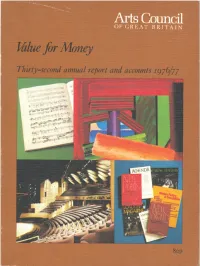
Arts Council OF GREAT BRITAI N Value fir Money ;ES;VHH AND IN,'-ORMATiON L13PARY DO NOT REMOVE FROM OM THIS ROOM Thirty-second annual report and accounts year ended 31 March 1977 Thirty-second Annual Report and Accounts 197 7 ISBN 07287 0143 X Published by the Arts Council of Great Britai n 105 Piccadilly, London W 1 V OA U Designed by Paul Sharp Printed in England by Shenval Pres s The montage on the cover illustrates the work of the Art s Council's specialist departments : Music : Page of vocal score of Sir William Walton 's Troilus and Cressida, showing revisions made by the composer for the 1976 production by the Royal Opera Art : Foy Nissen's Bombay by Howard Hodgkin Drama : The Olivier auditorium at the National Theatr e Literature : Some books and magazines published or subsidise d by the Council Contents Chairman 's Introduction 5 Secretary-General's Report 7 Regional Activities 15 Drama 1 6 Drama 1948-1977 (a personal commen t by N. V. Linklater) 20 Music 23 Visual Arts 26 Literature 30 Touring 3 1 Community Arts 32 Festivals 34 Housing the Arts 34 Training 35 Research and Information 36 Marketing 36 Scotland 37 Wales 41 Membership of Council and Staff 44 Council, Committees and Panels 45 Annual Accounts 53 The objects for which the Arts Council of Great Britai n is established by Royal Charter are : 1 To develop and .Improve the knowledge, understanding and practice of the arts ; 2 To increase the accessibility of the arts to the publi c throughout Great Britain ; and 3 To co-operate with government departments, local authorities and other bodies to achieve these objects. -

A History of Hip Hop in Halifax: 1985 - 1998
HOW THE EAST COAST ROCKS: A HISTORY OF HIP HOP IN HALIFAX: 1985 - 1998 by Michael McGuire Submitted in partial fulfilment of the requirements for the degree of Master of Arts at Dalhousie University Halifax, Nova Scotia August 2011 © Copyright by Michael McGuire, 2011 DALHOUSIE UNIVERSITY DEPARTMENT OF HISTORY The undersigned hereby certify that they have read and recommend to the Faculty of Graduate Studies for acceptance a thesis entitled “HOW THE EAST COAST ROCKS: A HISTORY OF HIP HOP IN HALIFAX: 1985 - 1998” by Michael McGuire in partial fulfilment of the requirements for the degree of Master of Arts. Dated: August 18, 2011 Supervisor: _________________________________ Readers: _________________________________ _________________________________ ii DALHOUSIE UNIVERSITY DATE: August 18, 2011 AUTHOR: Michael McGuire TITLE: How the East Coast Rocks: A History Of Hip Hop In Halifax: 1985 - 1998 DEPARTMENT OR SCHOOL: Department of History DEGREE: MA CONVOCATION: October YEAR: 2011 Permission is herewith granted to Dalhousie University to circulate and to have copied for non-commercial purposes, at its discretion, the above title upon the request of individuals or institutions. I understand that my thesis will be electronically available to the public. The author reserves other publication rights, and neither the thesis nor extensive extracts from it may be printed or otherwise reproduced without the author’s written permission. The author attests that permission has been obtained for the use of any copyrighted material appearing in the -

Channel 4 and British Film: an Assessment Of
Channel 4 and British Film: An Assessment of Industrial and Cultural Impact, 1982-1998 Laura Mayne This thesis is submitted in partial fulfilment of the requirements for the award of the degree of Doctor of Philosophy of the University of Portsmouth. September 2014 i Abstract This thesis is an historical investigation of Channel 4’s influence on the British film industry and on British film culture between 1982 and 1998. Combining archival research with interview testimony and secondary literature, this thesis presents the history of a broadcaster’s involvement in British film production, while also examining the cultural and industrial impact of this involvement over time. This study of the interdependence of film and television will aim to bring together aspects of what have hitherto been separate disciplinary fields, and as such will make an important contribution to film and television studies. In order to better understand this interdependence, this thesis will offer some original ideas about the relationship between film and television, examining the ways in which Channel 4’s funding methods led to new production practices. Aside from the important part the Channel played in funding (predominantly low-budget) films during periods when the industry was in decline and film finance was scarce, this partnership had profound effects on British cinema in the 1980s and 1990s. In exploring these effects, this thesis will look at the ways in which the film funding practices of the Channel changed the landscape of the film industry, offered opportunities to emerging new talent, altered perceptions of British film culture at home and abroad, fostered innovative aesthetic practices and brought new images of Britain to cinema and television screens. -
Focus, Meter, and Operations in Poetry
WILLIAM S. WILSON FOCUS, METER, AND OPERATIONS IN POETRY l. focus and meter Anything written 0n a page has two focal of poetry; so when Chaucer goes t0 wrap up planes-one of them distant and conceptual, be' Troilus and Creseida, he says good'bye to his yond the words in the meaning as it could be little book, dedicates it, misinterprets it, and con- abstracted from the materiality of the signs it as a verbal artifact to posterity. But he words-and the other close and physical: the alio invoks Christ and Mary at the last moment. paper,'color, texture, ink, typeface, and margins. Since they cannot be asimilated to the poem as the This doubie focus .is'inherent'in literature: how a thing of words, focusing on them shrinks as within the drily curious vvhen a beautiful story is read in a scale and scope of the'poem, even seen fr-om abwe drhb volume; how difficult for Wallace Stevens t0 poem the world shrinks ndren focus is beyond the get his .books designed and bound in a style by Troilus. Chaucer's final wftich is the reciprocal of the contents; how page, on God. ideas, there pleasiag Ohinese calligraphy is t0 one vuho cannot So while words are designating within even read Chinese. When Monkey, in the remains some undesignated materialitv poetry has always used this-for sixteenth+entury Ghinese nove! of that name, the words, and good luck of a rhyme-al' opens the scroll and finds it blank, he says t0 example the irrational there have been attempts t0 Buddha, ".