Downloaded Reference Sequences for Sulfurovum, Sulfuricurvum and Sulfurimonas Sp
Total Page:16
File Type:pdf, Size:1020Kb
Load more
Recommended publications
-

Basin Geochemical Evolution of the Eagle Ford and Effects On
BASIN GEOCHEMICAL EVOLUTION OF THE EAGLE FORD AND EFFECTS ON TRACE ELEMENT RELEASE A Thesis by IVAN MAULANA Submitted to the Office of Graduate and Professional Studies of Texas A&M University in partial fulfillment of the requirements for the degree of MASTER OF SCIENCE Chair of Committee, Michael Tice Co-chair of Committee, Bruce Herbert Committee Members, Franco Marcantonio Terry Wade Head of Department, Michael Pope May 2016 Major Subject: Geology Copyright 2016 Ivan Maulana ABSTRACT The Ocean Anoxic Event 2 (OAE-2) at the Cenomanian-Turonian boundary is recognized from a carbon isotope excursion (CIE) in the Eagle Ford (EF) Group, and commonly attributed to global anoxic conditions in deeper marine settings. Whereas OAE are typically marked by widespread deposition of organic-rich shales, previous work shows diachroneity between the CIE and the organic-rich Lower EF, as well as anoxia- euxinia in the Western Interior Seaway of North America. We found evidence for periodic photic zone euxinia from an EF core, based on ratios of biomarkers and redox-sensitive trace elements. Sedimentary structures suggest depositional environments above storm wave base. Integration with a sequence-stratigraphic framework emphasizes the role of estuarine-style salinity stratification, subject to redox shifts caused by storm mixing in relatively shallow water depths. Independent zircon ages indicate that transition from the Lower to Upper EF occurs in the south before the north, consistent with a northward migration of this stratification mechanism as sea level rose. This implies that the redox states during deposition of the EF leading up to the CIE were influenced by regionally distinct mechanisms at relatively shallow water depths, instead of global anoxic conditions in deeper marine settings. -
Molecular Biogeochemistry, Lecture 8
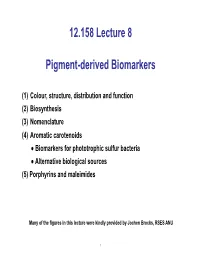
12.158 Lecture Pigment-derived Biomarkers (1) Colour, structure, distribution and function (2) Biosynthesis (3) Nomenclature (4) Aromatic carotenoids ● Biomarkers for phototrophic sulfur bacteria ● Alternative biological sources (5) Porphyrins and maleimides Many of the figures in this lecture were kindly provided by Jochen Brocks, RSES ANU 1 Carotenoid pigments ● Carotenoids are usually yellow, orange or red coloured pigments lutein β-carotene 17 18 19 2' 2 4 6 8 3 7 9 16 1 5 lycopenelycopene 2 Structural diversity ● More than 600 different natural structures are known, ● They are derived from the C40 carotenoid lycopene by varied hydrogenation, dehydrogenation, cyclization and oxidation reaction 17 18 19 2' 2 4 6 8 3 7 9 16 1 5 lycopene neurosporene α-carotene γ -carotene spirilloxanthin siphonaxanthin canthaxanthin spheroidenone 3 Structural diversity Purple non-sulfur bacteria peridinin 7,8-didehydroastaxanthin okenone fucoxanthin Biological distribution ● Carotenoids are biosynthesized de novo by all phototrophic bacteria, eukaryotes and halophilic archaea ● They are additionally synthesized by a large variety of non-phototrophs ● Vertebrates and invertebrates have to incorporate carotenoids through the diet, but have often the capacity to structurally modifiy them 4 Carotenoid function (1) Accessory pigments in Light Harvesting Complex (LHC) (annual production by marine phytoplancton alone: 4 million tons) e.g. LH-II Red and blue: protein complex Green: chlorophyll Yellow: lycopene (2) Photoprotection (3) photoreceptors for phototropism -

Niche Differentiation Among Sulfur-Oxidizing Bacterial Populations in Cave Waters
The ISME Journal (2008) 2, 590–601 & 2008 International Society for Microbial Ecology All rights reserved 1751-7362/08 $30.00 www.nature.com/ismej ORIGINAL ARTICLE Niche differentiation among sulfur-oxidizing bacterial populations in cave waters Jennifer L Macalady1, Sharmishtha Dattagupta1, Irene Schaperdoth1, Daniel S Jones1, Greg K Druschel2 and Danielle Eastman2 1Department of Geosciences, Pennsylvania State University, Pennsylvania, PA, USA and 2Department of Geology, University of Vermont, Burlington, VT, USA The sulfidic Frasassi cave system affords a unique opportunity to investigate niche relationships among sulfur-oxidizing bacteria, including epsilonproteobacterial clades with no cultivated representatives. Oxygen and sulfide concentrations in the cave waters range over more than two orders of magnitude as a result of seasonally and spatially variable dilution of the sulfidic groundwater. A full-cycle rRNA approach was used to quantify dominant populations in biofilms collected in both diluted and undiluted zones. Sulfide concentration profiles within biofilms were obtained in situ using microelectrode voltammetry. Populations in rock-attached streamers depended on the sulfide/oxygen supply ratio of bulk water (r ¼ 0.97; Po0.0001). Filamentous epsilonproteobacteria dominated at high sulfide to oxygen ratios (4150), whereas Thiothrix dominated at low ratios (o75). In contrast, Beggiatoa was the dominant group in biofilms at the sediment–water interface regardless of sulfide and oxygen concentrations or supply ratio. Our results -

Lipidomic and Genomic Investigation of Mahoney Lake, B.C
Lipidomic and Genomic Investigation of Mahoney Lake, B.C. The Harvard community has made this article openly available. Please share how this access benefits you. Your story matters Citation Bovee, Roderick. 2014. Lipidomic and Genomic Investigation of Mahoney Lake, B.C.. Doctoral dissertation, Harvard University. Citable link http://nrs.harvard.edu/urn-3:HUL.InstRepos:11745724 Terms of Use This article was downloaded from Harvard University’s DASH repository, and is made available under the terms and conditions applicable to Other Posted Material, as set forth at http:// nrs.harvard.edu/urn-3:HUL.InstRepos:dash.current.terms-of- use#LAA Lipidomic and Genomic Investigation of Mahoney Lake, B.C. A dissertation presented by Roderick Bovee to The Department of Earth and Planetary Sciences in partial fulfillment of the requirements for the degree of Doctor of Philosophy in the subject of Earth and Planetary Sciences Harvard University Cambridge, Massachusetts December, 2013 © 2013 – Roderick Bovee All rights reserved. Dissertation Adviser: Professor Ann Pearson Roderick Bovee Lipidomic and Genomic Investigation of Mahoney Lake, B.C. Abstract Photic-zone euxinia (PZE) is associated with several times in Earth's history including Phanerozoic extinction events and long parts of the Proterozoic. One of the best modern analogues for extreme PZE is Mahoney Lake in British Columbia, Canada where a dense layer of purple sulfur bacteria separate the oxic mixolimnion from one of the most sulfidic monimolimnions in the world. These purple sulfur bacteria are known to produce the carotenoid okenone. Okenone's diagenetic product, okenane, has potential as a biomarker for photic-zone euxinia, so understanding its production and transport is important for interpreting the geologic record. -
This Article Was Published in an Elsevier Journal. the Attached Copy
This article was published in an Elsevier journal. The attached copy is furnished to the author for non-commercial research and education use, including for instruction at the author’s institution, sharing with colleagues and providing to institution administration. Other uses, including reproduction and distribution, or selling or licensing copies, or posting to personal, institutional or third party websites are prohibited. In most cases authors are permitted to post their version of the article (e.g. in Word or Tex form) to their personal website or institutional repository. Authors requiring further information regarding Elsevier’s archiving and manuscript policies are encouraged to visit: http://www.elsevier.com/copyright Author's personal copy Available online at www.sciencedirect.com Geochimica et Cosmochimica Acta 72 (2008) 1396–1414 www.elsevier.com/locate/gca Okenane, a biomarker for purple sulfur bacteria (Chromatiaceae), and other new carotenoid derivatives from the 1640 Ma Barney Creek Formation Jochen J. Brocks a,*, Philippe Schaeffer b a Research School of Earth Sciences and Centre for Macroevolution and Macroecology, The Australian National University, Canberra, ACT 0200, Australia b Laboratoire de Ge´ochimie Bio-organique, CNRS UMR 7177, Ecole Europe´enne de Chimie, Polyme`res et Mate´riaux, 25 rue Becquerel, 67200 Strasbourg, France Received 20 June 2007; accepted in revised form 12 December 2007; available online 23 December 2007 Abstract Carbonates of the 1640 million years (Ma) old Barney Creek Formation (BCF), McArthur Basin, Australia, contain more than 22 different C40 carotenoid derivatives including lycopane, c-carotane, b-carotane, chlorobactane, isorenieratane, b-iso- renieratane, renieratane, b-renierapurpurane, renierapurpurane and the monoaromatic carotenoid okenane. -
View and Research Objectives
University of Alberta Carotenoid diversity in novel Hymenobacter strains isolated from Victoria Upper Glacier, Antarctica, and implications for the evolution of microbial carotenoid biosynthesis by Jonathan Lee Klassen A thesis submitted to the Faculty of Graduate Studies and Research in partial fulfillment of the requirements for the degree of Doctor of Philosophy in Microbiology and Cell Biotechnology Department of Biological Sciences ©Jonathan Lee Klassen Fall 2009 Edmonton, Alberta Permission is hereby granted to the University of Alberta Libraries to reproduce single copies of this thesis and to lend or sell such copies for private, scholarly or scientific research purposes only. Where the thesis is converted to, or otherwise made available in digital form, the University of Alberta will advise potential users of the thesis of these terms. The author reserves all other publication and other rights in association with the copyright in the thesis and, except as herein before provided, neither the thesis nor any substantial portion thereof may be printed or otherwise reproduced in any material form whatsoever without the author's prior written permission. Examining Committee Dr. Julia Foght, Department of Biological Science Dr. Phillip Fedorak, Department of Biological Sciences Dr. Brenda Leskiw, Department of Biological Sciences Dr. David Bressler, Department of Agriculture, Food and Nutritional Science Dr. Jeffrey Lawrence, Department of Biological Sciences, University of Pittsburgh Abstract Many diverse microbes have been detected in or isolated from glaciers, including novel taxa exhibiting previously unrecognized physiological properties with significant biotechnological potential. Of 29 unique phylotypes isolated from Victoria Upper Glacier, Antarctica (VUG), 12 were related to the poorly studied bacterial genus Hymenobacter including several only distantly related to previously described taxa. -
Metagenomic Insights Into S(0) Precipitation in a Terrestrial Subsurface Lithoautotrophic Ecosystem
ORIGINAL RESEARCH ARTICLE published: 08 January 2015 doi: 10.3389/fmicb.2014.00756 Metagenomic insights into S(0) precipitation in a terrestrial subsurface lithoautotrophic ecosystem Trinity L. Hamilton 1*, Daniel S. Jones 1,2, Irene Schaperdoth 1 and Jennifer L. Macalady 1* 1 Department of Geosciences, Penn State Astrobiology Research Center, The Pennsylvania State University, University Park, PA, USA 2 Department of Earth Sciences, University of Minnesota, Minneapolis, MN, USA Edited by: The Frasassi and Acquasanta Terme cave systems in Italy host isolated lithoautotrophic John R. Spear, Colorado School of ecosystems characterized by sulfur-oxidizing biofilms with up to 50% S(0) by mass. Mines, USA The net contributions of microbial taxa in the biofilms to production and consumption Reviewed by: of S(0) are poorly understood and have implications for understanding the formation Matthew Schrenk, Michigan State University, USA of geological sulfur deposits as well as the ecological niches of sulfur-oxidizing John R. Spear, Colorado School of autotrophs. Filamentous Epsilonproteobacteria are among the principal biofilm architects Mines, USA in Frasassi and Acquasanta Terme streams, colonizing high-sulfide, low-oxygen niches Takuro Nunoura, Japan Agency for relative to other major biofilm-forming populations. Metagenomic sequencing of eight Marine-Earth Science & Technology, Japan biofilm samples indicated the presence of diverse and abundant Epsilonproteobacteria. *Correspondence: Populations of Sulfurovum-like organisms were the most abundant Epsilonproteobacteria Trinity L. Hamilton and Jennifer L. regardless of differences in biofilm morphology, temperature, or water chemistry. After Macalady, Department of assembling and binning the metagenomic data, we retrieved four nearly-complete Geosciences, Penn State genomes of Sulfurovum-like organisms as well as a Sulfuricurvum spp. -

Anoxygenic Photosynthesis in Indian Reservoirs
Discussion Paper | Discussion Paper | Discussion Paper | Discussion Paper | Biogeosciences Discuss., 8, 12153–12178, 2011 www.biogeosciences-discuss.net/8/12153/2011/ Biogeosciences doi:10.5194/bgd-8-12153-2011 Discussions BGD © Author(s) 2011. CC Attribution 3.0 License. 8, 12153–12178, 2011 This discussion paper is/has been under review for the journal Biogeosciences (BG). Anoxygenic Please refer to the corresponding final paper in BG if available. photosynthesis in Indian reservoirs S. Kurian et al. Seasonal occurrence of anoxygenic photosynthesis in Tillari and Selaulim Title Page reservoirs, Western India Abstract Introduction Conclusions References 1 1,2 2 1 1 1 S. Kurian , R. Roy , D. J. Repeta , M. Gauns , D. M. Shenoy , T. Suresh , Tables Figures A. Sarkar1, G. Narvenkar1, C. G. Johnson2, and S. W. A. Naqvi1 1National Institute of Oceanography, CSIR, Goa 403 004, India J I 2Woods Hole Oceanographic Institution, Woods Hole, MA 02543, USA J I Received: 30 November 2011 – Accepted: 6 December 2011 – Published: 16 December 2011 Back Close Correspondence to: S. Kurian (siby@nio.org) Full Screen / Esc Published by Copernicus Publications on behalf of the European Geosciences Union. Printer-friendly Version Interactive Discussion 12153 Discussion Paper | Discussion Paper | Discussion Paper | Discussion Paper | Abstract BGD Phytoplankton and bacterial pigment compositions were determined by high perfor- mance liquid chromatography (HPLC) and liquid chromatography- mass spectrometry 8, 12153–12178, 2011 (LCMS) in two freshwater reservoirs (Tillari Dam and Selaulim Dam), which are located 5 at the foothills of the Western Ghats in India. These reservoirs experience anoxia in Anoxygenic the hypolimnion during summer. Water samples were collected from both reservoirs photosynthesis in during anoxic periods while one of them (Tillari Reservoir) was also sampled in win- Indian reservoirs ter, when convective mixing results in well-oxygenated conditions throughout the water column. -

The Pennsylvania State University
The Pennsylvania State University The Graduate School College of Earth and Mineral Sciences CULTURE-DEPENDENT AND INDEPENDENT STUDIES OF SULFUR OXIDIZING BACTERIA FROM THE FRASASSI CAVES A Thesis in Geosciences by Leah E. Tsao © 2014 Leah E. Tsao Submitted in Partial Fulfillment of the Requirements for the Degree of Master of Science December 2014 The thesis of Leah E. Tsao was reviewed and approved* by the following: Jennifer L. Macalady Associate Professor of Geosciences Thesis Adviser Katherine H. Freeman Professor of Geosciences Christopher H. House Professor of Geosciences Demian Saffer Professor of Geosciences Interim Associate Head of the Department of Geosciences *Signatures are on file in the Graduate School. ii ABSTRACT The Frasassi Caves (Italy) are developed in calcium carbonate rocks and contain sulfide from groundwater and oxygen from both the cave atmosphere and downward percolating meteoric water. The presence of sulfide and oxygen allows for both the abiotic and biotic formation of sulfuric acid, which subsequently reacts with calcium carbonate cave walls to enlarge the cave. While the contribution of abiotic processes on cave development has been studied, less research has focused on microbial contributions through the complete oxidation of reduced sulfur sources. I used culture-dependent and culture-independent methods to study the metabolic properties of Thiobacillus baregensis, a dominant sulfur oxidizing bacterium in sulfidic streams within the cave system, and a novel strain of Sulfuricurvum kujiense (Sulfuricurvum sp. strain Frasassi), the first Epsilonproteobacterium successfully cultured from the Frasassi Caves. Since T. baregensis is abundant and capable of completely oxidizing multiple reduced sulfur sources, it is likely to contribute to cave development. -

Open Maresca Thesis F.Pdf
The Pennsylvania State University The Graduate School Eberly College of Science THE GENETIC BASIS FOR PIGMENT VARIATION AMONG GREEN SULFUR BACTERIA A Thesis in Biochemistry and Molecular Biology by Julia A. Maresca Submitted in Partial Fulfillment of the Requirements for the Degree of Doctor of Philosophy May 2007 The thesis of Julia A. Maresca was reviewed and approved by the following committee members* Donald A. Bryant Ernest C. Pollard Professor of Biotechnology and Professor of Biochemistry and Molecular Biology Thesis Advisor Chair of Committee John H. Golbeck Professor of Biochemistry and Biophysics Sarah E. Ades Assistant Professor of Biochemistry and Molecular Biology Squire J. Booker Associate Professor of Biochemistry and Molecular Biology Lee R. Kump Professor of Geosciences Robert A. Schlegel Professor of Biochemistry and Molecular Biology Department Head, Department of Biochemistry and Molecular Biology *Signatures are on file with the Graduate School ii Abstract The pigmentation differences between green-colored and brown-colored green sulfur bacteria (GSB) are more than cosmetic: species with different pigmentation inhabit different parts of the photic zone. Green-colored species, which make bacteriochlorophyll (BChl) c or d as their primary antenna BChl and chlorobactene as their main carotenoid, tend to be found in the upper layer of anaerobic photic zones. Brown-colored species, which make BChl e and the dicyclic carotenoid isorenieratene, are usually found deeper in the water column. These pigment pairs are invariant, which means that for a green species to become a brown one or vice versa, changes in two unrelated biosynthetic pathways must occur. In this work, comparative genomics has been used to identify the genes unique to pigment biosynthesis in green-colored and brown-colored green sulfur bacterial species. -
An Oligarchic Microbial Assemblage in the Anoxic Bottom Waters of a Volcanic Subglacial Lake
The ISME Journal (2009) 3, 486–497 & 2009 International Society for Microbial Ecology All rights reserved 1751-7362/09 $32.00 www.nature.com/ismej ORIGINAL ARTICLE An oligarchic microbial assemblage in the anoxic bottom waters of a volcanic subglacial lake Eric Gaidos1,2, Viggo Marteinsson3, Thorsteinn Thorsteinsson4, Tomas Jo´hannesson5, A´ rni Rafn Ru´ narsson3, Andri Stefansson6, Brian Glazer7, Brian Lanoil8,11, Mark Skidmore9, Sukkyun Han8, Mary Miller10, Antje Rusch1 and Wilson Foo8 1Department of Geology and Geophysics, University of Hawaii at Manoa, Honolulu, HI, USA; 2NASA Astrobiology Institute, Mountain View, CA, USA; 3MATIS-Prokaria, Reykjavı´k, Iceland; 4Hydrological Service, National Energy Authority, Reykjavı´k, Iceland; 5Icelandic Meteorological Office, Reykjavı´k, Iceland; 6Science Institute, University of Iceland, Reykjavı´k, Iceland; 7Department of Oceanography, University of Hawaii, Honolulu, HI, USA; 8Department of Environmental Sciences, University of California at Riverside, Riverside, CA, USA; 9Department of Earth Sciences, Montana State University, Bozeman, MT, USA and 10Department of Microbiology and Immunology, University of Texas Medical Branch, Galveston, TX, USA In 2006, we sampled the anoxic bottom waters of a volcanic lake beneath the Vatnajo¨ kull ice cap (Iceland). The sample contained 5 Â 105 cells per ml, and whole-cell fluorescent in situ hybridization (FISH) and PCR with domain-specific probes showed these to be essentially all bacteria, with no detectable archaea. Pyrosequencing of the V6 hypervariable region of the 16S ribosomal RNA gene, Sanger sequencing of a clone library and FISH-based enumeration of four major phylotypes revealed that the assemblage was dominated by a few groups of putative chemotrophic bacteria whose closest cultivated relatives use sulfide, sulfur or hydrogen as electron donors, and oxygen, sulfate or CO2 as electron acceptors. -
Carotenoids Database: Structures, Chemical Fingerprints and Distribution Among Organisms Junko Yabuzaki*
Database, 2017, 1–11 doi: 10.1093/database/bax004 Original article Original article Carotenoids Database: structures, chemical fingerprints and distribution among organisms Junko Yabuzaki* Center for Information Biology, National Institute of Genetics, Yata 1111, Mishima, Shizuoka 411-8540, Japan *Corresponding author: Tel: þ81 774 23 2680; Fax: þ81 774 23 2680; Email: yzjunko@gmail.com[AQ] Present address: Junko Yabuzaki, 1 34-9, Takekura, Mishima, Shizuoka 411-0807, Japan. Citation details: Yabuzaki,J. Carotenoids Database: structures, chemical fingerprints and distribution among organisms (2017) Vol. 2017: article ID bax004; doi:10.1093/database/bax004 Received 13 April 2016; Revised 14 January 2017; Accepted 16 January 2017 Abstract To promote understanding of how organisms are related via carotenoids, either evolu- tionarily or symbiotically, or in food chains through natural histories, we built the Carotenoids Database. This provides chemical information on 1117 natural carotenoids with 683 source organisms. For extracting organisms closely related through the biosyn- thesis of carotenoids, we offer a new similarity search system ‘Search similar caroten- oids’ using our original chemical fingerprint ‘Carotenoid DB Chemical Fingerprints’. These Carotenoid DB Chemical Fingerprints describe the chemical substructure and the modification details based upon International Union of Pure and Applied Chemistry (IUPAC) semi-systematic names of the carotenoids. The fingerprints also allow (i) easier prediction of six biological functions of carotenoids: provitamin A, membrane stabilizers, odorous substances, allelochemicals, antiproliferative activity and reverse MDR activity against cancer cells, (ii) easier classification of carotenoid structures, (iii) partial and exact structure searching and (iv) easier extraction of structural isomers and stereoisomers. We believe this to be the first attempt to establish fingerprints using the IUPAC semi- systematic names.