Promoting International Cooperation on Tax Affairs Towards
Total Page:16
File Type:pdf, Size:1020Kb
Load more
Recommended publications
-
Nation- and Image Building by the Rehoboth Basters
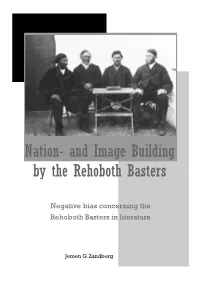
Nation- and Image Building by the Rehoboth Basters Negative bias concerning the Rehoboth Basters in literature Jeroen G. Zandberg Nation- and Image Building by the Rehoboth Basters Negative bias concerning the Rehoboth Basters in literature 1. Introduction Page 3 2. How do I define a negative biased statement? …………………..5 3. The various statements ……………………………………… 6 3.1 Huibregtse ……………………………………… ……. 6 3.2 DeWaldt ……………………………………………. 9 3.3 Barnard ……………………………………………. 12 3.4 Weiss ……………………………………………. 16 4. The consequences of the statements ………………………… 26 4.1 Membership application to the UNPO ……………27 4.2 United Nations ………………………………………29 4.3 Namibia ……………………………………………..31 4.4 Baster political identity ………………………………..34 5. Conclusion and recommendation ……………………………...…38 Bibliography …………………………………………………….41 Rehoboth journey ……………………………………………...43 Picture on front cover: The Kapteins Council in 1876. From left to right: Paul Diergaardt, Jacobus Mouton, Hermanus van Wijk, Christoffel van Wijk. On the table lies the Rehoboth constitution (the Paternal Laws) Jeroen Gerk Zandberg 2005 ISBN – 10: 9080876836 ISBN – 13: 9789080876835 2 1. Introduction The existence of a positive (self) image of a people is very important in the successful struggle for self-determination. An image can be constructed through various methods. This paper deals with the way in which an incorrect image of the Rehoboth Basters was constructed via the literature. Subjects that are considered interesting or popular, usually have a great number of different publications and authors. A large quantity of publications almost inevitably means that there is more information available on that specific topic. A large number of publications usually also indicates a great amount of authors who bring in many different views and interpretations. -
The Immediate and Long-Term Effects of Namibia's Colonization Process
The Immediate and Long-Term Effects of Namibia’s Colonization Process By: Jonathan Baker Honors Capstone Through Professor Taylor Politics of Sub-Saharan Africa Baker, 2 Table of Contents I. Authors Note II. Introduction III. Pre-Colonization IV. Colonization by Germany V. Colonization by South Africa VI. The Struggle for Independence VII. The Decolonization Process VIII. Political Changes- A Reaction to Colonization IX. Immediate Economic Changes Brought on by Independence X. Long Term Political Effects (of Colonization) XI. Long Term Cultural Effects XII. Long Term Economic Effects XIII. Prospects for the Future XIV. Conclusion XV. Bibliography XVI. Appendices Baker, 3 I. Author’s Note I learned such a great deal from this entire honors capstone project, that all the knowledge I have acquired can hardly be covered by what I wrote in these 50 pages. I learned so much more that I was not able to share both about Namibia and myself. I can now claim that I am knowledgeable about nearly all areas of Namibian history and life. I certainly am no expert, but after all of this research I can certainly consider myself reliable. I have never had such an extensive knowledge before of one academic area as a result of a school project. I also learned a lot about myself through this project. I learned how I can motivate myself to work, and I learned how I perform when I have to organize such a long and complicated paper, just to name a couple of things. The strange inability to be able to include everything I learned from doing this project is the reason for some of the more random appendices at the end, as I have a passion for both numbers and trivia. -

IMPACT REPORT a Word from the Founder and Director|
2017 - 2020 IMPACT REPORT A word from the founder and director| In October 2017 as we were preparing to launch a collaborative " network of journalists dedicated to pursuing and publishing the work of other reporters facing threats, prison or murder, prominent Maltese investigative journalist Daphne Caruana Galizia was horrifically silenced with a car bomb. Her murder was a cruel and stark reminder of how tenuous the free flow of information can be when democratic systems falter. We added Daphne to the sad and long list of journalists whose work Forbidden Stories is committed to continuing. For five months, we coordinated a historic collaboration of 45 journalists from 18 news organizations, aimed at keeping Daphne Caruana Galizia’s stories alive. Her investigations, as a result of this, ended up on the front pages of the world’s most widely-read newspapers. Seventy-four million people heard about the Daphne Project worldwide. Although her killers had hoped to silence her stories, the stories ended up having an echo way further than Malta. LAURENT RICHARD Forbidden Stories' founder Three years later, the journalists of the Daphne Project continue and executive director. to publish new revelations about her murder and pursue the investigations she started. Their explosive role in taking down former Maltese high-ranking government officials confirms that collaboration is the best protection against impunity. 2 2017-2020 Forbidden Stories Impact Report A word from the founder and director| That’s why other broad collaborative On a smaller scale, we have investigations followed. developed rapid response projects. We investigated the circumstances The Green Blood Project, in 2019, pursued behind the murders of Ecuadorian, the stories of reporters in danger for Mexican and Ghanaian journalists; investigating environmental scandals. -

FINANCE Offshore Finance.Pdf
This page intentionally left blank OFFSHORE FINANCE It is estimated that up to 60 per cent of the world’s money may be located oVshore, where half of all financial transactions are said to take place. Meanwhile, there is a perception that secrecy about oVshore is encouraged to obfuscate tax evasion and money laundering. Depending upon the criteria used to identify them, there are between forty and eighty oVshore finance centres spread around the world. The tax rules that apply in these jurisdictions are determined by the jurisdictions themselves and often are more benign than comparative rules that apply in the larger financial centres globally. This gives rise to potential for the development of tax mitigation strategies. McCann provides a detailed analysis of the global oVshore environment, outlining the extent of the information available and how that information might be used in assessing the quality of individual jurisdictions, as well as examining whether some of the perceptions about ‘OVshore’ are valid. He analyses the ongoing work of what have become known as the ‘standard setters’ – including the Financial Stability Forum, the Financial Action Task Force, the International Monetary Fund, the World Bank and the Organization for Economic Co-operation and Development. The book also oVers some suggestions as to what the future might hold for oVshore finance. HILTON Mc CANN was the Acting Chief Executive of the Financial Services Commission, Mauritius. He has held senior positions in the respective regulatory authorities in the Isle of Man, Malta and Mauritius. Having trained as a banker, he began his regulatory career supervising banks in the Isle of Man. -

Narrative Report on Panama
NARRATIVE REPORT ON PANAMA PART 1: NARRATIVE REPORT Rank: 15 of 133 Panama ranks 15th in the 2020 Financial Secrecy Index, with a high secrecy score of 72 but a small global scale weighting (0.22 per cent). How Secretive? 72 Coming within the top twenty ranking, Panama remains a jurisdiction of particular concern. Overview and background Moderately secretive 0 to 25 Long the recipient of drugs money from Latin America and with ample other sources of dirty money from the US and elsewhere, Panama is one of the oldest and best-known tax havens in the Americas. In recent years it has adopted a hard-line position as a jurisdiction that refuses to 25 to 50 cooperate with international transparency initiatives. In April 2016, in the biggest leak ever, 11.5 million documents from the Panama law firm Mossack Fonseca revealed the extent of Panama’s involvement in the secrecy business. The Panama Papers showed the 50 to 75 world what a few observers had long been saying: that the secrecy available in Panama makes it one of the world’s top money-laundering locations.1 Exceptionally 75 to 100 In The Sink, a book about tax havens, a US customs official is quoted as secretive saying: “The country is filled with dishonest lawyers, dishonest bankers, dishonest company formation agents and dishonest How big? 0.22% companies registered there by those dishonest lawyers so that they can deposit dirty money into their dishonest banks. The Free Trade Zone is the black hole through which Panama has become one of the filthiest money laundering sinks in the huge world.”2 Panama has over 350,000 secretive International Business Companies (IBCs) registered: the third largest number in the world after Hong Kong3 and the British Virgin Islands (BVI).4 Alongside incorporation of large IBCs, Panama is active in forming tax-evading foundations and trusts, insurance, and boat and shipping registration. -

Namibia and Angola: Analysis of a Symbiotic Relationship Hidipo Hamutenya*
Namibia and Angola: Analysis of a symbiotic relationship Hidipo Hamutenya* Introduction Namibia and Angola have much in common, but, at the same time, they differ greatly. For example, both countries fought colonial oppression and are now independent; however, one went through civil war, while the other had no such experience. Other similarities include the fact that the former military groups (Angola’s Movimiento Popular para la Liberacão de Angola, or MPLA, and Namibia’s South West Africa People’s Organisation, or SWAPO) are now in power in both countries. At one time, the two political movements shared a common ideological platform and lent each other support during their respective liberation struggles. The two countries are also neighbours, with a 1,376-km common border that extends from the Atlantic Ocean in the east to the Zambezi River in the west. Families and communities on both sides of the international boundary share resources, communicate, trade and engage in other types of exchange. All these facts point to a relationship between the two countries that goes back many decades, and continues strongly today. What defines this relationship and what are the crucial elements that keep it going? Angola lies on the Atlantic coast of south-western Africa. It is richly endowed with natural resources and measures approximately 1,246,700 km2 in land surface area. Populated with more than 14 million people, Angola was a former Portuguese colony. Portuguese explorers first came to Angola in 1483. Their conquest and exploitation became concrete when Paulo Dias de Novais erected a colonial settlement in Luanda in 1575. -
THE BÊTE NOIRE of ORGANIZED CRIME © Pexel.Com © Pexel.Com CONTENTS CONTENTS
1 JOURNALISTS: THE BÊTE NOIRE OF ORGANIZED CRIME © Pexel.com CONTENTS Foreword 4 Shut up or die Crime terminology 6 Mafias and cartels Disturbing figures 1. Emergence of a European mafia 8 Murders in three EU countries in less than a year 8 • Slovakia: Ján Kuciak wasn’t just annoying the ‘Ndrangheta • Malta: symbol of persecution of investigative journalists • Bulgaria: journalist’s murder under investigation Organized crime tightens hold on many European countries 12 • In Italy: Saviano, Borrometi and 194 others • Two journalists protected around the clock in the Netherlands • France not spared Balkan journalists and Russian mob 19 • Jovo Martinovic in Montenegro • Albania: smeared, hounded and threatened, Alida Tota keeps going Soft control: infiltrating the media 20 • A Bulgarian deputy and oligarch’s media empire 2. Take care, subject off limits 22 Drug cartels show no pity towards journalists 22 • At least 32 Mexican journalists killed by cartels since 2012 • Colombia: no-go areas Environmental journalists targeted by local gangs 24 • India’s sand mafia sows death • Journalists versus Cambodia’s sand cartels • John Grobler runs into Cosa Nostra in Namibia © Pexel.com Organized crime allied with corrupt businessmen and politicians 27 • Poland: Tomasz Piatek versus Russian mafia • Russia: politicians and hitmen • Turkey: pro-government gangster’s blacklist Japanese media keep mum about the yakuza 30 • Yakuza – they who shall not be named 3 • Interview with US journalist Jake Adelstein: “The yakuza use the media as an instrument of -

The Taxation of Trusts in Sadc Member States
CORE Metadata, citation and similar papers at core.ac.uk Provided by Stellenbosch University SUNScholar Repository 2018 (2) StellLR 270 THE TAXATION OF TRUSTS IN SADC MEMBER STATES Izelle du Plessis BCom (Law) LLB LLM (Taxation) LLD (Stell) Senior Lecturer: Department of Mercantile Law, Stellenbosch University. 1 Introduction It is generally acknowledged that the trust1 originated in the English law.2 Yet, trusts are used (or at least recognised) in most jurisdictions worldwide.3 In fact, many Southern African Development Community (“SADC”) member states4 use trusts. Evidence of the use of trusts was found in Botswana, Lesotho, Malawi, Mauritius Namibia, Seychelles, Swaziland, Tanzania, Zambia and Zimbabwe. Perhaps this is not surprising, taking into account the influence of the English law on many of its former colonies.5 Despite a concerted effort, no indication could be found that trusts are used in Angola, the Democratic Republic of the Congo, Madagascar or Mozambique. Although it may be possible that relevant information was missed due to language barriers,6 a more likely explanation is that trusts are unknown in these states, because the law in these states is based primarily on civilian principles, or were significantly influenced by civilian principles. Consequently, this articleis limited to a 1 For purposes of this article, the rather broad and general definition of a trust, as found in article 2 of Hague Convention on the Law Applicable to Trusts and on their Recognition (adopted on 1 July 1985, entered into force 1 January 1992), will be used. This definition reads as follows: “For the purposes of this Convention, the term ‘trust’ refers to the legal relationships created – inter vivos or on death – by a person, the settlor, when assets have been placed under the control of a trustee for the benefit of a beneficiary or for a specified purpose. -

100 Years Since the End of German Colonial Rule in Namibia, The
100 years since the end of German colonial rule in Namibia, the relationship between the former colonial power and the Namibian communities who were affected by its brutal colonial policies remains problematic, and interpretations of the past are still contested. This book examines the ongoing debates, conflicts and confrontations over the past. It scrutinises the consequences of German colonial rule, its impact on the descendants of victims of the 1904–08 genocide, Germany’s historical responsibility, and ways in which post-colonial reconciliation might be achieved. REINHART KÖSSLER is currently Director of the Arnold Bergstraesser Institute and Professor in the Politics Department of the University of Freiburg, Germany. His research includes social and development theory, political sociology and memory politics. Namibia and Germany: Negotiating the Past Reinhart Kössler University of Namibia Press www.unam.edu.na/unam-press unampress@unam.na Private Bag 13301 Windhoek Namibia © Reinhart Kössler, 2015 All rights reserved. No part of this publication may be reproduced, stored in any retrieval system or transmitted in any form, or by any means, e.g. electronic, mechanical, photocopying, recording or otherwise without prior permission of the author. First published: 2015 Cover photograph: Nicola Brandt, Spectre (2013), from her exhibition The Earth Inside, National Art Gallery of Namibia, 2014 Cover design: Steffen List Copy-editing: Tara Elyssa Design and layout: Vivien Barnes, Handmade Communications Printed by: John Meinert Printers, Windhoek ISBN 978-99916-42-09-3 Distributed internationally by the African Books Collective: www.africanbookscollective.com Westfälisches Dampfboot Verlag, Freiburg, has the English language rights for Germany, Austria and Switzerland: www.dampfboot-verlag.de ‘Even in brutality the inherited dress is sacred. -

FIFA's Unintended Role in Illuminating Jurisdictional Gaps of International
Brooklyn Journal of International Law Volume 41 Article 15 Issue 3 SYMPOSIUM: Reconsidering the Tax Treaty 2016 Free Kick: FIFA’s Unintended Role in Illuminating Jurisdictional Gaps of International Criminal Courts Travis L. Marmara Follow this and additional works at: https://brooklynworks.brooklaw.edu/bjil Part of the Criminal Law Commons, International Law Commons, and the Transnational Law Commons Recommended Citation Travis L. Marmara, Free Kick: FIFA’s Unintended Role in Illuminating Jurisdictional Gaps of International Criminal Courts, 41 Brook. J. Int'l L. (2016). Available at: https://brooklynworks.brooklaw.edu/bjil/vol41/iss3/15 This Note is brought to you for free and open access by the Law Journals at BrooklynWorks. It has been accepted for inclusion in Brooklyn Journal of International Law by an authorized editor of BrooklynWorks. FREE KICK: FIFA’S UNINTENDED ROLE IN ILLUMINATING JURISDICTIONAL GAPS OF INTERNATIONAL CRIMINAL COURTS “There can be no peace without justice, no justice without law and no meaningful law without a Court to decide what is just and lawful under any given circumstance.”1 INTRODUCTION he Fédération Internationale de Football Association T(FIFA) is more than just the governing body of the world’s most popular sport.2 For perspective, the organization has more member associations than the General Assembly of the United Nations.3 Due to the popularity of soccer,4 FIFA yields almost limitless power, and its position in the international community allows it to influence matters outside of the sport.5 In fact, FIFA itself proclaims: “[W]e have a responsibility that goes beyond the development of football and the organisation of our competitions. -
The Panama Papers and Investigative Journalism in Africa Lessons Learned from and About the Data
3. The role of open data THE PANAMA PAPERS AND INVESTIGATIVE JOURNALISM IN AFRICA LESSONS LEARNED FROM AND ABOUT THE DATA LESSONS LEARNED PAPER Summary Governments are tasked to raise and spend tax revenues wisely to improve the lives of all citizens. However, all too often resources are allocated to the few and away from the many who are most in need. Such discrimination needs to be documented and made transparent. Opening up data can help to facilitate the process. Data can often tell us the basics: the who, what, where, when and why of financial transactions. And investigative reporters can use data to provide answers to these crucial questions, and to mobilise citizens and institutions to hold the offenders to account. The International Consortium of Investigative Journalists (ICIJ), together with the German newspaper Suddeutsche Zeitung and more than 100 other media partners, spent a year sifting through 11.5 million leaked files from the Panama-based law firm Mossack Fonseca to expose the reported offshore holdings of world leadersand details of hidden financial dealings. The leaked data was commonly referred to as the Panama Papers. The African Network of Centers for Investigative Reporting (ANCIR), supported by funders such as the World Wide Web Foundation and Open Society Initiative of West Africa, coordinated and developed investigations in Africa. The Panama Papers project was the first time a major transnational investigation was coherently and collectively represented by journalists within the African countries being written about. This paper summarises the lessons learned from the African investigations of the Panama Papers, both in terms of what we learned about doing investigative data journalism in Africa and in terms of what those investigations revealed about the reported offshore holdings of the powerful and the deliberately complex governance structures allegedly set up to conceal the flow of money. -

Ethnicity in Namibia
Namibia Ethnicity in Namibia Group selection Ethnicity is relevant in Namibian politics but it is a complicated and unstable issue with constant re-groupings and changing identi- ties (see e.g. 3626; 3627; 3628; 3629; see 3630 for a list of the different 3626 [Flint, 2003] ethnic and linguistic groups, and their relationship and overlap- 3627 [Fosse, 1997] 3628 ping). Although the constitution and the government of Namibia are [Taylor, 2009] 3629 [Kjaeret & Stokke, 2003] strongly committed to a unified nation (“One Namibia, one nation”), 3630 [Lewis, 2009] there are differences regarding political representation and access to power which are to be explained by ethnic cleavages (3631). Most of 3631 [Daniels, 2003] the political parties in Namibia are formed around ethnic issues (see e.g. 3632; 3633). 3632 [Schillinger, 2005] 3633 [Emminghaus, 2002] Power relations 1990-2014 The SWAPO is dominating the political arena. It finds its support mainly among the Ovambos, yet as well to lesser extent among people of most other groups in the country, and includes members of other ethnic groups in the government: especially Hereros and Damaras and Namas following Schillinger’s and Suzman’s state- ments, as for example the Prime Minister and Deputy Prime Min- ister hail from the Damara and Nama communities, respectively (3634, 12f; 3635, 16). When coming to power after independence, the 3634 [Schillinger, 2005] SWAPO was facing the problem of building a unified nation out of 3635 [Suzman, 2002] an ethnically divided society inherited from the former colonizers (see 3636, 7-10). To avoid tribalization or ethnicization which could 3636 [Suzman, 2002] threaten the integrity of the new state, the national government tried to include traditional leaders from different ethnic groups in the political decision-making (ibid., 10).