Italian Cinema and the Fascist Past: Tracing Memory Amnesia
Total Page:16
File Type:pdf, Size:1020Kb
Load more
Recommended publications
-
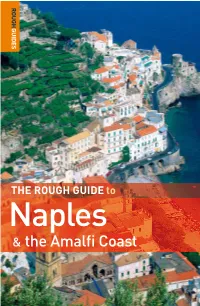
The Rough Guide to Naples & the Amalfi Coast
HEK=> =K?:;I J>;HEK=>=K?:;je CVeaZh i]Z6bVaÒ8dVhi D7FB;IJ>;7C7B<?9E7IJ 7ZcZkZcid BdcYgV\dcZ 8{ejV HVc<^dg\^d 8VhZgiV HVciÉ6\ViV YZaHVcc^d YZ^<di^ HVciVBVg^V 8{ejVKiZgZ 8VhiZaKdaijgcd 8VhVaY^ Eg^cX^eZ 6g^Zcod / AV\dY^EVig^V BVg^\a^Vcd 6kZaa^cd 9WfeZ_Y^_de CdaV 8jbV CVeaZh AV\dY^;jhVgd Edoojda^ BiKZhjk^jh BZgXVidHVcHZkZg^cd EgX^YV :gXdaVcd Fecf[__ >hX]^V EdbeZ^ >hX]^V IdggZ6ccjco^ViV 8VhiZaaVbbVgZY^HiVW^V 7Vnd[CVeaZh GVkZaad HdggZcid Edh^iVcd HVaZgcd 6bVa[^ 8{eg^ <ja[d[HVaZgcd 6cVX{eg^ 8{eg^ CVeaZh I]Z8Vbe^;aZ\gZ^ Hdji]d[CVeaZh I]Z6bVa[^8dVhi I]Z^haVcYh LN Cdgi]d[CVeaZh FW[ijkc About this book Rough Guides are designed to be good to read and easy to use. The book is divided into the following sections, and you should be able to find whatever you need in one of them. The introductory colour section is designed to give you a feel for Naples and the Amalfi Coast, suggesting when to go and what not to miss, and includes a full list of contents. Then comes basics, for pre-departure information and other practicalities. The guide chapters cover the region in depth, each starting with a highlights panel, introduction and a map to help you plan your route. Contexts fills you in on history, books and film while individual colour sections introduce Neapolitan cuisine and performance. Language gives you an extensive menu reader and enough Italian to get by. 9 781843 537144 ISBN 978-1-84353-714-4 The book concludes with all the small print, including details of how to send in updates and corrections, and a comprehensive index. -

Italian Cinema WL 3390/CTV 3390 No Prerequisites. in English
Italian Cinema WL 3390/CTV 3390 No prerequisites. In English. SYLLABUS Brandy Alvarez balvarez@smu.edu 416 Clements Hall Tel. 214 768 1892 Required texts: Peter Bondanella, Italian Cinema from Noerealism to the Present ; Continuum, New York, 1997 (Third Edition 2001) and course packet Grading: 25 % class discussion 25 % daily response papers 25 % oral presentation 25 % final paper Methods of evaluation : Students will write short responses to each film (generally one page to a page and a half) and answer analytical questions that are distributed with each film, present to the class a summary of a critical film essay, and write a five-page final paper on one of the film's we viewed in class. Absences: Given the nature of the J-term course, any absence will affect the final grade (one grade for each absence). Student Learning Outcomes: (from Creativity and Aesthetics: Level One : 1). Students will be able to identify methods, techniques, or languages of a particular art form and explain how those inform its creation, performance, or analysis, and 2. Students will be able to demonstrate an understanding of concepts fundamental to the creative impulse through analysis. Overview and additional learning expectations : This course offers a brief chronological survey of renowned Italian films and directors as well as exemplars of popular cinema that enjoyed box office success abroad. We will explore the themes and cinematic style of Neorealism and the 'generational' waves of those directors who followed in its wake, including Fellini. Students will watch the films in original language with English subtitles. • Students learn the fundamentals of film analysis, including the basic structural and narrative components of a film, and the terminology necessary to describe both. -

The Myth of the Good Italian in the Italian Cinema
ISSN 2039-2117 (online) Mediterranean Journal of Social Sciences Vol 5 No 16 ISSN 2039-9340 (print) MCSER Publishing, Rome-Italy July 2014 The Myth of the Good Italian in the Italian Cinema Sanja Bogojević Faculty of Philosophy, University of Montenegro Doi:10.5901/mjss.2014.v5n16p675 Abstract In this paper we analyze the phenomenon called the “myth of the good Italian” in the Italian cinema, especially in the first three decades of after-war period. Thanks to the recent success of films such as Tarantino’s Inglorious Basterds or Academy Award- winning Benigni’s film La vita è bella and Spielberg’s Schindler’s List it is commonly believed that the Holocaust is a very frequent and popular theme. Nevertheless, this statement is only partly true, especially when it comes to Italian cinema. Soon after the atrocities of the WWII Italian cinema became one of the most prominent and influential thanks to its national film movement, neorealism, characterized by stories set amongst the poor and famished postwar Italy, celebrating the fight for freedom under the banners of Resistance and representing a nation opposed to the Fascist and Nazi regime. Interestingly, these films, in spite of their very important social engagement, didn’t even mention the Holocaust or its victims and it wasn’t until the 1960’s that Italian cinema focused on representing and telling this horrific stories. Nevertheless, these films represented Italians as innocent and incapable of committing cruel acts. The responsibility is usually transferred to the Germans as typically cold and sadistic, absolving Italians of their individual and national guilt. -

Guide to the Papers of the Capri Community Film Society
Capri Community Film Society Papers Guide to the Papers of the Capri Community Film Society Auburn University at Montgomery Archives and Special Collections © AUM Library Written By: Rickey Best & Jason Kneip Last Updated: 2/19/2008 TABLE OF CONTENTS Content Page # Collection Summary 2 Administrative Information 2 Restrictions 2-3 Index Terms 3 Agency History 3-4 1 of 64 Capri Community Film Society Papers Scope and Content 5 Arrangement 5-10 Inventory 10- Collection Summary Creator: Capri Community Film Society Title: Capri Community Film Society Papers Dates: 1983-present Quantity: 6 boxes; 6.0 cu. Ft. Identification: 92/2 Contact Information: AUM Library Archives & Special Collections P.O. Box 244023 Montgomery, AL 36124-4023 Ph: (334) 244-3213 Email: archives@mail.aum.edu Administrative Information Preferred Citation: Capri Community Film Society Papers, Auburn University Montgomery Library, Archives & Special Collections. Acquisition Information: The collection began with an initial transfer on September 19, 1991. A second donation occurred in February, 1995. Since then, regular donations of papers occur on a yearly basis. Processed By: Jermaine Carstarphen, Student Assistant & Rickey Best, Archivist/Special Collections Librarian (1993); Jason Kneip, Archives/Special Collections Librarian. Samantha McNeilly, Archives/Special Collections Assistant. 2 of 64 Capri Community Film Society Papers Restrictions Restrictions on access: Access to membership files is closed for 25 years from date of donation. Restrictions on usage: Researchers are responsible for addressing copyright issues on materials not in the public domain. Index Terms The material is indexed under the following headings in the Auburn University at Montgomery’s Library catalogs – online and offline. -

Onlus 10Anni
Report on 10 years of activity anni onlus 10 2009 > 2019 INDEX 1. Introduction .........................................pag. 6 2. Maurizio Valenzi .................................................pag. 9 3. Places of the Foundation ...................... pag. 15 THE OFFICES .........................................................pag. 15 THE ARCHIVE .......................................................pag. 15 ART COLLECTION .................................................pag. 16 4. Activities ........................................... pag. 19 FOR MEMORY .......................................................pag. 21 FOR EDUCatION ..................................................pag. 24 FOR ART ................................................................pag. 26 FOR THE SOCIAL ..................................................pag. 30 FOR DEVELOPMENT ............................................pag. 33 5. Our next 10 years ............................... pag. 36 APPENDIX GOVERNANCE AND CONtaCTS .........................pag. 39 HONORARY COMMITTEE ....................................pag. 40 STEERING COMMITTEE .......................................pag. 40 SCIENTIFIC COMMITTEE .....................................pag. 40 BIBLIOGRAPHY ON MAURIZIO VaLENZI ..........pag. 41 PUBLICatIONS .....................................................pag. 42 AGREEMENTS AND PaRTNERSHIPS..................pag. 43 TO SUPPORT THE FOUNDatION ........................pag. 44 THE NUMBERS OF THE FOUNDatION ..............pag. 45 THE FOUNDatION ON SOCIAL MEDIA ..............pag. -

Ian Campbell 4 Dominioni, Matteo, 2008, Lo Sfascio Dell'impero
Shiferaw Bekele Citation: Bekele Shiferaw, 2010, Testimony. Interview conducted by Roman Herzog April 19th 2010, http://www.campifascisti.it/file/media/TSB%201%20Testimony%20Shiferew%20Bekele.pdf Name: Shiferaw Surname: Bekele Nationality: Ethiopian Gender: m Profession: Expert: Historian Camps of imprisonment: Shano Nocra Dhanaane/Danane* Ambo Mayor topics and particularities of the interview (Summary): The fascist war and occupation in Ethiopia; the first total war; re-dating Second World War; Africanist Historians and their position in the World; the ideology of Italian Fascism; racism and racial laws; the project of Italian Empire; Germany learning from Italy; the Ethiopian War as field of experimentation of modern wars; Policy and impunity; the failure of the League of Nations; atrocities; the resistance after the proclamation of the Empire; the concentration camps; the economic role of the camps; killing camps; the deportation to Italy; the research basis; relation between the German and the Italian camps; the role of the Blackshirts; the Ethiopian Jews; n international justice; Ethiopia scarified for post war stability; Italo-Ethiopian relations after 1945; the Del Boca group; compensation; intelligenzia and collective memory; Ethiopian collaboration; Ethiopian Memory. Date, place and duration of the interview: April 19th 2010, Addis Abeba, 112’50” Language used: English Recording quality: (48 kHz., Stereo) Name of the researcher and copyright holder: Roman Herzog Fundamental elements of the meeting: Interview in a room in the Ibaks Hotel. Researcher I would like to begin a little bit about the war itself, what is particular about Italian Coloni- alism, about the Fascist war and occupation in Ethiopia? Shiferaw Bekele The fascist occupation and the fascist war have quite e few peculiar features in the history of colonialism in Africa. -

California State University, Sacramento Department of World Literatures and Languages Italian 104 a INTRODUCTION to ITALIAN CINEMA I GE Area C1 SPRING 2017
1 California State University, Sacramento Department of World Literatures and Languages Italian 104 A INTRODUCTION TO ITALIAN CINEMA I GE Area C1 SPRING 2017 Course Hours: Wednesdays 5:30-8:20 Course Location: Mariposa 2005 Course Instructor: Professor Barbara Carle Office Location: Mariposa Hall 2057 Office Hours: W 2:30-3:30, TR 5:20-6:20 and by appointment CATALOG DESCRIPTION ITAL 104A. Introduction to Italian Cinema I. Italian Cinema from the 1940's to its Golden Period in the 1960's through the 1970's. Films will be viewed in their cultural, aesthetic and/or historical context. Readings and guiding questionnaires will help students develop appropriate viewing skills. Films will be shown in Italian with English subtitles. Graded: Graded Student. Units: 3.0 COURSE GOALS and METHODS: To develop a critical knowledge of Italian film history and film techniques and an aesthetic appreciation for cinema, attain more than a mere acquaintance or a broad understanding of specific artistic (cinematographic) forms, genres, and cultural sources, that is, to learn about Italian civilization (politics, art, theatre and customs) through cinema. Guiding questionnaires will also be distributed on a regular basis to help students achieve these goals. All questionnaires will be graded. Weekly discussions will help students appreciate connections between cinema and art and literary movements, between Italian cinema and American film, as well as to deal with questionnaires. You are required to view the films in the best possible conditions, i.e. on a large screen in class. Viewing may be enjoyable but is not meant to be exclusively entertaining. -

Omar Al-Mukhtar the Libyan Battle for the Heritage of Omar Al-Mukhtar, the “Lion of the Desert” by Andrew Mcgregor
VOLUME IX, ISSUE 10 u MARCH 10, 2011 IN THIS ISSUE: BRIEFS..................................................................................................................................1 AL-QAEDA IN THE ARABIAN PENINSULA AND THE PROTESTS IN YEMEN By Erik Stier..............................................................................................................3 THE CASE OF THE IRANIAN WARSHIPS AND THE SUEZ CANAL By Nima Adelkhah.......................................................................................................5 Omar al-Mukhtar THE LIBYAN BATTLE FOR THE HERITAGE OF OMAR AL-MUKHTar, the “lion of THE DESERt” By Andrew McGregor...............................................................................................7 Terrorism Monitor is a publication of The Jamestown Foundation. The Terrorism Monitor is designed to be read by policy- makers and other specialists yet be accessible to the general LIBYAN LOYALISTS AND DISSIDENTS VIE FOR TUAREG FIGHTERS public. The opinions expressed within are solely those of the With the fate of Libya in the balance, both sides in the struggle to determine its authors and do not necessarily future are appealing to North Africa’s indigenous Tuareg warriors for military reflect those of The Jamestown Foundation. help. Libya’s own Tuareg population of roughly 50,000 has been simultaneously courted and deprived of its cultural and ethnic heritage by the Qaddafi government. The regime classes the non-Semitic Berber Tuareg as a branch of Unauthorized reproduction or the Arab nation -

Programme 2010.Indd
Table of contents 2 Welcome 4 Overview 8 Presentation of Reports 12 Meetings 14 Agenda › 6 December morning 19 Agenda › 6 December afternoon 28 Agenda › 7 December morning 34 Agenda › 7 December afternoon 38 Exhibitions 42 Speakers 47 Organisations 51 General Map 52 Development Village Plan 56 EDD 2010 OFF Programme 1 Welcome European Development Days is a landmark event in Objectives the European development calendar. It is Europe’s fore- The objective of European Development Days is to most platform for dialogue and discussion on develop- encourage a policy dialogue, where the development ment issues. In bringing together the global development community can exchange ideas on how to tackle community, European Development Days presents an challenges, and debate how best to get the most unmatched opportunity for key development actors to from the added value of development aid and its cost- share and develop ideas and debate the EU’s policies effectiveness. Europe’s development policy has to address for tackling poverty worldwide. The event, organised a variety of challenges to achieve “higher-impact” aid. jointly by the European Commission and the Belgian These challenges – many of which are highlighted in the Presidency of the European Union, will bring together Commission’s Green Paper on Development Policy to be Heads of State, representatives of national govern- published ahead of EDD – include the issue of ensuring ments, Members of the European Parliament, European more inclusive growth, as well as fairer, more effi cient and development fi nance institutions, key civil society repre- more environmentally sustainable development policies. sentatives, NGOs, as well as Business Europe and the Two essential prerequisites are effective cooperation and International Finance Corporation, to name but a few. -

(Dis)Figuring White Template Vision Through Passione Stefania Capogreco
(Dis)figuring white template vision through Passione Stefania Capogreco To cite this version: Stefania Capogreco. (Dis)figuring white template vision through Passione. Muiraquitã, Nepan Edi- tora, 2017, South-Verting Italian Studies, 5 (2). hprints-03049743 HAL Id: hprints-03049743 https://hal-hprints.archives-ouvertes.fr/hprints-03049743 Submitted on 10 Dec 2020 HAL is a multi-disciplinary open access L’archive ouverte pluridisciplinaire HAL, est archive for the deposit and dissemination of sci- destinée au dépôt et à la diffusion de documents entific research documents, whether they are pub- scientifiques de niveau recherche, publiés ou non, lished or not. The documents may come from émanant des établissements d’enseignement et de teaching and research institutions in France or recherche français ou étrangers, des laboratoires abroad, or from public or private research centers. publics ou privés. (DIS)FIGURING WHITE TEMPLATE VISION THROUGH PASSIONE: UN’AVVENTURA MUSICALE Stefania Capogreco Macquarie University Introduction This paper suggests that north-normative thought in Italian Studies must be disrupted by recovering the various Souths haunting and inhabiting white template vision. I propose to usefully disrupt north-normative colonial cartographies of vision by disclosing the “fleshy folds” of John Turturro’s complex audio-visual work Passione: Un’Avventura Musicale (2010). Passione is a documentary film which draws on, as it narrates the story of, a broad assemblage of Neapolitan music and theatricalities. Neapolitan music is often conflated with Italian traditional song or confined to the realm of regional music, in both popular interpretations and scholarly analyses (PLASTINO, 2007). This widespread conflation of Neapolitan and Italian traditional song, resulted in the porous Neapolitan voice (always allowing itself to be interpenetrated by an indeterminate other; PLASTINO, 2007) and its embodied performance manifestations (PLASTINO & SCIORRA, 2016) being largely overlooked. -

On the Roman Frontier1
Rome and the Worlds Beyond Its Frontiers Impact of Empire Roman Empire, c. 200 B.C.–A.D. 476 Edited by Olivier Hekster (Radboud University, Nijmegen, The Netherlands) Editorial Board Lukas de Blois Angelos Chaniotis Ségolène Demougin Olivier Hekster Gerda de Kleijn Luuk de Ligt Elio Lo Cascio Michael Peachin John Rich Christian Witschel VOLUME 21 The titles published in this series are listed at brill.com/imem Rome and the Worlds Beyond Its Frontiers Edited by Daniëlle Slootjes and Michael Peachin LEIDEN | BOSTON This is an open access title distributed under the terms of the CC-BY-NC 4.0 License, which permits any non-commercial use, distribution, and reproduction in any medium, provided the original author(s) and source are credited. The Library of Congress Cataloging-in-Publication Data is available online at http://catalog.loc.gov LC record available at http://lccn.loc.gov/2016036673 Typeface for the Latin, Greek, and Cyrillic scripts: “Brill”. See and download: brill.com/brill-typeface. issn 1572-0500 isbn 978-90-04-32561-6 (hardback) isbn 978-90-04-32675-0 (e-book) Copyright 2016 by Koninklijke Brill NV, Leiden, The Netherlands. Koninklijke Brill NV incorporates the imprints Brill, Brill Hes & De Graaf, Brill Nijhoff, Brill Rodopi and Hotei Publishing. All rights reserved. No part of this publication may be reproduced, translated, stored in a retrieval system, or transmitted in any form or by any means, electronic, mechanical, photocopying, recording or otherwise, without prior written permission from the publisher. Authorization to photocopy items for internal or personal use is granted by Koninklijke Brill NV provided that the appropriate fees are paid directly to The Copyright Clearance Center, 222 Rosewood Drive, Suite 910, Danvers, MA 01923, USA. -

Italy's Colonial Futures
Italy’s Colonial Futures: Colonial Inertia and Postcolonial Capital in Asmara Mia Fuller Asmara is no longer a secret. --Naigzy Gebremedhin (2007, 25) The mal d’Africa of the nineteenth century has been supplanted by the mal d’Europa of the twentieth century. --Ruth Iyob (2005b, 271) Italy hardly appears likely to acquire colonial territories in the future, though it participates in some of the West’s wars and peacekeeping efforts (the Iraq coalition and NATO’s assault on Qadhafi’s regime; Eritrea and Lebanon) – all of them, from one point of view, legacies of the colonial era. Instead, this article takes into consideration a different sort of colonial future: one inherent in an unconcluded colonial past. Italy certainly has a colonial past, albeit one that is often described as rimosso (“repressed” or “displaced”), suggesting it is less than accessible, and perhaps hard to locate. Although it is true that most Italians are poorly informed about their country’s past deeds and misdeeds in Eritrea, Somalia, Libya, the Dodecanese Islands, Ethiopia, and Albania, I claim here that rather than invisible, the traces of Italy’s colonial ventures are ubiquitous. This is true of Italy itself, if one knows where to look, but in this essay I am interested in the former colonies above all. In Asmara, the capital city of the ex-colony of Eritrea, I describe Italy’s colonial inertia, or how Italy’s once-vigorously implanted colonial signature has sustained momentum and shows every promise of continuing to do so. When Italian colonizers left in the post-World War Two era, their refashioning of built, cultural, and social environments to their own specifications did not vanish with them.1 On the contrary, Italians’ architectural and urban interventions, along with social, economic, and linguistic reminders of their occupation of Asmara, have been preserved quite faithfully.