NASA Fundamental Space Biology Science Plan, 2010-2020
Total Page:16
File Type:pdf, Size:1020Kb
Load more
Recommended publications
-
Intelligent Design, Abiogenesis, and Learning from History: Dennis R
Author Exchange Intelligent Design, Abiogenesis, and Learning from History: Dennis R. Venema A Reply to Meyer Dennis R. Venema Weizsäcker’s book The World View of Physics is still keeping me very busy. It has again brought home to me quite clearly how wrong it is to use God as a stop-gap for the incompleteness of our knowledge. If in fact the frontiers of knowledge are being pushed back (and that is bound to be the case), then God is being pushed back with them, and is therefore continually in retreat. We are to find God in what we know, not in what we don’t know; God wants us to realize his presence, not in unsolved problems but in those that are solved. Dietrich Bonhoeffer1 am thankful for this opportunity to nature, is the result of intelligence. More- reply to Stephen Meyer’s criticisms over, this assertion is proffered as the I 2 of my review of his book Signature logical basis for inferring design for the in the Cell (hereafter Signature). Meyer’s origin of biological information: if infor- critiques of my review fall into two gen- mation only ever arises from intelli- eral categories. First, he claims I mistook gence, then the mere presence of Signature for an argument against bio- information demonstrates design. A few logical evolution, rendering several of examples from Signature make the point my arguments superfluous. Secondly, easily: Meyer asserts that I have failed to refute … historical scientists can show that his thesis by not providing a “causally a presently acting cause must have adequate alternative explanation” for the been present in the past because the origin of life in that the few relevant cri- proposed candidate is the only known tiques I do provide are “deeply flawed.” cause of the effect in question. -

Standard 2: CELL BIOLOGY – REVIEW of BASICS
Standard 2: CELL BIOLOGY – REVIEW OF BASICS CELL PART OR TYPE OF CELL WHERE FOUND WHAT DOES IT FUNCTION: MISCELLANEOUS ORGANELLE Prokaryotic cell Plant cell LOOK LIKE: Job it does in INFORMATION: things Eukaryotic cell Animal cell Describe or Draw the cell such as color, what it is Both Both made of, size, etc. plasma/cell See diagram Holds cell together Phospholipid bilayer with membrane both both Regulates what goes proteins in/out of cell Semipermeable cytoplasm both Clear thick jelly- Supports/protects both like material in cell cell organelles See diagram Control center nucleus eukaryotic both Contains DNA See diagram Where proteins are ribosome both both made See diagram Process proteins Golgi complex eukaryotic both that go to other /apparatus parts of cell Membrane-bound Digests materials lysosome eukaryotic animal sac of digestive within the cell enzymes Membrane-bound Stores water, food, One large one in plants vacuole eukaryotic both storage area waste and dissolved Many smaller ones in minerals animals endoplasmic Network of Transport materials Can be rough (with reticulum eukaryotic both membrane tubes throughout the cell ribosomes attached) or smooth (without ribosomes) See diagram Where cell respiration Called Powerhouse of cell mitochondria eukaryotic both occurs (releases Makes ATP from energy for cell to use) breaking down glucose See diagram Where photosynthesis Contains chlorophyll chloroplast eukaryotic plant takes place Converts light energy into chemical energy in glucose Some pro- and plant (also fungi Rigid structure -
Introduction to the Cell Cell History Cell Structures and Functions
Introduction to the cell cell history cell structures and functions CK-12 Foundation December 16, 2009 CK-12 Foundation is a non-profit organization with a mission to reduce the cost of textbook materials for the K-12 market both in the U.S. and worldwide. Using an open-content, web-based collaborative model termed the “FlexBook,” CK-12 intends to pioneer the generation and distribution of high quality educational content that will serve both as core text as well as provide an adaptive environment for learning. Copyright ©2009 CK-12 Foundation This work is licensed under the Creative Commons Attribution-Share Alike 3.0 United States License. To view a copy of this license, visit http://creativecommons.org/licenses/by-sa/3.0/us/ or send a letter to Creative Commons, 171 Second Street, Suite 300, San Francisco, California, 94105, USA. Contents 1 Cell structure and function dec 16 5 1.1 Lesson 3.1: Introduction to Cells .................................. 5 3 www.ck12.org www.ck12.org 4 Chapter 1 Cell structure and function dec 16 1.1 Lesson 3.1: Introduction to Cells Lesson Objectives • Identify the scientists that first observed cells. • Outline the importance of microscopes in the discovery of cells. • Summarize what the cell theory proposes. • Identify the limitations on cell size. • Identify the four parts common to all cells. • Compare prokaryotic and eukaryotic cells. Introduction Knowing the make up of cells and how cells work is necessary to all of the biological sciences. Learning about the similarities and differences between cell types is particularly important to the fields of cell biology and molecular biology. -

Biochemistry Biotechnology Cell Biology
Undergraduate Biochemistry Opportunities www.ed.ac.uk/biology Biotechnology Cell Biology Biochem_Biotech_CellBio_A5.indd 1 21/05/2019 14:25 Biochemistry The programme combines coverage of the Biochemistry is the study of living systems at basic principles and knowledge underpinning the cellular and molecular level. This dynamic biotechnology and an appreciation of the field draws on a variety of subjects and has processes involved in converting an idea widespread application. Biochemistry applies a into a product. The objective is to provide a knowledge of chemistry and physical sciences firm foundation in molecular and microbial to investigate basic life processes. The subject biotechnology through compulsory sections has a major impact on modern medical research dealing with topics such as expression vectors, and upon the pharmaceutical, bioengineering, microbial fermentation, protein structure, drug agricultural and environmental industries. design and the development of antimicrobials and vaccines. The programme encourages the critical assessment of current developments in areas of Cell Biology biological interest. Modern cell biology is a dynamic discipline that combines the interests and techniques of many Biotechnology scientific fields. Cell biologists investigate the Biotechnology is concerned with industrial basic structural and functional units of life, the and biomedical applications of fundamental cells that compose all living organisms. They aim knowledge derived from biology. This covers to understand: cellular structure, composition many facets from making useful products and regulation, the organelles that cells contain, using microbial, plant or animal cells to using cell growth, nuclear and cellular division, and bioinformatics and structural biology to design cell death. Understanding how cells work is new drugs. Biotechnology is an exciting area fundamental to many areas of biology and is of with new developments each year in areas that particular importance to fields such as cancer affect us all. -

Space Biology Research and Biosensor Technologies: Past, Present, and Future †
biosensors Perspective Space Biology Research and Biosensor Technologies: Past, Present, and Future † Ada Kanapskyte 1,2, Elizabeth M. Hawkins 1,3,4, Lauren C. Liddell 5,6, Shilpa R. Bhardwaj 5,7, Diana Gentry 5 and Sergio R. Santa Maria 5,8,* 1 Space Life Sciences Training Program, NASA Ames Research Center, Moffett Field, CA 94035, USA; akanapskyte@gmail.com (A.K.); e.hawkins742@gmail.com (E.M.H.) 2 Biomedical Engineering Department, The Ohio State University, Columbus, OH 43210, USA 3 KBR Wyle, Moffett Field, CA 94035, USA 4 Mammoth Biosciences, Inc., South San Francisco, CA 94080, USA 5 NASA Ames Research Center, Moffett Field, CA 94035, USA; lauren.c.liddell@nasa.gov (L.C.L.); shilpa.r.shankar@gmail.com (S.R.B.); diana.gentry@nasa.gov (D.G.) 6 Logyx, LLC, Mountain View, CA 94043, USA 7 The Bionetics Corporation, Yorktown, VA 23693, USA 8 COSMIAC Research Institute, University of New Mexico, Albuquerque, NM 87131, USA * Correspondence: sergio.santamaria@nasa.gov; Tel.: +1-650-604-1411 † Presented at the 1st International Electronic Conference on Biosensors, 2–17 November 2020; Available online: https://iecb2020.sciforum.net/. Abstract: In light of future missions beyond low Earth orbit (LEO) and the potential establishment of bases on the Moon and Mars, the effects of the deep space environment on biology need to be examined in order to develop protective countermeasures. Although many biological experiments have been performed in space since the 1960s, most have occurred in LEO and for only short periods of time. These LEO missions have studied many biological phenomena in a variety of model organisms, and have utilized a broad range of technologies. -

Independent Research Resources Demonstrations/Simulations
Independent Research Resources Independent Generation of Research (IGoR) - IGoR provides a platform for people to pool their knowledge, resources, time, and creativity so that everyone can pursue their own scientific curiosity. Virginia Junior Academy of Science Resource Library - Extensive collection of open-access resources for students in Biology & Medicine, Botany, Ecology, Environmental Sciences, Chemistry, Engineering and Physics The Society for Science and the Public Science Project Resources - A catalog of science resources that can support your quest to learn and do science Science Buddies - Ideas for science projects Teacher resources National Center for Science Education Scientist in the Classroom - Platform allows teachers to request classroom visits from scientists Genetics Education Outreach Network (GEON) - Network of genetics professionals HHMI BioInteractive Data Points - Explore and interpret primary data from published research Biotech in a Box Loan Kits - Shipped to your school from Fralin Life Sciences Institute at Virginia Tech Demonstrations/Simulations Genetic Science Learning Center- Simulations, videos and interactive activities that explore genetics, cell biology, neuroscience, ecology and health Remotely Accessible Instruments for Nanotechnology (RAIN) - Access and control nanoinstruments over the Internet in real-time with the assistance of an experienced engineer PhET Simulations - Interactive STEM simulations for all grade levels HHMI BioInteractive Interactive Media - Recommendations: Virus Explorer; Exploring -
Quarterly Launch Report
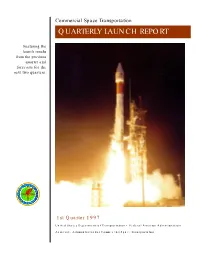
Commercial Space Transportation QUARTERLY LAUNCH REPORT Featuring the launch results from the previous quarter and forecasts for the next two quarters. 1st Quarter 1997 U n i t e d S t a t e s D e p a r t me n t o f T r a n sp o r t a t i o n • F e d e r a l A v i a t io n A d m in i st r a t i o n A s so c i a t e A d mi n is t r a t o r f o r C o mm e r c ia l S p a c e T r a n s p o r t a t io n QUARTERLY LAUNCH R EPORT 1 1ST QUARTER 1997 R EPORT Objectives This report summarizes recent and scheduled worldwide commercial, civil, and military orbital space launch events. Scheduled launches listed in this report are vehicle/payload combinations that have been identified in open sources, including industry references, company manifests, periodicals, and government documents. Note that such dates are subject to change. This report highlights commercial launch activities, classifying commercial launches as one or more of the following: • Internationally competed launch events (i.e., launch opportunities considered available in principle to competitors in the international launch services market), • Any launches licensed by the Office of the Associate Administrator for Commercial Space Transportation of the Federal Aviation Administration under U.S. Code Title 49, Section 701, Subsection 9 (previously known as the Commercial Space Launch Act), and • Certain European launches of post, telegraph and telecommunications payloads on Ariane vehicles. -

Biochemistry Metabolism
Biochemistry Metabolism 07.11.2017 – 27.11.2017 Photosynthesis Gerhild van Echten-Deckert Tel. 73 2703 E-mail: g.echten.deckert@uni-bonn.de www.limes-institut-bonn.de Photosynthesis Light reaction: - Light absorption, generation of a high energy electron and oxidation of water - Electron transport from water to NADPH and generation of a proton-motive force -Synthesis of ATP Berg, Tymoczko, Stryer: Biochemistry “Dark reaction”: - CO2 conversion into carbohydrates consuming ATP and NADPH (Calvin Cycle) Photosynthesis is localized to the thylakoid membranes Lodish et al. Molecular Cell Biology Comparison of photosynthesis and oxidative phosphorylation Berg, Tymoczko, Stryer: Biochemistry Chlorophyll a is the main pigment capturing energy of light Lodish et al. Molecular Cell Biology Energy diagram indicating the electronic states of chlorophyll and their most important modes of interconversion Other light-absorbing pigments, such as carotenoids, extend the range of light that can be absorbed and used for photosynthesis The action spectrum of photosynthesis matches the absorption spectra of chlorophyll a and b and of -carotene The absorption of photons from two distinct photosystems (PSI and PSII + is required for complete electron flow from H2O to NADP Berg, Tymoczko, Stryer: Biochemistry Light absorption by reaction-centre chlorophylls causes a charge separation across the thylakoid membrane The energy of the absorbed light is used to strip an electron from a chlorophyll molecule of the reaction centre to a primary electron acceptor thereby acquiring a positive charge (generation of a strong oxidizing- and a strong reducing agent) Lodish et al. Molecular Cell Biology Subsequent electron flow and coupled proton movement Lodish et al. -
Quarterly Launch Report
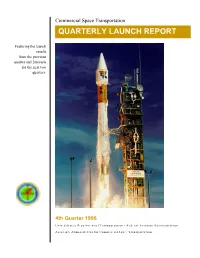
Commercial Space Transportation QUARTERLY LAUNCH REPORT Featuring the launch results from the previous quarter and forecasts for the next two quarters. 4th Quarter 1996 U n i t e d S t a t e s D e p a r t m e n t o f T r a n s p o r t a t i o n • F e d e r a l A v i a t i o n A d m i n i s t r a t i o n A s s o c i a t e A d m i n i s t r a t o r f o r C o m m e r c i a l S p a c e T r a n s p o r t a t i o n QUARTERLY LAUNCH REPORT 1 4TH QUARTER REPORT Objectives This report summarizes recent and scheduled worldwide commercial, civil, and military orbital space launch events. Scheduled launches listed in this report are vehicle/payload combinations that have been identified in open sources, including industry references, company manifests, periodicals, and government documents. Note that such dates are subject to change. This report highlights commercial launch activities, classifying commercial launches as one or more of the following: • Internationally competed launch events (i.e., launch opportunities considered available in principle to competitors in the international launch services market), • Any launches licensed by the Office of the Associate Administrator for Commercial Space Transportation of the Federal Aviation Administration under U.S. -
Exploring the Unknown Vol. 6
Exploring the Unknown Exploring the Selected Documents Unknown in the History of the U.S. Civil Space Program Volume VI: Space and Earth Science John M. Logsdon Editor with Stephen J. Garber Roger D. Launius Ray A. Williamson The NASA History Series Selected Documents in the History of the U.S. Civil Space Program National Aeronautics and Space Administration Office of External Relations Volume VI: Space and Earth Science NASA History Division Washington, D.C. Edited by John M. Logsdon 2004 NASA SP-2004-4407 with Stephen J. Garber, Roger D. Launius, and Ray A. Williamson **EU6 Chap 02 9/2/04 4:01 PM Page 266 Exploring the Unknown Selected Documents in the History Exploring the of the U.S. Civil Space Program Unknown Volume VI: Space and Volume VI Earth Science John M. Logsdon Editor with Stephen J. Garber Roger D. Launius Ray A. Williamson NASA SP-2004-4407 **EU6 front matter 9/2/04 4:09 PM Page i EXPLORING THE UNKNOWN **EU6 front matter 9/2/04 4:09 PM Page iii NASA SP-2004-4407 EXPLORING THE UNKNOWN Selected Documents in the History of the U.S. Civil Space Program Volume VI: Space and Earth Science John M. Logsdon, General Editor with Stephen J. Garber, Roger D. Launius, and Ray A. Williamson The NASA History Series National Aeronautics and Space Administration NASA History Office Office of External Relations Washington, DC 2004 **EU6 front matter 9/2/04 4:09 PM Page iv Library of Congress Cataloguing-in-Publication Data Exploring the Unknown: Selected Documents in the History of the U.S. -
U S E R M a N U
•Introduction 6/04/01 11:09 Page 1 SOYUZ USER’ S MANUAL ST-GTD-SUM-01 - ISSUE 3 - REVISION 0 - APRIL 2001 © Starsem 2001. All rights reserved. •Introduction 6/04/01 11:09 Page 2 •Introduction 6/04/01 11:09 Page 3 SOYUZ USER’S MANUAL ST-GTD-SUM-01 ISSUE 3, REVISION 0 APRIL 2001 FOREWORD Starsem is a Russian-European joint venture founded in 1996 that is charged with the commercialization of launch services using the Soyuz launch vehicle, the most frequently launched rocket in the world and the only manned vehicle offered for commercial space launches. Starsem headquarters are located in Paris, France and the Soyuz is launched from the Baikonour Cosmodrome in the Republic of Kazakhstan. Starsem is a partnership with 50% European and 50% Russian ownership. Its shareholders are the European Aeronautic, Defence, and Space Company, EADS (35%), Arianespace (15%), the Russian Aeronautics and Space Agency, Rosaviacosmos (25%), and the Samara Space Center, TsSKB-Progress (25%). Starsem is the sole organization entrusted to finance, market, and conduct the commercial sale of the Soyuz launch vehicle family, including future upgrades such as the Soyuz/ST. Page3 •Introduction 6/04/01 11:09 Page 4 SOYUZ USER’S MANUAL ST-GTD-SUM-01 ISSUE 3, REVISION 0 APRIL 2001 REVISION CONTROL SHEET Revision Date Revision No. Change Description 1996 Issue 1, Revision 0 New issue June 1997 Issue 2, Revision 0 Complete update April 2001 Issue 3, Revision 0 Complete update ST-GTD-SUM-01 General modifications that reflect successful flights in 1999-2000 and Starsem’s future development plans. -

Georgia Institute of Technology Atlanta, USA 1 WELCOME
IPPW-6 Monday-Friday, June 23-27, 2008, Georgia Institute of Technology in Atlanta, Ga., U.S.A. Georgia Institute of Technology Atlanta, USA 1 WELCOME Welcome to the 6th International Planetary Probe Workshop. For the next four and a half days, we will explore the technological challenges and scientific opportunities associated with entry, descent, landing and flight in planetary atmospheres. We are pleased to welcome such a large group of scientists, technologists, engineers, mission designers, students, and policy-makers, as together, we discuss and pursue planetary probe missions to solar system moons and planets with atmospheres. Today through Friday, we hope you will: Gain insight into the current outlook for planetary probe missions Examine mission concept studies and historical perspectives Catch up with ongoing and proposed technology development activities Review sample return missions challenges Learn of recent advances in planetary entry science payloads Focus on the engineering and science of current planetary entry missions Discuss and build collaborative partnerships with otherworkshop participants Spend time meeting many of the participating students who are interested in a future career in this area Please enjoy Atlanta while you are here. You will find a list of the city’s more popular attractions in addition to local restaurants near Technology Square in this program. Now, let’s get started! Best Regards, Bernard Bienstock Robert D. Braun Jet Propulsion Laboratory Georgia Institute of Technology IPPW6 International IPPW6