6 Whole-Genome Snp Linkage Analysis
Total Page:16
File Type:pdf, Size:1020Kb
Load more
Recommended publications
-
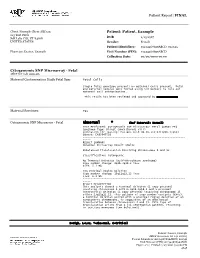
Cytogenomic SNP Microarray - Fetal ARUP Test Code 2002366 Maternal Contamination Study Fetal Spec Fetal Cells
Patient Report |FINAL Client: Example Client ABC123 Patient: Patient, Example 123 Test Drive Salt Lake City, UT 84108 DOB 2/13/1987 UNITED STATES Gender: Female Patient Identifiers: 01234567890ABCD, 012345 Physician: Doctor, Example Visit Number (FIN): 01234567890ABCD Collection Date: 00/00/0000 00:00 Cytogenomic SNP Microarray - Fetal ARUP test code 2002366 Maternal Contamination Study Fetal Spec Fetal Cells Single fetal genotype present; no maternal cells present. Fetal and maternal samples were tested using STR markers to rule out maternal cell contamination. This result has been reviewed and approved by Maternal Specimen Yes Cytogenomic SNP Microarray - Fetal Abnormal * (Ref Interval: Normal) Test Performed: Cytogenomic SNP Microarray- Fetal (ARRAY FE) Specimen Type: Direct (uncultured) villi Indication for Testing: Patient with 46,XX,t(4;13)(p16.3;q12) (Quest: EN935475D) ----------------------------------------------------------------- ----- RESULT SUMMARY Abnormal Microarray Result (Male) Unbalanced Translocation Involving Chromosomes 4 and 13 Classification: Pathogenic 4p Terminal Deletion (Wolf-Hirschhorn syndrome) Copy number change: 4p16.3p16.2 loss Size: 5.1 Mb 13q Proximal Region Deletion Copy number change: 13q11q12.12 loss Size: 6.1 Mb ----------------------------------------------------------------- ----- RESULT DESCRIPTION This analysis showed a terminal deletion (1 copy present) involving chromosome 4 within 4p16.3p16.2 and a proximal interstitial deletion (1 copy present) involving chromosome 13 within 13q11q12.12. This -
Identification of the Binding Partners for Hspb2 and Cryab Reveals
Brigham Young University BYU ScholarsArchive Theses and Dissertations 2013-12-12 Identification of the Binding arP tners for HspB2 and CryAB Reveals Myofibril and Mitochondrial Protein Interactions and Non- Redundant Roles for Small Heat Shock Proteins Kelsey Murphey Langston Brigham Young University - Provo Follow this and additional works at: https://scholarsarchive.byu.edu/etd Part of the Microbiology Commons BYU ScholarsArchive Citation Langston, Kelsey Murphey, "Identification of the Binding Partners for HspB2 and CryAB Reveals Myofibril and Mitochondrial Protein Interactions and Non-Redundant Roles for Small Heat Shock Proteins" (2013). Theses and Dissertations. 3822. https://scholarsarchive.byu.edu/etd/3822 This Thesis is brought to you for free and open access by BYU ScholarsArchive. It has been accepted for inclusion in Theses and Dissertations by an authorized administrator of BYU ScholarsArchive. For more information, please contact scholarsarchive@byu.edu, ellen_amatangelo@byu.edu. Identification of the Binding Partners for HspB2 and CryAB Reveals Myofibril and Mitochondrial Protein Interactions and Non-Redundant Roles for Small Heat Shock Proteins Kelsey Langston A thesis submitted to the faculty of Brigham Young University in partial fulfillment of the requirements for the degree of Master of Science Julianne H. Grose, Chair William R. McCleary Brian Poole Department of Microbiology and Molecular Biology Brigham Young University December 2013 Copyright © 2013 Kelsey Langston All Rights Reserved ABSTRACT Identification of the Binding Partners for HspB2 and CryAB Reveals Myofibril and Mitochondrial Protein Interactors and Non-Redundant Roles for Small Heat Shock Proteins Kelsey Langston Department of Microbiology and Molecular Biology, BYU Master of Science Small Heat Shock Proteins (sHSP) are molecular chaperones that play protective roles in cell survival and have been shown to possess chaperone activity. -

Prostate Cancer Prognostics Using Biomarkers Prostatakrebsprognostik Mittels Biomarkern Prognostic Du Cancer De La Prostate Au Moyen De Biomarqueurs
(19) TZZ Z_T (11) EP 2 885 640 B1 (12) EUROPEAN PATENT SPECIFICATION (45) Date of publication and mention (51) Int Cl.: of the grant of the patent: G01N 33/574 (2006.01) C12Q 1/68 (2018.01) 18.07.2018 Bulletin 2018/29 C40B 30/04 (2006.01) (21) Application number: 13829137.2 (86) International application number: PCT/US2013/055429 (22) Date of filing: 16.08.2013 (87) International publication number: WO 2014/028884 (20.02.2014 Gazette 2014/08) (54) PROSTATE CANCER PROGNOSTICS USING BIOMARKERS PROSTATAKREBSPROGNOSTIK MITTELS BIOMARKERN PROGNOSTIC DU CANCER DE LA PROSTATE AU MOYEN DE BIOMARQUEURS (84) Designated Contracting States: • GHADESSI, Mercedeh AL AT BE BG CH CY CZ DE DK EE ES FI FR GB New Westminster, British Columbia V3M 6E2 (CA) GR HR HU IE IS IT LI LT LU LV MC MK MT NL NO • JENKINS, Robert, B. PL PT RO RS SE SI SK SM TR Rochester, Minnesota 55902 (US) • VERGARA CORREA, Ismael A. (30) Priority: 16.08.2012 US 201261684066 P Bundoora, Victoria 3083 (AU) 13.02.2013 US 201361764365 P 14.03.2013 US 201361783124 P (74) Representative: Cornish, Kristina Victoria Joy et al Kilburn & Strode LLP (43) Date of publication of application: Lacon London 24.06.2015 Bulletin 2015/26 84 Theobalds Road London WC1X 8NL (GB) (73) Proprietors: • Genomedx Biosciences, Inc. (56) References cited: Vancouver BC V6B 2W9 (CA) WO-A1-2009/143603 WO-A1-2013/090620 • MAYO FOUNDATION FOR MEDICAL WO-A2-2006/091776 WO-A2-2006/110264 EDUCATION AND RESEARCH WO-A2-2007/056049 US-A1- 2006 134 663 Rochester, MN 55905 (US) US-A1- 2007 037 165 US-A1- 2007 065 827 US-A1- -
A Computational Approach for Defining a Signature of Β-Cell Golgi Stress in Diabetes Mellitus
Page 1 of 781 Diabetes A Computational Approach for Defining a Signature of β-Cell Golgi Stress in Diabetes Mellitus Robert N. Bone1,6,7, Olufunmilola Oyebamiji2, Sayali Talware2, Sharmila Selvaraj2, Preethi Krishnan3,6, Farooq Syed1,6,7, Huanmei Wu2, Carmella Evans-Molina 1,3,4,5,6,7,8* Departments of 1Pediatrics, 3Medicine, 4Anatomy, Cell Biology & Physiology, 5Biochemistry & Molecular Biology, the 6Center for Diabetes & Metabolic Diseases, and the 7Herman B. Wells Center for Pediatric Research, Indiana University School of Medicine, Indianapolis, IN 46202; 2Department of BioHealth Informatics, Indiana University-Purdue University Indianapolis, Indianapolis, IN, 46202; 8Roudebush VA Medical Center, Indianapolis, IN 46202. *Corresponding Author(s): Carmella Evans-Molina, MD, PhD (cevansmo@iu.edu) Indiana University School of Medicine, 635 Barnhill Drive, MS 2031A, Indianapolis, IN 46202, Telephone: (317) 274-4145, Fax (317) 274-4107 Running Title: Golgi Stress Response in Diabetes Word Count: 4358 Number of Figures: 6 Keywords: Golgi apparatus stress, Islets, β cell, Type 1 diabetes, Type 2 diabetes 1 Diabetes Publish Ahead of Print, published online August 20, 2020 Diabetes Page 2 of 781 ABSTRACT The Golgi apparatus (GA) is an important site of insulin processing and granule maturation, but whether GA organelle dysfunction and GA stress are present in the diabetic β-cell has not been tested. We utilized an informatics-based approach to develop a transcriptional signature of β-cell GA stress using existing RNA sequencing and microarray datasets generated using human islets from donors with diabetes and islets where type 1(T1D) and type 2 diabetes (T2D) had been modeled ex vivo. To narrow our results to GA-specific genes, we applied a filter set of 1,030 genes accepted as GA associated. -

Molecular and Cellular Mechanisms of the Angiogenic Effect of Poly(Methacrylic Acid-Co-Methyl Methacrylate) Beads
Molecular and Cellular Mechanisms of the Angiogenic Effect of Poly(methacrylic acid-co-methyl methacrylate) Beads by Lindsay Elizabeth Fitzpatrick A thesis submitted in conformity with the requirements for the degree of Doctor of Philosophy Institute of Biomaterials and Biomedical Engineering University of Toronto © Copyright by Lindsay Elizabeth Fitzpatrick 2012 Molecular and Cellular Mechanisms of the Angiogenic Effect of Poly(methacrylic acid-co-methyl methacrylate) Beads Lindsay Elizabeth Fitzpatrick Doctorate of Philosophy Institute of Biomaterials and Biomedical Engineering University of Toronto 2012 Abstract Poly(methacrylic acid -co- methyl methacrylate) beads were previously shown to have a therapeutic effect on wound closure through the promotion of angiogenesis. However, it was unclear how this polymer elicited its beneficial properties. The goal of this thesis was to characterize the host response to MAA beads by identifying molecules of interest involved in MAA-mediated angiogenesis (in comparison to poly(methyl methacrylate) beads, PMMA). Using a model of diabetic wound healing and a macrophage-like cell line (dTHP-1), eight molecules of interest were identified in the host response to MAA beads. Gene and/or protein expression analysis showed that MAA beads increased the expression of Shh, IL-1β, IL-6, TNF- α and Spry2, but decreased the expression of CXCL10 and CXCL12, compared to PMMA and no beads. MAA beads also appeared to modulate the expression of OPN. In vivo, the global gene expression of OPN was increased in wounds treated with MAA beads, compared to PMMA and no beads. In contrast, dTHP-1 decreased OPN gene expression compared to PMMA and no beads, but expressed the same amount of secreted OPN, suggesting that the cells decreased the expression of the intracellular isoform of OPN. -

Download The
PROBING THE INTERACTION OF ASPERGILLUS FUMIGATUS CONIDIA AND HUMAN AIRWAY EPITHELIAL CELLS BY TRANSCRIPTIONAL PROFILING IN BOTH SPECIES by POL GOMEZ B.Sc., The University of British Columbia, 2002 A THESIS SUBMITTED IN PARTIAL FULFILLMENT OF THE REQUIREMENTS FOR THE DEGREE OF MASTER OF SCIENCE in THE FACULTY OF GRADUATE STUDIES (Experimental Medicine) THE UNIVERSITY OF BRITISH COLUMBIA (Vancouver) January 2010 © Pol Gomez, 2010 ABSTRACT The cells of the airway epithelium play critical roles in host defense to inhaled irritants, and in asthma pathogenesis. These cells are constantly exposed to environmental factors, including the conidia of the ubiquitous mould Aspergillus fumigatus, which are small enough to reach the alveoli. A. fumigatus is associated with a spectrum of diseases ranging from asthma and allergic bronchopulmonary aspergillosis to aspergilloma and invasive aspergillosis. Airway epithelial cells have been shown to internalize A. fumigatus conidia in vitro, but the implications of this process for pathogenesis remain unclear. We have developed a cell culture model for this interaction using the human bronchial epithelium cell line 16HBE and a transgenic A. fumigatus strain expressing green fluorescent protein (GFP). Immunofluorescent staining and nystatin protection assays indicated that cells internalized upwards of 50% of bound conidia. Using fluorescence-activated cell sorting (FACS), cells directly interacting with conidia and cells not associated with any conidia were sorted into separate samples, with an overall accuracy of 75%. Genome-wide transcriptional profiling using microarrays revealed significant responses of 16HBE cells and conidia to each other. Significant changes in gene expression were identified between cells and conidia incubated alone versus together, as well as between GFP positive and negative sorted cells. -

Genetic Analysis of Over One Million People Identifies 535 New Loci Associated with Blood 2 Pressure Traits
1 Genetic analysis of over one million people identifies 535 new loci associated with blood 2 pressure traits. 3 4 Table of Contents 5 SUPPLEMENTARY TABLES LEGENDS……………………………………………………………………………….…….3 6 SUPPLEMENTARY FIGURES LEGENDS ........................................................................................ 6 7 SUPPLEMENTARY METHODS ................................................................................................... 10 8 1. UK Biobank data .................................................................................................................................... 10 9 2. UKB Quality Control ............................................................................................................................... 10 10 3. Phenotypic data ..................................................................................................................................... 11 11 4. UKB analysis ........................................................................................................................................... 11 12 5. Genomic inflation and confounding ....................................................................................................... 12 13 6. International Consortium for Blood Pressure (ICBP) GWAS .................................................................... 12 14 7. Meta-analyses of discovery datasets ..................................................................................................... 13 15 8. Linkage Disequilibrium calculations ...................................................................................................... -

Noelia Díaz Blanco
Effects of environmental factors on the gonadal transcriptome of European sea bass (Dicentrarchus labrax), juvenile growth and sex ratios Noelia Díaz Blanco Ph.D. thesis 2014 Submitted in partial fulfillment of the requirements for the Ph.D. degree from the Universitat Pompeu Fabra (UPF). This work has been carried out at the Group of Biology of Reproduction (GBR), at the Department of Renewable Marine Resources of the Institute of Marine Sciences (ICM-CSIC). Thesis supervisor: Dr. Francesc Piferrer Professor d’Investigació Institut de Ciències del Mar (ICM-CSIC) i ii A mis padres A Xavi iii iv Acknowledgements This thesis has been made possible by the support of many people who in one way or another, many times unknowingly, gave me the strength to overcome this "long and winding road". First of all, I would like to thank my supervisor, Dr. Francesc Piferrer, for his patience, guidance and wise advice throughout all this Ph.D. experience. But above all, for the trust he placed on me almost seven years ago when he offered me the opportunity to be part of his team. Thanks also for teaching me how to question always everything, for sharing with me your enthusiasm for science and for giving me the opportunity of learning from you by participating in many projects, collaborations and scientific meetings. I am also thankful to my colleagues (former and present Group of Biology of Reproduction members) for your support and encouragement throughout this journey. To the “exGBRs”, thanks for helping me with my first steps into this world. Working as an undergrad with you Dr. -

MRFAP1 (NM 033296) Human Tagged ORF Clone – RG206815
OriGene Technologies, Inc. 9620 Medical Center Drive, Ste 200 Rockville, MD 20850, US Phone: +1-888-267-4436 techsupport@origene.com EU: info-de@origene.com CN: techsupport@origene.cn Product datasheet for RG206815 MRFAP1 (NM_033296) Human Tagged ORF Clone Product data: Product Type: Expression Plasmids Product Name: MRFAP1 (NM_033296) Human Tagged ORF Clone Tag: TurboGFP Symbol: MRFAP1 Synonyms: PAM14; PGR1 Vector: pCMV6-AC-GFP (PS100010) E. coli Selection: Ampicillin (100 ug/mL) Cell Selection: Neomycin ORF Nucleotide >RG206815 representing NM_033296 Sequence: Red=Cloning site Blue=ORF Green=Tags(s) TTTTGTAATACGACTCACTATAGGGCGGCCGGGAATTCGTCGACTGGATCCGGTACCGAGGAGATCTGCC GCCGCGATCGCC ATGCGGCCCCTGGACATCGTCGAGCTGGCGGAACCGGAGGAAGTGGAGGTGCTGGAGCCCGAGGAGGATT TCGAGCAGTTTCTGCTCCCGGTCATCAACGAGATGCGCGAGGACATCGCGTCGCTGACGCGCGAGCACGG GCGGGCGTACCTGCGGAACCGGAGCAAGCTGTGGGAGATGGACAATATGCTCATCCAGATCAAAACGCAG GTGGAGGCCTCGGAGGAGAGCGCCCTCAACCACCTCCAGAACCCGGGCGACGCGGCCGAGGGCCGGGCGG CCAAGAGGTGCGAGAAGGCCGAGGAGAAGGCCAAGGAGATTGCGAAGATGGCAGAGATGCTGGTGGAGCT GGTCCGGCGGATAGAGAAGAGCGAGTCGTCG ACGCGTACGCGGCCGCTCGAG - GFP Tag - GTTTAA Protein Sequence: >RG206815 representing NM_033296 Red=Cloning site Green=Tags(s) MRPLDIVELAEPEEVEVLEPEEDFEQFLLPVINEMREDIASLTREHGRAYLRNRSKLWEMDNMLIQIKTQ VEASEESALNHLQNPGDAAEGRAAKRCEKAEEKAKEIAKMAEMLVELVRRIEKSESS TRTRPLE - GFP Tag - V Restriction Sites: SgfI-MluI This product is to be used for laboratory only. Not for diagnostic or therapeutic use. View online » ©2021 OriGene Technologies, Inc., 9620 Medical Center Drive, Ste 200, Rockville, -

Integrative Clinical Sequencing in the Management of Refractory Or
Supplementary Online Content Mody RJ, Wu Y-M, Lonigro RJ, et al. Integrative Clinical Sequencing in the Management of Children and Young Adults With Refractory or Relapsed CancerJAMA. doi:10.1001/jama.2015.10080. eAppendix. Supplementary appendix This supplementary material has been provided by the authors to give readers additional information about their work. © 2015 American Medical Association. All rights reserved. Downloaded From: https://jamanetwork.com/ on 09/29/2021 SUPPLEMENTARY APPENDIX Use of Integrative Clinical Sequencing in the Management of Pediatric Cancer Patients *#Rajen J. Mody, M.B.B.S, M.S., *Yi-Mi Wu, Ph.D., Robert J. Lonigro, M.S., Xuhong Cao, M.S., Sameek Roychowdhury, M.D., Ph.D., Pankaj Vats, M.S., Kevin M. Frank, M.S., John R. Prensner, M.D., Ph.D., Irfan Asangani, Ph.D., Nallasivam Palanisamy Ph.D. , Raja M. Rabah, M.D., Jonathan R. Dillman, M.D., Laxmi Priya Kunju, M.D., Jessica Everett, M.S., Victoria M. Raymond, M.S., Yu Ning, M.S., Fengyun Su, Ph.D., Rui Wang, M.S., Elena M. Stoffel, M.D., Jeffrey W. Innis, M.D., Ph.D., J. Scott Roberts, Ph.D., Patricia L. Robertson, M.D., Gregory Yanik, M.D., Aghiad Chamdin, M.D., James A. Connelly, M.D., Sung Choi, M.D., Andrew C. Harris, M.D., Carrie Kitko, M.D., Rama Jasty Rao, M.D., John E. Levine, M.D., Valerie P. Castle, M.D., Raymond J. Hutchinson, M.D., Moshe Talpaz, M.D., ^Dan R. Robinson, Ph.D., and ^#Arul M. Chinnaiyan, M.D., Ph.D. CORRESPONDING AUTHOR (S): # Arul M. -

WO 2012/174282 A2 20 December 2012 (20.12.2012) P O P C T
(12) INTERNATIONAL APPLICATION PUBLISHED UNDER THE PATENT COOPERATION TREATY (PCT) (19) World Intellectual Property Organization International Bureau (10) International Publication Number (43) International Publication Date WO 2012/174282 A2 20 December 2012 (20.12.2012) P O P C T (51) International Patent Classification: David [US/US]; 13539 N . 95th Way, Scottsdale, AZ C12Q 1/68 (2006.01) 85260 (US). (21) International Application Number: (74) Agent: AKHAVAN, Ramin; Caris Science, Inc., 6655 N . PCT/US20 12/0425 19 Macarthur Blvd., Irving, TX 75039 (US). (22) International Filing Date: (81) Designated States (unless otherwise indicated, for every 14 June 2012 (14.06.2012) kind of national protection available): AE, AG, AL, AM, AO, AT, AU, AZ, BA, BB, BG, BH, BR, BW, BY, BZ, English (25) Filing Language: CA, CH, CL, CN, CO, CR, CU, CZ, DE, DK, DM, DO, Publication Language: English DZ, EC, EE, EG, ES, FI, GB, GD, GE, GH, GM, GT, HN, HR, HU, ID, IL, IN, IS, JP, KE, KG, KM, KN, KP, KR, (30) Priority Data: KZ, LA, LC, LK, LR, LS, LT, LU, LY, MA, MD, ME, 61/497,895 16 June 201 1 (16.06.201 1) US MG, MK, MN, MW, MX, MY, MZ, NA, NG, NI, NO, NZ, 61/499,138 20 June 201 1 (20.06.201 1) US OM, PE, PG, PH, PL, PT, QA, RO, RS, RU, RW, SC, SD, 61/501,680 27 June 201 1 (27.06.201 1) u s SE, SG, SK, SL, SM, ST, SV, SY, TH, TJ, TM, TN, TR, 61/506,019 8 July 201 1(08.07.201 1) u s TT, TZ, UA, UG, US, UZ, VC, VN, ZA, ZM, ZW. -

Diana Maria De Figueiredo Pinto Marcadores Moleculares Para A
Universidade de Aveiro Departamento de Química 2015 Diana Maria de Marcadores moleculares para a Nefropatia Figueiredo Pinto Diabética Molecular markers for Diabetic Nephropathy Universidade de Aveiro Departamento de Química 2015 Diana Maria de Marcadores moleculares para a Nefropatia Diabética Figueiredo Pinto Molecular markers for Diabetic Nephropathy Dissertação apresentada à Universidade de Aveiro para cumprimento dos requisitos necessários à obtenção do grau de Mestre em Bioquímica, ramo de Bioquímica Clínica, realizada sob a orientação científica da Doutora Maria Conceição Venâncio Egas, investigadora do Centro de Neurociências e Biologia Celular da Universidade de Coimbra, e da Doutora Rita Maria Pinho Ferreira, professora auxiliar do Departamento de Química da Universidade de Aveiro. Este trabalho foi efetuado no âmbito do programa COMPETE, através do projeto DoIT – Desenvolvimento e Operacionalização da Investigação de Translação, ref: FCOMP-01-0202-FEDER- 013853. o júri presidente Prof. Francisco Manuel Lemos Amado professor associado do Departamento de Química da Universidade de Aveiro Doutora Maria do Rosário Pires Maia Neves Almeida investigadora do Centro de Neurociências e Biologia Celular da Universidade de Coimbra Doutora Maria Conceição Venâncio Egas investigadora do Centro de Neurociências e Biologia Celular da Universidade de Coimbra Agradecimentos Em primeiro lugar quero expressar o meu agradecimento à Doutora Conceição Egas, orientadora desta dissertação, pelo seu apoio, palavras de incentivo e disponibilidade demonstrada em todas as fases que levaram à concretização do presente trabalho. Obrigada pelo saber transmitido, que tanto contribuiu para elevar os meus conhecimentos científicos, assim como pela oportunidade de integrar o seu grupo de investigação. O seu apoio e sugestões foram determinantes para a realização deste estudo.