The Chemical Ecology of Tree-Herbivore-Pathogen Interactions
Total Page:16
File Type:pdf, Size:1020Kb
Load more
Recommended publications
-
Chrysomelidae, Cassidinae)
Molecular Ecology (2004) 13, 2405–2420 doi: 10.1111/j.1365-294X.2004.02213.x ReproductiveBlackwell Publishing, Ltd. effects and geographical distributions of two Wolbachia strains infecting the Neotropical beetle, Chelymorpha alternans Boh. (Chrysomelidae, Cassidinae) G. P. KELLER,*†‡ D. M. WINDSOR,* J. M. SAUCEDO* and J. H. WERREN§ *Smithsonian Tropical Research Institute, Apdo. 2072, Balboa, Rep. of Panama †University of Georgia, Entomology Department, Athens, GA 80602, §Department of Biology, University of Rochester, Rochester, NY 14627–0211 Abstract Wolbachia are maternally inherited endocellular bacteria known to alter insect host repro- duction to facilitate their own transmission. Multiple Wolbachia infections are more com- mon in tropical than temperate insects but few studies have investigated their dynamics in field populations. The beetle, Chelymorpha alternans, found throughout the Isthmus of Panama, is infected with two strains of Wolbachia, wCalt1 (99.2% of beetles) and wCalt2 (53%). Populations infected solely by the wCalt1 strain were limited to western Pacific Panama, whereas populations outside this region were either polymorphic for single (wCalt1) and double infections (wCalt1 + wCalt2) or consisted entirely of double infec- tions. The wCalt2 strain was not found as a single infection in the wild. Both strains caused cytoplasmic incompatibility (CI). The wCalt1 strain caused weak CI (∼20%) and the double infection induced moderate CI (∼70–90%) in crosses with uninfected beetles. The wCalt1 strain rescued about 75% of eggs fertilized by sperm from wCalt2 males. Based on the relation- ships of beetle mtDNA and infection status, maternal transmission, and repeated popula- tion sampling we determined that the double infection invaded C. alternans populations about 100 000 years ago and that the wCalt2 strain appears to be declining in some popula- tions, possibly due to environmental factors. -

Invasive Insects (Adventive Pest Insects) in Florida1
Archival copy: for current recommendations see http://edis.ifas.ufl.edu or your local extension office. ENY-827 Invasive Insects (Adventive Pest Insects) in Florida1 J. H. Frank and M. C. Thomas2 What is an Invasive Insect? include some of the more obscure native species, which still are unrecorded; they do not include some The term 'invasive species' is defined as of the adventive species that have not yet been 'non-native species which threaten ecosystems, detected and/or identified; and they do not specify the habitats, or species' by the European Environment origin (native or adventive) of many species. Agency (2004). It is widely used by the news media and it has become a bureaucratese expression. This is How to Recognize a Pest the definition we accept here, except that for several reasons we prefer the word adventive (meaning they A value judgment must be made: among all arrived) to non-native. So, 'invasive insects' in adventive species in a defined area (Florida, for Florida are by definition a subset (those that are example), which ones are pests? We can classify the pests) of the species that have arrived from abroad more prominent examples, but cannot easily decide (adventive species = non-native species = whether the vast bulk of them are 'invasive' (= pests) nonindigenous species). We need to know which or not, for lack of evidence. To classify them all into insect species are adventive and, of those, which are pests and non-pests we must draw a line somewhere pests. in a continuum ranging from important pests through those that are uncommon and feed on nothing of How to Know That a Species is consequence to humans, to those that are beneficial. -

Insects of Western North America 4. Survey of Selected Insect Taxa of Fort Sill, Comanche County, Oklahoma 2
Insects of Western North America 4. Survey of Selected Insect Taxa of Fort Sill, Comanche County, Oklahoma 2. Dragonflies (Odonata), Stoneflies (Plecoptera) and selected Moths (Lepidoptera) Contributions of the C.P. Gillette Museum of Arthropod Diversity Colorado State University Survey of Selected Insect Taxa of Fort Sill, Comanche County, Oklahoma 2. Dragonflies (Odonata), Stoneflies (Plecoptera) and selected Moths (Lepidoptera) by Boris C. Kondratieff, Paul A. Opler, Matthew C. Garhart, and Jason P. Schmidt C.P. Gillette Museum of Arthropod Diversity Department of Bioagricultural Sciences and Pest Management Colorado State University, Fort Collins, Colorado 80523 March 15, 2004 Contributions of the C.P. Gillette Museum of Arthropod Diversity Colorado State University Cover illustration (top to bottom): Widow Skimmer (Libellula luctuosa) [photo ©Robert Behrstock], Stonefly (Perlesta species) [photo © David H. Funk, White- lined Sphinx (Hyles lineata) [photo © Matthew C. Garhart] ISBN 1084-8819 This publication and others in the series may be ordered from the C.P. Gillette Museum of Arthropod Diversity, Department of Bioagricultural Sciences, Colorado State University, Fort Collins, Colorado 80523 Copyrighted 2004 Table of Contents EXECUTIVE SUMMARY……………………………………………………………………………….…1 INTRODUCTION…………………………………………..…………………………………………….…3 OBJECTIVE………………………………………………………………………………………….………5 Site Descriptions………………………………………….. METHODS AND MATERIALS…………………………………………………………………………….5 RESULTS AND DISCUSSION………………………………………………………………………..…...11 Dragonflies………………………………………………………………………………….……..11 -

Programme Against African Trypanosomiasis Year 2006 Volume
ZFBS 1""5 1SPHSBNNF *44/ WPMVNF "HBJOTU "GSJDBO QBSU 5SZQBOPTPNJBTJT 43%43%!.$4290!./3/-)!3)3).&/2-!4)/. $EPARTMENTFOR )NTERNATIONAL $EVELOPMENT year 2006 PAAT Programme volume 29 Against African part 1 Trypanosomiasis TSETSE AND TRYPANOSOMIASIS INFORMATION Numbers 13466–13600 Edited by James Dargie Bisamberg Austria FOOD AND AGRICULTURE ORGANIZATION OF THE UNITED NATIONS Rome, 2006 The designations employed and the presentation of material in this information product do not imply the expression of any opinion whatsoever on the part of the Food and Agriculture Organization of the United Nations concerning the legal or development status of any country, territory, city or area or of its authorities, or concerning the delimitation of its frontiers or boundaries. All rights reserved. Reproduction and dissemination of material in this in- formation product for educational or other non-commercial purposes are authorized without any prior written permission from the copyright holders provided the source is fully acknowledged. Reproduction of material in this information product for resale or other commercial purposes is prohibited without written permission of the copyright holders. Applications for such permission should be addressed to the Chief, Electronic Publishing Policy and Support Branch, Information Division, FAO, Viale delle Terme di Caracalla, 00100 Rome, Italy or by e-mail to copyright@fao.org © FAO 2006 Tsetse and Trypanosomiasis Information Volume 29 Part 1, 2006 Numbers 13466–13600 Tsetse and Trypanosomiasis Information TSETSE AND TRYPANOSOMIASIS INFORMATION The Tsetse and Trypanosomiasis Information periodical has been established to disseminate current information on all aspects of tsetse and trypanosomiasis research and control to institutions and individuals involved in the problems of African trypanosomiasis. -

"A Most Dangerous Tree": the Lombardy Poplar in Landscape Gardening
"A Most Dangerous Tree": The Lombardy Poplar in Landscape Gardening Christina D. Wood ~ The history of the Lombardy poplar in America illustrates that there are fashions in trees just as in all else. "The Lombardy poplar," wrote Andrew Jackson may have originated in Persia or perhaps the Downing in 1841, "is too well known among Himalayan region; because the plant was not us to need any description."’ This was an ex- mentioned in Roman agricultural texts, writ- traordinary thing to say about a tree that had ers reasoned that it must have been introduced been introduced to North America less than to Italy from central Asia.3 But subsequent sixty years earlier. In that short time, this writers have thought it more likely that the distinctive cultivar of dominating height Lombardy sprang up as a mutant of the black had gained notoriety due to aggressive over- poplar. Augustine Henry found evidence that planting in the years just after its introduction. it originated between 1700 and 1720 in Lom- The Lombardy poplar (Populus nigra bardy and spread worldwide by cuttings, reach- ’Italica’) is a very tall, rapidly growing tree ing France in 1749, England in 1758, and North with a distinctively columnar shape, often America in 1784.4 It was soon widely planted with a buttressed base. It is a fastigiate muta- in Europe as an avenue tree, as an ornamental, tion of a male black poplar (P. nigra).2 As a and for a time, for its timber. According to at member of the willow family (Salicaceae)- least one source, it was used in Italy to make North American members of the genus in- crates for grapes until the early nineteenth clude the Eastern poplar (Populus deltoides), century, when its wood was abandoned for this bigtooth aspen (Populus granditata), and purpose in favor of that of P. -
2018 Bioblitz Report
Bioblitz 2018: 942 species recorded. Wow! The Kingston Field Naturalists held their 20th BioBlitz June 15-16th, 2018 on our own property, the Helen Quilliam Sanctuary, at Otter Lake. This 250 hectare nature reserve has a wide variety of habitats providing a good diversity of plant and animal life. The BioBlitz aims to list as many species of living things as possible in 24 hours. This snapshot of the biodiversity provides a baseline for observing future changes caused by global warming, invasive species and loss of endangered species as well as through natural succession. BioBlitzes were held at this site in 2000 and 2002. 4.1 Vertebrates Mammalia Mammals Vespertilionidae Bats Perimyotis subflavus Tricolored bat Sciuridae Squirrels Tamias striatus lysteri Chipmunk Sciurus carolinensis pennsyulvanicus Gray Squirrel Tamiasciurius hudsonicus loquax Red Squirrel Marmota monax rufescens Woodchuck Castoridae Beavers Castor canadensis Beaver Muridae Mice, Rats And Voles Peromyscus leucopus novoboracensis White-footed Mouse Ondatra zibethicus zibethicus Muskrat Erethizontidae Porcupines Erithozon dorsatum dorsatum Porcupine Canidae Dogs Canis latrans thamnos Coyote Mustelidae Weasels Lutra canadensis canadensis O�er Procyonidae Raccoons Procyon lotor lotor Raccoon Cervidae Deer Odocoileus viginianus borealis White-tailed deer Aves Birds Phasianidae Turkeys And Grouse Bonasa umbellus Ruffed Grouse Meleagris gallopavo Wild Turkey continued ... The Blue Bill Volume 65, No. 3 71 Vertebrates continued ... Gaviidae Loons Gavia immer Common Loon Ardeidae -
Coleoptera: Introduction and Key to Families
Royal Entomological Society HANDBOOKS FOR THE IDENTIFICATION OF BRITISH INSECTS To purchase current handbooks and to download out-of-print parts visit: http://www.royensoc.co.uk/publications/index.htm This work is licensed under a Creative Commons Attribution-NonCommercial-ShareAlike 2.0 UK: England & Wales License. Copyright © Royal Entomological Society 2012 ROYAL ENTOMOLOGICAL SOCIETY OF LONDON Vol. IV. Part 1. HANDBOOKS FOR THE IDENTIFICATION OF BRITISH INSECTS COLEOPTERA INTRODUCTION AND KEYS TO FAMILIES By R. A. CROWSON LONDON Published by the Society and Sold at its Rooms 41, Queen's Gate, S.W. 7 31st December, 1956 Price-res. c~ . HANDBOOKS FOR THE IDENTIFICATION OF BRITISH INSECTS The aim of this series of publications is to provide illustrated keys to the whole of the British Insects (in so far as this is possible), in ten volumes, as follows : I. Part 1. General Introduction. Part 9. Ephemeroptera. , 2. Thysanura. 10. Odonata. , 3. Protura. , 11. Thysanoptera. 4. Collembola. , 12. Neuroptera. , 5. Dermaptera and , 13. Mecoptera. Orthoptera. , 14. Trichoptera. , 6. Plecoptera. , 15. Strepsiptera. , 7. Psocoptera. , 16. Siphonaptera. , 8. Anoplura. 11. Hemiptera. Ill. Lepidoptera. IV. and V. Coleoptera. VI. Hymenoptera : Symphyta and Aculeata. VII. Hymenoptera: Ichneumonoidea. VIII. Hymenoptera : Cynipoidea, Chalcidoidea, and Serphoidea. IX. Diptera: Nematocera and Brachycera. X. Diptera: Cyclorrhapha. Volumes 11 to X will be divided into parts of convenient size, but it is not possible to specify in advance the taxonomic content of each part. Conciseness and cheapness are main objectives in this new series, and each part will be the work of a specialist, or of a group of specialists. -

A Systematic Study of the Family Rhynchitidae of Japan(Coleoptera
Humans and Nature. No. 2, 1 ―93, March 1993 A Systematic Study of the Family Rhynchitidae of Japan (Coleoptera, Curculionoidea) * Yoshihisa Sawada Division of Phylogenetics, Museum of Nature and Human Activities, Hyogo, Yayoi~ga~oka 6, Sanda, 669~ 13 fapan Abstract Japanese RHYNCHITIDAE are systematically reviewed and revised. Four tribes, 17 genera and 62 species are recognized. Original and additional descriptions are given, with illustrations of and keys to their taxa. The generic and subgeneric names of Voss' system are reviewed from the viewpoint of nomenclature. At the species level, 12 new species Auletobius planifrons, Notocyrtus caeligenus, Involvulus flavus, I. subtilis, I. comix, I. aes, I. lupulus, Deporaus tigris, D. insularis, D. eumegacephalus, D. septemtrionalis and D. rhynchitoides are described and 1 species Engnamptus sauteri are newly recorded from Japan. Six species and subspecies names Auletes carvus, A. testaceus and A. irkutensis japonicus, Auletobius okinatuaensis, Aderorhinus pedicellaris nigricollis and Rhynchites cupreus purpuleoviolaceus are synonymized under Auletobius puberulus, A. jumigatus, A. uniformis, Ad. crioceroides and I. cylindricollis, respectively. One new name Deporaus vossi is given as the replacement name of the primally junior homonym D. pallidiventris Voss, 1957 (nec Voss, 1924). Generic and subgeneric classification is revised in the following points. The genus Notocyrtus is revived as an independent genus including subgenera Notocyrtus s. str., Exochorrhynchites and Heterorhynchites. Clinorhynckites and Habrorhynchites are newly treated as each independent genera. Caenorhinus is newly treated as a valid subgenus of the genus Deporaus. The genera Neocoenorrhinus and Piazorhynckites are newly synonymized under Notocyrtus and Agilaus, respectively, in generic and subgeneric rank. A subgeneric name, Aphlorhynehites subgen. -

Zootaxa, a New Species of Megadineura Malaise (Hymenoptera: Tenthredinidae) and a Key to the Known Species of the Genus
Zootaxa 1920: 51–60 (2008) ISSN 1175-5326 (print edition) www.mapress.com/zootaxa/ ZOOTAXA Copyright © 2008 · Magnolia Press ISSN 1175-5334 (online edition) A new species of Megadineura Malaise (Hymenoptera: Tenthredinidae) and a key to the known species of the genus MEICAI WEI1 & HAIYAN NIE2 College of Life Science and Technology, Central South University of Forestry and Technology, 498 South Shaoshan Road, Changsha 410004, P. R .China. 1Corresponding author. E-mail: weimc@126.com 2E-mail:niehaiyan@126.com Abstract Megadineura leucotarsis Wei, a new species of Nematinae (Hymenoptera, Tenthredinidae) from China is described. The genus Megadineura Malaise, 1931 is redescribed and a key to known species is provided. The difference between Mega- dineura and Mesoneura Hartig, 1837, Renonerva Wei & Nie, 1998, Katsujia Togashi, 1964 is also discussed briefly. The type specimens of the new species are deposited in the Insect Collection of Central South University of Forestry and Technology, China. Key words: Hymenoptera, Tenthredinidae, Nematinae, Megadineura, new species, China Introduction The genus Megadineura was erected by Malaise in 1931 for Dineura grandis André, 1882 from E. Siberia and Japan (Malaise 1931). Megadineura is so rare that only a few publications have referred to it in the past 75 years. The genus can be easily recognized by the large and elongated body, the presence of vein 1r in the forewing (unusual for the subfamily Nematinae), the broad frontal wall, large claw, thick and black antenna with 2 or 3 apical segments white, rugose mesepisternum and the simple sheath. Benson (1963) described a second species of the genus, M. himalayana, from Kashmir. -
Newsletter Dedicated to Information About the Chrysomelidae Report No
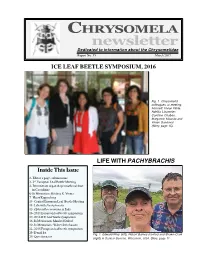
CHRYSOMELA newsletter Dedicated to information about the Chrysomelidae Report No. 55 March 2017 ICE LEAF BEETLE SYMPOSIUM, 2016 Fig. 1. Chrysomelid colleagues at meeting, from left: Vivian Flinte, Adelita Linzmeier, Caroline Chaboo, Margarete Macedo and Vivian Sandoval (Story, page 15). LIFE WITH PACHYBRACHIS Inside This Issue 2- Editor’s page, submissions 3- 2nd European Leaf Beetle Meeting 4- Intromittant organ &spermathecal duct in Cassidinae 6- In Memoriam: Krishna K. Verma 7- Horst Kippenberg 14- Central European Leaf Beetle Meeting 11- Life with Pachybrachis 13- Ophraella communa in Italy 16- 2014 European leaf beetle symposium 17- 2016 ICE Leaf beetle symposium 18- In Memoriam: Manfred Doberl 19- In Memoriam: Walter Steinhausen 22- 2015 European leaf beetle symposium 23- E-mail list Fig. 1. Edward Riley (left), Robert Barney (center) and Shawn Clark 25- Questionnaire (right) in Dunbar Barrens, Wisconsin, USA. Story, page 11 International Date Book The Editor’s Page Chrysomela is back! 2017 Entomological Society of America Dear Chrysomelid Colleagues: November annual meeting, Denver, Colorado The absence pf Chrysomela was the usual combina- tion of too few submissions, then a flood of articles in fall 2018 European Congress of Entomology, 2016, but my mix of personal and professional changes at July, Naples, Italy the moment distracted my attention. As usual, please consider writing about your research, updates, and other 2020 International Congress of Entomology topics in leaf beetles. I encourage new members to July, Helsinki, Finland participate in the newsletter. A major development in our community was the initiation of a Facebook group, Chrysomelidae Forum, by Michael Geiser. It is popular and connections grow daily. -
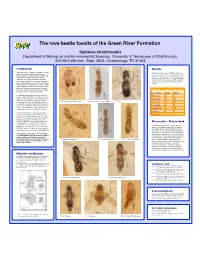
The Rove Beetle Fossils of the Green River Formation
The rove beetle fossils of the Green River Formation! Stylianos Chatzimanolis" Department of Biological and Environmental Sciences, University of Tennessee at Chattanooga, " 615 McCallie Ave., Dept. 2653, Chattanooga, TN 37403! ! Introduction! Results! ! The Green River Formation is a system of Eocene Examination of more than 10,000 fossiliferous lakes located near the present day borders of rocks over a period of three weeks produced 354 Wyoming, Colorado and Utah. Over the past 150 specimens of rove beetles. A preliminary account years, there have been several astonishing of those revealed the presence of eight subfamilies vertebrate discoveries from these fossil beds, and at least 25 new species (see Table below) in including crocodiles, boa constrictors, numerous addition to the specimens described before by fish and the earliest known bat (Nuds and Selden Scudder.! 2008). The flora of the area has also been studied in detail (MacGinitie 1969) showing that cut-tails, ! palms and sycamores were common. However, the insect fauna remains relatively neglected with Subfamily! Species Specimens hundreds of species awaiting description.! ! Aleocharinae! Many Many Two elements make the Green River Formation Omaliinae 2 3 fossils exciting: a) the limestone matrix is very fine ! and allowed for the preservation of minute details Oxytelinae! 6+ 27 of these fossils and b) the already described fossils support the hypothesis that the climate of Fig. 2 Staphylinites obsoletum Scudder! Fig. 3 Lathrobium abscessum Scudder! Fig. 4 Steninae! Paederinae! 8+ 94+ North America was much warmer 48 million years ago than it is today. The abovementioned fossils Pselaphinae! 2 2 point to a moist subtropical climate with average Staphylininae 4+ 10 annual temperatures ~4°C higher than today. -

Addo-Bediako, A., Ch
Research, Society and Development, v. 9, n. 12, e47291210923, 2020 (CC BY 4.0) | ISSN 2525-3409 | DOI: http://dx.doi.org/10.33448/rsd-v9i12.10923 Resposta antecipada ou atrasada em relação à chuva: Efeito da precipitação sobre uma assembleia de artrópodes em um enclave de floresta perenifólia Anticipated or delayed responses to rainfall: Effects of rainfall on arthropods assemblage in an enclave of evergreen forest Respuesta anticipada o retrasada a la lluvia: efecto de la precipitación en un ensamblaje de artrópodos en un enclave de bosque siempre verde Received: 12/04/2020 | Reviewed: 12/11/2020 | Accept: 12/29/2020 | Published: 12/30/2020 Raul Azevedo ORCID: https://orcid.org/0000-0002-6269-8358 Universidade Federal do Cariri, Brazil E-mail: raul.azevedo@ufca.edu.br Raimundo Nonato Costa Ferreira ORCID: https://orcid.org/0000-0001-6260-6807 Universidade Federal do Cariri, Brazil E-mail: nonato.ferreira@ufca.edu.br Francisco Roberto de Azevedo ORCID: https://orcid.org/0000-0002-6953-6175 Universidade Federal do Cariri, Brazil E-mail: roberto.azevedo@ufca.edu.br Larissa da Silva Nascimento ORCID: https://orcid.org/0000-0001-7031-9496 Universidade Federal do Cariri, Brazil E-mail: larissa-silva169@outlook.com João Roberto Pereira dos Santos ORCID: https://orcid.org/0000-0001-6719-6974 Universidade Federal do Cariri, Brazil E-mail: joaorobertopereira052@gmail.com Rita de Cássia Alves de Brito Ferreira ORCID: https://orcid.org/0000-0002-5751-8615 Universidade Federal do Cariri, Brazil E-mail: rittacassiabrito.ferreira@gmail.com 1 Research, Society and Development, v. 9, n. 12, e47291210923, 2020 (CC BY 4.0) | ISSN 2525-3409 | DOI: http://dx.doi.org/10.33448/rsd-v9i12.10923 Francisco de Oliveira Mesquita ORCID: https://orcid.org/0000-0002-8580-079X Instituto Nacional do Semiárido, Brazil E-mail: mesquitaagro@yahoo.com.br Abstract In northeast Brazil, the most part of vegetation is a deciduous seasonally dry tropical forest called of “Caatinga”.