BULLETIN of the FLORIDA STATE MUSEUM Biological Sciences
Total Page:16
File Type:pdf, Size:1020Kb
Load more
Recommended publications
-
Ohio EPA Macroinvertebrate Taxonomic Level December 2019 1 Table 1. Current Taxonomic Keys and the Level of Taxonomy Routinely U
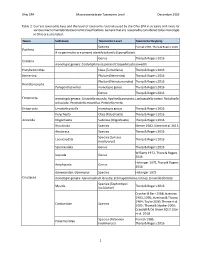
Ohio EPA Macroinvertebrate Taxonomic Level December 2019 Table 1. Current taxonomic keys and the level of taxonomy routinely used by the Ohio EPA in streams and rivers for various macroinvertebrate taxonomic classifications. Genera that are reasonably considered to be monotypic in Ohio are also listed. Taxon Subtaxon Taxonomic Level Taxonomic Key(ies) Species Pennak 1989, Thorp & Rogers 2016 Porifera If no gemmules are present identify to family (Spongillidae). Genus Thorp & Rogers 2016 Cnidaria monotypic genera: Cordylophora caspia and Craspedacusta sowerbii Platyhelminthes Class (Turbellaria) Thorp & Rogers 2016 Nemertea Phylum (Nemertea) Thorp & Rogers 2016 Phylum (Nematomorpha) Thorp & Rogers 2016 Nematomorpha Paragordius varius monotypic genus Thorp & Rogers 2016 Genus Thorp & Rogers 2016 Ectoprocta monotypic genera: Cristatella mucedo, Hyalinella punctata, Lophopodella carteri, Paludicella articulata, Pectinatella magnifica, Pottsiella erecta Entoprocta Urnatella gracilis monotypic genus Thorp & Rogers 2016 Polychaeta Class (Polychaeta) Thorp & Rogers 2016 Annelida Oligochaeta Subclass (Oligochaeta) Thorp & Rogers 2016 Hirudinida Species Klemm 1982, Klemm et al. 2015 Anostraca Species Thorp & Rogers 2016 Species (Lynceus Laevicaudata Thorp & Rogers 2016 brachyurus) Spinicaudata Genus Thorp & Rogers 2016 Williams 1972, Thorp & Rogers Isopoda Genus 2016 Holsinger 1972, Thorp & Rogers Amphipoda Genus 2016 Gammaridae: Gammarus Species Holsinger 1972 Crustacea monotypic genera: Apocorophium lacustre, Echinogammarus ischnus, Synurella dentata Species (Taphromysis Mysida Thorp & Rogers 2016 louisianae) Crocker & Barr 1968; Jezerinac 1993, 1995; Jezerinac & Thoma 1984; Taylor 2000; Thoma et al. Cambaridae Species 2005; Thoma & Stocker 2009; Crandall & De Grave 2017; Glon et al. 2018 Species (Palaemon Pennak 1989, Palaemonidae kadiakensis) Thorp & Rogers 2016 1 Ohio EPA Macroinvertebrate Taxonomic Level December 2019 Taxon Subtaxon Taxonomic Level Taxonomic Key(ies) Informal grouping of the Arachnida Hydrachnidia Smith 2001 water mites Genus Morse et al. -

Increased Temperature Delays the Late-Season Phenology Of
www.nature.com/scientificreports OPEN Increased temperature delays the late-season phenology of multivoltine insect Received: 26 February 2016 Adam Glazaczow1, David Orwin2 & Michał Bogdziewicz1 Accepted: 04 November 2016 We analyzed the impact of increased water temperature on the late-season phenology of the mayfly Published: 01 December 2016 (Baetis liebenauae). The River Gwda, unlike two other examined rivers (controls), has reservoirs along its length and thus, higher water temperature. Elevated water temperature prolonged summer diapause of the mayfly and shifted its life cycle to the later autumn: the last generation of mayflies started development later in the Gwda than in the control rivers. This translated into terrestrial stages (subimagos) of the insect being more abundant at the water surface in the late autumn in the Gwda river than in the control rivers. The low water temperature in the late autumn hampers subimagos emergence from the water surface. Thus, the altered insect phenology at Gwda resulted in a largely lost generation. However, the effect of reservoirs on the river water temperature was context-dependent, with the heating effect (and the impact on mayfly phenology) weaker in the year with lower average air temperature. In summary, warming blurred the environmental cue used by mayflies to tune their phenology, which resulted in a developmental trap. Since the projections of increases in global temperatures reach even 6.4 °C, reported mechanisms will potentially also occur in non-transformed watercourses. Phenology is the timing of seasonal activities of plants and animals such as flowering or mating. Alterations in phenology are among the best-supported effects of climate change on organisms1–5. -
TB142: Mayflies of Maine: an Annotated Faunal List
The University of Maine DigitalCommons@UMaine Technical Bulletins Maine Agricultural and Forest Experiment Station 4-1-1991 TB142: Mayflies of aine:M An Annotated Faunal List Steven K. Burian K. Elizabeth Gibbs Follow this and additional works at: https://digitalcommons.library.umaine.edu/aes_techbulletin Part of the Entomology Commons Recommended Citation Burian, S.K., and K.E. Gibbs. 1991. Mayflies of Maine: An annotated faunal list. Maine Agricultural Experiment Station Technical Bulletin 142. This Article is brought to you for free and open access by DigitalCommons@UMaine. It has been accepted for inclusion in Technical Bulletins by an authorized administrator of DigitalCommons@UMaine. For more information, please contact um.library.technical.services@maine.edu. ISSN 0734-9556 Mayflies of Maine: An Annotated Faunal List Steven K. Burian and K. Elizabeth Gibbs Technical Bulletin 142 April 1991 MAINE AGRICULTURAL EXPERIMENT STATION Mayflies of Maine: An Annotated Faunal List Steven K. Burian Assistant Professor Department of Biology, Southern Connecticut State University New Haven, CT 06515 and K. Elizabeth Gibbs Associate Professor Department of Entomology University of Maine Orono, Maine 04469 ACKNOWLEDGEMENTS Financial support for this project was provided by the State of Maine Departments of Environmental Protection, and Inland Fisheries and Wildlife; a University of Maine New England, Atlantic Provinces, and Quebec Fellow ship to S. K. Burian; and the Maine Agricultural Experiment Station. Dr. William L. Peters and Jan Peters, Florida A & M University, pro vided support and advice throughout the project and we especially appreci ated the opportunity for S.K. Burian to work in their laboratory and stay in their home in Tallahassee, Florida. -
An Updated List of Type Material of Ephemeroptera Hyatt & Arms, 1890, Deposited at the Zoological Museum of Hamburg (ZMH)
A peer-reviewed open-access journal ZooKeys 607: 49–68An (2016) updated list of type material of Ephemeroptera Hyatt & Arms, 1890... 49 doi: 10.3897/zookeys.607.9391 CATALOGUE http://zookeys.pensoft.net Launched to accelerate biodiversity research An updated list of type material of Ephemeroptera Hyatt & Arms, 1890, deposited at the Zoological Museum of Hamburg (ZMH) Michel Sartori1,2, Martin Kubiak2, Hossein Rajaei2,3 1 Museum of zoology, Palais de Rumine, Place Riponne 6, CH-1005 Lausanne, Switzerland 2 Zoologisches Museum, Centrum für Naturkunde (CeNak), Martin-Luther-King-Platz 3, 20146 Hamburg, Germany 3 Staatliches Museum für Naturkunde Stuttgart, Rosenstein 1, 70191 Stuttgart, Germany Corresponding author: Michel Sartori (Michel.sartori@vd.ch) Academic editor: E. Dominguez | Received 31 May 2016 | Accepted 6 July 2016 | Published 26 July 2016 http://zoobank.org/F2D11E9A-5AC0-4309-BB04-B83142605624 Citation: Sartori M, Kubiak M, Rajaei H (2016) An updated list of type material of Ephemeroptera Hyatt & Arms, 1890, deposited at the Zoological Museum of Hamburg (ZMH). ZooKeys 607: 49–68. doi: 10.3897/zookeys.607.9391 Abstract The type specimens of Ephemeroptera (Insecta) housed at the Zoological Museum of Hamburg (ZMH) are compiled in this document. The current nomenclature of all species is given. In total, Ephemerop- tera type material of ZMH encompasses 161 species. Fifty-one holotypes and five lectotypes are present. Forty-one species are represented by syntypes, 85 by paratypes and five by paralectotypes. Material of two species (Cinygma asiaticum Ulmer, 1924 and Pseudocloeon klapaleki Müller-Liebenau, 1982) is missing. The present catalogue is an updated version of Weidner (1964a). -
Ephemeroptera: Caenidae) in Honey Creek, Oklahoma
LIFE HISTORY AND SECONDARY PRODUCTION OF Caenis latipennis BANKS (EPHEMEROPTERA: CAENIDAE) IN HONEY CREEK, OKLAHOMA Jason M. T aylor, B.A. Thesis Prepared for the Degree of MASTER OF SCIENCE UNIVERSITY OF NORTH TEXAS August 2001 APPROVED: James H. Kennedy, Major Professor William T. Waller, Committee Member Earl G. Zimmerman, Chair of the Department of Biological Sciences, Committee Member Warren W. Burggren, Dean of the College of Arts and Sciences C. Neal Tate, Dean of the Robert B. Toulouse School of Graduate Studies Taylor, Jason M., Life History and Secondary Production of Caenis latipennis Banks (Ephemeroptera: Caenidae) in Honey Creek, Oklahoma. Masters of Science (Biology), August 2001, 89 pp., 8 tables, 22 figures, references, 71 titles. A study of the life history and secondary production of Caenis latipennis, a caenid mayfly, was conducted on Honey Creek, OK. from August 1999 through September 2000. The first instar nymph was described. Nymphs were separated into five development classes. Laboratory egg and nymph development rates, emergence, fecundity, voltinism, and secondary production were analyzed. C. latipennis eggs and nymphs take 132 and 1709 degree days to develop. C. latipennis had an extended emergence with five peaks. Females emerged, molted, mated, and oviposited in an estimated 37 minutes. Mean fecundity was 888.4 ± 291.9 eggs per individual (range 239 –1576). C. latipennis exhibited a multivoltine life cycle with four overlapping generations. Secondary production was 6,052.57 mg/m2/yr. ACKNOWLEDGMENTS I would like to thank Dr. J. H. Kennedy for his whole-hearted interest and support in this project and my career. His enthusiasm as a teacher and field biologist has taught me much more than just biology. -
Understanding Effects of Changes in Land Use, Environmental Parameters, Habitat Characteristics on the Great Basin Aquatic Inver
UNLV Theses, Dissertations, Professional Papers, and Capstones 5-1-2013 Understanding effects of changes in land use, environmental parameters, habitat characteristics on the Great Basin aquatic invertebrates using ecological stoichiometric theory Knut Mehler University of Nevada, Las Vegas Follow this and additional works at: https://digitalscholarship.unlv.edu/thesesdissertations Part of the Desert Ecology Commons, Environmental Monitoring Commons, Fresh Water Studies Commons, and the Terrestrial and Aquatic Ecology Commons Repository Citation Mehler, Knut, "Understanding effects of changes in land use, environmental parameters, habitat characteristics on the Great Basin aquatic invertebrates using ecological stoichiometric theory" (2013). UNLV Theses, Dissertations, Professional Papers, and Capstones. 1862. http://dx.doi.org/10.34917/4478281 This Dissertation is protected by copyright and/or related rights. It has been brought to you by Digital Scholarship@UNLV with permission from the rights-holder(s). You are free to use this Dissertation in any way that is permitted by the copyright and related rights legislation that applies to your use. For other uses you need to obtain permission from the rights-holder(s) directly, unless additional rights are indicated by a Creative Commons license in the record and/or on the work itself. This Dissertation has been accepted for inclusion in UNLV Theses, Dissertations, Professional Papers, and Capstones by an authorized administrator of Digital Scholarship@UNLV. For more information, please contact -
100 Characters
40 Review and Update of Non-mollusk Invertebrate Species in Greatest Need of Conservation: Final Report Leon C. Hinz Jr. and James N. Zahniser Illinois Natural History Survey Prairie Research Institute University of Illinois 30 April 2015 INHS Technical Report 2015 (31) Prepared for: Illinois Department of Natural Resources State Wildlife Grant Program (Project Number T-88-R-001) Unrestricted: for immediate online release. Prairie Research Institute, University of Illinois at Urbana Champaign Brian D. Anderson, Interim Executive Director Illinois Natural History Survey Geoffrey A. Levin, Acting Director 1816 South Oak Street Champaign, IL 61820 217-333-6830 Final Report Project Title: Review and Update of Non-mollusk Invertebrate Species in Greatest Need of Conservation. Project Number: T-88-R-001 Contractor information: University of Illinois at Urbana/Champaign Institute of Natural Resource Sustainability Illinois Natural History Survey 1816 South Oak Street Champaign, IL 61820 Project Period: 1 October 2013—31 September 2014 Principle Investigator: Leon C. Hinz Jr., Ph.D. Stream Ecologist Illinois Natural History Survey One Natural Resources Way, Springfield, IL 62702-1271 217-785-8297 leon.hinz@illinois.gov Prepared by: Leon C. Hinz Jr. & James N. Zahniser Goals/ Objectives: (1) Review all SGNC listing criteria for currently listed non-mollusk invertebrate species using criteria in Illinois Wildlife Action Plan, (2) Assess current status of species populations, (3) Review criteria for additional species for potential listing as SGNC, (4) Assess stressors to species previously reviewed, (5) Complete draft updates and revisions of IWAP Appendix I and Appendix II for non-mollusk invertebrates. T-88 Final Report Project Title: Review and Update of Non-mollusk Invertebrate Species in Greatest Need of Conservation. -
Appendix Page
NORTH CAROLINA DEPARTMENT OF ENVIRONMENT AND NATURAL RESOURCES Division of Water Quality Environmental Sciences Section August 2004 This page was intentionally left blank NCDENR, Division of Water Quality Basinwide Assessment Report – Cape Fear River Basin - August 2004 1 TABLE OF CONTENTS Page LIST OF APPENDICIES ........................................................................................................................ 5 LIST OF TABLES................................................................................................................................... 7 LIST OF FIGURES .............................................................................................................................. 11 OVERVIEW OF THE WATER QUALITY OF THE CAPE FEAR RIVER BASIN.....................................17 EXECUTIVE SUMMARIES BY PROGRAM AREA.................................................................................27 FISHERIES ...................................................................................................................................... 27 BENTHIC MACROINVERTEBRATES............................................................................................. 30 LAKE ASSESSMENT....................................................................................................................... 32 PHYTOPLANKTON MONITORING................................................................................................. 33 AMBIENT MONITORING................................................................................................................ -

Central Wisconsin Wildlife Areas Property Group
Rapid Ecological Assessment for Central Wisconsin Wildlife Areas Property Group A Rapid Ecological Assessment Focusing on Rare Plants, Selected Rare Animals, and High-quality Natural Communities Properties included in this report are: Dewey Marsh State Wildlife Area (Portage Co.) Mead Conifer Bogs State Natural Area Dewey Marsh State Natural Area (Portage Co.) (Portage and Wood Co.) George W. Mead State Wildlife Area McMillan Marsh State Wildlife Area (Marathon, Portage, and Wood Co.) (Marathon Co.) Wisconsin’s Natural Heritage Inventory Program Bureau of Endangered Resources Department of Natural Resources P.O. Box 7921, Madison, WI 53707 June 2012 PUB-ER-841 2012 Acknowledgments We extend special thanks to Tom Meier, Brian Peters, Matthew Slater, Greg Dahl, Lesa Kardash, and Patrice Eyers for their assistance in compiling this report and assisting with property access and field surveys. We are also grateful for support from the Ecosystem Management Planning Team, Diane Brusoe, Joanne Farnsworth, Alan Crossley, Kate Fitzgerald, Rebecca Schroeder, and Lance Potter. Funding for this project was provided by the Wisconsin DNR Bureau of Wildlife Management. Primary Authors: Ryan O’Connor, Amy Staffen, Richard Staffen Contributors: Noah Anderson – herptile surveys Julie Bleser – data management Andy Clark – plant and natural community surveys Terrell Hyde – data processing Christina Isenring – inventory coordination Kathy Kirk – terrestrial invertebrate surveys Sumner Matteson – black tern surveys Ryan O’Connor – plant and natural community surveys, data processing Brian Peters – bird surveys Stacy Rowe – data processing Kurt Schmude – aquatic invertebrate surveys William Smith – inventory coordination Amy Staffen – breeding bird and natural community surveys, data processing Rich Staffen – breeding bird surveys, data processing, inventory coordination Ryan Stephens – small mammal surveys Cover Photos: Top (left to right): Muskeg at Dewey Marsh State Wildlife Area by Ryan P. -
Microsoft Outlook
Joey Steil From: Leslie Jordan <ljordan@TNC.ORG> Sent: Tuesday, September 25, 2018 1:13 PM To: Angela Ruberto Subject: Potential Environmental Beneficial Users of Surface Water in Your GSA Attachments: Paso Basin - County of San Luis Obispo Groundwater Sustainabilit_detail.xls; Field_Descriptions.xlsx; Freshwater_Species_Data_Sources.xls; FW_Paper_PLOSONE.pdf; FW_Paper_PLOSONE_S1.pdf; FW_Paper_PLOSONE_S2.pdf; FW_Paper_PLOSONE_S3.pdf; FW_Paper_PLOSONE_S4.pdf CALIFORNIA WATER | GROUNDWATER To: GSAs We write to provide a starting point for addressing environmental beneficial users of surface water, as required under the Sustainable Groundwater Management Act (SGMA). SGMA seeks to achieve sustainability, which is defined as the absence of several undesirable results, including “depletions of interconnected surface water that have significant and unreasonable adverse impacts on beneficial users of surface water” (Water Code §10721). The Nature Conservancy (TNC) is a science-based, nonprofit organization with a mission to conserve the lands and waters on which all life depends. Like humans, plants and animals often rely on groundwater for survival, which is why TNC helped develop, and is now helping to implement, SGMA. Earlier this year, we launched the Groundwater Resource Hub, which is an online resource intended to help make it easier and cheaper to address environmental requirements under SGMA. As a first step in addressing when depletions might have an adverse impact, The Nature Conservancy recommends identifying the beneficial users of surface water, which include environmental users. This is a critical step, as it is impossible to define “significant and unreasonable adverse impacts” without knowing what is being impacted. To make this easy, we are providing this letter and the accompanying documents as the best available science on the freshwater species within the boundary of your groundwater sustainability agency (GSA). -

Distribution of Mayfly Species in North America List Compiled from Randolph, Robert Patrick
Page 1 of 19 Distribution of mayfly species in North America List compiled from Randolph, Robert Patrick. 2002. Atlas and biogeographic review of the North American mayflies (Ephemeroptera). PhD Dissertation, Department of Entomology, Purdue University. 514 pages and information presented at Xerces Mayfly Festival, Moscow, Idaho June, 9-12 2005 Acanthametropodidae Ameletus ludens Needham Acanthametropus pecatonica (Burks) Canada—ON,NS,PQ. USA—IL,GA,SC,WI. USA—CT,IN,KY,ME,MO,NY,OH,PA,WV. Ameletus majusculus Zloty Analetris eximia Edmunds Canada—AB. Canada—AB ,SA. USA—MT,OR,WA. USA—UT,WY. Ameletus minimus Zloty & Harper USA—OR. Ameletidae Ameletus oregonenesis McDunnough Ameletus amador Mayo Canada—AB ,BC,SA. Canada—AB. USA—ID,MT,OR,UT. USA—CA,OR. Ameletus pritchardi Zloty Ameletus andersoni Mayo Canada—AB,BC. USA—OR,WA. Ameletus quadratus Zloty & Harper Ameletus bellulus Zloty USA—OR. Canada—AB. Ameletus shepherdi Traver USA—MT. Canada—BC. Ameletus browni McDunnough USA—CA,MT,OR. Canada—PQ Ameletus similior McDunnough USA—ME,PA,VT. Canada—AB,BC. Ameletus celer McDunnough USA—CO,ID,MT,OR,UT Canada—AB ,BC. Ameletus sparsatus McDunnough USA—CO,ID,MT,UT Canada—AB,BC,NWT. Ameletus cooki McDunnough USA—AZ,CO,ID,MT,NM,OR Canada—AB,BC. Ameletus subnotatus Eaton USA—CO,ID,MT,OR,WA. Canada—AB,BC,MB,NB,NF,ON,PQ. Ameletus cryptostimulus Carle USA—CO,UT,WY. USA—NC,NY,PA,SC,TN,VA,VT,WV. Ameletus suffusus McDunnough Ameletus dissitus Eaton Canada—AB,BC. USA—CA,OR. USA—ID,OR. Ameletus doddsianus Zloty Ameletus tarteri Burrows USA—AZ,CO,NM,NV,UT. -

Insecticide Contamination of Streams in a Warming Climate
Insecticide contamination of streams in a warming climate Samuel James Macaulay A thesis submitted for the degree of Doctor of Philosophy at the University of Otago, Dunedin, New Zealand. June 2019 Abstract Feeding a growing global population in the context of a changing climate will bring challenges for food producers and environmental managers seeking to mitigate the impact of intensifying agricultural practices. The control of insect pest populations through insecticide application is an important practice for improving crop yields, yet contamination of the environment with insecticides combined with impacts from climate change are together subjecting ecosystems to novel stressors and stressor combinations. Contamination of surface waters with neonicotinoids, the most widely used insecticides in the world, has become a chronic global problem. Despite a growing body of research investigating the impacts of neonicotinoids in aquatic ecosystems, prior to my research there were no published toxicity data for their effects on aquatic insects in New Zealand. Moreover, international data on chronic, neonicotinoid-mixture, interactive multiple-stressor and community-level effects in stream ecosystems were also lacking. My overall PhD research objective was to investigate the ecological impacts of neonicotinoid insecticides on New Zealand’s freshwater macroinvertebrate communities in a multiple-stressor and climate- change context. I developed and optimized laboratory procedures for testing chronic toxicities of neonicotinoids and observing their lethal and sublethal effects on stream insect larvae in controlled laboratory experiments. Through a series of 4-week experiments, the chronic toxicities of three commonly used neonicotinoids (imidacloprid, clothianidin and thiamethoxam) to nymphs of the ubiquitous New Zealand mayfly Deleatidium spp.