Evolution of Hyperossification Expands Skull Diversity in Frogs
Total Page:16
File Type:pdf, Size:1020Kb
Load more
Recommended publications
-
Aark-10Yr-Final.Pdf
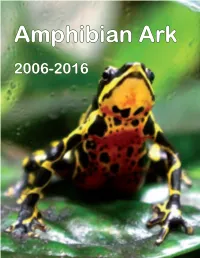
Amphibian Ark 2006-2016 FROM THE EXECUTIVE DIRECTOR Frosted Flatwoods Salamander © Pierson Hill The amphibian extinction crisis is one of the great- We’ve come a long way in the past ten years. Since est challenges facing the conservation community, its inception in 2006 AArk has been helping zoos, with 40% of the 7,500 amphibian species listed as aquariums, and other ex situ conservation organiza- threatened by the IUCN. Without an integrated and tions address the captive components of the ACAP. world-wide response, much of this entire vertebrate The community has responded to the call for action, class could be lost. with nearly 180 ex situ rescue and husbandry re- search programs for threatened species around the In 2006, in response to the (then draft) Amphibian world. Conservation Action Plan (ACAP) the World Associa- tion of Zoos and Aquariums (WAZA) passed a resolu- With a focus on well-managed, range-country ex situ tion calling for the international zoo and aquarium conservation programs, AArk’s primary activities community to respond immediately to the amphib- center around: ian crisis, and the Amphibian Ark (AArk) was born. • assessing the conservation needs of amphibian species; • training and capacity-building where it is most needed; • providing seed grants to help establish ex situ facilities in range countries; • raising awareness about amphibian declines and the steps being taken to reduce those declines; and • monitoring the progress of ex situ programs. European Green Toad © Claes Andrén Our vision Edited by: Anne Baker, Kevin Johnson, Luis Carrillo Publication date: June 2017 Amphibians thriving in nature Layout by: Candace M. -

Anura: Hemiphractidae: Gastrotheca)
Accepted Manuscript Short communication Brazilian marsupial frogs are diphyletic (Anura: Hemiphractidae: Gastrotheca) David C. Blackburn, William E. Duellman PII: S1055-7903(13)00179-6 DOI: http://dx.doi.org/10.1016/j.ympev.2013.04.021 Reference: YMPEV 4580 To appear in: Molecular Phylogenetics and Evolution Received Date: 7 January 2013 Revised Date: 2 April 2013 Accepted Date: 22 April 2013 Please cite this article as: Blackburn, D.C., Duellman, W.E., Brazilian marsupial frogs are diphyletic (Anura: Hemiphractidae: Gastrotheca), Molecular Phylogenetics and Evolution (2013), doi: http://dx.doi.org/10.1016/ j.ympev.2013.04.021 This is a PDF file of an unedited manuscript that has been accepted for publication. As a service to our customers we are providing this early version of the manuscript. The manuscript will undergo copyediting, typesetting, and review of the resulting proof before it is published in its final form. Please note that during the production process errors may be discovered which could affect the content, and all legal disclaimers that apply to the journal pertain. 1 Short Communication 2 3 Brazilian marsupial frogs are diphyletic (Anura: Hemiphractidae: Gastrotheca) 4 5 David C. Blackburna,*, William E. Duellmanb 6 a Department of Vertebrate Zoology & Anthropology, California Academy of Sciences, 55 7 Music Concourse Drive, San Francisco, CA 94118, USA 8 b Biodiversity Institute, University of Kansas, 1345 Jayhawk Boulevard, Lawrence, KS 9 66045, USA 10 * Corresponding author. E-mail address: dblackburn@calacademy.org (D.C. Blackburn) 11 12 Abstract 13 Molecular phylogenetic analyses based on expanded taxonomic and geographic sampling 14 support the monophyly of the marsupial frog genera (family Hemiphractidae), resolve six 15 geographically circumscribed lineages within Gastrotheca, and, for the first time, reveal 16 that two divergent lineages of Gastrotheca inhabit the Atlantic Coastal Forests of Brazil. -
Partial Report of Activities Carried out in the Masako Forest Reserve
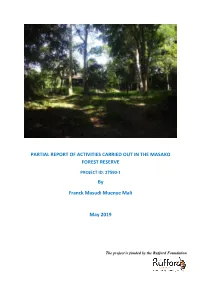
PARTIAL REPORT OF ACTIVITIES CARRIED OUT IN THE MASAKO FOREST RESERVE PROJECT ID: 27590-1 By Franck Masudi Muenye Mali May 2019 The project is funded by the Rufford Foundation “Amphibian diversity and environmental education for local people and capacity building for decision makers for the survival of Masako Forest Reserve in the DRC” PROJECT ID: 27590-1 Table of Contents 1. INTRODUCTION ............................................................................................................................... 3 2. FIELD METHODOLOGY ..................................................................................................................... 3 2.1. Investigation ............................................................................................................................ 3 2.2. Amphibian inventory .................................................................................................................... 4 3. PRELIMINARY RESULTS .................................................................................................................... 5 3.1. Views and proposals collected from the local community on the destruction of the Masako forest reserve ...................................................................................................................................... 5 3.1.1. Summary of responses to questions submitted to the local community ....................... 5 3.1.2. Immediate consequences observed following the destruction of the Masako reserve . 5 3.2. List of direct consequences -

Amphibiaweb's Illustrated Amphibians of the Earth
AmphibiaWeb's Illustrated Amphibians of the Earth Created and Illustrated by the 2020-2021 AmphibiaWeb URAP Team: Alice Drozd, Arjun Mehta, Ash Reining, Kira Wiesinger, and Ann T. Chang This introduction to amphibians was written by University of California, Berkeley AmphibiaWeb Undergraduate Research Apprentices for people who love amphibians. Thank you to the many AmphibiaWeb apprentices over the last 21 years for their efforts. Edited by members of the AmphibiaWeb Steering Committee CC BY-NC-SA 2 Dedicated in loving memory of David B. Wake Founding Director of AmphibiaWeb (8 June 1936 - 29 April 2021) Dave Wake was a dedicated amphibian biologist who mentored and educated countless people. With the launch of AmphibiaWeb in 2000, Dave sought to bring the conservation science and basic fact-based biology of all amphibians to a single place where everyone could access the information freely. Until his last day, David remained a tirelessly dedicated scientist and ally of the amphibians of the world. 3 Table of Contents What are Amphibians? Their Characteristics ...................................................................................... 7 Orders of Amphibians.................................................................................... 7 Where are Amphibians? Where are Amphibians? ............................................................................... 9 What are Bioregions? ..................................................................................10 Conservation of Amphibians Why Save Amphibians? ............................................................................. -

Pedal Luring in the Leaf-Frog Phyllomedusa Burmeisteri (Anura, Hylidae, Phyllomedusinae)
Phyllomedusa 1(2):93-95, 2002 © 2002 Melopsittacus Publicações Científicas ISSN 1519-1397 Pedal luring in the leaf-frog Phyllomedusa burmeisteri (Anura, Hylidae, Phyllomedusinae) Jaime Bertoluci Departamento de Zoologia, Universidade Federal de Minas Gerais. Caixa Postal 486, Belo Horizonte, MG, Brazil, 31270-901. E-mail: bertoluc@icb.ufmg.br. Keywords - Phyllomedusa burmeisteri, Phyllomedusinae, Hylidae, Anura, pedal luring, prey capture, feeding behavior. Luring behavior as a strategy of prey cap- the frog was maintained in a 60 × 30 × 37-cm ture has evolved independently in several glass terrarium containing soil and a bromeliad. squamate lineages, including pygopodid lizards On the fourth day of acclimation at 2300 h and (Murray et al. 1991), and boid (Murphy et al. under dim light, pedal luring was observed in 1978, Radcliffe et al. 1980), viperid (Greene response to offering the frog an individual adult and Campbell 1972, Heatwole and Dawson cricket (Orthoptera); the same observations were 1976, Henderson 1970, Sazima 1991), elapid made the next night. During the next three days, (Carpenter et al. 1978), and colubrid snakes the frog fed on domestic cockroaches (Sazima and Puorto 1993). Bavetz (1994) (Blattaria), but pedal luring was not observed in reported pedal luring related to predation in these circumstances. Larval mealworms ambystomatid salamanders. In anurans, this (Tenebrio sp.) also were offered to the frog, but feeding behavior has been described only for the always were refused. terrestrial leptodactylid frogs Ceratophrys Phyllomedusa burmeisteri is a sit-and-wait calcarata (Murphy 1976) and C. ornata predator that typically perches with its hands (Radcliffe et al. 1986). Pedal luring apparently and feet firmly grasping the substrate while does not occur in the terrestrial leptodactylids searching for prey. -
Bibliography and Scientific Name Index to Amphibians
lb BIBLIOGRAPHY AND SCIENTIFIC NAME INDEX TO AMPHIBIANS AND REPTILES IN THE PUBLICATIONS OF THE BIOLOGICAL SOCIETY OF WASHINGTON BULLETIN 1-8, 1918-1988 AND PROCEEDINGS 1-100, 1882-1987 fi pp ERNEST A. LINER Houma, Louisiana SMITHSONIAN HERPETOLOGICAL INFORMATION SERVICE NO. 92 1992 SMITHSONIAN HERPETOLOGICAL INFORMATION SERVICE The SHIS series publishes and distributes translations, bibliographies, indices, and similar items judged useful to individuals interested in the biology of amphibians and reptiles, but unlikely to be published in the normal technical journals. Single copies are distributed free to interested individuals. Libraries, herpetological associations, and research laboratories are invited to exchange their publications with the Division of Amphibians and Reptiles. We wish to encourage individuals to share their bibliographies, translations, etc. with other herpetologists through the SHIS series. If you have such items please contact George Zug for instructions on preparation and submission. Contributors receive 50 free copies. Please address all requests for copies and inquiries to George Zug, Division of Amphibians and Reptiles, National Museum of Natural History, Smithsonian Institution, Washington DC 20560 USA. Please include a self-addressed mailing label with requests. INTRODUCTION The present alphabetical listing by author (s) covers all papers bearing on herpetology that have appeared in Volume 1-100, 1882-1987, of the Proceedings of the Biological Society of Washington and the four numbers of the Bulletin series concerning reference to amphibians and reptiles. From Volume 1 through 82 (in part) , the articles were issued as separates with only the volume number, page numbers and year printed on each. Articles in Volume 82 (in part) through 89 were issued with volume number, article number, page numbers and year. -

New Record of Corythomantis Greeningi Boulenger, 1896 (Amphibia, Hylidae) in the Cerrado Domain, State of Tocantins, Central Brazil
Herpetology Notes, volume 7: 717-720 (2014) (published online on 21 December 2014) New record of Corythomantis greeningi Boulenger, 1896 (Amphibia, Hylidae) in the Cerrado domain, state of Tocantins, Central Brazil Leandro Alves da Silva1,*, Mauro Celso Hoffmann2 and Diego José Santana3 Corythomantis greeningi is a hylid frog distributed Caatinga. This new record extends the distribution of along xeric and subhumid regions of northeastern Corythomantis greeningi around 160 km western from Brazil, usually associated with the Caatinga domain the EESGT, which means approximately 400 km from (Jared et al., 1999). However, recent studies have shown the edge of the Caatinga domain (Figure 1). Although a larger distribution for the species in the Caatinga and Corythomantis greeningi has already been registered Cerrado (Valdujo et al., 2011; Pombal et al., 2012; in the Cerrado, this record shows a wider distribution Godinho et al., 2013) (Table 1; Figure 1). This casque- into this formation, not only marginally as previously headed frog is a medium-sized hylid, with a pronounced suggested (Valdujo et al., 2012). This is the most western ossification in the head and high intraspecific variation record of Corythomantis greeningi. in skin coloration (Andrade and Abe, 1997; Jared et al., Quaternary climatic oscillations have modeled 2005). Herein, we report a new record of Corythomantis the distribution of South American open vegetation greeningi in the Cerrado and provide its distribution map formations (Caatinga, Cerrado and Chaco) (Werneck, based -

Craniofacial Morphology of Simosuchus Clarki (Crocodyliformes: Notosuchia) from the Late Cretaceous of Madagascar
Society of Vertebrate Paleontology Memoir 10 Journal of Vertebrate Paleontology Volume 30, Supplement to Number 6: 13–98, November 2010 © 2010 by the Society of Vertebrate Paleontology CRANIOFACIAL MORPHOLOGY OF SIMOSUCHUS CLARKI (CROCODYLIFORMES: NOTOSUCHIA) FROM THE LATE CRETACEOUS OF MADAGASCAR NATHAN J. KLEY,*,1 JOSEPH J. W. SERTICH,1 ALAN H. TURNER,1 DAVID W. KRAUSE,1 PATRICK M. O’CONNOR,2 and JUSTIN A. GEORGI3 1Department of Anatomical Sciences, Stony Brook University, Stony Brook, New York, 11794-8081, U.S.A., Nathan.Kley@stonybrook.edu; jsertich@ic.sunysb.edu; Alan.Turner@stonybrook.edu; David.Krause@stonybrook.edu; 2Department of Biomedical Sciences, Ohio University College of Osteopathic Medicine, Athens, Ohio 45701, U.S.A., oconnorp@oucom.ohiou.edu; 3Department of Anatomy, Arizona College of Osteopathic Medicine, Midwestern University, Glendale, Arizona 85308, U.S.A., jgeorgi@midwestern.edu ABSTRACT—Simosuchus clarki is a small, pug-nosed notosuchian crocodyliform from the Late Cretaceous of Madagascar. Originally described on the basis of a single specimen including a remarkably complete and well-preserved skull and lower jaw, S. clarki is now known from five additional specimens that preserve portions of the craniofacial skeleton. Collectively, these six specimens represent all elements of the head skeleton except the stapedes, thus making the craniofacial skeleton of S. clarki one of the best and most completely preserved among all known basal mesoeucrocodylians. In this report, we provide a detailed description of the entire head skeleton of S. clarki, including a portion of the hyobranchial apparatus. The two most complete and well-preserved specimens differ substantially in several size and shape variables (e.g., projections, angulations, and areas of ornamentation), suggestive of sexual dimorphism. -

Ceratophrys Cranwelli) with Implications for Extinct Giant Frogs Scientific Reports, 2017; 7(1):11963-1-11963-10
PUBLISHED VERSION A. Kristopher Lappin, Sean C. Wilcox, David J. Moriarty, Stephanie A.R. Stoeppler, Susan E. Evans, Marc E.H. Jones Bite force in the horned frog (Ceratophrys cranwelli) with implications for extinct giant frogs Scientific Reports, 2017; 7(1):11963-1-11963-10 © The Author(s) 2017 Open Access This article is licensed under a Creative Commons Attribution 4.0 International License, which permits use, sharing, adaptation, distribution and reproduction in any medium or format, as long as you give appropriate credit to the original author(s) and the source, provide a link to the Creative Commons license, and indicate if changes were made. The images or other third party material in this article are included in the article’s Creative Commons license, unless indicated otherwise in a credit line to the material. If material is not included in the article’s Creative Commons license and your intended use is not permitted by statutory regulation or exceeds the permitted use, you will need to obtain permission directly from the copyright holder. To view a copy of this license, visit http://creativecommons.org/licenses/by/4.0/. Originally published at: http://doi.org/10.1038/s41598-017-11968-6 PERMISSIONS http://creativecommons.org/licenses/by/4.0/ 19th of April 2018 http://hdl.handle.net/2440/110874 www.nature.com/scientificreports OPEN Bite force in the horned frog (Ceratophrys cranwelli) with implications for extinct giant frogs Received: 27 March 2017 A. Kristopher Lappin1, Sean C. Wilcox1,2, David J. Moriarty1, Stephanie A. R. Stoeppler1, Accepted: 1 September 2017 Susan E. -
Africa's Gulf of Guinea Forests: Biodiversity Patterns and Conservation Priorities
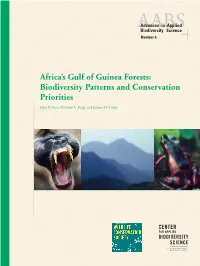
Advances in Applied Biodiversity Science, no. 6 AABSAdvances in Applied Biodiversity Science Number 6 Africa’s Gulf of Guinea Forests: Africa’s Gulf of Guinea Forests:Biodiversity Patterns and Conservation Africa’s Biodiversity Patterns and Conservation Priorities John F. Oates, Richard A. Bergl, and Joshua M. Linder Priorities C Conservation International ONSERVATION 1919 M Street, NW, Suite 600 Washington, DC 20036 TEL: 202-912-1000 FAX: 202-912-0772 I NTERNATIONAL ISBN 1-881173-82-8 WEB: www.conservation.org 9 0 0 0 0> www.biodiversityscience.org 9781881173823 About the Authors John F. Oates is a CABS Research Fellow, Professor of Anthropology at Hunter College, City University of New York (CUNY), and a Senior Conservation Advisor to the Africa program of the Wildlife Conservation Society (WCS). He is cur- rently advising WCS on biodiversity conservation projects in eastern Nigeria and western Cameroon. Dr. Oates has conducted research on the ecology of forest primates in Africa and Asia since 1966, and has assisted with the development of rainforest protected areas in South India and West Africa. He has published extensively on primate biology and conservation and, as an active member of the IUCN-SSC Primate Specialist Group, has compiled conservation action plans for African primates. He holds a PhD from the University of London. Richard A. Bergl is a doctoral student in anthropology at the CUNY Graduate Center, in the graduate training program of the New York Consortium in Evolutionary Primatology (NYCEP). He is currently conducting research into the population and habitat viability of the Cross River gorilla (Gorilla gorilla diehli) in Nigeria and Cameroon. -

Goliath Frogs Build Nests for Spawning – the Reason for Their Gigantism? Marvin Schäfera, Sedrick Junior Tsekanéb, F
JOURNAL OF NATURAL HISTORY 2019, VOL. 53, NOS. 21–22, 1263–1276 https://doi.org/10.1080/00222933.2019.1642528 Goliath frogs build nests for spawning – the reason for their gigantism? Marvin Schäfera, Sedrick Junior Tsekanéb, F. Arnaud M. Tchassemb, Sanja Drakulića,b,c, Marina Kamenib, Nono L. Gonwouob and Mark-Oliver Rödel a,b,c aMuseum für Naturkunde, Leibniz Institute for Evolution and Biodiversity Science, Berlin, Germany; bFaculty of Science, Laboratory of Zoology, University of Yaoundé I, Yaoundé, Cameroon; cFrogs & Friends, Berlin, Germany ABSTRACT ARTICLE HISTORY In contrast to its popularity, astonishingly few facts have become Received 16 April 2019 known about the biology of the Goliath Frog, Conraua goliath.We Accepted 7 July 2019 herein report the so far unknown construction of nests as spawning KEYWORDS sites by this species. On the Mpoula River, Littoral District, West Amphibia; Anura; Cameroon; Cameroon we identified 19 nests along a 400 m section. Nests Conraua goliath; Conrauidae; could be classified into three types. Type 1 constitutes rock pools parental care that were cleared by the frogs from detritus and leaf-litter; type 2 constitutes existing washouts at the riverbanks that were cleared from leaf-litter and/or expanded, and type 3 were depressions dug by the frogs into gravel riverbanks. The cleaning and digging activ- ities of the frogs included removal of small to larger items, ranging from sand and leaves to larger stones. In all nest types eggs and tadpoles of C. goliath were detected. All nest types were used for egg deposition several times, and could comprise up to three distinct cohorts of tadpoles. -
Antipredator Mechanisms of Post-Metamorphic Anurans: a Global Database and Classification System
Utah State University DigitalCommons@USU Ecology Center Publications Ecology Center 5-1-2019 Antipredator Mechanisms of Post-Metamorphic Anurans: A Global Database and Classification System Rodrigo B. Ferreira Utah State University Ricardo Lourenço-de-Moraes Universidade Estadual de Maringá Cássio Zocca Universidade Vila Velha Charles Duca Universidade Vila Velha Karen H. Beard Utah State University Edmund D. Brodie Jr. Utah State University Follow this and additional works at: https://digitalcommons.usu.edu/eco_pubs Part of the Ecology and Evolutionary Biology Commons Recommended Citation Ferreira, R.B., Lourenço-de-Moraes, R., Zocca, C. et al. Behav Ecol Sociobiol (2019) 73: 69. https://doi.org/ 10.1007/s00265-019-2680-1 This Article is brought to you for free and open access by the Ecology Center at DigitalCommons@USU. It has been accepted for inclusion in Ecology Center Publications by an authorized administrator of DigitalCommons@USU. For more information, please contact digitalcommons@usu.edu. 1 Antipredator mechanisms of post-metamorphic anurans: a global database and 2 classification system 3 4 Rodrigo B. Ferreira1,2*, Ricardo Lourenço-de-Moraes3, Cássio Zocca1, Charles Duca1, Karen H. 5 Beard2, Edmund D. Brodie Jr.4 6 7 1 Programa de Pós-Graduação em Ecologia de Ecossistemas, Universidade Vila Velha, Vila Velha, ES, 8 Brazil 9 2 Department of Wildland Resources and the Ecology Center, Utah State University, Logan, UT, United 10 States of America 11 3 Programa de Pós-Graduação em Ecologia de Ambientes Aquáticos Continentais, Universidade Estadual 12 de Maringá, Maringá, PR, Brazil 13 4 Department of Biology and the Ecology Center, Utah State University, Logan, UT, United States of 14 America 15 16 *Corresponding author: Rodrigo B.