Catalogue of Woody Plants 2011
Total Page:16
File Type:pdf, Size:1020Kb
Load more
Recommended publications
-

Arboretum News Armstrong News & Featured Publications
Georgia Southern University Digital Commons@Georgia Southern Arboretum News Armstrong News & Featured Publications Spring 2019 Arboretum News Georgia Southern University- Armstrong Campus Follow this and additional works at: https://digitalcommons.georgiasouthern.edu/armstrong-arbor-news Part of the Education Commons This article is brought to you for free and open access by the Armstrong News & Featured Publications at Digital Commons@Georgia Southern. It has been accepted for inclusion in Arboretum News by an authorized administrator of Digital Commons@Georgia Southern. For more information, please contact digitalcommons@georgiasouthern.edu. Arboretum News Issue 9 | Spring 2019 A Newsletter of the Georgia Southern University Armstrong Campus Arboretum From the Editor: Arboretum News, published by the Grounds Operations Department ’d like to introduce you to the Armstrong Arboretum of the new of Georgia Southern University- IGeorgia Southern University-Armstrong Campus. Designated Armstrong Campus, is distributed as an on-campus arboretum in 2001 by former Armstrong to faculty, staff, students and Atlantic State University president Dr. Thomas Jones, the friends of the Armstrong Arboretum. The Arboretum university recognized the rich diversity of plant life on campus. encompasses Armstrong’s 268- The Arboretum continues to add to that diversity and strives to acre campus and displays a wide function as a repository for the preservation and the conservation variety of shrubs and other woody of plants from all over the world. We also hope to inspire students, plants. Developed areas of campus faculty, staff and visitors to appreciate the incredible diversity contain native and introduced species of trees and shrubs. Most that plants have to offer. -
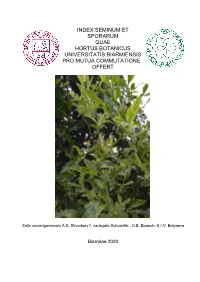
Index Seminum Et Sporarum Quae Hortus Botanicus Universitatis Biarmiensis Pro Mutua Commutatione Offert
INDEX SEMINUM ET SPORARUM QUAE HORTUS BOTANICUS UNIVERSITATIS BIARMIENSIS PRO MUTUA COMMUTATIONE OFFERT Salix recurvigemmata A.K. Skvortsov f. variegata Schumikh., O.E. Epanch. & I.V. Belyaeva Biarmiae 2020 Federal State Autonomous Educational Institution of Higher Education «Perm State National Research University», A.G. Genkel Botanical Garden ______________________________________________________________________________________ СПИСОК СЕМЯН И СПОР, ПРЕДЛАГАЕМЫХ ДЛЯ ОБМЕНА БОТАНИЧЕСКИМ САДОМ ИМЕНИ А.Г. ГЕНКЕЛЯ ПЕРМСКОГО ГОСУДАРСТВЕННОГО НАЦИОНАЛЬНОГО ИССЛЕДОВАТЕЛЬСКОГО УНИВЕРСИТЕТА Syringa vulgaris L. ‘Красавица Москвы’ Пермь 2020 Index Seminum 2020 2 Federal State Autonomous Educational Institution of Higher Education «Perm State National Research University», A.G. Genkel Botanical Garden ______________________________________________________________________________________ Дорогие коллеги! Ботанический сад Пермского государственного национального исследовательского университета был создан в 1922 г. по инициативе и под руководством проф. А.Г. Генкеля. Здесь работали известные ученые – ботаники Д.А. Сабинин, В.И. Баранов, Е.А. Павский, внесшие своими исследованиями большой вклад в развитие биологических наук на Урале. В настоящее время Ботанический сад имени А.Г. Генкеля входит в состав регионального Совета ботанических садов Урала и Поволжья, Совет ботанических садов России, имеет статус научного учреждения и особо охраняемой природной территории. Основными научными направлениями работы являются: интродукция и акклиматизация растений, -

Plant Records.Pub
Watsonia 27 : 375–387 (2009) PLANT RECORDS 375 Plant Records Records for publication must be submitted to the appropriate Vice-county Recorder (see BSBI Year Book 2008 ), and not to the Editors. Following publication of the New Atlas of the British & Irish Flora and the Vice-county Census Catalogue , new criteria have been drawn up for the inclusion of records in Plant Records . (See BSBI News no. 95, January 2004 pp. 10 & 11). These are outlined below: • First records of all taxa (species, subspecies and hybrids) included in the VCCC, designated as native, archaeophyte, neophyte or casual. • First record since 1970 of the taxa above, except in the case of Rubus , Hieracium and Taraxacum . • Records demonstrating the rediscovery of all taxa published as extinct in the VCCC or subsequently. • Newly reported definite extinctions. • Deletions from the VCCC (e.g. through the discovery of errors, the redetermination of specimens etc.) NB – only those errors affecting VCCC entry. • New 10km square records for Rare and Scarce plants, defined as those species in the New Atlas mapped in the British Isles in 100 10km squares or fewer. (See BSBI News no. 95, January 2004 pp 36–43). Records for the subdivisions of vice-counties will not be treated separately; they must therefore be records for the vice-county as a whole. However, records will be accepted for the major islands in v.cc. 100, 102–104, 110 and 113. In the following list, records are arranged in the order given in the List of Vascular Plants of the British Isles and its supplements by D. -

2. ACER Linnaeus, Sp. Pl. 2: 1054. 1753. 枫属 Feng Shu Trees Or Shrubs
Fl. China 11: 516–553. 2008. 2. ACER Linnaeus, Sp. Pl. 2: 1054. 1753. 枫属 feng shu Trees or shrubs. Leaves mostly simple and palmately lobed or at least palmately veined, in a few species pinnately veined and entire or toothed, or pinnately or palmately 3–5-foliolate. Inflorescence corymbiform or umbelliform, sometimes racemose or large paniculate. Sepals (4 or)5, rarely 6. Petals (4 or)5, rarely 6, seldom absent. Stamens (4 or 5 or)8(or 10 or 12); filaments distinct. Carpels 2; ovules (1 or)2 per locule. Fruit a winged schizocarp, commonly a double samara, usually 1-seeded; embryo oily or starchy, radicle elongate, cotyledons 2, green, flat or plicate; endosperm absent. 2n = 26. About 129 species: widespread in both temperate and tropical regions of N Africa, Asia, Europe, and Central and North America; 99 species (61 endemic, three introduced) in China. Acer lanceolatum Molliard (Bull. Soc. Bot. France 50: 134. 1903), described from Guangxi, is an uncertain species and is therefore not accepted here. The type specimen, in Berlin (B), has been destroyed. Up to now, no additional specimens have been found that could help clarify the application of this name. Worldwide, Japanese maples are famous for their autumn color, and there are over 400 cultivars. Also, many Chinese maple trees have beautiful autumn colors and have been cultivated widely in Chinese gardens, such as Acer buergerianum, A. davidii, A. duplicatoserratum, A. griseum, A. pictum, A. tataricum subsp. ginnala, A. triflorum, A. truncatum, and A. wilsonii. In winter, the snake-bark maples (A. davidii and its relatives) and paper-bark maple (A. -

And Lepidoptera Associated with Fraxinus Pennsylvanica Marshall (Oleaceae) in the Red River Valley of Eastern North Dakota
A FAUNAL SURVEY OF COLEOPTERA, HEMIPTERA (HETEROPTERA), AND LEPIDOPTERA ASSOCIATED WITH FRAXINUS PENNSYLVANICA MARSHALL (OLEACEAE) IN THE RED RIVER VALLEY OF EASTERN NORTH DAKOTA A Thesis Submitted to the Graduate Faculty of the North Dakota State University of Agriculture and Applied Science By James Samuel Walker In Partial Fulfillment of the Requirements for the Degree of MASTER OF SCIENCE Major Department: Entomology March 2014 Fargo, North Dakota North Dakota State University Graduate School North DakotaTitle State University North DaGkroadtaua Stet Sacteho Uolniversity A FAUNAL SURVEYG rOFad COLEOPTERA,uate School HEMIPTERA (HETEROPTERA), AND LEPIDOPTERA ASSOCIATED WITH Title A FFRAXINUSAUNAL S UPENNSYLVANICARVEY OF COLEO MARSHALLPTERTAitl,e HEM (OLEACEAE)IPTERA (HET INER THEOPTE REDRA), AND LAE FPAIDUONPATLE RSUAR AVSESYO COIFA CTOEDLE WOIPTTHE RFRAA, XHIENMUISP PTENRNAS (YHLEVTAENRICOAP TMEARRAS),H AANLDL RIVER VALLEY OF EASTERN NORTH DAKOTA L(EOPLIDEAOCPTEEAREA) I ANS TSHOEC RIAETDE RDI VWEITRH V FARLALXEIYN UOSF P EEANSNTSEYRLNV ANNOICRAT HM DAARKSHOATALL (OLEACEAE) IN THE RED RIVER VAL LEY OF EASTERN NORTH DAKOTA ByB y By JAMESJAME SSAMUEL SAMUE LWALKER WALKER JAMES SAMUEL WALKER TheThe Su pSupervisoryervisory C oCommitteemmittee c ecertifiesrtifies t hthatat t hthisis ddisquisition isquisition complies complie swith wit hNorth Nor tDakotah Dako ta State State University’s regulations and meets the accepted standards for the degree of The Supervisory Committee certifies that this disquisition complies with North Dakota State University’s regulations and meets the accepted standards for the degree of University’s regulations and meetMASTERs the acce pOFted SCIENCE standards for the degree of MASTER OF SCIENCE MASTER OF SCIENCE SUPERVISORY COMMITTEE: SUPERVISORY COMMITTEE: SUPERVISORY COMMITTEE: David A. Rider DCoa-CCo-Chairvhiadi rA. -

Global Survey of Ex Situ Betulaceae Collections Global Survey of Ex Situ Betulaceae Collections
Global Survey of Ex situ Betulaceae Collections Global Survey of Ex situ Betulaceae Collections By Emily Beech, Kirsty Shaw and Meirion Jones June 2015 Recommended citation: Beech, E., Shaw, K., & Jones, M. 2015. Global Survey of Ex situ Betulaceae Collections. BGCI. Acknowledgements BGCI gratefully acknowledges the many botanic gardens around the world that have contributed data to this survey (a full list of contributing gardens is provided in Annex 2). BGCI would also like to acknowledge the assistance of the following organisations in the promotion of the survey and the collection of data, including the Royal Botanic Gardens Edinburgh, Yorkshire Arboretum, University of Liverpool Ness Botanic Gardens, and Stone Lane Gardens & Arboretum (U.K.), and the Morton Arboretum (U.S.A). We would also like to thank contributors to The Red List of Betulaceae, which was a precursor to this ex situ survey. BOTANIC GARDENS CONSERVATION INTERNATIONAL (BGCI) BGCI is a membership organization linking botanic gardens is over 100 countries in a shared commitment to biodiversity conservation, sustainable use and environmental education. BGCI aims to mobilize botanic gardens and work with partners to secure plant diversity for the well-being of people and the planet. BGCI provides the Secretariat for the IUCN/SSC Global Tree Specialist Group. www.bgci.org FAUNA & FLORA INTERNATIONAL (FFI) FFI, founded in 1903 and the world’s oldest international conservation organization, acts to conserve threatened species and ecosystems worldwide, choosing solutions that are sustainable, based on sound science and take account of human needs. www.fauna-flora.org GLOBAL TREES CAMPAIGN (GTC) GTC is undertaken through a partnership between BGCI and FFI, working with a wide range of other organisations around the world, to save the world’s most threated trees and the habitats which they grow through the provision of information, delivery of conservation action and support for sustainable use. -

Online Na-English-Chinese Dictionary (Version 1.0)
Online Na-English-Chinese Dictionary (version 1.0) Alexis Michaud August 5, 2015 1 GUIDE TO USING THE DICTIONARY Introduction About the language This dictionary documents the lexicon of the Na language (nɑ˩-ʐwɤ˥) as spoken in and around the plain of Yongning, located in Southwestern China, at the border between Yunnan and Sichuan, at a latitude of 27°50’ N and a longitude of 100°41’ E. This language is known locally as ‘Mosuo’. Chronology and method The author’s fieldwork on Yongning Na began in October 2006, with tone as its main focus (lexical tone, andtonalmor- phology). This required examining as many lexical items as possible to ensure that no tone category was overlooked, but lexicographic work was not in itself a priority. A list of words was begun through elicitation, and gradually expanded and corrected as narratives were recorded and transcribed; addition of new words was therefore a slow process. An advantage of placing the emphasis on text collection is that a context is available to help clarify the meaning of newly encountered words, also offering a basis for further discussion of their usage. But systematic elicitation of large amounts ofvocabulary was not carried out, hence the limited number of entries: currently slightly under 3,000. Unless otherwise stated, all the data are from one language consultant, Mrs. Latami Dashilame (lɑ˧tʰɑ˧mi˥ ʈæ˧ʂɯ˧- lɑ˩mv˩; Chinese: 拉它米打史拉么). She was born in 1950 in the hamlet called ə˧lɑ˧-ʁwɤ#˥ in Na, close to the monastery of Yongning. The administrative coordinates of this village are: Yúnnán province, Lìjiāng municipality, Nínglàng Yí autonomous county, Yǒngníng district, Ālāwǎ village (云南省丽江市宁蒗彝族自治县永宁乡阿拉瓦村). -

Number 3, Spring 1998 Director’S Letter
Planning and planting for a better world Friends of the JC Raulston Arboretum Newsletter Number 3, Spring 1998 Director’s Letter Spring greetings from the JC Raulston Arboretum! This garden- ing season is in full swing, and the Arboretum is the place to be. Emergence is the word! Flowers and foliage are emerging every- where. We had a magnificent late winter and early spring. The Cornus mas ‘Spring Glow’ located in the paradise garden was exquisite this year. The bright yellow flowers are bright and persistent, and the Students from a Wake Tech Community College Photography Class find exfoliating bark and attractive habit plenty to photograph on a February day in the Arboretum. make it a winner. It’s no wonder that JC was so excited about this done soon. Make sure you check of themselves than is expected to seedling selection from the field out many of the special gardens in keep things moving forward. I, for nursery. We are looking to propa- the Arboretum. Our volunteer one, am thankful for each and every gate numerous plants this spring in curators are busy planting and one of them. hopes of getting it into the trade. preparing those gardens for The magnolias were looking another season. Many thanks to all Lastly, when you visit the garden I fantastic until we had three days in our volunteers who work so very would challenge you to find the a row of temperatures in the low hard in the garden. It shows! Euscaphis japonicus. We had a twenties. There was plenty of Another reminder — from April to beautiful seven-foot specimen tree damage to open flowers, but the October, on Sunday’s at 2:00 p.m. -

Literaturverzeichnis
Literaturverzeichnis Abaimov, A.P., 2010: Geographical Distribution and Ackerly, D.D., 2009: Evolution, origin and age of Genetics of Siberian Larch Species. In Osawa, A., line ages in the Californian and Mediterranean flo- Zyryanova, O.A., Matsuura, Y., Kajimoto, T. & ras. Journal of Biogeography 36, 1221–1233. Wein, R.W. (eds.), Permafrost Ecosystems. Sibe- Acocks, J.P.H., 1988: Veld Types of South Africa. 3rd rian Larch Forests. Ecological Studies 209, 41–58. Edition. Botanical Research Institute, Pretoria, Abbadie, L., Gignoux, J., Le Roux, X. & Lepage, M. 146 pp. (eds.), 2006: Lamto. Structure, Functioning, and Adam, P., 1990: Saltmarsh Ecology. Cambridge Uni- Dynamics of a Savanna Ecosystem. Ecological Stu- versity Press. Cambridge, 461 pp. dies 179, 415 pp. Adam, P., 1994: Australian Rainforests. Oxford Bio- Abbott, R.J. & Brochmann, C., 2003: History and geography Series No. 6 (Oxford University Press), evolution of the arctic flora: in the footsteps of Eric 308 pp. Hultén. Molecular Ecology 12, 299–313. Adam, P., 1994: Saltmarsh and mangrove. In Groves, Abbott, R.J. & Comes, H.P., 2004: Evolution in the R.H. (ed.), Australian Vegetation. 2nd Edition. Arctic: a phylogeographic analysis of the circu- Cambridge University Press, Melbourne, pp. marctic plant Saxifraga oppositifolia (Purple Saxi- 395–435. frage). New Phytologist 161, 211–224. Adame, M.F., Neil, D., Wright, S.F. & Lovelock, C.E., Abbott, R.J., Chapman, H.M., Crawford, R.M.M. & 2010: Sedimentation within and among mangrove Forbes, D.G., 1995: Molecular diversity and deri- forests along a gradient of geomorphological set- vations of populations of Silene acaulis and Saxi- tings. -

Garden Wise Non-Invasive Plants for Your Garden
Garden Wise Non-Invasive Plants for Your Garden Western Washington Guide Voluntary codes of conduct For the gardening public (annotated): In an effort to reduce the spread of invasive plants used for horticultural purposes, experts have created the “Voluntary Codes of Conduct,” a series of steps that nursery professionals, landscape architects, gardeners, and others can take to help curb the spread of invasive horticultural plants. ◊ Ask for only non-invasive species when you acquire plants. Plant only environmentally safe species in your gardens. Work towards and promote new landscape design that is friendly to regional ecosystems. ◊ Seek information on which species are invasive in your area. Sources could include botanical gardens, horticulturists, conservationists, and government agencies. Remove invasive species from your land and replace them with non-invasive species suited to your site and needs. ◊ Do not trade plants with other gardeners if you know they are species with invasive characteristics. ◊ Request that botanical gardens and nurseries promote, display, and sell only non-invasive species. ◊ Help educate your community and other gardeners in your area through personal contact and in such settings as garden clubs and other civic groups. For the full Gardening Codes of Conduct, or to learn about the Codes of Conduct for Government, Nursery Professionals, Landscape Architects, and Botanic Gardens and Arboreta, please go to the Invasive.org, TNC’s Global Invasive Species Team webpage: www.invasive.org/gist/horticulture/using-codes.html. Garden Wise is dedicated to Ann Lennartz Garden Wise Non-Invasive Plants for Your Garden While most exotic plants are not problematic, a few have become invasive in Washington State. -

Plant Breeding & Evaluation
SNA RESEARCH CONFERENCE - VOL. 47 - 2002 Plant Breeding & Evaluation Sandra M. Reed Section Editor and Moderator 623 SNA RESEARCH CONFERENCE - VOL. 47 - 2002 ‘Summer Cascade’ River Birch Thomas G. Ranney1, John D. Allen2, Daniel A. Allen2, and Myron O. Fountain3 1Mountain Horticultural Crops Research and Extension Center, North Carolina State University, 455 Research Drive, Fletcher, NC 28732 2Shiloh Nursery, 164 Allen Road, Harmony, NC 28634 3North Carolina Foundation Seed Producers, 3709 Hillsborough St., Room 3A, Raleigh, NC 27607 Index Words: Betula nigra L., New Introduction, Nursery Crop Nature of Work: River birch (Betula nigra L.) are important landscape plants for much of the United States and are valued for their desirable ornamental characteristics (4), heat tolerance (2), tolerance to poor drainage (1), and pest resistance (3). Identification and evaluation of new forms of river birch can expand the utility of this tree for diverse landscape applications. Results and Discussion: ‘Summer Cascade’ river birch (PPAF) is a new, weeping form of river birch that was discovered by John and Daniel Allen at Shiloh Nursery in Harmony, NC. The tree is unique in its pendu- lous habit, with graceful arching branches, that creates an ideal speci- men plant or focal point in the landscape (Figure 1). Detailed character- istics of the tree include: Habit. If untrained, the plant forms a mounded shrub or small tree with successive layers of arching branches. Alternatively, the plant can be staked/trained with a central trunk and pendulous branches. Flexible new growth also makes the tree ideal for use in topiary. Growth Rate. Growth is fast. -
Expression and Function of the Chloroplast-Encoded Gene Matk
Expression and Function of the Chloroplast-encoded Gene matK. Michelle Marie Barthet Dissertation submitted to the faculty of the Virginia Polytechnic Institute and State University in partial fulfillment of the requirements for the degree of Doctor of Philosophy In Biological Sciences K. W. Hilu, Chair E. Beers G. Gillaspy J. Sible R. A. Walker February 9, 2006 Blacksburg, Virginia Keywords: MatK, chloroplast, maturase, fast-evolving, Orchidaceae Copyright 2006, Michelle Marie Barthet Expression and Function of the chloroplast-encoded gene matK. Michelle Marie Barthet ABSTRACT The chloroplast matK gene has been identified as a rapidly evolving gene at nucleotide and corresponding amino acid levels. The high number of nucleotide substitutions and length mutations in matK has provided a strong phylogenetic signal for resolving plant phylogenies at various taxonomic levels. However, these same features have raised questions as to whether matK produces a functional protein product. matK is the only proposed chloroplast-encoded group II intron maturase. There are 15 genes in the chloroplast that would require a maturase for RNA splicing. Six of these genes have introns that are not excised by a nuclear imported maturase, leaving MatK as the only candidate for processing introns in these genes. Very little research has been conducted concerning the expression and function of this important gene and its protein product. It has become crucial to understand matK expression in light of its significance in RNA processing and plant systematics. In this study, we examined the expression, function and evolution of MatK using a combination of molecular and genetic methods. Our findings indicate that matK RNA and protein is expressed in a variety of plant species, and expression of MatK protein is regulated by development.