Sxbrc Front Cover
Total Page:16
File Type:pdf, Size:1020Kb
Load more
Recommended publications
-

Topic Paper Chilterns Beechwoods
. O O o . 0 O . 0 . O Shoping growth in Docorum Appendices for Topic Paper for the Chilterns Beechwoods SAC A summary/overview of available evidence BOROUGH Dacorum Local Plan (2020-2038) Emerging Strategy for Growth COUNCIL November 2020 Appendices Natural England reports 5 Chilterns Beechwoods Special Area of Conservation 6 Appendix 1: Citation for Chilterns Beechwoods Special Area of Conservation (SAC) 7 Appendix 2: Chilterns Beechwoods SAC Features Matrix 9 Appendix 3: European Site Conservation Objectives for Chilterns Beechwoods Special Area of Conservation Site Code: UK0012724 11 Appendix 4: Site Improvement Plan for Chilterns Beechwoods SAC, 2015 13 Ashridge Commons and Woods SSSI 27 Appendix 5: Ashridge Commons and Woods SSSI citation 28 Appendix 6: Condition summary from Natural England’s website for Ashridge Commons and Woods SSSI 31 Appendix 7: Condition Assessment from Natural England’s website for Ashridge Commons and Woods SSSI 33 Appendix 8: Operations likely to damage the special interest features at Ashridge Commons and Woods, SSSI, Hertfordshire/Buckinghamshire 38 Appendix 9: Views About Management: A statement of English Nature’s views about the management of Ashridge Commons and Woods Site of Special Scientific Interest (SSSI), 2003 40 Tring Woodlands SSSI 44 Appendix 10: Tring Woodlands SSSI citation 45 Appendix 11: Condition summary from Natural England’s website for Tring Woodlands SSSI 48 Appendix 12: Condition Assessment from Natural England’s website for Tring Woodlands SSSI 51 Appendix 13: Operations likely to damage the special interest features at Tring Woodlands SSSI 53 Appendix 14: Views About Management: A statement of English Nature’s views about the management of Tring Woodlands Site of Special Scientific Interest (SSSI), 2003. -

Fauna Lepidopterologica Volgo-Uralensis" 150 Years Later: Changes and Additions
©Ges. zur Förderung d. Erforschung von Insektenwanderungen e.V. München, download unter www.zobodat.at Atalanta (August 2000) 31 (1/2):327-367< Würzburg, ISSN 0171-0079 "Fauna lepidopterologica Volgo-Uralensis" 150 years later: changes and additions. Part 5. Noctuidae (Insecto, Lepidoptera) by Vasily V. A n ik in , Sergey A. Sachkov , Va d im V. Z o lo t u h in & A n drey V. Sv ir id o v received 24.II.2000 Summary: 630 species of the Noctuidae are listed for the modern Volgo-Ural fauna. 2 species [Mesapamea hedeni Graeser and Amphidrina amurensis Staudinger ) are noted from Europe for the first time and one more— Nycteola siculana Fuchs —from Russia. 3 species ( Catocala optata Godart , Helicoverpa obsoleta Fabricius , Pseudohadena minuta Pungeler ) are deleted from the list. Supposedly they were either erroneously determinated or incorrect noted from the region under consideration since Eversmann 's work. 289 species are recorded from the re gion in addition to Eversmann 's list. This paper is the fifth in a series of publications1 dealing with the composition of the pres ent-day fauna of noctuid-moths in the Middle Volga and the south-western Cisurals. This re gion comprises the administrative divisions of the Astrakhan, Volgograd, Saratov, Samara, Uljanovsk, Orenburg, Uralsk and Atyraus (= Gurjev) Districts, together with Tataria and Bash kiria. As was accepted in the first part of this series, only material reliably labelled, and cover ing the last 20 years was used for this study. The main collections are those of the authors: V. A n i k i n (Saratov and Volgograd Districts), S. -

Holland's Duinen Nr. 57, April 2011
Informatie over het duinonderzoek in Berkheide, Meijendel en Solleveld Nummer 57 april 2011 Omslag Holland's Duinen 57.indd 1 11-4-11 17:12 H O L L A N D ’ S D U I N E N Informatie over het duinonderzoek in Berkheide, Meijendel en Solleveld 1 Holland’s Duinen nr 57, april 2011 Inhoud H. Lucas. Het duin... een dierentuin? 3 - 5 R. Beringen en W. van der Slikke. Flora-monitoring in Meijendel, Berkheide en Solleveld 6 - 15 W. Moerland. Nachtvlinderonderzoek in de Wassenaarse duinen 16 - 31 H.E. Kirk. Natuurlijke hybridisatie tussen Senecio jacobaea en Senecio aquaticus 32 - 36 I. Kruisinga-Zanen. Bijzondere vondsten in hok 83 - 462 38 - 39 P.N. Peperkamp en R. Wielinga. Onderzoek naar het effect van de begrazing op de mycoflora van Solleveld 2009-2010 40 - 45 F.C. Hooijmans en A. Remeeus. Vlinders in Meijendel: aantallen in 2010 langs twee telroutes 46 - 49 T. van Schie. Aalscholvers in Solleveld 50 - 51 F.C. Hooijmans. Broedvogelmonitoring Meijendel 2009 52 - 69 Colofon 72 REDACTIONEEL Opnieuw zijn een aantal tekeningen van Pia Sprong opgenomen. Dit nummer herbergt weer een breed scala aan interessante onderwerpen. Het opent met: is het duin een dierentuin aan het worden? Daarna volgen diverse artikelen met reeksen van inventarisaties, die vooral door vrijwilligers worden uitgevoerd en waar Dunea een beperkte bijdrage heeft. Het Landelijk Meetnet Flora aandachtssoorten (LMF-a) is lokaal voortgezet en nu bijna 12 jaar: tijd voor een stand van zaken en een blik in de toekomst of het netwerk een bijdrage kan leveren als kwaliteitsparameter voor Natura2000. -

Coleoptera Tenebrionoidea) with Redescription of Falsopseudotomoxia Argyropleura (Franciscolo, 1942) N
BOLL. SOC. ENTOMOL. ITAL., 145 (3): 103-115, ISSN 0373-3491 15 DICEMBRE 2013 Enrico ruZZiEr Taxonomic and faunistic notes on Italian Mordellidae (Coleoptera Tenebrionoidea) with redescription of Falsopseudotomoxia argyropleura (Franciscolo, 1942) n. comb. Riassunto: Note faunistiche e tassonomiche sui Mordellidi italiani con ridescrizione di Falsopseudotomoxia argyropleura (Franciscolo, 1942) n. comb. Nel presente lavoro sono forniti nuovi dati faunistici sui Mordellidae italiani ed è redatta una nuova checklist. Viene inoltre ridescritta Variimorda argyropleura e fornita una nuova combinazione tassonomica. Abstract: New faunistic records of italian Mordellidae and an updated checklist are given. Variimorda argyropleura is re-described and the species is assigned to the genus Falsopseudotomoxia. Key words: Coleoptera; Tenebrionoidea; Mordellidae; faunistic. iNTroduCTioN species whose status was in doubt. in this paper the Mordellidae is an extremely complex and ho- new status of Falsopseudotomoxia argyropleura mogeneous beetle family where a secure identifica- (Franciscolo, 1942) will be explained and an updated tion at species level is not possible without a check list of italian Mordellidae will be given. combination of genital morphology, external charac- ters (such as ridges on hind tibiae and tarsi, colour CHECK LisT oF iTALiAN MordELLidAE of the hairs on the elytra) and morphometric analysis. (* status not clear; [?] doubtful presence) in particular, genera such as Mordella (Linnaeus, ErPC: Enrico ruzzier Personal Collection, Mirano 1758) and Mordellistena (A. Costa, 1854) require at- (Venezia). tention due to the richness of sibling species (K. Er- CBFV: Centro Nazionale per lo studio e la Conservazione misch, 1954; 1956; 1963; 1965b; 1969; 1977), often della Biodiversità Forestale Bosco Fontana, Verona. sympatric. Therefore, faunistic research requires FAPC: Fernando Angelini Personal Collection, Francavilla careful and precise study of all material available. -

Plant Diversity Effects on Plant-Pollinator Interactions in Urban and Agricultural Settings
Research Collection Doctoral Thesis Plant diversity effects on plant-pollinator interactions in urban and agricultural settings Author(s): Hennig, Ernest Ireneusz Publication Date: 2011 Permanent Link: https://doi.org/10.3929/ethz-a-006689739 Rights / License: In Copyright - Non-Commercial Use Permitted This page was generated automatically upon download from the ETH Zurich Research Collection. For more information please consult the Terms of use. ETH Library Diss. ETH No. 19624 Plant Diversity Effects on Plant-Pollinator Interactions in Urban and Agricultural Settings A dissertation submitted to the ETH ZURICH¨ for the degree of DOCTOR OF SCIENCES presented by ERNEST IRENEUSZ HENNIG Degree in Environmental Science (Comparable to Msc (Master of Science)) University Duisburg-Essen born 09th February 1977 in Swiebodzice´ (Poland) accepted on the recommendation of Prof. Dr. Jaboury Ghazoul, examiner Prof. Dr. Felix Kienast, co-examiner Dr. Simon Leather, co-examiner Prof. Dr. Alex Widmer, co-examiner 2011 You can never make a horse out of a donkey my father Andrzej Zbigniew Hennig Young Man Intrigued by the Flight of a Non-Euclidian Fly (Max Ernst, 1944) Contents Abstract Zusammenfassung 1 Introduction 9 1.1 Competition and facilitation in plant-plant interactions for pollinator services .9 1.2 Pollination in the urban environment . 11 1.3 Objectives . 12 1.4 References . 12 2 Does plant diversity enhance pollinator facilitation? An experimental approach 19 2.1 Introduction . 20 2.2 Materials & Methods . 21 2.2.1 Study Design . 21 2.2.2 Data Collection . 22 2.2.3 Analysis . 22 2.3 Results . 23 2.3.1 Pollinator Species and Visits . -

Xyleninae 73.087 2385 Small Mottled Willow
Xyleninae 73.087 2385 Small Mottled Willow (Spodoptera exigua) 73.089 2386 Mediterranean Brocade (Spodoptera littoralis) 73.091 2396 Rosy Marbled (Elaphria venustula) 73.092 2387 Mottled Rustic (Caradrina morpheus) 73.093 2387a Clancy's Rustic (Caradrina kadenii) 73.095 2389 Pale Mottled Willow (Caradrina clavipalpis) 73.096 2381 Uncertain (Hoplodrina octogenaria) 73.0961 2381x Uncertain/Rustic agg. (Hoplodrina octogenaria/blanda) 73.097 2382 Rustic (Hoplodrina blanda) 73.099 2384 Vine's Rustic (Hoplodrina ambigua) 73.100 2391 Silky Wainscot (Chilodes maritima) 73.101 2380 Treble Lines (Charanyca trigrammica) 73.102 2302 Brown Rustic (Rusina ferruginea) 73.103 2392 Marsh Moth (Athetis pallustris) 73.104 2392a Porter's Rustic (Athetis hospes) 73.105 2301 Bird's Wing (Dypterygia scabriuscula) 73.106 2304 Orache Moth (Trachea atriplicis) 73.107 2300 Old Lady (Mormo maura) 73.109 2303 Straw Underwing (Thalpophila matura) 73.111 2097 Purple Cloud (Actinotia polyodon) 73.113 2306 Angle Shades (Phlogophora meticulosa) 73.114 2305 Small Angle Shades (Euplexia lucipara) 73.118 2367 Haworth's Minor (Celaena haworthii) 73.119 2368 Crescent (Helotropha leucostigma) 73.120 2352 Dusky Sallow (Eremobia ochroleuca) 73.121 2364 Frosted Orange (Gortyna flavago) 73.123 2361 Rosy Rustic (Hydraecia micacea) 73.124 2362 Butterbur (Hydraecia petasitis) 73.126 2358 Saltern Ear (Amphipoea fucosa) 73.127 2357 Large Ear (Amphipoea lucens) 73.128 2360 Ear Moth (Amphipoea oculea) 73.1281 2360x Ear Moth agg. (Amphipoea oculea agg.) 73.131 2353 Flounced Rustic (Luperina -
Contribution to the Knowledge of the Fauna of Bombyces, Sphinges And
driemaandelijks tijdschrift van de VLAAMSE VERENIGING VOOR ENTOMOLOGIE Afgiftekantoor 2170 Merksem 1 ISSN 0771-5277 Periode: oktober – november – december 2002 Erkenningsnr. P209674 Redactie: Dr. J–P. Borie (Compiègne, France), Dr. L. De Bruyn (Antwerpen), T. C. Garrevoet (Antwerpen), B. Goater (Chandlers Ford, England), Dr. K. Maes (Gent), Dr. K. Martens (Brussel), H. van Oorschot (Amsterdam), D. van der Poorten (Antwerpen), W. O. De Prins (Antwerpen). Redactie-adres: W. O. De Prins, Nieuwe Donk 50, B-2100 Antwerpen (Belgium). e-mail: willy.deprins@antwerpen.be. Jaargang 30, nummer 4 1 december 2002 Contribution to the knowledge of the fauna of Bombyces, Sphinges and Noctuidae of the Southern Ural Mountains, with description of a new Dichagyris (Lepidoptera: Lasiocampidae, Endromidae, Saturniidae, Sphingidae, Notodontidae, Noctuidae, Pantheidae, Lymantriidae, Nolidae, Arctiidae) Kari Nupponen & Michael Fibiger [In co-operation with Vladimir Olschwang, Timo Nupponen, Jari Junnilainen, Matti Ahola and Jari- Pekka Kaitila] Abstract. The list, comprising 624 species in the families Lasiocampidae, Endromidae, Saturniidae, Sphingidae, Notodontidae, Noctuidae, Pantheidae, Lymantriidae, Nolidae and Arctiidae from the Southern Ural Mountains is presented. The material was collected during 1996–2001 in 10 different expeditions. Dichagyris lux Fibiger & K. Nupponen sp. n. is described. 17 species are reported for the first time from Europe: Clostera albosigma (Fitch, 1855), Xylomoia retinax Mikkola, 1998, Ecbolemia misella (Püngeler, 1907), Pseudohadena stenoptera Boursin, 1970, Hadula nupponenorum Hacker & Fibiger, 2002, Saragossa uralica Hacker & Fibiger, 2002, Conisania arida (Lederer, 1855), Polia malchani (Draudt, 1934), Polia vespertilio (Draudt, 1934), Polia altaica (Lederer, 1853), Mythimna opaca (Staudinger, 1899), Chersotis stridula (Hampson, 1903), Xestia wockei (Möschler, 1862), Euxoa dsheiron Brandt, 1938, Agrotis murinoides Poole, 1989, Agrotis sp. -

Cataleg Biodiversitat Albufera Mallorca 1998
Edita: Conselleria de Medi Ambient Direcció General de Biodiversitat Dibuix de la coberta: Joan Miquel Bennàssar Impressió: Gràfiques Son Espanyolet Diposit Legal: PM 1992-2002 Pròleg Aquesta obra que teniu a les mans és el producte d’un llarg procés de recerca i d’investiga- ció. És el resultat de més de 12 anys de treballs que han duit a terme els científics del grup s‘Albufera-IBG i molts d‘altres experts i aficionats que han aportat l’esforç i els coneixe- ments per completar aquesta visió global de la biodiversitat de s‘Albufera de Mallorca. Un cos de coneixements que s’ha anat formant pas a pas, com és característic de tot procés cien- tífic. La Conselleria de Medi Ambient és ben conscient que la conservació del patrimoni natural no es pot fer sense els estudis que ens han de permetre conèixer quins són els recursos sota la nostra responsabilitat i quin valor tenen. De cada vegada el gran públic coneix més quines són les espècies amenaçades i les accions per conservar-les troben ressò en els mitjans de comunicació i en la sensibilitat de la socie- tat en general. Però cal demanar-se: estam fent tot allò que és necessari per garantir la con- servació del patrimoni natural per a les generacions pròximes? Són suficients els coneixe- ments actuals d’aquest patrimoni? Quines espècies o quines poblacions són les més valuo- ses? Aquest llibre ajudarà a respondre algunes d‘aquestes preguntes. És un compromís entre la visió del científic, que sempre desitja aprofundir en l’estudi, i els gestors, que demanen amb urgència unes eines adequades per planificar les accions de conservació i avaluar-les. -

Microlepidoptera.Hu 12: 83–94|19.06.2017|HU ISSN 2062–6738 83
DOI: 10.24386/Microlep.2017.12.83 Microlepidoptera.hu 12: 83–94|19.06.2017|HU ISSN 2062–6738 83 New findings of the case-bearing moth genus Coleophora from the Balkan Peninsula with the description of Coleophora vardarella sp. nov. (Lepidoptera: Coleophoridae) Ignác Richter Abstract. Present article brings information about new findings of case–bearing moths (Lepidoptera: Coleophoridae) from the Balkan Peninsula. Several species of the genus Coleophora were recorded for the first time for some of the Balkan countries. Coleophora herniariae, C. daglarica and C. albipennella are recorded as new for the fauna of Europe. The description Coleophora vardarella Richter, sp. nov., from Macedonia is given. Keywords. Lepidoptera, Coleophoridae, Coleophora vardarella sp. nov., Coleophora herniariae, Coleophora daglarica, Coleophora albipennella, Macedonia, the Balkan Peninsula. Author’s address. Ignác Richter | Malá Čausa 289, SK–971 01, Slovakia E-mail: ignac.richter@gmail.com Introduction Intensive faunistic research of small moths (“Microlepidoptera”) of the Balkan Peninsula continues for several decades already and lasts until the recent times. The family Coleophoridae Bruand, 1850 belongs to the less known moths of the Balkans, therefore our focus has been oriented towards this large Lepidoptera family. Faunistic and systematic studies of this moth group in the Balkans resulted in interesting findings. One of the most important recent works about the genera Coleophora Hübner, 1822 and Goniodoma Zeller, 1849 of the Balkan Peninsula is the contribution of Richter & Pastorális (2015). Results of surveys conducted by seni- or author, executed in the years 2010–2014 at different sites of Croatia, Montene- gro, Macedonia, and Bulgaria were presented. -
Moth Group Newsletter Autumn 2009 Final.Pub
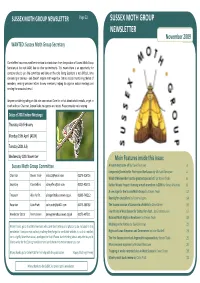
SUSSEX MOTH GROUP NEWSLETTER Page 32 SUSSEX MOTH GROUP NEWSLETTER November 2009 WANTED: Sussex Moth Group Secretary Clare Jeffers has announced her intention to stand down from the position of Sussex Moth Group Secretary at the next AGM, due to other commitments. This means there is an opportunity for someone else to join the committee and take on this role. Being Secretary is not difficult, time consuming or onerous - and doesn't require moth expertise. Duties include maintaining the list of members; sending welcome letters to new members; helping to organise indoor meetings and sending the occasional email. Anyone considering taking on this role can contact Clare for a chat about what it entails, or get in touch with our Chairman, Steven Teale, to express an interest. Please consider volunteering. Dates of 2010 Indoor Meetings: Thursday 4th February Monday 19th April (AGM) Tuesday 20th July Wednesday 10th November Main Features inside this issue: Sussex Moth Group Committee A hunch that came off by David Burrows 3 Lampronia flavimitrella : First record for Sussex by Michael Blencowe 4 Chairman Steven Teale clicka15@ymail.com 01273-516716 Which SMG member has the greatest species list? by Steven Teale 6 Secretary Clare Jeffers clarejeffers@aol.com 01323-423711 Rother Woods Project: Running a moth marathon in 2009 by Steve Wheatley 8 A new logo for the Sussex Moth Group by Steven Teale 12 Treasurer Alice Parfitt aliceparfitt@sussexwt.org.uk 01903-740212 Beating for caterpillars by Graeme Lyons 14 Recorder Colin Pratt colin.pratt@talk21.com 01273-586780 The Sussex invasion of Camareria ohridella by Dave Green 16 Fourth site in West Sussex for Dotted Fan-foot.. -
Additions, Deletions and Corrections to An
Bulletin of the Irish Biogeographical Society No. 36 (2012) ADDITIONS, DELETIONS AND CORRECTIONS TO AN ANNOTATED CHECKLIST OF THE IRISH BUTTERFLIES AND MOTHS (LEPIDOPTERA) WITH A CONCISE CHECKLIST OF IRISH SPECIES AND ELACHISTA BIATOMELLA (STAINTON, 1848) NEW TO IRELAND K. G. M. Bond1 and J. P. O’Connor2 1Department of Zoology and Animal Ecology, School of BEES, University College Cork, Distillery Fields, North Mall, Cork, Ireland. e-mail: <k.bond@ucc.ie> 2Emeritus Entomologist, National Museum of Ireland, Kildare Street, Dublin 2, Ireland. Abstract Additions, deletions and corrections are made to the Irish checklist of butterflies and moths (Lepidoptera). Elachista biatomella (Stainton, 1848) is added to the Irish list. The total number of confirmed Irish species of Lepidoptera now stands at 1480. Key words: Lepidoptera, additions, deletions, corrections, Irish list, Elachista biatomella Introduction Bond, Nash and O’Connor (2006) provided a checklist of the Irish Lepidoptera. Since its publication, many new discoveries have been made and are reported here. In addition, several deletions have been made. A concise and updated checklist is provided. The following abbreviations are used in the text: BM(NH) – The Natural History Museum, London; NMINH – National Museum of Ireland, Natural History, Dublin. The total number of confirmed Irish species now stands at 1480, an addition of 68 since Bond et al. (2006). Taxonomic arrangement As a result of recent systematic research, it has been necessary to replace the arrangement familiar to British and Irish Lepidopterists by the Fauna Europaea [FE] system used by Karsholt 60 Bulletin of the Irish Biogeographical Society No. 36 (2012) and Razowski, which is widely used in continental Europe. -
Ciram Case Study 5: Thorney Island
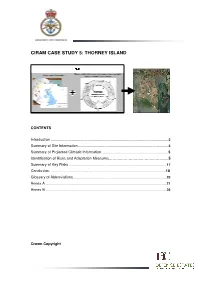
CIRAM CASE STUDY 5: THORNEY ISLAND CONTENTS Introduction ................................................................................................................ 2 Summary of Site Information ...................................................................................... 3 Summary of Projected Climatic Information ....................................................................... 3 Identification of Risks and Adaptation Measures………………………………………....5 Summary of Key Risks ............................................................................................. 17 Conclusion………………………………………………………………………………….. 18 Glossary of Abbreviations......................................................................................... 20 Annex A ................................................................................................................... 21 Annex B ................................................................................................................... 26 Crown Copyright INTRODUCTION Climate Impacts Risk Assessment Methodology (CIRAM) 1. CIRAM has been developed by Defence Estates (in partnership with specialist climate risk consultants, Acclimatise) with the aim of assessing potential threats to MOD sites as a result of projected climate change and help maintain each estates operational capability and capacity. The outcomes of CIRAM can inform management planning and decision making e.g. through Integrated Estate Management Plans (IEMPs) and Business Continuity Plans. 2. Additionally under the