SEAM Holdings List – August 2011 Newspapers – Brunei-Burma
Total Page:16
File Type:pdf, Size:1020Kb
Load more
Recommended publications
-

A Biography of Leon Ma. Guerrero, by Erwin S. Fernandez
The ISEAS – Yusof Ishak Institute (formerly Institute of Southeast Asian Studies) was established as an autonomous organization in 1968. It is a regional centre dedicated to the study of socio-political, security and economic trends and developments in Southeast Asia and its wider geostrategic and economic environment. The Institute’s research programmes are the Regional Economic Studies (RES, including ASEAN and APEC), Regional Strategic and Political Studies (RSPS), and Regional Social and Cultural Studies (RSCS). ISEAS Publishing, an established academic press, has issued more than 2,000 books and journals. It is the largest scholarly publisher of research about Southeast Asia from within the region. ISEAS Publishing works with many other academic and trade publishers and distributors to disseminate important research and analyses from and about Southeast Asia to the rest of the world. 16-1333 00 The Diplomat-Scholar.indd 2 6/4/17 8:37 AM First published in Singapore in 2017 by ISEAS Publishing 30 Heng Mui Keng Terrace Singapore 119614 E-mail: publish@iseas.edu.sg Website: <http://bookshop.iseas.edu.sg> All rights reserved. No part of this publication may be reproduced, stored in a retrieval system, or transmitted in any form or by any means, electronic, mechanical, photocopying, recording or otherwise, without the prior permission of the ISEAS – Yusof Ishak Institute. © 2017 ISEAS – Yusof Ishak Institute, Singapore The responsibility for facts and opinions in this publication rests exclusively with the author and his interpretations do not necessarily reflect the views or the policy of the publisher or its supporters. ISEAS Library Cataloguing-in-Publication Data Fernandez, Erwin S. -

Liem Thian Joe's Unpublished History of Kian Gwan
Southeast Asian Studies, Vol. 27, No.2, September 1989 Liem Thian Joe's Unpublished History of Kian Gwan Charles A. COPPEL* Studies on the role of the overseas Chinese sue the talent for writing which was already in the economies of Southeast Asia are rare evident in his schoolwork. A short ex enough, despite their generally acknowledged perience as a trader in Ngadiredjo soon con importance. This has been particularly true vinced him, however, that he should seek his of Indonesia, and consequently it is a matter livelihood as a writer. of some interest to discover an unpublished His career in journalism seems to have history of Kian Gwan (Oei Tiong Ham Con begun in the 1920's when he joined the staff of cern), the biggest and longest-lasting Chinese the Semarang peranakan Chinese daily, Warna business of all in Indonesia. Further interest Warla (although there is some suggestion that is aroused by the fact that the manuscript was he also contributed to the Jakarta daily, Per written by the late Liem Thian Joe, the well niagaan, at this time). In the early 1930's, he known Semarang journalist and historian. moved from Warna Warta to edit the Semarang This combination gives us promise of insights daily, Djawa Tengah (and its sister monthly into the firm itself, the Oei family which Djawa Tengah Review). In later years he established it and built it up, and the history of was also a regular contributor to the weekly the Chinese of Semarang where its original edition of the Jakarta newspaper, Sin PO.2) office was founded. -
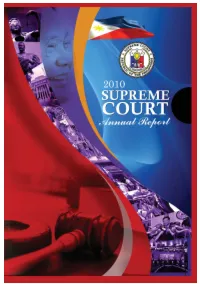
2010 Annual Report
THE 2010 CORONA COURT (Standing, Left to Right) Chief Justice Renato C. Corona, Associate Justices Antonio T. Carpio, Presbitero J. Velasco, Jr., Arturo D. Brion, Diosdado M. Peralta, Mariano C. del Castillo, Martin S. Villarama, Jr., and Jose Portugal Perez, (Seated, Left to Right) Conchita Carpio Morales, Antonio Eduardo B. Nachura, Teresita J. Leonardo-de Castro, Lucas P. Bersamin, Roberto A. Abad, Maria Lourdes Aranal Sereno, and Jose Catral Mendoza. 1 ANNUAL REPORT 2010 | SUPREME COURT OF THE PHILIPPINES 2 ANNUAL REPORT 2010| SUPREME COURT OF THE PHILIPPINES 3 ANNUAL REPORT 2010 | SUPREME COURT OF THE PHILIPPINES The 2010 CORONA COURT i Message from CHIEF JUSTICE RENATO C. CORONA 5 2010: PASSING THE TORCH 8 JUSTICES of the Supreme Court 13 Highlights of the CY 2012 SPLC BUDGET PROPOSAL 32 The STATE OF THE 2010 JUDICIARY 37 2010 Supreme Court REFORM PROJECTS 42 OFFICIALS of the Supreme Court 45 ATTACHED INSTITUTIONS 56 2010 SIGNIFICANT DECISIONS 59 2010SIGNIFICANT RULES, Guidelines, 67 Circulars, and Orders SIGNIFICANT ACCOMPLISHMENTS of SC COMMITTEES 70 and Technical Working Groups SIGNIFICANT FORA, Conferences, 73 Seminars, and Workshops 2009 SIGNIFICANT ADMINISTRATIVE RULINGS 78 EMPLOYEE WELFARE AND BENEFITS 84 The Philippine JUDICIAL SYSTEM 87 4 ANNUAL REPORT 2010| SUPREME COURT OF THE PHILIPPINES A first-rate Judiciary. This is something that should be in everyone’s wish list for our country. I say this not just as head of the Judiciary but also as Renato C. Corona, a Filipino citizen. The reason is simple: For the social and economic development of our country to be deep and lasting, the same must be underpinned by the rule of law. -

The Chinese Community of Surabaya, from Its Origins to the 1930S Crisis
Chinese Southern Diaspora Studies , Volume 3, 2009 南方华裔研究杂志, 第第第三第三三三卷卷卷卷, 2009 The Chinese Community of Surabaya, from its Origins to the 1930s Crisis 1 Claudine SALMON Abstract: This article traces the history of the Chinese community in Surabaya, a major port-city on the East Coast of Java, over several centuries. It uses evidence gathered from numerous sources, including Chinese epigraphy and genealogical records collected locally by the author, early European travel accounts, Dutch colonial records and memoirs, and Chinese and Malay language newspapers. The essay unravels, for the first time, the history of a handful of influential entrepreneurial of families who pioneered local cash-crop production, the sugar industry especially, during the Dutch colonial era. It concludes by tracing the waves of resinicisation that swept the community in the later nineteenth and early twentieth centuries, the new associations that arose as a result and the gradually fracturing of communal life that followed. Introduction Anyone who has studied the history of the Chinese community in Jakarta is aware that this city has a remarkable number of ancient temples. Five date back to the seventeenth century and seven to the second half of the eighteenth, including two ancestral and two guild temples.2 What is most striking in regard to the Chinese community of Surabaya is how rare these temples are and, moreover, how generally unimportant they are in community life there. According to oral tradition the oldest one (situated in Jl. Coklat) is the Hok An Kiong 福安宫, or “Temple of Happiness and Peace”. It is dedicated to Tianhou 天后, the protective goddess of sailors and travelling merchants, and dates from the second half of the eighteenth century. -

Indo 92 0 1319755155 157
W omen an d M odernity: Reading the Femme Fatale in Early Twentieth-Century Indies Novels Elizabeth Chandra1 In colonial Indonesia, literary works written in Malay by Chinese authors were commonly denigrated as pulp fiction, and therefore deemed "un-literary," due to their affinity with stories of secrecy, scandal, sex, and crime.2 The sinister sensibilities of these novels supposedly ran counter to the ideal notion of literature as "beautiful writings," which the colonial government had attempted to introduce in the Netherlands Indies beginning in the second decade of the twentieth century.3 This article offers a close examination of one such novel, Si Riboet atawa Boenga Mengandoeng Ratjoen: Soeatoe Tjerita jang Betoel Terdjadi di Soerabaja Koetika di Pertengahan Taon 1916, jaitoe Politie Opziener Coenraad Boenoe Actrice Constantinopel jang Mendjadi Katjinta'annja (Riboet, or the Venomous Flower: A True Story which Occurred in Soerabaja in Mid- 11 thank those who read and commented on this essay at different stages: Tamara Loos, John Wolff, Sylvia Tiwon, Benedict Anderson, and Indonesia's editors and anonymous reviewer. Any remaining errors are, of course, my own. 2 Claudine Salmon, Literature in Malay by the Chinese of Indonesia: A Provisional Annotated Bibliography (Paris: Editions de la Maison des Sciences de l'Homme, 1981). See also Elizabeth Chandra, "National Fictions: Chinese-Malay Literature and the Politics of Forgetting" (PhD dissertation, University of California- Berkeley, 2006). 3 Balai Pustaka, Balai Pustaka Sewadjarnja, 1908-1942 (Djakarta: Balai Pustaka, 1948); Bureau voor de Volkslectuur, The Bureau of Popular Literature of Netherlands India: What It is and What It Does (Batavia: Bureau voor de Volkslectuur, 1930); D. -
SC Reports First Term Projects, Achievements
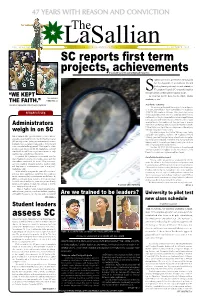
47 YEARS WITH REASON AND CONVICTION The V O L . X LV I I N O . 5 LaSallianBASTION OF ISSUE-ORIENTED CRITICAL THINKING 15 OCTOBER 2007 SC reports first term projects,BY LORAINEachievements SAGUINSIN AND CREZZEILLE FRANCISCO tudents are sent to university to be prepared for the demands of professional life and lifelong learning through formal education. The Student Council (SC) enters the situation Sthrough initiatives that address student needs. “we kept So what has the SC done for the DLSU-Manila SEE ARCHERS studentry so far? THE Faith.” VINDICATED, 20 PHOTOS BY JENNERSON ONG AND ERIKA SERRANO Academic concerns To improve and expand the scope of the endeavors of the SC, the Office of the Vice President for Academics (OVP-ACAD) made its Pahiram Libro book borrowing PERSPECTIVES system accessible online. This is to speed up the borrowing and claiming of books, since students can just create Pahiram Libro accounts and reserve books online. In order to claim reserved books, the students will then just have to present Administrators their IDs to any Pahiram Libro Committee Member in the SC Office. Right now, the office is in the process of developing the clearing system for borrowers. weigh in on SC Complaints about the Online Pahiram Libro being outdated were raised by students. VP Academics Nicole DR. CARMELITA QUEBENGCO, UNIVERSITY Villarojo reasoned that the shelves where the books are be- chancellor, expressed her view that the Student Council ing stored are not secured. Therefore, they have a hard time (SC) can improve by “getting more accurate information keeping track of those who just keep on getting books from especially from complaints submitted to them that are their storage area without permission. -

Dari Nasionalisme Cina Hingga Indonesierschap: Pemikiran Liem Koen Hian Tentang Kedudukan Orang Tionghoa Di Indonesia (1919 – 1951)
UNIVERSITAS INDONESIA DARI NASIONALISME CINA HINGGA INDONESIERSCHAP: PEMIKIRAN LIEM KOEN HIAN TENTANG KEDUDUKAN ORANG TIONGHOA DI INDONESIA (1919 – 1951) SKRIPSI Diajukan sebagai salah satu syarat memperoleh gelar Sarjana MICHAEL AGUSTINUS 0706279875 FAKULTAS ILMU PENGETAHUAN BUDAYA PROGRAM STUDI ILMU SEJARAH DEPOK JULI 2012 i Dari nasionalisme..., Michael Agustinus, FIB UI, 2012 ii Dari nasionalisme..., Michael Agustinus, FIB UI, 2012 iii Dari nasionalisme..., Michael Agustinus, FIB UI, 2012 iv Dari nasionalisme..., Michael Agustinus, FIB UI, 2012 KATA PENGANTAR Puji syukur penulis panjatkan kepada Tuhan Yang Maha Esa. Berkat kasih sayangnya, penulis dapat menyelesaikan pendidikan pada jenjang sarjana di Universitas Indonesia. Pada kesempatan ini, penulis ingin mengucapkan rasa terima kasih yang begitu dalam kep ada keluarga yang telah memberikan dukungan moril dan materil demi rampungnya masa studi penulis. Rasa terima kasih ini khususnya kepada kedua kakak penulis, Aileen, dan Aime, yang dengan penuh kasih sayang terus memberi semangat penulis untuk segera menyelesaikan skripsi ini. Dari sisi akademis, penulis banyak ucapkan terima kasih kepada para dosen Program Studi Ilmu Sejarah yang telah membimbing hingga rampungnya skripsi ini. Kepada Tri Wahyuning Mudaryanti, M.Si. sebagai dosen pembimbing, penulis banyak mengucapkan terima kasih atas kesediaan waktu dan juga arahannya selama pengerjaan tugas akhir ini, mulai dari kelas Bimbingan Bacaan hingga skripsi. Dosen-dosen lain juga sangat berjasa melalui perkuliahan dan diskusi yang mereka berikan selama sepuluh semester ini. Untuk itu, penulis ucapkan terima kasih kepada semua dosen di Program Studi Ilmu Sejarah. Dalam menjalankan penelitian lapangan, penulis sangat berterima kasih kepada para pengurus Perpustakaan FIB UI dan Perpustakaan Nasional atas pelayanannya yang sangat baik. Kepada semua pihak yang telah membantu penulis dalam penelitian lapangan yang tidak bisa penulis sebutkan satu per satu, penulis ucapkan banyak terima kasih. -

Eksistensi Kaum Tionghoa Dalam Dunia Pers Di Hindia Belanda
Bihari: Jurnal Pendidikan Sejarah dan Ilmu Sejarah, Vol. 4 No. 1 Tahun 2021 URL: http://jurnal.unsil.ac.id/index.php/bihari P-ISSN : 2655-3600, E-ISSN: 2714-7908 Eksistensi Kaum Tionghoa dalam Dunia Pers di Hindia Belanda Tahun 1869-1942 Iyus Jayusmana, 1 Miftahul Habib Fachrurozib, 2 * a bProgram Studi Pendidikan Sejarah, Universitas Siliwangi, Tasikmalaya, Indonesia 1 iyus.jayusman@unsil.ac.id; 2 miftahul.habib@unsil.ac.id * Corresponding author Abstrak Artikel ini bertujuan untuk: (1) mengetahui peranan orang Tionghoa dalam dunia pers di Hindia Belanda sebelum abad kedua puluh, (2) mengetahui perkembangan industri pers Tionghoa di Hindia Belanda pada masa pergerakan nasional. Artikel ini disusun dengan berdasarkan metode penelitian sejarah menurut Kuntowijoyo melalui tahapan pemulihan topik, heuristik, kritik sumber, interpretasi dan historiografi. Eksistensi kaum Tionghoa dalam dunia pers di Hindia Belanda dimulai dengan kemunculan Lo Tun Tay sebagai editor surat kabar Mataharie pada tahun 1869. Krisis ekonomi yang terjadi menjelang akhir abad kesembilan belas mendorong munculnya embrio industri pers Tionghoa yang ditandai dengan akuisisi sejumlah pers Eropa oleh pengusaha Tionghoa. Pers Tionghoa semakin berkembang memasuki masa pergerakan nasional. Pers Tionghoa memiliki perbedaan orientasi politik yakni mendukung Nasionalisme Indonesia, mendukung Nasionalisme Tionghoa, dan mendukung pemerintah kolonial. Adapun sikap tersebut tidak dapat dilepaskan dari kepentingan politik maupun ekonomi. Dengan demikian, eksistensi pers Tionghoa pada masa pergerakan nasional tidak hanya dapat ditinjau dari aspek politik saja, melainkan pula aspek ekonomi. Industri pers Tionghoa di Hindia Belanda berakhir seiring dengan pendudukan Jepang pada tahun 1942. Kata Kunci: : Pers, Kaum Tionghoa, Hindia Belanda Abstract This article aims to: (1) find out the role of the Chinese in the press in the Dutch East Indies before the twentieth century, (2) find out the development of the Chinese press industry in the Dutch East Indies during the national movement era. -
The Discourse Organization of Philippine University Newspaper Opinion Columns
The discourse organization of Philippine university newspaper opinion columns ilfre ariel apas University of Santo Tomas, Manila, The Philippines wgabrielgapas@gmail.com Abstract Recent studies on text organization have focused mostly on business documents, academic texts, and certain newspaper articles such as editorials and news stories. However, the organization of opinion articles found in university-level newspapers has not been formally investigated. Therefore, this study attempts to determine whether these articles are written in accordance to journalistic writing principles. A total of 45 opinion articles were taken and served as the study corpus. These articles were analyzed based on Ho’s (2001) framework, as supported by the principles of macrostructure and the features of editorials in journalistic riting he fndings indicate that the discourse structure of Philippine newspaper opinion articles employs the two-move pattern in the orientation, exposition, and summation locks, here to freuently used specifc steps are found in each lock he fndings suggest that university students adhere to a prescried journalistic tet organization, although there is also a tendency to deviate from it. Furthermore, it is possible that their judicious choices in using a particular step may have been inuenced y the riters ojective of effectively communicating their opinion to a wide variety of readers. Keywords: Written discourse, opinion articles, macrostructures, move analysis, campus journalism 1. Introduction 1.1 Argumentation and Opinion Columns It is believed that argumentation actively occurs in all available avenues of expressing one’s thoughts (I. de Leon, personal communication, February 2, 2015). Freely and Steinberg () defne it as an act of reasoning in communication, here individuals eplain and justify their actions, beliefs, and perceptions. -

Liem Thian Joe's Unpublished History of Kian Gwan(Oei Tiong Ham
Liem Thian Joe's Unpublished History of Kian Gwan(<Special Title Issue>Oei Tiong Ham Concern: The First Business Empire of Southeast Asia) Author(s) Coppel, Charles A. Citation 東南アジア研究 (1989), 27(2): 177-187 Issue Date 1989-09 URL http://hdl.handle.net/2433/56365 Right Type Departmental Bulletin Paper Textversion publisher Kyoto University Southeast Asian Studies, Vol. 27, No.2, September 1989 Liem Thian Joe's Unpublished History of Kian Gwan Charles A. COPPEL* Studies on the role of the overseas Chinese sue the talent for writing which was already in the economies of Southeast Asia are rare evident in his schoolwork. A short ex enough, despite their generally acknowledged perience as a trader in Ngadiredjo soon con importance. This has been particularly true vinced him, however, that he should seek his of Indonesia, and consequently it is a matter livelihood as a writer. of some interest to discover an unpublished His career in journalism seems to have history of Kian Gwan (Oei Tiong Ham Con begun in the 1920's when he joined the staff of cern), the biggest and longest-lasting Chinese the Semarang peranakan Chinese daily, Warna business of all in Indonesia. Further interest Warla (although there is some suggestion that is aroused by the fact that the manuscript was he also contributed to the Jakarta daily, Per written by the late Liem Thian Joe, the well niagaan, at this time). In the early 1930's, he known Semarang journalist and historian. moved from Warna Warta to edit the Semarang This combination gives us promise of insights daily, Djawa Tengah (and its sister monthly into the firm itself, the Oei family which Djawa Tengah Review). -

Dutch Commerce and Chinese Merchants in Java Verhandelingen Van Het Koninklijk Instituut Voor Taal-, Land- En Volkenkunde
Dutch Commerce and Chinese Merchants in Java Verhandelingen van het Koninklijk Instituut voor Taal-, Land- en Volkenkunde Edited by Rosemarijn Hoefte KITLV, Leiden Henk Schulte Nordholt KITLV, Leiden Editorial Board Michael Laffan Princeton University Adrian Vickers Sydney University Anna Tsing University of California Santa Cruz VOLUME 291 The titles published in this series are listed at brill.com/vki Dutch Commerce and Chinese Merchants in Java Colonial Relationships in Trade and Finance, 1800–1942 By Alexander Claver LEIDEN • BOSTON 2014 This is an open access title distributed under the terms of the Creative Commons Attribution‐ Noncommercial‐NonDerivative 3.0 Unported (CC‐BY‐NC‐ND 3.0) License, which permits any noncommercial use, and distribution, provided no alterations are made and the original author(s) and source are credited. The realization of this publication was made possible by the support of KITLV (Royal Netherlands Institute of Southeast Asian and Caribbean Studies). Front cover illustration: Sugar godown of the sugar enterprise ‘Assem Bagoes’ in Sitoebondo, East Java, ca. 1900. Collection Koninklijk Instituut voor Taal-, Land- en Volkenkunde (KITLV), Leiden (image code: 6017). Back cover illustration: Five guilder banknote of De Javasche Bank, 1934. Front side showing a male dancer of the Wayang Wong theatre of Central Java. Back side showing batik motives and a text in Dutch, Chinese, Arabic and Javanese script warning against counterfeiting. Design by the Dutch artist C.A. Lion Cachet. Printed by Joh. Enschedé en Zonen. Library of Congress Cataloging-in-Publication Data Claver, Alexander. Dutch commerce and Chinese merchants in Java : colonial relationships in trade and finance, 1800-1942 / by Alexander Claver. -

Language Preference of Student Journalists in Mindanao State University-Marawi, Philippines: Reasons and Attitudes
Advances in Sciences and Humanities 2016; 2(6): 92-103 http://www.sciencepublishinggroup.com/j/ash doi: 10.11648/j.ash.20160206.16 ISSN: 2472-0941 (Print); ISSN: 2472-0984 (Online) Language Preference of Student Journalists in Mindanao State University-Marawi, Philippines: Reasons and Attitudes Riz P. Sunio1, Jerryk C. Alico2, * 1Department of Liberal Arts, RC-Al Khwarizmi International College, Marawi City, Philippines 2Senior High School, Mindanao State University, Marawi City, Philippines Email address: rizsunio@gmail.com (R. P. Sunio), alico_jerryk@yahoo.com (J. C. Alico) *Corresponding author To cite this article: Riz P. Sunio, Jerryk C. Alico. Language Preference of Student Journalists in Mindanao State University-Marawi, Philippines: Reasons and Attitudes. Advances in Sciences and Humanities. Vol. 2, No. 6, 2016, pp. 92-103. doi: 10.11648/j.ash.20160206.16 Received: August 26, 2016; Accepted: September 12, 2016; Published: October 21, 2016 Abstract: Student journalists are trained to express and translate their outputs into paper. The preferred language medium they use to do so, however, may convey their perception and attitude towards languages. This study aimed to determine the preferred language that student journalists use in their articles, the reason for their preference, and their attitude towards English, Filipino, and their vernacular language. Mixed qualitative and quantitative methods were used as research design. Data were collected through distributing survey questionnaires to 58 student journalists in Mindano State Univeristy-Marawi during academic year 2013-2014 and conducting interviews to a random sample of 12 from those surveyed. Results showed that most of the student journalists prefer English while only a few uses Filipino and none prefer vernacular in writing.