The Last Roman Emperor, the Mahdī, and Jerusalem
Total Page:16
File Type:pdf, Size:1020Kb
Load more
Recommended publications
-
“Gog and Magog” Revelation 20:7-10; Ezekiel 38 & 39
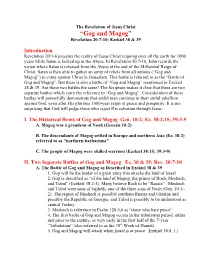
The Revelation of Jesus Christ “Gog and Magog” Revelation 20:7-10; Ezekiel 38 & 39 Introduction Revelation 20:1-6 presents the reality of Jesus Christ reigning over all the earth for 1000 years while Satan is locked up in the Abyss. In Revelation 20:7-10, John records the vision where Satan is released from the Abyss at the end of the Millennial Reign of Christ. Satan is then able to gather an army of rebels from all nations (“Gog and Magog”) to come against Christ in Jerusalem. This battle is referred to as the “Battle of Gog and Magog”. But there is also a battle of “Gog and Magog” mentioned in Ezekiel 38 & 39. Are these two battles the same? The Scripture makes it clear that there are two separate battles which carry the reference to “Gog and Magog”. Consideration of these battles will powerfully demonstrate that sinful men continue in their sinful rebellion against God, even after His glorious 1000-year reign of peace and prosperity. It is not surprising that God will judge those who reject His salvation through Jesus. I. The Historical Roots of Gog and Magog Gen. 10:2; Ez. 38:2,15; 39:3-9 A. Magog was a grandson of Noah (Genesis 10:2) B. The descendants of Magog settled in Europe and northern Asia (Ez. 38:2) referred to as "northern barbarians" C. The people of Magog were skilled warriors (Ezekiel 38:15; 39:3-9) II. Two Separate Battles of Gog and Magog Ez. 38 & 39; Rev. 20:7-10 A. -
The Ministry of Jesus the Messiah” 3-13-16 Joel Breidenbaugh (Luke 3-21) Intro
FBS “The Ministry of Jesus the Messiah” 3-13-16 Joel Breidenbaugh (Luke 3-21) Intro. Today we begin a 4-part series entitled “Jesus the Messiah” from the Gospel of Luke. It will take us just past Easter as our main focus will be the crucifixion & resurrection of Jesus the Messiah (hence, the cross & tomb up here on stage). To help set that context, I want to do an overview of Luke 3-21 on “The Ministry of Jesus the Messiah.” When you think about ministry, it is quite common to think of ministers. I heard about how a group of ministers and a salesman’s organization were holding conventions in the same hotel, and the catering department had to work at top speed serving dinners to both. The salesmen were having spiked watermelon for dessert. But the chef discovered that it was being served to the ministers by mistake. “Quick!” he commanded a waiter. “Bring it back!” The waiter returned, reporting that it was too late. The ministers were already eating the liquor-spiced treat. “Do they like it?” asked the chef. “Don’t know,” replied the waiter, “but they’re putting the seeds in their pockets” (Quoted Magazine). Ministry can be wearisome enough that one might turn to such things to dull the pain, but the high mark of ministry is in following in our Lord’s footsteps. Let’s read a few select passages to set the stage for “The Ministry of Jesus the Messiah.” Theme: Christ’s ministry Background: You know the first couple of chapters of Luke better than these chapters we’re looking at today—news about the births of John the Baptist & Jesus, Jesus’ presentation in the temple & teaching to astound the religious leaders at the age of twelve. -
Overview of the Book of Revelation the Seven Seals (Seven 1,000-Year Periods of the Earth’S Temporal Existence)
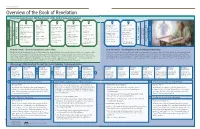
NEW TESTAMENT Overview of the Book of Revelation The Seven Seals (Seven 1,000-Year Periods of the Earth’s Temporal Existence) 1 2 3 4 5 6 7 Adam’s ministry began City of Enoch was Abraham’s ministry Israel was divided into John the Baptist’s Renaissance and Destruction of the translated two kingdoms ministry Reformation wicked Wickedness began to Isaac, Jacob, and spread Noah’s ministry twelve tribes of Israel Isaiah’s ministry Christ’s ministry Industrial Revolution Christ comes to reign as King of kings Repentance was Great Flood— Israel’s bondage in Ten tribes were taken Church was Joseph Smith’s ministry taught by prophets and mankind began Egypt captive established Earth receives Restored Church patriarchs again paradisiacal glory Moses’s ministry Judah was taken The Savior’s atoning becomes global CREATION Adam gathered and Tower of Babel captive, and temple sacrifice Satan is bound Conquest of land of Saints prepare for Christ EARTH’S DAY OF DAY EARTH’S blessed his children was destroyed OF DAY EARTH’S PROBATION ENDS PROBATION PROBATION ENDS PROBATION ETERNAL REWARD FALL OF ADAM FALL Jaredites traveled to Canaan Gospel was taken to Millennial era of peace ETERNAL REWARD ETERNITIES PAST Great calamities Great calamities FINAL JUDGMENT FINAL JUDGMENT PREMORTAL EXISTENCE PREMORTAL Adam died promised land Jews returned to the Gentiles and love and love ETERNITIES FUTURE Israelites began to ETERNITIES FUTURE ALL PEOPLE RECEIVE THEIR Jerusalem Zion established ALL PEOPLE RECEIVE THEIR Enoch’s ministry have kings Great Apostasy and Earth -

Moses Hayim Luzzatto's Quest for Providence
City University of New York (CUNY) CUNY Academic Works All Dissertations, Theses, and Capstone Projects Dissertations, Theses, and Capstone Projects 10-2014 'Like Iron to a Magnet': Moses Hayim Luzzatto's Quest for Providence David Sclar Graduate Center, City University of New York How does access to this work benefit ou?y Let us know! More information about this work at: https://academicworks.cuny.edu/gc_etds/380 Discover additional works at: https://academicworks.cuny.edu This work is made publicly available by the City University of New York (CUNY). Contact: AcademicWorks@cuny.edu “Like Iron to a Magnet”: Moses Hayim Luzzatto’s Quest for Providence By David Sclar A Dissertation Submitted to the Graduate Faculty in History in Partial Fulfillment of the Requirement for the Degree of Doctor of Philosophy The City University of New York 2014 © 2014 David Sclar All Rights Reserved This Manuscript has been read and accepted by the Graduate Faculty in History in satisfaction of the Dissertation requirement for the degree of Doctor of Philosophy Prof. Jane S. Gerber _______________ ____________________________________ Date Chair of the Examining Committee Prof. Helena Rosenblatt _______________ ____________________________________ Date Executive Officer Prof. Francesca Bregoli _______________________________________ Prof. Elisheva Carlebach ________________________________________ Prof. Robert Seltzer ________________________________________ Prof. David Sorkin ________________________________________ Supervisory Committee iii Abstract “Like Iron to a Magnet”: Moses Hayim Luzzatto’s Quest for Providence by David Sclar Advisor: Prof. Jane S. Gerber This dissertation is a biographical study of Moses Hayim Luzzatto (1707–1746 or 1747). It presents the social and religious context in which Luzzatto was variously celebrated as the leader of a kabbalistic-messianic confraternity in Padua, condemned as a deviant threat by rabbis in Venice and central and eastern Europe, and accepted by the Portuguese Jewish community after relocating to Amsterdam. -

SVAKO-NEKA-VERUJE-En
1 2 Conference EVERLASTING VALUE AND PERMANENT ACTUALITY OF THE EDICT OF MILAN On the Way to the Great Jubilee in 2013 Book 1 Everyone Should Believe as His Heart Wishes Belgrade, September 2011 Under the auspices of His Holiness Mr. Irinej, the Serbian Patriarch EVERLASTING VALUE AND PERMANENT ACTUALITY OF THE EDICT OF MILAN ON THE Way TO THE Great Jubilee IN 2013 Book 1 - Everyone Should Believe as HIS Heart Wishes Publisher Association of Nongovernmental Organizations in SEE – CIVIS Dositejeva 4/IV, 11000 Belgrade, Serbia Tel: +381 11 26 21 723, Fax: +381 11 26 26 332 www.civis-see.org For publisher Mirjana Prljević Chief Editor Mirjana Prljević Editor Bojana Popović Translators Marina Djordjević Bojana Popović Translator of the text “Edict of Milan” by Nebojša Ozimić Ivana Filipović Design & Prepress Marko ZAkovskI Printed by Graphic, Novi Sad Press run: 500 pcs ISBN 978-86-908103-2-1 The publishing of this book was supported by German Foundation Renovabis Content 5 INTRODUCTION 6 CONCLUSIONS FROM THE CONFERENCE Opening speeches 7 H.E. Bishop of Bačka, Dr Irinej 9 Miloš Simonović 9 Archpriest Vitalij Tarasjev 10 H.E. Mons. Orlando Antonini 11 Dr Johann Marte 12 Mirjana Prljević 13 Božidar Đelić 15 I sesSION 17 Dr. Christian Gastgeber Constantine the Great and His Bible Order 20 Erika Juhasz Constantine the Great and his Importance: Seen by the Historiography of the 7th Century 25 Dr. Sebastiano Panteghini Constantine the Great and the Renewal of His Image (14th century, Ecclesiastical History by Nike- phoros Xanthopulos) 30 Prof. Milutin Timotijević Emperor Constantine’s Aureole 37 Prof. -

The City: the New Jerusalem
Chapter 1 The City: The New Jerusalem “I saw the holy city, the New Jerusalem” (Revelation 21:2). These words from the final book of the Bible set out a vision of heaven that has captivated the Christian imagina- tion. To speak of heaven is to affirm that the human long- ing to see God will one day be fulfilled – that we shall finally be able to gaze upon the face of what Christianity affirms to be the most wondrous sight anyone can hope to behold. One of Israel’s greatest Psalms asks to be granted the privilege of being able to gaze upon “the beauty of the Lord” in the land of the living (Psalm 27:4) – to be able to catch a glimpse of the face of God in the midst of the ambiguities and sorrows of this life. We see God but dimly in this life; yet, as Paul argued in his first letter to the Corinthian Christians, we shall one day see God “face to face” (1 Corinthians 13:12). To see God; to see heaven. From a Christian perspective, the horizons defined by the parameters of our human ex- istence merely limit what we can see; they do not define what there is to be seen. Imprisoned by its history and mortality, humanity has had to content itself with pressing its boundaries to their absolute limits, longing to know what lies beyond them. Can we break through the limits of time and space, and glimpse another realm – another dimension, hidden from us at present, yet which one day we shall encounter, and even enter? Images and the Christian Faith It has often been observed that humanity has the capacity to think. -
BYZANTINE CAMEOS and the AESTHETICS of the ICON By
BYZANTINE CAMEOS AND THE AESTHETICS OF THE ICON by James A. Magruder, III A dissertation submitted to Johns Hopkins University in conformity with the requirements for the degree of Doctor of Philosophy Baltimore, Maryland March 2014 © 2014 James A. Magruder, III All rights reserved Abstract Byzantine icons have attracted artists and art historians to what they saw as the flat style of large painted panels. They tend to understand this flatness as a repudiation of the Classical priority to represent Nature and an affirmation of otherworldly spirituality. However, many extant sacred portraits from the Byzantine period were executed in relief in precious materials, such as gemstones, ivory or gold. Byzantine writers describe contemporary icons as lifelike, sometimes even coming to life with divine power. The question is what Byzantine Christians hoped to represent by crafting small icons in precious materials, specifically cameos. The dissertation catalogs and analyzes Byzantine cameos from the end of Iconoclasm (843) until the fall of Constantinople (1453). They have not received comprehensive treatment before, but since they represent saints in iconic poses, they provide a good corpus of icons comparable to icons in other media. Their durability and the difficulty of reworking them also makes them a particularly faithful record of Byzantine priorities regarding the icon as a genre. In addition, the dissertation surveys theological texts that comment on or illustrate stone to understand what role the materiality of Byzantine cameos played in choosing stone relief for icons. Finally, it examines Byzantine epigrams written about or for icons to define the terms that shaped icon production. -

Gog and Magog Battle Israel
ISRAEL IN PROPHECY LESSON 5 GOG AND MAGOG BATTLE ISRAEL The “latter days” battle against Israel described in Ezekiel is applied by dispensationalists to a coming battle against the modern nation of Israel in Palestine. The majority of popular Bible commentators try to map out this battle and even name nations that will take part in it. In this lesson you will see that this prophecy in Ezekiel chapters 36 and 37 does not apply to the modern nation of Israel at all. You will study how the book of Revelation gives us insights into how this prophecy will be applied to God’s people, spiritual Israel (the church) in the last days. You will also see a clear parallel between the events described in Ezekiel’s prophecy and John’s description of the seven last plagues in Revelation. This prophecy of Ezekiel gives you another opportunity to learn how the “Three Fold Application” applies to Old Testament prophecy. This lesson lays out how Ezekiel’s prophecy was originally given to the literal nation of Israel at the time of the Babylonian captivity, and would have met a victorious fulfillment if they had remained faithful to God and accepted their Messiah, Jesus Christ. However, because of Israel’s failure this prophecy is being fulfilled today to “spiritual Israel”, the church in a worldwide setting. The battle in Ezekiel describes Satan’s last efforts to destroy God’s remnant people. It will intensify as we near the second coming of Christ. Ezekiel’s battle will culminate and reach it’s “literal worldwide in glory” fulfillment at the end of the 1000 years as described in Revelation chapter 20. -
Christian Moral Decline: a New Context for the Sibylla Tiburtina (Ms Escorial &.I.3)
Holdenried, A. (2016). Christian Moral Decline: A New Context for the Sibylla Tiburtina (Ms Escorial &.I.3). In Peoples of the Apocalypse : Eschatological Beliefs and Political Scenarios (Vol. 63, pp. 321-336). (Millennium-Studien / Millennium Studies 63; Vol. 63). de Gruyter. Peer reviewed version Link to publication record in Explore Bristol Research PDF-document This is the accepted author manuscript (AAM). The final published version (version of record) is available online via Walter de Gruyter GmbH at https://www.degruyter.com/viewbooktoc/product/469126. Please refer to any applicable terms of use of the publisher. University of Bristol - Explore Bristol Research General rights This document is made available in accordance with publisher policies. Please cite only the published version using the reference above. Full terms of use are available: http://www.bristol.ac.uk/red/research-policy/pure/user-guides/ebr-terms/ Christian Moral Decline: A New Context for the Sibylla Tiburtina (Ms Escorial &.I.3) The Sibylla Tiburtina was one of the most popular, widespread and influential apocalyptic texts of the medieval period. I have considered elsewhere the Tiburtina’s reception by its medieval audience.1 My observations in this paper, however, concern a new aspect of the Latin text - its early history. Much remains to be said about this topic, since, as has been rightly remarked: ‘the history of the family of texts that for convenience’s sake we call the Sibylla Tiburtina is still imperfectly known’.2 This is perhaps not surprising: with roots in late antiquity, the Tiburtina’s text evolved over a remarkably long period. -
A Re-Examination of the Millennium in Rev 20:1–6: Consummation and Recapitulation
JETS 44/2 (June 2001) 237–51 A RE-EXAMINATION OF THE MILLENNIUM IN REV 20:1–6: CONSUMMATION AND RECAPITULATION dave mathewson* i. introduction The question of the so-called millennial kingdom in Rev 20:1–6 continues to be a source of fascination in evangelical discussion and dialogue.1 The purpose of this article is to re-examine the question of the millennial king- dom as articulated in Rev 20:1–6. More specifically, this article will consider the meaning and function of 20:1–6 within Revelation as it relates to the contemporary debate about whether this section is best understood within a premillennial or amillennial framework. Hermeneutically, most of the de- bate has centered around how literally the reference to the one thousand years in 20:1–6 should be taken and, more importantly, the relationship be- tween 20:1–6 and 19:11–21. Does the thousand year period in 20:1–6 re- fer to a more or less literal period of time?2 Or should it be understood more symbolically? Does 20:1–6 follow 19:11–21 chronologically, with the one thou- sand years featuring a Zwischenreich (premillennialism), or does the final battle in 20:7–10 recapitulate the battle in 19:11–21, with the reference to the one thousand years in 20:1–6 extending all the way back to the first coming of Christ (amillennialism)?3 * Dave Mathewson is instructor in New Testament at Oak Hills Christian College, 1600 Oak Hills Road SW, Bemidji, MN 56601. 1 Cf. R. -

Gog and Magog and Ethnic Difference in the Catalan Atlas (1375) Thomas Franke
University of New Mexico UNM Digital Repository History ETDs Electronic Theses and Dissertations 9-12-2014 Monsters at the End of Time: Gog and Magog and Ethnic Difference in the Catalan Atlas (1375) Thomas Franke Follow this and additional works at: https://digitalrepository.unm.edu/hist_etds Recommended Citation Franke, Thomas. "Monsters at the End of Time: Gog and Magog and Ethnic Difference in the Catalan Atlas (1375)." (2014). https://digitalrepository.unm.edu/hist_etds/30 This Thesis is brought to you for free and open access by the Electronic Theses and Dissertations at UNM Digital Repository. It has been accepted for inclusion in History ETDs by an authorized administrator of UNM Digital Repository. For more information, please contact disc@unm.edu. Thomas Samuel Franke Candidate History Department This thesis is approved, and it is acceptable in quality and form for publication: Approved by the Thesis Committee: Michael A. Ryan , Chairperson Timothy C. Graham Sarah Davis-Secord Franke i MONSTERS AT THE END OF TIME: GOG AND MAGOG AND ETHNIC DIFFERENCE IN THE CATALAN ATLAS (1375) by THOMAS FRANKE BACHELOR OF ARTS, UC IRVINE 2012 THESIS Submitted in Partial Fulfillment of the Requirements for the Degree of MASTER OF ARTS HISTORY The University of New Mexico Albuquerque, New Mexico JULY 2014 Franke ii Abstract Franke, Thomas. Monsters at the End of Time: Gog and Magog and Ethnic Difference in the Catalan Atlas (1375). University of New Mexico, 2014. Although they are only mentioned briefly in Revelation, the destructive Gog and Magog formed an important component of apocalyptic thought for medieval European Christians, who associated Gog and Magog with a number of non-Christian peoples. -

Finding-And-Following-Jesus-عليه-السلام-The-Muslim-Claim-To-The
f j ii d The Muslim Claim to the Messiah :ﻋﻠﯿﻪ اﻟﺴﻼم Finding and Following Jesus | 2 Author Biography Dr. Shabbir Akhtar is a philosopher trained at Cambridge University. He has published widely on pluralism and race relations in Britain and on Islam’s and Christianity’s differing responses to modern secularism. His books include The Light in the Enlightenment (1990) and Be Careful with Muhammad! (1989), a classic critique of Salman Rushdie, as well as The Quran and the Secular Mind (2007) and Islam as Political Religion (2010). He has also published three volumes of poetry in English. In 2018, he published the first of a three-volume commentary on the Greek New Testament: The New Testament in Muslim Eyes: Paul's Letter to the Galatians (Routledge). He is currently a member of the Faculty of Theology and Religions at Oxford University. Disclaimer: The views, opinions, findings, and conclusions expressed in these papers and articles are strictly those of the authors. Furthermore, Yaqeen does not endorse any of the personal views of the authors on any platform. Our team is diverse on all fronts, allowing for constant, enriching dialogue that helps us produce high-quality research. Copyright © 2018. Yaqeen Institute for Islamic Research The Muslim Claim to the Messiah :ﻋﻠﯿﻪ اﻟﺴﻼم Finding and Following Jesus | 3 and the House of Abraham Divided ﻋﻠﯿﻪ اﻟﺴﻼم I. Jesus Christians do not care much when Muslims tell them that the prophets of the Old Testament (Hebrew Bible) are also prophets of Islam. They care a great deal when ﻋﻠﯿﻪ اﻟﺴﻼم they find out that Jesus , their special savior, is a revered prophet in the Qur’an.