Afghanistan Livelihood Trajectories Evidence from Kandahar
Total Page:16
File Type:pdf, Size:1020Kb
Load more
Recommended publications
-

Afghanistan: Background and U.S. Policy
Afghanistan: Background and U.S. Policy July 18, 2019 Congressional Research Service https://crsreports.congress.gov R45818 SUMMARY R45818 Afghanistan: Background and U.S. Policy July 18, 2019 Afghanistan has been a significant U.S. foreign policy concern since 2001, when the United States, in response to the terrorist attacks of September 11, 2001, led a military Clayton Thomas campaign against Al Qaeda and the Taliban government that harbored and supported it. Analyst in Middle Eastern In the intervening 18 years, the United States has suffered approximately 2,400 military Affairs fatalities in Afghanistan, with the cost of military operations reaching nearly $750 billion. Congress has appropriated approximately $133 billion for reconstruction. In that time, an elected Afghan government has replaced the Taliban, and most measures of human development have improved, although Afghanistan’s future prospects remain mixed in light of the country’s ongoing violent conflict and political contention. Topics covered in this report include: Security dynamics. U.S. and Afghan forces, along with international partners, combat a Taliban insurgency that is, by many measures, in a stronger military position now than at any point since 2001. Many observers assess that a full-scale U.S. withdrawal would lead to the collapse of the Afghan government and perhaps even the reestablishment of Taliban control over most of the country. Taliban insurgents operate alongside, and in periodic competition with, an array of other armed groups, including regional affiliates of Al Qaeda (a longtime Taliban ally) and the Islamic State (a Taliban foe and increasing focus of U.S. policy). U.S. -
“It Is Not Charity, It Is a Chair of Power” - Moving Beyond Symbolic Representation in Afghanistan’S Transition Politics?
“It is not Charity, it is a Chair of Power” - Moving Beyond Symbolic Representation in Afghanistan’s Transition Politics? Andrea Fleschenberg Research Study Publication Series “Reviewing Gender Quotas in Afghanistan and Pakistan” 2016 “It is not Charity, it is a Chair of Power”1- Moving Beyond Symbolic Representation in Afghanistan’s Transition Politics? Research Study Publication Series “Reviewing Gender Quotas in Afghanistan and Pakistan” 2016 Andrea Fleschenberg 1 “It is not charity, it is a chair of power and when you are there, you have to get tough with all the vulnerability you face” (interview with MP Farkhunda Zahra Naderi, Kabul, April 2015). The Heinrich Böll Stiftung is a German foundation and part of the Green political movement that has developed worldwide as a response to the traditional politics of socialism, liberalism, and conservatism. Our main tenets are ecology and sustainability, democracy and human rights, self-determination and justice. We place particular emphasis on gender democracy, meaning social emancipation and equal rights for women and men. We are also committed to equal rights for cultural and ethnic minorities. Finally, we promote non-violence and proactive peace policies. To achieve our goals, we seek strategic partnerships with others who share our values. Our namesake, Heinrich Böll, personifies the values we stand for: protection of freedom, civic courage, tolerance, open debate, and the valuation of art and culture as independent spheres of thought and action. For further information on our country programs in Afghanistan and Pakistan please visit our websites: www.af.boell.org www.pk.boell.org Disclaimer: This comparative action research project and its publication series were prepared with the support of the Heinrich Böll Stiftung, Afghanistan office. -
Custodians of Culture and Biodiversity
Custodians of culture and biodiversity Indigenous peoples take charge of their challenges and opportunities Anita Kelles-Viitanen for IFAD Funded by the IFAD Innovation Mainstreaming Initiative and the Government of Finland The opinions expressed in this manual are those of the authors and do not nec - essarily represent those of IFAD. The designations employed and the presenta - tion of material in this publication do not imply the expression of any opinion whatsoever on the part of IFAD concerning the legal status of any country, terri - tory, city or area or of its authorities, or concerning the delimitation of its frontiers or boundaries. The designations “developed” and “developing” countries are in - tended for statistical convenience and do not necessarily express a judgement about the stage reached in the development process by a particular country or area. This manual contains draft material that has not been subject to formal re - view. It is circulated for review and to stimulate discussion and critical comment. The text has not been edited. On the cover, a detail from a Chinese painting from collections of Anita Kelles-Viitanen CUSTODIANS OF CULTURE AND BIODIVERSITY Indigenous peoples take charge of their challenges and opportunities Anita Kelles-Viitanen For IFAD Funded by the IFAD Innovation Mainstreaming Initiative and the Government of Finland Table of Contents Executive summary 1 I Objective of the study 2 II Results with recommendations 2 1. Introduction 2 2. Poverty 3 3. Livelihoods 3 4. Global warming 4 5. Land 5 6. Biodiversity and natural resource management 6 7. Indigenous Culture 7 8. Gender 8 9. -
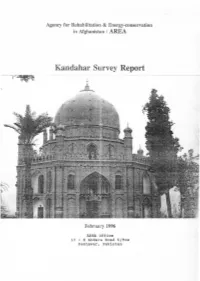
Kandahar Survey Report
Agency for Rehabilitation & Energy-conservation in Afghanistan I AREA Kandahar Survey Report February 1996 AREA Office 17 - E Abdara Road UfTow Peshawar, Pakistan Agency for Rehabilitation & Energy-conservation in Afghanistan I AREA Kandahar Survey Report Prepared by Eng. Yama and Eng. S. Lutfullah Sayed ·• _ ....... "' Content - Introduction ................................. 1 General information on Kandahar: - Summery ........................... 2 - History ........................... 3 - Political situation ............... 5 - Economic .......................... 5 - Population ........................ 6 · - Shelter ..................................... 7 -Cost of labor and construction material ..... 13 -Construction of school buildings ............ 14 -Construction of clinic buildings ............ 20 - Miscellaneous: - SWABAC ............................ 2 4 -Cost of food stuff ................. 24 - House rent· ........................ 2 5 - Travel to Kanadahar ............... 25 Technical recommendation .~ ................. ; .. 26 Introduction: Agency for Rehabilitation & Energy-conservation in Afghanistan/ AREA intends to undertake some rehabilitation activities in the Kandahar province. In order to properly formulate the project proposals which AREA intends to submit to EC for funding consideration, a general survey of the province has been conducted at the end of Feb. 1996. In line with this objective, two senior staff members of AREA traveled to Kandahar and collect the required information on various aspects of the province. -

The Kingdom of Afghanistan: a Historical Sketch George Passman Tate
University of Nebraska Omaha DigitalCommons@UNO Books in English Digitized Books 1-1-1911 The kingdom of Afghanistan: a historical sketch George Passman Tate Follow this and additional works at: http://digitalcommons.unomaha.edu/afghanuno Part of the History Commons, and the International and Area Studies Commons Recommended Citation Tate, George Passman The kingdom of Afghanistan: a historical sketch, with an introductory note by Sir Henry Mortimer Durand. Bombay: "Times of India" Offices, 1911. 224 p., maps This Monograph is brought to you for free and open access by the Digitized Books at DigitalCommons@UNO. It has been accepted for inclusion in Books in English by an authorized administrator of DigitalCommons@UNO. For more information, please contact unodigitalcommons@unomaha.edu. Tate, G,P. The kfn&ean sf Af&mistan, DATE DUE I Mil 7 (7'8 DEDICATED, BY PERMISSION, HIS EXCELLENCY BARON HARDINGE OF PENSHURST. VICEROY AND GOVERNOR-GENERAL OF INDIA, .a- . (/. BY m HIS OBEDIENT, SERVANT THE AUTHOR. il.IEmtev 01 the Asiniic Society, Be?zg-nl, S?~rueyof I~din. dafhor of 'I Seisinqz : A Menzoir on the FJisio~y,Topo~rcrphj~, A7zliquiiies, (112d Peo$Ie of the Cozi?zt~y''; The F/.o?zlic7,.~ of Baluchisia'nn : Travels on ihe Border.? of Pe~szk n?zd Akhnnistnn " ; " ICalnf : A lMe??zoir on t7ze Cozl7~try and Fnrrzily of the Ahntadsai Khn7zs of Iinlnt" ; 4 ec. \ViTkI AN INrPR<dl>kJCTOl2Y NO'FE PRINTED BY BENNETT COLEMAN & Co., Xc. PUBLISHED AT THE " TIMES OF INDIA" OFFTCES, BOMBAY & C.1LCUTT-4, LONDON AGENCY : gg, SI-IOE LANE, E.C. -
The High Stakes Battle for the Future of Musa Qala
JULY 2008 . VOL 1 . ISSUE 8 The High Stakes Battle for district. This created the standard and treated their presumed supporters in of small landlords farming small, the south better,5 this time there would the Future of Musa Qala well-irrigated holdings. While tribal be no mercy shown to “collaborators.” structure, economy and population alike This included executing, along with By David C. Isby have been badly damaged by decades of alleged criminals, several “spies,” which warfare, Musa Qala has a situation that included Afghans who had taken part in since its reoccupation by NATO and is more likely to yield internal stability work-for-food programs.6 Afghan forces in December 2007, the by building on what is left of traditional remote Musa Qala district of northern Afghanistan. The Alizai are also hoping to get more Helmand Province in Afghanistan from the new security situation. They has become important to the future Before the well-publicized October 2006 have requested that Kabul make Musa course of the insurgency but also to the “truce” that Alizai leaders concluded Qala a separate province.7 This proposal future of a Pashtun tribe (the Alizai), with the Taliban, Musa Qala had has been supported by current and a republic (the Islamic Republic of experienced a broad range of approaches former Helmand provincial governors. Afghanistan) and even a kingdom (the to countering the insurgency. In addition This would provide opportunities for United Kingdom). The changes that to their dissatisfaction with British patronage and give them a legally- take place at Musa Qala will influence operations in 2006, local inhabitants recognized base that competing tribal the future of all of them. -

AFGHANISTAN South
AFGHANISTAN Weekly Humanitarian Update (25 – 31 January 2021) KEY FIGURES IDPs IN 2021 (AS OF 31 JANUARY) 3,430 People displaced by conflict (verified) 35,610 Received assistance (including 2020 caseload) NATURAL DISASTERS IN 2020 (AS OF 31 JANUARY) 104,470 Number of people affected by natural disasters Conflict incident UNDOCUMENTED RETURNEES Internal displacement IN 2021 (AS OF 21 JANUARY) 36,496 Disruption of services Returnees from Iran 367 Returnees from Pakistan 0 South: Hundreds of people displaced by ongoing Returnees from other countries fighting in Kandahar province HUMANITARIAN RESPONSE Fighting between Afghan National Security Forces (ANSF) and a non-state armed PLAN (HRP) REQUIREMENTS & group (NSAG) continued in Hilmand, Kandahar and Uruzgan provinces. FUNDING In Kandahar, fighting continued mainly in Arghandab, Zheray and Panjwayi 1.28B districts. Ongoing fighting displaced hundreds of people in Kandahar province, but Requirements (US$) – HRP the exact number of internally displaced persons (IDPs) is yet to be confirmed. 2021 Humanitarian actors with coordination of provincial authorities are assessing the needs of IDPs and will provide them with immediate assistance. Farmers and 37.8M agricultural activities continued to be affected by ongoing fighting. All movements 3% funded (US$) in 2021 on the main highway-1 connecting Hilmand to Kandahar provinces reportedly AFGHANISTAN resumed, however improvised explosive devices (IEDs) along the highway HUMANITARIAN FUND (AHF) continue to pose a threat. 2021 In Uruzgan province, clashes between ANSF and an NSAG continued along with the threat of IED attacks in Dehrawud, Gizab and Tirinkot districts. Two civilians 5.72M were reportedly killed and eight others wounded by an IED detonation in Tirinkot Contributions (US$) district. -

Afghanistan: Politics, Elections, and Government Performance
Afghanistan: Politics, Elections, and Government Performance Kenneth Katzman Specialist in Middle Eastern Affairs March 25, 2014 Congressional Research Service 7-5700 www.crs.gov RS21922 Afghanistan: Politics, Elections, and Government Performance Summary The capacity, transparency, and legitimacy of Afghan governance are considered crucial to Afghan stability as U.S.-led NATO forces turn over the security mission to Afghan leadership. The size and capability of the Afghan governing structure has increased significantly since the Taliban regime fell in late 2001, but the government remains weak and rife with corruption. The government has struggled to widen its writ, even though substantial powers are concentrated in the elected presidency through powers of appointment at all levels. President Hamid Karzai has served as president since late 2001; he is constitutionally term-limited and will leave office after presidential and provincial elections scheduled for April 5, 2014. Several major figures—some close to Karzai and others opposed—have registered to run for president; many of their slates include faction leaders long accused of human rights abuses. Some observers are concerned that Karzai might try to use state machinery to favor a particular candidate, and he appears to have tilted toward his longtime confidant and former Foreign Minister, Zalmay Rasoul. If a run-off is needed, it is possible that the new president would not take office until some time in July 2014. Fraud in two successive elections (for president in 2009 and parliament in 2010) was extensively documented, but Afghan officials, civil society organizations, and key donor countries have taken substantial steps to limit the potential for systemic manipulation and fraud in the upcoming vote. -
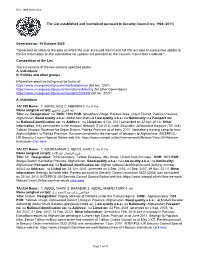
19 October 2020 "Generated on Refers to the Date on Which the User Accessed the List and Not the Last Date of Substantive Update to the List
Res. 1988 (2011) List The List established and maintained pursuant to Security Council res. 1988 (2011) Generated on: 19 October 2020 "Generated on refers to the date on which the user accessed the list and not the last date of substantive update to the list. Information on the substantive list updates are provided on the Council / Committee’s website." Composition of the List The list consists of the two sections specified below: A. Individuals B. Entities and other groups Information about de-listing may be found at: https://www.un.org/securitycouncil/ombudsperson (for res. 1267) https://www.un.org/securitycouncil/sanctions/delisting (for other Committees) https://www.un.org/securitycouncil/content/2231/list (for res. 2231) A. Individuals TAi.155 Name: 1: ABDUL AZIZ 2: ABBASIN 3: na 4: na ﻋﺒﺪ اﻟﻌﺰﻳﺰ ﻋﺒﺎﺳﯿﻦ :(Name (original script Title: na Designation: na DOB: 1969 POB: Sheykhan Village, Pirkowti Area, Orgun District, Paktika Province, Afghanistan Good quality a.k.a.: Abdul Aziz Mahsud Low quality a.k.a.: na Nationality: na Passport no: na National identification no: na Address: na Listed on: 4 Oct. 2011 (amended on 22 Apr. 2013) Other information: Key commander in the Haqqani Network (TAe.012) under Sirajuddin Jallaloudine Haqqani (TAi.144). Taliban Shadow Governor for Orgun District, Paktika Province as of early 2010. Operated a training camp for non- Afghan fighters in Paktika Province. Has been involved in the transport of weapons to Afghanistan. INTERPOL- UN Security Council Special Notice web link: https://www.interpol.int/en/How-we-work/Notices/View-UN-Notices- Individuals click here TAi.121 Name: 1: AZIZIRAHMAN 2: ABDUL AHAD 3: na 4: na ﻋﺰﯾﺰ اﻟﺮﺣﻤﺎن ﻋﺒﺪ اﻻﺣﺪ :(Name (original script Title: Mr Designation: Third Secretary, Taliban Embassy, Abu Dhabi, United Arab Emirates DOB: 1972 POB: Shega District, Kandahar Province, Afghanistan Good quality a.k.a.: na Low quality a.k.a.: na Nationality: Afghanistan Passport no: na National identification no: Afghan national identification card (tazkira) number 44323 na Address: na Listed on: 25 Jan. -

Afghanistan Monthly Idp Update
AFGHANISTAN MONTHLY IDP UPDATE 01 – 30 November 2014 KEY FIGURES HIGHLIGHTS --- -------------------- ---------------- - . Region end-Oct 2014 Increase Decrease end-Nov 2014 15,617 individuals, displaced by conflict, were profiled South 207,160 3,050 - 210,210 during November 2014, of West 193,439 4,286 - 197,725 whom: East 134,640 1,030 - 135,670 10,138 individuals were North 100,897 1,785 - 102,682 displaced in November; 2,674 in October; 649 in September; Central 112,081 5,432 - 117,513 1,002 in August; 60 in July; 31 Southeast 18,328 - - 18,328 in June; and 1,063 earlier. Central Highlands - 34 - 34 . The total number of profiled Total 766,545 15,617 - 782,162 IDPs as of end November 2014 is 782,162 individuals. The major causes of displacement were the military operations and armed conflict between Anti Governmental Elements (AGEs) and Afghan National Security Forces (ANSF)/Afghan local police. Other causes included harassments by AGEs. Disaggregated data for November profiled: 49 % male The primary needs profiled was food and NFIs, followed by shelter and cash grants. and 51% female; The majority of the profiled IDPs in November were assisted with food and NFIs, 48% adults and 52% children. through the IDP Task Force agencies including DoRR, DRC, NRC, UNHCR, WFP, APA, ODCG, ACF, etc. PARTNERSHIPS Lack of access to verify displacement and respond to immediate needs of IDPs continues to be a significant challenge for IDP Task Force agencies. The National IDP Task Force is The UNHCR led verification of Kabul informal settlements which was planned for chaired by the Ministry of November is completed. -

Great Game to 9/11
Air Force Engaging the World Great Game to 9/11 A Concise History of Afghanistan’s International Relations Michael R. Rouland COVER Aerial view of a village in Farah Province, Afghanistan. Photo (2009) by MSst. Tracy L. DeMarco, USAF. Department of Defense. Great Game to 9/11 A Concise History of Afghanistan’s International Relations Michael R. Rouland Washington, D.C. 2014 ENGAGING THE WORLD The ENGAGING THE WORLD series focuses on U.S. involvement around the globe, primarily in the post-Cold War period. It includes peacekeeping and humanitarian missions as well as Operation Enduring Freedom and Operation Iraqi Freedom—all missions in which the U.S. Air Force has been integrally involved. It will also document developments within the Air Force and the Department of Defense. GREAT GAME TO 9/11 GREAT GAME TO 9/11 was initially begun as an introduction for a larger work on U.S./coalition involvement in Afghanistan. It provides essential information for an understanding of how this isolated country has, over centuries, become a battleground for world powers. Although an overview, this study draws on primary- source material to present a detailed examination of U.S.-Afghan relations prior to Operation Enduring Freedom. Opinions, conclusions, and recommendations expressed or implied within are solely those of the author and do not necessarily represent the views of the U.S. Air Force, the Department of Defense, or the U.S. government. Cleared for public release. Contents INTRODUCTION The Razor’s Edge 1 ONE Origins of the Afghan State, the Great Game, and Afghan Nationalism 5 TWO Stasis and Modernization 15 THREE Early Relations with the United States 27 FOUR Afghanistan’s Soviet Shift and the U.S. -

My Memoirs Shah Wali Khan
University of Nebraska at Omaha DigitalCommons@UNO Digitized Books Archives & Special Collections 1970 My Memoirs Shah Wali Khan Follow this and additional works at: http://digitalcommons.unomaha.edu/ascdigitizedbooks Part of the Arts and Humanities Commons Recommended Citation Khan, Shah Wali, "My Memoirs" (1970). Digitized Books. 18. http://digitalcommons.unomaha.edu/ascdigitizedbooks/18 This Book is brought to you for free and open access by the Archives & Special Collections at DigitalCommons@UNO. It has been accepted for inclusion in Digitized Books by an authorized administrator of DigitalCommons@UNO. For more information, please contact unodigitalcommons@unomaha.edu. MY MEMOIRS ( \ ~ \ BY HIS ROYAL HIGHNESS SARDAR SHAH WALi VICTOR OF KABUL KABUL COLUMN OF JNDEPENDENCE Afghan Coll. 1970 DS 371 sss A313 His Royal Highness Marshal Sardar Shah Wali Khan Victor of Kabul MY MEMOIRS BY HIS ROYAL HIGHNESS MARSHAL SARDAR SHAH WALi VICTOR OF KABUL KABUL 1970 PRINTED IN PAKISTAN BY THE PUNJAB EDUCATIONAL PRESS, , LAHORE CONTENTS PART I THE WAR OF INDEPENDENCE Pages A Short Biography of His Royal Highness Sardar Shah Wali Khan, Victor of Kabul i-iii 1. My Aim 1 2. Towards the South 7 3. The Grand Assembly 13 4. Preliminary Steps 17 5. Fall of Thal 23 6. Beginning of Peace Negotiations 27 7. The Armistice and its Effects 29 ~ 8. Back to Kabul 33 PART II DELIVERANCE OF THE COUNTRY 9. Deliverance of the Country 35 C\'1 10. Beginning of Unrest in the Country 39 er 11. Homewards 43 12. Arrival of Sardar Shah Mahmud Ghazi 53 Cµ 13. Sipah Salar's Activities 59 s:: ::s 14.