ART 483 Greek and Roman Art Fall 2017
Total Page:16
File Type:pdf, Size:1020Kb
Load more
Recommended publications
-

Marathon 2,500 Years Edited by Christopher Carey & Michael Edwards
MARATHON 2,500 YEARS EDITED BY CHRISTOPHER CAREY & MICHAEL EDWARDS INSTITUTE OF CLASSICAL STUDIES SCHOOL OF ADVANCED STUDY UNIVERSITY OF LONDON MARATHON – 2,500 YEARS BULLETIN OF THE INSTITUTE OF CLASSICAL STUDIES SUPPLEMENT 124 DIRECTOR & GENERAL EDITOR: JOHN NORTH DIRECTOR OF PUBLICATIONS: RICHARD SIMPSON MARATHON – 2,500 YEARS PROCEEDINGS OF THE MARATHON CONFERENCE 2010 EDITED BY CHRISTOPHER CAREY & MICHAEL EDWARDS INSTITUTE OF CLASSICAL STUDIES SCHOOL OF ADVANCED STUDY UNIVERSITY OF LONDON 2013 The cover image shows Persian warriors at Ishtar Gate, from before the fourth century BC. Pergamon Museum/Vorderasiatisches Museum, Berlin. Photo Mohammed Shamma (2003). Used under CC‐BY terms. All rights reserved. This PDF edition published in 2019 First published in print in 2013 This book is published under a Creative Commons Attribution-NonCommercial- NoDerivatives (CC-BY-NC-ND 4.0) license. More information regarding CC licenses is available at http://creativecommons.org/licenses/ Available to download free at http://www.humanities-digital-library.org ISBN: 978-1-905670-81-9 (2019 PDF edition) DOI: 10.14296/1019.9781905670819 ISBN: 978-1-905670-52-9 (2013 paperback edition) ©2013 Institute of Classical Studies, University of London The right of contributors to be identified as the authors of the work published here has been asserted by them in accordance with the Copyright, Designs and Patents Act 1988. Designed and typeset at the Institute of Classical Studies TABLE OF CONTENTS Introductory note 1 P. J. Rhodes The battle of Marathon and modern scholarship 3 Christopher Pelling Herodotus’ Marathon 23 Peter Krentz Marathon and the development of the exclusive hoplite phalanx 35 Andrej Petrovic The battle of Marathon in pre-Herodotean sources: on Marathon verse-inscriptions (IG I3 503/504; Seg Lvi 430) 45 V. -

The Burial of the Urban Poor in Italy in the Late Republic and Early Empire
Death, disposal and the destitute: The burial of the urban poor in Italy in the late Republic and early Empire Emma-Jayne Graham Thesis submitted for the degree of Doctor of Philosophy Department of Archaeology University of Sheffield December 2004 IMAGING SERVICES NORTH Boston Spa, Wetherby West Yorkshire, LS23 7BQ www.bl.uk The following have been excluded from this digital copy at the request of the university: Fig 12 on page 24 Fig 16 on page 61 Fig 24 on page 162 Fig 25 on page 163 Fig 26 on page 164 Fig 28 on page 168 Fig 30on page 170 Fig 31 on page 173 Abstract Recent studies of Roman funerary practices have demonstrated that these activities were a vital component of urban social and religious processes. These investigations have, however, largely privileged the importance of these activities to the upper levels of society. Attempts to examine the responses of the lower classes to death, and its consequent demands for disposal and commemoration, have focused on the activities of freedmen and slaves anxious to establish or maintain their social position. The free poor, living on the edge of subsistence, are often disregarded and believed to have been unceremoniously discarded within anonymous mass graves (puticuli) such as those discovered at Rome by Lanciani in the late nineteenth century. This thesis re-examines the archaeological and historical evidence for the funerary practices of the urban poor in Italy within their appropriate social, legal and religious context. The thesis attempts to demonstrate that the desire for commemoration and the need to provide legitimate burial were strong at all social levels and linked to several factors common to all social strata. -
Classical and Hellenistic Glass Workshops from Rhodes
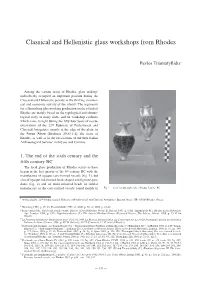
Classical and Hellenistic glass workshops from Rhodes Pavlos Triantafyllidis* Among the various crafts of Rhodes, glass making1 undoubtedly occupied an important position during the Classical and Hellenistic periods in the thriving commer- cial and economic activity of the island2. The arguments for a flourishing glassworking production on the island of Rhodes are mainly based on the typological and chrono- logical study of many finds, and on workshop evidence which came to light during the fifty-four years of rescue excavations of the 22nd Ephorate of Prehistorical and Classical Antiquities, mainly at the edge of the plain, in the Pano;ı “Akran (Diodoros 20.83.1-4), the town of Rhodes, as well as in the excavations of the then Italian Archaeological Service3 in Ialysos and Camiros. 1. The end of the sixth century and the fifth century BC The local glass production of Rhodes seems to have begun in the last quarter of the 6th century BC with the manufacture of opaque core-formed vessels (fig. 1), but also of opaque rod-formed head-shaped and figurine-pen- dants (fig. 2) and of multi-coloured beads of similar manufacture to the core-formed vessels found mainly in Fig. 1 — Core-formed amphoriskoi. Rhodes. Late 6c. BC. * Archaeologist, 22nd Archaeological Ephorate of Prehistorical and Classical Antiquities, Ippoton Street, GR- 85100 Rhodes, Greece. 1 Weinberg 1992, p. 19, 23; Triantafyllidis 1997; id. 2000, p. 30; id. 2002, p. 21-22. 2 Rostovtzeff (M.), The Social and Economic History of the Hellenistic World, II, Oxford, 1941, p. 676ff.; Berthold (R.M.), Rhodes in the Hellenistic Age, London, 1984, p. -
Parthenon 1 Parthenon
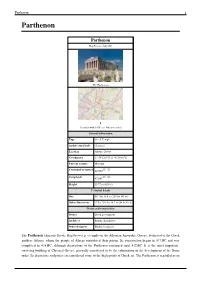
Parthenon 1 Parthenon Parthenon Παρθενών (Greek) The Parthenon Location within Greece Athens central General information Type Greek Temple Architectural style Classical Location Athens, Greece Coordinates 37°58′12.9″N 23°43′20.89″E Current tenants Museum [1] [2] Construction started 447 BC [1] [2] Completed 432 BC Height 13.72 m (45.0 ft) Technical details Size 69.5 by 30.9 m (228 by 101 ft) Other dimensions Cella: 29.8 by 19.2 m (98 by 63 ft) Design and construction Owner Greek government Architect Iktinos, Kallikrates Other designers Phidias (sculptor) The Parthenon (Ancient Greek: Παρθενών) is a temple on the Athenian Acropolis, Greece, dedicated to the Greek goddess Athena, whom the people of Athens considered their patron. Its construction began in 447 BC and was completed in 438 BC, although decorations of the Parthenon continued until 432 BC. It is the most important surviving building of Classical Greece, generally considered to be the culmination of the development of the Doric order. Its decorative sculptures are considered some of the high points of Greek art. The Parthenon is regarded as an Parthenon 2 enduring symbol of Ancient Greece and of Athenian democracy and one of the world's greatest cultural monuments. The Greek Ministry of Culture is currently carrying out a program of selective restoration and reconstruction to ensure the stability of the partially ruined structure.[3] The Parthenon itself replaced an older temple of Athena, which historians call the Pre-Parthenon or Older Parthenon, that was destroyed in the Persian invasion of 480 BC. Like most Greek temples, the Parthenon was used as a treasury. -

Romans in Cumbria
View across the Solway from Bowness-on-Solway. Cumbria Photo Hadrian’s Wall Country boasts a spectacular ROMANS IN CUMBRIA coastline, stunning rolling countryside, vibrant cities and towns and a wealth of Roman forts, HADRIAN’S WALL AND THE museums and visitor attractions. COASTAL DEFENCES The sites detailed in this booklet are open to the public and are a great way to explore Hadrian’s Wall and the coastal frontier in Cumbria, and to learn how the arrival of the Romans changed life in this part of the Empire forever. Many sites are accessible by public transport, cycleways and footpaths making it the perfect place for an eco-tourism break. For places to stay, downloadable walks and cycle routes, or to find food fit for an Emperor go to: www.visithadrianswall.co.uk If you have enjoyed your visit to Hadrian’s Wall Country and want further information or would like to contribute towards the upkeep of this spectacular landscape, you can make a donation or become a ‘Friend of Hadrian’s Wall’. Go to www.visithadrianswall.co.uk for more information or text WALL22 £2/£5/£10 to 70070 e.g. WALL22 £5 to make a one-off donation. Published with support from DEFRA and RDPE. Information correct at time Produced by Anna Gray (www.annagray.co.uk) of going to press (2013). Designed by Andrew Lathwell (www.lathwell.com) The European Agricultural Fund for Rural Development: Europe investing in Rural Areas visithadrianswall.co.uk Hadrian’s Wall and the Coastal Defences Hadrian’s Wall is the most important Emperor in AD 117. -

Byzantium and France: the Twelfth Century Renaissance and the Birth of the Medieval Romance
University of Tennessee, Knoxville TRACE: Tennessee Research and Creative Exchange Doctoral Dissertations Graduate School 12-1992 Byzantium and France: the Twelfth Century Renaissance and the Birth of the Medieval Romance Leon Stratikis University of Tennessee - Knoxville Follow this and additional works at: https://trace.tennessee.edu/utk_graddiss Part of the Modern Languages Commons Recommended Citation Stratikis, Leon, "Byzantium and France: the Twelfth Century Renaissance and the Birth of the Medieval Romance. " PhD diss., University of Tennessee, 1992. https://trace.tennessee.edu/utk_graddiss/2521 This Dissertation is brought to you for free and open access by the Graduate School at TRACE: Tennessee Research and Creative Exchange. It has been accepted for inclusion in Doctoral Dissertations by an authorized administrator of TRACE: Tennessee Research and Creative Exchange. For more information, please contact trace@utk.edu. To the Graduate Council: I am submitting herewith a dissertation written by Leon Stratikis entitled "Byzantium and France: the Twelfth Century Renaissance and the Birth of the Medieval Romance." I have examined the final electronic copy of this dissertation for form and content and recommend that it be accepted in partial fulfillment of the equirr ements for the degree of Doctor of Philosophy, with a major in Modern Foreign Languages. Paul Barrette, Major Professor We have read this dissertation and recommend its acceptance: James E. Shelton, Patrick Brady, Bryant Creel, Thomas Heffernan Accepted for the Council: Carolyn R. Hodges Vice Provost and Dean of the Graduate School (Original signatures are on file with official studentecor r ds.) To the Graduate Council: I am submitting herewith a dissertation by Leon Stratikis entitled Byzantium and France: the Twelfth Century Renaissance and the Birth of the Medieval Romance. -

Constructions of Childhood on the Funerary Monuments of Roman Athens Grizelda Mcclelland Washington University in St
Washington University in St. Louis Washington University Open Scholarship All Theses and Dissertations (ETDs) Summer 8-26-2013 Constructions of Childhood on the Funerary Monuments of Roman Athens Grizelda McClelland Washington University in St. Louis Follow this and additional works at: https://openscholarship.wustl.edu/etd Recommended Citation McClelland, Grizelda, "Constructions of Childhood on the Funerary Monuments of Roman Athens" (2013). All Theses and Dissertations (ETDs). 1150. https://openscholarship.wustl.edu/etd/1150 This Dissertation is brought to you for free and open access by Washington University Open Scholarship. It has been accepted for inclusion in All Theses and Dissertations (ETDs) by an authorized administrator of Washington University Open Scholarship. For more information, please contact digital@wumail.wustl.edu. WASHINGTON UNIVERSITY IN ST. LOUIS Department of Classics Department of Art History and Archaeology Dissertation Examination Committee: Susan I. Rotroff, Chair Wendy Love Anderson William Bubelis Robert D. Lamberton George Pepe Sarantis Symeonoglou Constructions of Childhood on the Funerary Monuments of Roman Athens by Grizelda D. McClelland A dissertation presented to the Graduate School of Arts and Sciences of Washington University in partial fulfillment of the requirements for the degree of Doctor of Philosophy August 2013 St. Louis, Missouri © 2013, Grizelda Dunn McClelland Table of Contents Figures ............................................................................................................................... -

EARLY CHRISTIAN GOLD GLASS Century B.C
Early Christian Gold Class Author(s): C. Louise Avery Source: The Metropolitan Museum of Art Bulletin, Vol. 16, No. 8 (Aug., 1921), pp. 170-175 Published by: The Metropolitan Museum of Art Stable URL: http://www.jstor.org/stable/3254437 Accessed: 14/08/2009 10:30 Your use of the JSTOR archive indicates your acceptance of JSTOR's Terms and Conditions of Use, available at http://www.jstor.org/page/info/about/policies/terms.jsp. JSTOR's Terms and Conditions of Use provides, in part, that unless you have obtained prior permission, you may not download an entire issue of a journal or multiple copies of articles, and you may use content in the JSTOR archive only for your personal, non-commercial use. Please contact the publisher regarding any further use of this work. Publisher contact information may be obtained at http://www.jstor.org/action/showPublisher?publisherCode=mma. Each copy of any part of a JSTOR transmission must contain the same copyright notice that appears on the screen or printed page of such transmission. JSTOR is a not-for-profit organization founded in 1995 to build trusted digital archives for scholarship. We work with the scholarly community to preserve their work and the materials they rely upon, and to build a common research platform that promotes the discovery and use of these resources. For more information about JSTOR, please contact support@jstor.org. The Metropolitan Museum of Art is collaborating with JSTOR to digitize, preserve and extend access to The Metropolitan Museum of Art Bulletin. http://www.jstor.org BULLETIN OF THE METROPOLITAN MUSEUM OF ART be found in Case E of the Fourth Room, dark green. -

PAUSBED Yılda Üç Kez Yayımlanmaktadır
ISSN 1308 - 2922 Sayı/Number 7 Ağustos/August 2010 Sahibi ve Yazı İşleri Müdürü Pamukkale Üniversitesi Sosyal Bilimler Enstitüsü Adına Doç. Dr. Bilal SÖĞÜT Baş Editör Prof. Dr. Ceyhun Vedat UYGUR İngilizce Düzeltme Yrd. Doç. Dr. Recep Şahin ARSLAN Hakemli bilimsel bir dergi olan PAUSBED yılda üç kez yayımlanmaktadır. Dergide yayımlanan çalışmalardan, kaynak gösterilmek şartıyla alıntı yapılabilir. Çalışmaların tüm sorumluluğu yazarına/yazarlarına aittir. Grafik ve Dizgi Gülderen ÇAVUŞ ALTINTAŞ Baskı GENÇASLAN Dijital Baskı Merkezi +90 258 261 68 60 Yazışma Adresi Pamukkale Üniversitesi Sosyal Bilimler Enstitüsü Rektörlük Binası Kat: 2 Kınıklı Yerleşkesi 20070 Kınıklı – DENİZLİ / TÜRKİYE Tel. + 90 (258) 296 22 10 Fax. +90 (258) 296 23 47 e-posta: pausbed@pau.edu.tr Danışma ve Yayın Kurulu Prof. Dr. Ceyhun Vedat UYGUR Pamukkale Üniversitesi Doç. Dr. Ramazan BAŞTÜRK Pamukkale Üniversitesi Doç. Dr. Milay KÖKTÜRK Pamukkale Üniversitesi Doç. Dr. Ali Rıza ERDEM Pamukkale Üniversitesi Doç. Dr. Yasin SEZER Pamukkale Üniversitesi Doç. Dr. M. Yaşar ERTAŞ Pamukkale Üniversitesi Yrd. Doç. Dr. Aydın SARI Pamukkale Üniversitesi Yrd. Doç. Dr. Nurten SARICA Pamukkale Üniversitesi Yrd. Doç. Dr. Kerim DEMİRCİ Pamukkale Üniversitesi Yrd. Doç. Dr. Kamil ORHAN Pamukkale Üniversitesi Yrd. Doç. Dr. Recep Şahin ARSLAN Pamukkale Üniversitesi Yrd. Doç. Dr. Türkay Nuri TOK Pamukkale Üniversitesi Yrd. Doç. Dr. Saim CİRTİL Pamukkale Üniversitesi Yrd. Doç. Dr. Türkan ERDOĞAN Pamukkale Üniversitesi Yrd. Doç. Dr. Safi AVCI Pamukkale Üniversitesi Yrd. Doç. Dr. Selçuk Burak HAŞILOĞLU Pamukkale Üniversitesi Hakem Kurulu Prof. Dr. Aylin Görgün BARAN Hacettepe Üniversitesi Prof. Dr. Aytül KASAPOĞLU Ankara Üniversitesi Prof. Dr. Celal ŞİMŞEK Pamukkale Üniversitesi Prof. Dr. Hasan BOYNUKARA Yüzüncüyıl Üniversitesi Prof. Dr. Mehmet MEDER Pamukkale Üniversitesi Prof. -

First Evidence of Rice (Oryza Cf. Sativa L.) and Black Pepper (Piper Nigrum) in Roman Mursa, Croatia
Archaeol Anthropol Sci DOI 10.1007/s12520-017-0545-y ORIGINAL PAPER First evidence of rice (Oryza cf. sativa L.) and black pepper (Piper nigrum) in Roman Mursa, Croatia Kelly Reed1 & Tino Leleković2 Received: 14 March 2017 /Accepted: 18 September 2017 # The Author(s) 2017. This article is an open access publication Abstract This paper presents archaeobotanical evidence of Empire. In the newly incorporated region of Pannonia, the rice (Oryza cf. sativa L.) and black pepper (Piper nigrum) establishment of military installations, road systems, recovered from an early 2nd century AD septic pit excavated specialised craft production, migration and the emergence of near the centre of colonia Aelia Mursa (Osijek, Croatia). different social classes would have had a significant impact on Within Roman Panonnia the archaeobotanical record shows the diet and subsistence of the local inhabitants. By examining evidence of trade consisting mostly of local Mediterranean the archaeological remains of food, important information goods such as olives, grapes and figs, however, the recovery about people and societies can be acquired since understand- of rice and black pepper from Mursa provides the first evi- ing food production, how and where food was obtained, as dence of exotics arriving to Pannonia from Asia. Preliminary well as consumption patterns can help us approach questions thoughts on the role of these foods within the colony and who regarding status and even identity. At present, archaeologists may have been consuming them are briefly discussed. The generally tend to focus on pottery typologies rather than en- Roman period represents a time of major change in the diet vironmental remains as indicators of food economies. -
Highlights from the Plaster Cast Collection
Fairfield University DigitalCommons@Fairfield Gifts from Athens - Ephemera Gifts From Athens 9-2010 Highlights from the Plaster Cast Collection Katherine Schwab Fairfield University, kaschwab@fairfield.edu Jill J. Deupi Fairfield University, jdeupi@fairfield.edu Follow this and additional works at: https://digitalcommons.fairfield.edu/gifts-from-athens-ephemera Recommended Citation Schwab, Katherine and Deupi, Jill J., "Highlights from the Plaster Cast Collection" (2010). Gifts from Athens - Ephemera. 1. https://digitalcommons.fairfield.edu/gifts-from-athens-ephemera/1 This item has been accepted for inclusion in DigitalCommons@Fairfield by an authorized administrator of DigitalCommons@Fairfield. It is brought to you by DigitalCommons@Fairfield with permission from the rights- holder(s) and is protected by copyright and/or related rights. You are free to use this item in any way that is permitted by the copyright and related rights legislation that applies to your use. For other uses, you need to obtain permission from the rights-holder(s) directly, unless additional rights are indicated by a Creative Commons license in the record and/or on the work itself. For more information, please contact digitalcommons@fairfield.edu. Highlights from the Plaster Cast Collection 1 Plaster Casts Technical Notes Plaster casts are replicas of other works of art. While the methods used to create casts vary, most commonly a mould is created by applying plaster of Paris, gelatin, silicone rubber or polyurethane to the original artifact. After the mould dries, it is removed, retaining an impression of the source object on its interior surfaces. Wet plaster is then poured into the resulting cavity. When this is dry, the mould is removed and the new cast is revealed. -
Numerical Notation: a Comparative History
This page intentionally left blank Numerical Notation Th is book is a cross-cultural reference volume of all attested numerical notation systems (graphic, nonphonetic systems for representing numbers), encompassing more than 100 such systems used over the past 5,500 years. Using a typology that defi es progressive, unilinear evolutionary models of change, Stephen Chrisomalis identifi es fi ve basic types of numerical notation systems, using a cultural phylo- genetic framework to show relationships between systems and to create a general theory of change in numerical systems. Numerical notation systems are prima- rily representational systems, not computational technologies. Cognitive factors that help explain how numerical systems change relate to general principles, such as conciseness and avoidance of ambiguity, which also apply to writing systems. Th e transformation and replacement of numerical notation systems relate to spe- cifi c social, economic, and technological changes, such as the development of the printing press and the expansion of the global world-system. Stephen Chrisomalis is an assistant professor of anthropology at Wayne State Uni- versity in Detroit, Michigan. He completed his Ph.D. at McGill University in Montreal, Quebec, where he studied under the late Bruce Trigger. Chrisomalis’s work has appeared in journals including Antiquity, Cambridge Archaeological Jour- nal, and Cross-Cultural Research. He is the editor of the Stop: Toutes Directions project and the author of the academic weblog Glossographia. Numerical Notation A Comparative History Stephen Chrisomalis Wayne State University CAMBRIDGE UNIVERSITY PRESS Cambridge, New York, Melbourne, Madrid, Cape Town, Singapore, São Paulo, Delhi, Dubai, Tokyo Cambridge University Press The Edinburgh Building, Cambridge CB2 8RU, UK Published in the United States of America by Cambridge University Press, New York www.cambridge.org Information on this title: www.cambridge.org/9780521878180 © Stephen Chrisomalis 2010 This publication is in copyright.