Alwaplan-Niva Benthic Fauna in the Northern Barents
Total Page:16
File Type:pdf, Size:1020Kb
Load more
Recommended publications
-

Bryozoan Studies 2019
BRYOZOAN STUDIES 2019 Edited by Patrick Wyse Jackson & Kamil Zágoršek Czech Geological Survey 1 BRYOZOAN STUDIES 2019 2 Dedication This volume is dedicated with deep gratitude to Paul Taylor. Throughout his career Paul has worked at the Natural History Museum, London which he joined soon after completing post-doctoral studies in Swansea which in turn followed his completion of a PhD in Durham. Paul’s research interests are polymatic within the sphere of bryozoology – he has studied fossil bryozoans from all of the geological periods, and modern bryozoans from all oceanic basins. His interests include taxonomy, biodiversity, skeletal structure, ecology, evolution, history to name a few subject areas; in fact there are probably none in bryozoology that have not been the subject of his many publications. His office in the Natural History Museum quickly became a magnet for visiting bryozoological colleagues whom he always welcomed: he has always been highly encouraging of the research efforts of others, quick to collaborate, and generous with advice and information. A long-standing member of the International Bryozoology Association, Paul presided over the conference held in Boone in 2007. 3 BRYOZOAN STUDIES 2019 Contents Kamil Zágoršek and Patrick N. Wyse Jackson Foreword ...................................................................................................................................................... 6 Caroline J. Buttler and Paul D. Taylor Review of symbioses between bryozoans and primary and secondary occupants of gastropod -
Grischenko Annals 1
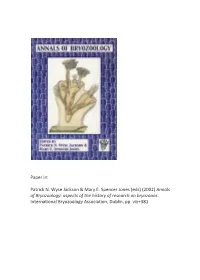
Paper in: Patrick N. Wyse Jackson & Mary E. Spencer Jones (eds) (2002) Annals of Bryozoology: aspects of the history of research on bryozoans. International Bryozoology Association, Dublin, pp. viii+381. BRYOZOAN STUDIES IN THE BERING SEA 97 History of investigations and current state of knowledge of bryozoan species diversity in the Bering Sea Andrei V. Grischenko Systematics and Evolution, Division of Biological Sciences, Graduate School of Science, Hokkaido University, Sapporo, 060–0810, Japan 1. Introduction 2. Investigations of the American bryozoological school 3. Investigations of the Russian bryozoological school 4. Current knowledge on the bryozoans of the Bering Sea 4.1. Total diversity 4.2 Regional diversity 5. Discussion 6. Acknowledgements 1. Introduction The Bryozoa are one of the most abundant and widely distributed groups of macrobenthos in the Bering Sea. Although investigations of the phylum have taken place over a century, knowledge of species diversity in this sea is still very incomplete. The coastal waters of the Bering Sea belong territorially to Russia and the United States of America and, accordingly, study of the bryofauna has been achieved generally by the efforts of the Russian and American bryozoological schools. For a number of reasons, their investigations were conducted independently and, because the investigators identified specimens collected within their “national” sea areas, species occurring in the eastern and southeastern shelves of the sea were generally studied by American scientists and those in western coastal waters by Russians. Therefore the history of bryozoan investigations of the Bering Sea is most usefully presented according to the two lines of research. 2. Investigations of the American bryozoological school The first reliable data about bryozoans in the Bering Sea were connected with biological investigations of the Alaskan shelf and reported by Alice Robertson.1 She recorded three species – Membranipora membranacea (L.), Bugula purpurotincta (later changed to B. -

Fauna of Bryozoa from Kongsfjorden, West Spitsbergen
vol. 23, no. 2, pp. 193–206, 2002 Fauna of Bryozoa from Kongsfjorden, West Spitsbergen Piotr KUKLIŃSKI Instytut Oceanologii, Polska Akademia Nauk, ul. Powstanców Warszawy 55, 81−712 Sopot, Poland (mailing address) < kuki@iopan.gda.pl> UNIS (The University Courses on Svalbard), P.O. Box 156, 9171 Longyearbyean, Norway ABSTRACT: Bryozoans were collected in Kongsfjorden (79°N and 12°E) in the summer seasons of 1997, 1998, and 1999. In the total of 44 grab, dredge, and SCUBA diving sam− ples 143 taxa were determined: 123 species, 17 to the generic and 3 to the family level. In the investigated material were 24% Arctic species and 66% boreal−Arctic species. This sug− gests a rather Arctic nature of the fjord. A few boreal species indicate the influence of warm water masses (West Spitsbergen Current). The majority of species (76%) have an encrust− ing life form. There were 5 species with a frequency of occurrence higher than 20%. These are Electra crustulenta var. arctica (31.82%); Cylindroporella tubulosa (27.27%); Tegella arctica (22.73%); Tegella armifera (20.45%); and Hippothoa divaricata var. arctica (20.45%). Among all identified species 23 were recorded for the first time in the area of Svalbard archipelago. Most (79%) of newly noted species have Arctic distributions. The lower sampling effort of previous researchers most likely accounts for the present enrich− ment of the list of Bryozoa of Kongsfjorden. Key words: Arctic, Spitsbergen, Kongsfjorden, Bryozoa. Introduction Bryozoa are benthic organisms, occurring mainly in marine ecosystems. The majority of species (ca. to 5000) live in the sea, but some are also found in freshwaters (Ryland 1970). -

Falcidens Longus2.Pdf
Falcidens longus Scheltema 1998 Mollusca, Caudofoveata: Falcidentidae SCAMIT Supplement Vol. 23 SCAMIT CODE: None Date Examined: 05 April 2005 Voucher By: K. Barwick/D. Cadien SYNONYMY: Falcidens sp B SCAMIT 1985§ LITERATURE: Scheltema, 1998 DIAGNOSTIC CHARACTERS: 1. Body regionated (Figure A), BLI 5.5-8.9; anterium somewhat inflated, separated from neck by a constriction; neck short, separated from anterior trunk by constriction; anterior trunk significantly longer than posterior trunk; posterior trunk larger in diameter than any other region except anterium. 2. Posterium slightly expanded, not set off from posterior trunk by a narrowing; spicular fring of posterium long, extending well beyond peribranchial plate (Figure C); plate flat to very slightly convex, covered with radiating spicules; no peribranchial skirt evident 3. Oral shield dorsally incised, wider than tall (Figure B), with small, poorly defined dorsal lobes; about ½ as wide as anterium. 4. Radular denticles large, sickle-shaped, and meeting at the top of the radular cone; triangular plate present (can be lost); radular cone barely tapering in frontal view (Figure D), normally tapering in lateral view; cone much narrower in frontal than in lateral view. 5. Mid-anterior trunk spicules centrally keeled, with thickened edges; a few lateral ridges may be present. Under birefringence mid-anterior spicule colors, typically are white with yellowish brown ridges with the central keel being darkest. (Figures F) RELATED SPECIES AND CHARACTER DIFFERENCES: 1. Despite its name, Falcidens longus has a BLI which places it among the short group of chaetodermomorph species in the NEP. Other members of this group are Chaetoderma californicum, C. nanulum, C. -

Individual Autozooidal Behaviour and Feeding in Marine Bryozoans
Individual autozooidal behaviour and feeding in marine bryozoans Natalia Nickolaevna Shunatova, Andrew Nickolaevitch Ostrovsky Shunatova NN, Ostrovsky AN. 2001. Individual autozooidal behaviour and feeding in marine SARSIA bryozoans. Sarsia 86:113-142. The article is devoted to individual behaviour of autozooids (mainly connected with feeding and cleaning) in 40 species and subspecies of marine bryozoans from the White Sea and the Barents Sea. We present comparative descriptions of the observations and for the first time describe some of autozooidal activities (e.g. cleaning of the colony surface by a reversal of tentacular ciliature beating, variants of testing-position, and particle capture and rejection). Non-contradictory aspects from the main hypotheses on bryozoan feeding have been used to create a model of feeding mechanism. Flick- ing activity in the absence of previous mechanical contact between tentacle and particle leads to the inference that polypides in some species can detect particles at some distance. The discussion deals with both normal and “spontaneous” reactions, as well as differences and similarities in autozooidal behaviour and their probable causes. Approaches to classification of the diversity of bryozoan behav- iour (functional and morphological) are considered. Behavioural reactions recorded are classified using a morphological approach based on the structure (tentacular ciliature, tentacles and entire polypide) performing the reaction. We suggest that polypide protrusion and retraction might be the basis of the origin of some other individual activities. Individual autozooidal behaviour is considered to be a flexible and sensitive system of reactions in which the activities can be performed in different combinations and successions and can be switched depending on the situation. -
2020 Interim Receiving Waters Monitoring Report
POINT LOMA OCEAN OUTFALL MONTHLY RECEIVING WATERS INTERIM RECEIVING WATERS MONITORING REPORT FOR THE POINTM ONITORINGLOMA AND SOUTH R EPORTBAY OCEAN OUTFALLS POINT LOMA 2020 WASTEWATER TREATMENT PLANT NPDES Permit No. CA0107409 SDRWQCB Order No. R9-2017-0007 APRIL 2021 Environmental Monitoring and Technical Services 2392 Kincaid Road x Mail Station 45A x San Diego, CA 92101 Tel (619) 758-2300 Fax (619) 758-2309 INTERIM RECEIVING WATERS MONITORING REPORT FOR THE POINT LOMA AND SOUTH BAY OCEAN OUTFALLS 2020 POINT LOMA WASTEWATER TREATMENT PLANT (ORDER NO. R9-2017-0007; NPDES NO. CA0107409) SOUTH BAY WATER RECLAMATION PLANT (ORDER NO. R9-2013-0006 AS AMENDED; NPDES NO. CA0109045) SOUTH BAY INTERNATIONAL WASTEWATER TREATMENT PLANT (ORDER NO. R9-2014-0009 AS AMENDED; NPDES NO. CA0108928) Prepared by: City of San Diego Ocean Monitoring Program Environmental Monitoring & Technical Services Division Ryan Kempster, Editor Ami Latker, Editor June 2021 Table of Contents Production Credits and Acknowledgements ...........................................................................ii Executive Summary ...................................................................................................................1 A. Latker, R. Kempster Chapter 1. General Introduction ............................................................................................3 A. Latker, R. Kempster Chapter 2. Water Quality .......................................................................................................15 S. Jaeger, A. Webb, R. Kempster, -
B03 Aplacs Duplex.Indd
Chaetoderma sp A SCAMIT 2005§ Mollusca, Caudofoveata: Chaetodermatidae SCAMIT Supplement Vol. 23 SCAMIT CODE: None Date Examined: 05 April 2005 Voucher By: K. Barwick/D. Cadien SYNONYMY: None LITERATURE: Scheltema, 1998 DIAGNOSTIC CHARACTERS: 1. Body regionated, BLI 6.7; anterium somewhat inflated, neck equal in diameter to anterior trunk; anterior and posterior trunks subequal in length, posterior trunk of greater diameter (Figure A); slight reduction of body diameter at end of posterior trunk and beginning of posterium (Figure B) 2. Posterium abruptly expanded into an annulus under the peribranchial plate; peribranchial skirt not evident; spicular fringe very short, not reaching peribranchial plate (Figure B). 3. Oral shield entire, not dorsally incised (Figure D). 4. Radular denticles of moderate size, about 30% the length of the lateral plate; radular cone straight and gently tapering in frontal view; cone concave frontally and broader in lateral view (Figure E) 5. Mid-anterior trunk spicules of anterior trunk with strong central keel; little or no lateral ridging; edges thickened. Some with rounded bases others with ragged squared-off bases. (Figure F). RELATED SPECIES AND CHARACTER DIFFERENCES: 1. Chaetoderma sp A is among the shorter chaetodermomorphs in the NEP. The short group also includes C. californicum, C. nanulum, C. recisum, C. scabrum, Falcidens longus, and F. macracanthos. It can be distinguished from C. californicum, C. nanulum and the two Falcidens species by having an entire, unincised oral shield. 2. C. recisum differs from C. sp A in having: an inflated neck wider than the anterior trunk; and in the long spicular fringe of the posterium; 3. -

Cross-Shelf Habitat Suitability Modeling: Characterizing Potential Distributions of Deep-Sea Corals, Sponges, and Macrofauna Offshore of the US West Coast
SCCWRP #1171 OCS Study BOEM 2020-021 Cross-Shelf Habitat Suitability Modeling: Characterizing Potential Distributions of Deep-Sea Corals, Sponges, and Macrofauna Offshore of the US West Coast US Department of the Interior Bureau of Ocean Energy Management Pacific OCS Region OCS Study BOEM 2020-021 Cross-Shelf Habitat Suitability Modeling: Characterizing Potential Distributions of Deep-Sea Corals, Sponges, and Macrofauna Offshore of the US West Coast October 2020 Authors: Matthew Poti1,2, Sarah K. Henkel3, Joseph J. Bizzarro4, Thomas F. Hourigan5, M. Elizabeth Clarke6, Curt E. Whitmire7, Abigail Powell8, Mary M. Yoklavich4, Laurie Bauer1,2, Arliss J. Winship1,2, Michael Coyne1,2, David J. Gillett9, Lisa Gilbane10, John Christensen2, and Christopher F.G. Jeffrey1,2 1. CSS, Inc., 10301 Democracy Ln, Suite 300, Fairfax, VA 22030 2. National Centers for Coastal Ocean Science (NCCOS), National Oceanic and Atmospheric Administration (NOAA), National Ocean Service, 1305 East West Hwy SSMC4, Silver Spring, MD 20910 3. Oregon State University, Hatfield Marine Science Center, 2030 Marine Science Drive, Newport, OR 97365 4. Institute of Marine Sciences, University of California, Santa Cruz & Fisheries Ecology Division, Southwest Fisheries Science Center (SWFSC), NOAA National Marine Fisheries Service (NMFS), Santa Cruz, CA 95060 5. Deep Sea Coral Research & Technology Program, NOAA NMFS, 1315 East West Hwy, Silver Spring, MD 20910 6. Northwest Fisheries Science Center (NWFSC), NOAA NMFS, 2725 Montlake Blvd East, Seattle, WA 98112 7. Fishery Resource Analysis and Monitoring Division, NWFSC, NOAA NMFS, 99 Pacific St, Bldg 255-A, Monterey, CA 93940 8. Lynker Technologies under contract to the NWFSC, NOAA NMFS, 2725 Montlake Blvd East, Seattle, WA 98112 9. -

B03 Aplacs Duplex.Indd
Falcidens hartmanae (Schwabl, 1961) Mollusca, Caudofoveata: Falcidentidae SCAMIT Supplement Vol. 23 SCAMIT CODE: None Date Examined: 05 April 2005 Voucher By: K. Barwick/D. Cadien SYNONYMY: Crystallophrisson hartmani Schwabl, 1961 LITERATURE: Schwabl, 1961; Schwabl, 1963; Scheltema, 1998 DIAGNOSTIC CHARACTERS: 1. Body regionated; anterium and neck about equal in diameter to anterior trunk; posterior trunk much narrower than anterior trunk, and narrower than posterium (Figure A) 2. Oral shield entire, uncleft dorsally; surrounding mouth (Figure B) 3. Peribranchial plate flattened to dome shaped, spicular fringe protruding (if plate flat) or not protruding (if plate convex and dome shaped)(Figure C). 4. Mid-anterior trunk spicules with single or double central keel, otherwise lacking ridges (Figure E), slightly bent toward body axis (Figure F) 5. Radula with triangular plate well developed, bearing a pair of apophyses. Denticles strong, sickle-shaped, with long robust bases (Figure D) 6. Radular cone narrow and straight in frontal view, broad and somewhat asymmetrically extended anteriorly in lateral view (Figure D) RELATED SPECIES AND CHARACTER DIFFERENCES: 1. Differs from all other NEP chetodermomorphs in the strongly inflated anterior trunk which is much wider than the posterior trunk (forming a shank-like tail) 2. Similar to Chaetoderma sp A, C. scabrum and C. recisum in having an entire oral shield. Can easily be differentiated from all three on the basis of body regionation and posession of a triangular plate in the radula DEPTH RANGE: 200 - 1843m DISTRIBUTION: Upper and mid Continental Slope; Southern California Bight to Oregon DISCUSSION: Falcidens hartmanae is quite distinctive in its body form among Southern California Bight chaetodermomorphs, although this particular pattern of regionation is reasonably common among members of the genus. -
Foraging Tactics in Mollusca: a Review of the Feeding Behavior of Their Most Obscure Classes (Aplacophora, Polyplacophora, Monoplacophora, Scaphopoda and Cephalopoda)
Oecologia Australis 17(3): 358-373, Setembro 2013 http://dx.doi.org/10.4257/oeco.2013.1703.04 FORAGING TACTICS IN MOLLUSCA: A REVIEW OF THE FEEDING BEHAVIOR OF THEIR MOST OBSCURE CLASSES (APLACOPHORA, POLYPLACOPHORA, MONOPLACOPHORA, SCAPHOPODA AND CEPHALOPODA) Vanessa Fontoura-da-Silva¹, ², *, Renato Junqueira de Souza Dantas¹ and Carlos Henrique Soares Caetano¹ ¹Universidade Federal do Estado do Rio de Janeiro, Instituto de Biociências, Departamento de Zoologia, Laboratório de Zoologia de Invertebrados Marinhos, Av. Pasteur, 458, 309, Urca, Rio de Janeiro, RJ, Brasil, 22290-240. ²Programa de Pós Graduação em Ciência Biológicas (Biodiversidade Neotropical), Universidade Federal do Estado do Rio de Janeiro E-mails: vanessa_fontoura@globo.com, renato.biomar@gmail.com, chcaetano@zipmail.com.br ABSTRACT Mollusca is regarded as the second most diverse phylum of invertebrate animals. It presents a wide range of geographic distribution patterns, feeding habits and life standards. Despite the impressive fossil record, its evolutionary history is still uncertain. Ancestors adopted a simple way of acquiring food, being called deposit-feeders. Amongst its current representatives, Gastropoda and Bivalvia are two most diversely distributed and scientifically well-known classes. The other classes are restricted to the marine environment and show other limitations that hamper possible researches and make them less frequent. The upcoming article aims at examining the feeding habits of the most obscure classes of Mollusca (Aplacophora, Polyplacophora, Monoplacophora, Scaphoda and Cephalopoda), based on an extense literary research in books, journals of malacology and digital data bases. The review will also discuss the gaps concerning the study of these classes and the perspectives for future analysis. -
B03 Aplacs Duplex.Indd
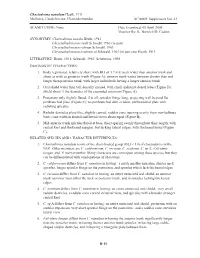
Chaetoderma nanulum Heath, 1911 Mollusca, Caudofoveata: Chaetodermatidae SCAMIT Supplement Vol. 23 SCAMIT CODE: None Date Examined: 05 April 2005 Voucher By: K. Barwick/D. Cadien SYNONYMY: Chaetoderma nanula Heath, 1911 Chrystallophrisson riedli Schwabl, 1963 (in part) Chrystallophrisson rubrum Schwabl, 1963 Chrystallophrisson scabrum of Schwabl, 1963 (in part) not Heath, 1911 LITERATURE: Heath, 1911; Schwabl, 1963; Scheltema, 1998 DIAGNOSTIC CHARACTERS: 1. Body regionated, relatively short, with BLI of 3.7-8.6; neck wider than anterior trunk and about as wide as posterior trunk (Figure A); anterior trunk varies between shorter than and longer than posterior trunk, with larger individuals having a longer anterior trunk. 2. Oral shield wider than tall, dorsally incised, with small indistinct dorsal lobes (Figure D); shield about ½ the diameter of the expanded anterium (Figure A). 3. Posterium only slightly flared, if at all; spicular fringe long, projecting well beyond flat peribranchial plate (Figure E); no peribranchial skirt evident; peribranchial plate with radiating spicules. 4. Radular denticles plate-like, slightly curved; radular cone tapering evenly from non-bulbous base; cone width in frontal and lateral views about equal (Figure B). 5. Mid-anterior trunk spicules flared at base, then tapering evenly throughout their length; with central keel and thickened margins, but lacking lateral ridges, with thickened bases (Figure C). RELATED SPECIES AND CHARACTER DIFFERENCES: 1. Chaetoderma nanulum is one of the short-bodied group (BLI < 10) of chaetoderms in the NEP. Other members are C. californicum, C. recisum, C. scabrum, C. sp A, Falcidens longus, and F. macracanthos. Many characters are convergent among these species, but they can be differentiated with combinations of characters. -

Furcillidens Incrassatus (Schwabl 1963) Mollusca, Caudofoveata: Falcidentidae SCAMIT Supplement Vol
Furcillidens incrassatus (Schwabl 1963) Mollusca, Caudofoveata: Falcidentidae SCAMIT Supplement Vol. 23 SCAMIT CODE: None Date Examined: 05 April 2005 Voucher By: K. Barwick/D. Cadien SYNONYMY: Crystallophrisson incrassatum Schwabl 1963 ? Chaetoderma sp B of Shrake 1985 LITERATURE: Schwabl, 1963; Scheltema, 1998; Salvini-Plawen, 1975 DIAGNOSTIC CHARACTERS: 1. Body regionated (Figure A); anterium and neck inflated, much broader than anterior trunk; posterior trunk broader than anterior trunk; posterium often has the appearance of an annulus or ring, and may be set off from posterior trunk by distinct ridge, lacking spicular fringe (Figure B) 2. Animal very short for a chaetodermomorph, with a BLI of 3-4 due to the inflated anterium/ neck and posterior trunk (Figure A) 3. Oral shield incised, wider than tall, with well-defined dorsal lobes, less than half the width of the inflated anterium (Figure C) 4. Radula lacking denticles; radular cone continuous with robust forked process extending forward like tongs and covered in a heavy sheath of connective tissue (Figure E); cone narrow in anterior view, broad in lateral view 5. Anterior and posterior trunk spicules similar, adherent, lacking keel, ridges, or grooves, long and narrow (Figure D) RELATED SPECIES AND CHARACTER DIFFERENCES: 1. Several NEP Chaetoderma species have inflated anteriums, but none have the combination of inflated anterium and neck and short broad posterior trunk which make this animal so distinctive. In Chaetoderma elegans the animal is very long and narrow ( BLI 24) and the inflated anterium is carried at a nearly right angle to the main body axis. In Chaetoderma hancocki the animal is also much more attenuated than is F.