Schedule Thiruvananthapuram – Download As
Total Page:16
File Type:pdf, Size:1020Kb
Load more
Recommended publications
-

The Conference Brochure
The Many Lives of Indian Cinema: 1913-2013 and beyond Centre for the Study of Developing Societies, Delhi 9-11 January 2014 1 Credits Concept: Ravi Vasudevan Production: Ishita Tiwary Operations: Ashish Mahajan Programme coordinator: Tanveer Kaur Infrastructure: Sachin Kumar, Vikas Chaurasia Consultant: Ravikant Audio-visual Production: Ritika Kaushik Print Design: Mrityunjay Chatterjee Cover Image: Mrityunjay Chatterjee Back Cover Image: Shahid Datawala, Sarai Archive Staff of the Centre for the Study of Developing Societies We gratefully acknowledge support from the following institutions: Indian Council for Social Science Research; Arts and Humanities Research Council; Research Councils UK; Goethe Institute, Delhi; Indian Council for Historical Research; Sage Publishing. Doordarshan have generously extended media partnership to the conference. Images in the brochure are selected from Sarai Archive collections. Sponsors Media Partner 2 The Idea Remembering legendary beginnings provides us the occasion to redefine and make contemporary the history we set out to honour. We need to complicate the idea of origins and `firsts’ because they highlight some dimensions of film culture and usage over others, and obscure the wider network of media technologies, cultural practices, and audiences which made cinema possible. In India, it is a matter of debate whether D.G. Phalke's Raja Harishchandra (1913), popularly referred to as the first Indian feature film, deserves that accolade. As Rosie Thomas has shown, earlier instances of the story film can be identified, includingAlibaba (Hiralal Sen, 1903), an Arabian Nights fantasy which would point to the presence of a different cultural universe from that provided by Phalke's Hindu mythological film. Such a revisionary history is critical to our research agenda. -

Macho Icons Going Places
J. Vis. Art & Des., Vol. 11. No. 1, 2019, 1-18 1 Macho Icons Going Places Muhammad Asghar1 & Muhammad Arshad Rehmani2 1Institute of Art and Design, Government College University, New Civil Lines Campus, Near Regency Plaza, 38000 Faisalabad, Pakistan 2Institute of Art and Design, University of Sargodha, University Road, 40100 Sargodha, Pakistan E-mail: asghar@daad-alumni.de Abstract. This paper is an exploration of the increasing trend of popular macho representations on the back of three-wheeled auto rickshaws in the Punjab, Pakistan. Through an ethnographic field research it was observed that the painted visuals of popular icons in clichéd heroic poses are rampant on rickshaws, representing a mobile exhibition of urban folk art. These visuals are mostly taken from the local Punjabi film industry, which has eclipsed over the past two decades. This study further explored the reasons for the increase of male figures displayed on rickshaws (and other) popular art and the almost total extinction of female figures because of increased religious assertion in Pakistan over this two- decade period. Our analysis shows that the relationship between rickshaw drivers and a common male audience with these powerful visuals is so strong that it reinforces the ‘impulse to image’. The power of macho visuals satisfies the taste of cinemagoers who love to travel by rickshaws loaded with such visuals. We argue that these macho ideal representations have a strong impact on the beholders and they influence society through the power they convey. Finally, this study concludes that the popular macho visuals effectively communicate real emotions and please the mood of vast audiences in particular segments of society. -

The Role of the Women in Cinema Collective (WCC) in ‘Voicing the Women’ in the Malayalam Film Industry
Journal of International Women's Studies Volume 22 Issue 6 Women—a Multidimensional Spectrum. Select papers from the National Conference on “Women in Leadership” conducted by the Article 15 Women Empowerment Cell of Kristu Jayanti College (Autonomous), Bangalore, India. June 2021 From Resistance to Leadership: The Role of the Women in Cinema Collective (WCC) in ‘Voicing the Women’ in the Malayalam Film Industry Jimin S. Mathew Alna Mariya Isac Follow this and additional works at: https://vc.bridgew.edu/jiws Part of the Women's Studies Commons Recommended Citation Mathew, Jimin S. and Isac, Alna Mariya (2021). From Resistance to Leadership: The Role of the Women in Cinema Collective (WCC) in ‘Voicing the Women’ in the Malayalam Film Industry. Journal of International Women's Studies, 22(6), 150-156. Available at: https://vc.bridgew.edu/jiws/vol22/iss6/15 This item is available as part of Virtual Commons, the open-access institutional repository of Bridgewater State University, Bridgewater, Massachusetts. This journal and its contents may be used for research, teaching and private study purposes. Any substantial or systematic reproduction, re-distribution, re-selling, loan or sub-licensing, systematic supply or distribution in any form to anyone is expressly forbidden. ©2021 Journal of International Women’s Studies. From Resistance to Leadership: The Role of the Women in Cinema Collective (WCC) in ‘Voicing the Women’ in the Malayalam Film Industry By Jimin S Mathew1, Alna Mariya Isac2 Abstract On February 17, 2017 a popular film actress in the Malayalam film industry was sexually assaulted and harassed in a running vehicle as she was returning from work. -

Portrayal of the Muslim Community and Islam by Indian Cinema Post 9/11- an Analysis
Portrayal of the Muslim Community and Islam by Indian cinema Post 9/11- An Analysis (published in JMS Vol 28 (1) and can be found online at : http://www.jms.edu.pk/ViewArticle.aspx?ArticleID=178) Abstract Indian cinema has been a mirror to the multidimensional nature of the subcontinent, be it in its portrayal of Indian culture, society, castes, classes, politics, art, or religion. Movies like Bombay depict the trauma of an inter-religious love and marriage of a young Hindu man and a beautiful Muslim woman, and their ultimate triumph, amidst a communal riot. Muslim terrorism was depicted in movies like Roja, Mission Kashmir, Maachis and others, with Kashmir and the Indo-Pakistan conflict as the theme. Minorities especially Muslims, as spies, traitors, or smugglers, has been a common theme in commercial cinema. This paper attempts to examine the representation of a minority community— the Muslims- in Indian cinema post 9/11. The paper presents a content analysis of the films New York, Anwar and Vishwaroopam. Predominantly, so far, the representation of this minority community in Indian cinema has remained within the dominant discourse, even in its stereotyping. Key words: Indian cinema, portrayal, Muslims, post 9/11, content analysis, stereotyping. Introduction In this era of communication explosion, wars begin and end with media (MEŠIĆ, Mirza). The media play a significant role in the process of social construction of reality and can be used as a potent weapon to mould and sculpt people’s perceptions, as the information that individuals are exposed to greatly influence their perception of the world. -
Reg No Name Name of Father 50 C.J. Peter C.P. John 55 K.J. George Joseph J
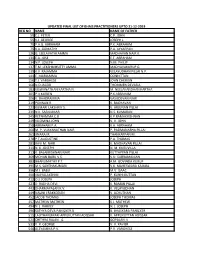
UPDATED FINAL LIST OF BHMS PRACTITIONERS UPTO 31-12-2019 REG NO NAME NAME OF FATHER 50 C.J. PETER C.P. JOHN 55 K.J. GEORGE JOSEPH J. 70 P.A.G. ABRAHAM P.K. ABRAHAM 75 K.A. GOMATHY P.A. AYYAPPAN 126 G. LEELAVATHI AMMA MADHAVAN NAIR K. 131 E.A. JOSE E.T. ABRAHAM 134 N.P. JOSEPH N.M. PHILIP 137 T.M. LEKSHMIKUTTY AMMA MADHAVAKURUP G. 139 K.V. RAJAMMA VELAYUDHAN PILLAI N.P. 141 E. MARIAMMA OONNITTAN 156 T.J. VARGHESE JOHN CHERIAN 168 N.D.JACOB THOMMEN DEVASIA 183 VISWANATHAN KARTHA N. M. NEELAKANDHAN KARTHA 205 P.A.KURIEN P.K.ABRAHAM 206 V. BHADRAMMA VASUDEVAN NAIR 219 PONNAN R. K. RAGHAVAN 223 KUMARI LAKSHMY S. V. ARJUNAN PILLAI 235 N.K. SASIKUMAR N.S. KUMARAN 245 RETNAMMA.C.B K.P.RAMAKRISHNAN 249 VILOMINA JOHN V. V. JOHN 258 ABRAHAM P.A. K.A. ABRAHAM 260 M. P. VIJAYANATHAN NAIR P. PADMANABHA PILLAI 261 JINARAJ R. THANKAPPAN M. 278 P.T.AUGUSTINE P.A. THOMAS 281 RAVI M. NAIR K. MADHAVAN PILLAI 311 N. K. JOSEPH N. M. KURUVILLA 313 K. BALAKRISHNAN NAIR KUTTAPPAN PILLAI 369 MOHAN BABU V.S. V.U. SUBRAMANIAN 383 BHANUMATHY P.T. A.M. GOVINDA KURUP 395 M.S. SANTHAKUMARI V.K. MAHESWARA KAIMAL 396 M.I. BABU M.V. ISAAC 400 VIJAYALAKSHMI P. KUNHI KUTTAN 412 O.J. JOSEPH JOSEPH 423 D. RADHA DEVI K. RAMAN PILLAI 443 DHARMAPALAN K.V. K. VELAYUDHAN 449 NALINI ERAKKODAN V. ACHUTHAN 452 JACOB THOMAS JOSEPH THOMAS 457 MATHEW MATHEW K.J. -
List#1 of Shortlisted Candidates for the Written Test to Be Conducted on 19-04-2015 for Selection to the Post of Warehouse Assistant Grade-II in Hyderabad Region
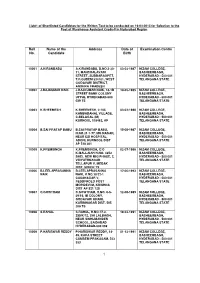
List#1 of Shortlisted Candidates for the Written Test to be conducted on 19-04-2015 for Selection to the Post of Warehouse Assistant Grade-II in Hyderabad Region Roll Name of the Address Date of Examination Centre No. Candidate Birth 10001 A.KIRANBABU A.KIRANBABU, D.NO.3-20- 03-02-1987 NIZAM COLLEGE, 11, MANCHALAVARI BASHEERBAGH, STREET, SUBBARAOPET, HYDERABAD - 500 001 T.P.GUDEM 534101, WEST TELANGANA STATE GODAVARI DISTRICT, ANDHRA PRADESH 10002 J.RAJKUMAR NAIK J.RAJKUMAR NAIK, 18-1B 10-05-1985 NIZAM COLLEGE, STREET BANK COLONY BASHEERBAGH, UPPAL HYDERABAD-500 HYDERABAD - 500 001 039 TS TELANGANA STATE 10003 K.BHEEMESH K.BHEEMESH, 2-105 03-03-1988 NIZAM COLLEGE, KAMBADAHAL VILLAGE, BASHEERBAGH, C.BELAGAL (M) HYDERABAD - 500 001 KURNOOL 518462, AP TELANGANA STATE 10004 B.SAI PRATAP BABU B.SAI PRATAP BABU, 15-08-1987 NIZAM COLLEGE, H.NO.21-1-77, MG NAGAR, BASHEERBAGH, NEAR ESI HOSPITAL, HYDERABAD - 500 001 ADONI, KURNOOL DIST TELANGANA STATE AP 518 301 10005 K.PREMSINGH K.PREMSINGH, C/O 02-07-1986 NIZAM COLLEGE, K.MALLAIAH H.NO. 4252 BASHEERBAGH, BHEL NEW MIG PHASE, 2, HYDERABAD - 500 001 VIDYUTHNAGAR TELANGANA STATE TELLAPUR V, MEDAK DIST. 502032 TS 10006 B.LEELAPRASANNA B.LEELAPRASANNA 17-06-1993 NIZAM COLLEGE, NAIK NAIK, H.NO.10/22-1 BASHEERBAGH, CASANAGAR V, HYDERABAD - 500 001 PEDDPROLO POST TELANGANA STATE MOPIDEVI M, KRISHNA DIST AP 521 125 10007 C.GOWTHAM C.GOWTHAM, H.NO. 6-5- 12-08-1989 NIZAM COLLEGE, 59/16, IB COLONY, BASHEERBAGH, GODAVARI KHANI, HYDERABAD - 500 001 KARIMNAGAR DIST. 505 TELANGANA STATE 209 TS 10008 S.RAHUL S.RAHUL, -

The Hidden Role Patriarchy in Malayalam Cinema: an Analysis of the Movie ‘Sufiyum Sujathayum’ Febini M Joseph1, Cefy Joice J2
International Journal of English Literature and Social Sciences, 5(6) Nov-Dec 2020 | Available online: https://ijels.com/ The hidden role Patriarchy in Malayalam Cinema: An analysis of the movie ‘sufiyum sujathayum’ Febini M Joseph1, Cefy Joice J2 1Assistant Professor of English, SCMS School of Engineering and Technology, Karukutty, Ernakulam, Kerala, India 2Student, Kerala Law Academy, Trivandrum, India Received: 09 Nov 2020; Received in revised form: 23 Nov 2020; Accepted: 26 Nov 2020; Available online: 14 Dec 2020 ©2020 The Author(s). Published by Infogain Publication. This is an open access article under the CC BY license (https://creativecommons.org/licenses/by/4.0/). Abstract— Movies are the most popular medium that represents the popular taste and culture. Malayalam cinema has undergone several radical shifts throughout the past years, But still there are movies to satisfy or reinstate the traditional gender roles and patriarchy. The movie Sufiyum Sujathayum is about how society transforms our way of thinking based on the strict adhesion to patriarchy. More than love people consider social acceptance as the most important priority. The paper is an analysis of the movie by using theories such as male gaze and feminism. Keywords— Gender Stereotypes, Male Gaze, Patriarchy. Gender has been seen as a principle set up by Through the sexual orientation people start to fortify theorists like Simone de Beauvoir. Rather than the result of certain 'proper' practices, young ladies get prepared in craft sexual differences, it is represented as the consequence of and music while young men takeover the play areas. social customs and practices which incorporates support Barbie dolls and kitchen sets enhance the rooms of girls from movies to practice of regular discussions as described when the young boys play with automatic rifles and autos. -

Malayalam Cinema from Politics to Poetics
Malayalam Cinema from Politics to Poetics By Gönül Dönmez-Colin Spring 2007 Issue of KINEMA MALAYALAM CINEMA FROM POLITICS TO POETICS INDIA IS the leading producer of films in the world with over 1000 films per year. The tiny south- western state of Kerala where a language called Malayalam is spoken has surpassed West Bengal as a major centre of art films. Its most important filmmaker, Adoor Gopalakrishnan is hailed as the living Satyajit Ray. Since the beginning of the 1970s, with the strong film society movement supported by the literary traditions of the state, Malayalam cinema has excelled in politically engagé films with artistic inclinations. When the Golden Age of Tamil and Telugu movies ended, Kannada and Malayalam cinemas came to the fore. Although, they too had their share of stars, the director came to be recognized as the most important person behind a film. The ”new cinema” distinguished itself from the outset for its thematic excellence. Even themediocre films initiated by the early involvement of writers and leftist theatre personalities concerned themselves with social and political issues such as tribal emancipation, illiteracy, land distribution and trade unionism. A straightforward love story would have deeper allegorical layers evoking Fredric Jameson’s hypothesis that ”all third world texts are necessarily allegorical...the story of the private individual destiny is always an allegory of the embattled situation of the public third-world culture and society.”(1) The films of John Abraham, Adoor Gopalakrishnan, Govinda Aravindan, T.V. Chandran, M. P. Sukumaran Nair, Shaji Karun and several others are testimony to this hypothesis. -

English Language and Literature Core Course VIII – Film Studies
English Language and Literature SEMESTER V Core Course VIII – Film Studies (EN 1543) Part 2 FILM MOVEMENTS SOVIET MONTAGE (1924-1930) • Montage is a technique in film editing in which a series of shorts are edited into a sequence to compact space, time, and information. • Visual montage may combine shots to tell a story chronologically or may juxtapose images to produce an impression or to illustrate an association of ideas. • Montage technique developed early in cinema, primarily through the work of the American directors Edwin S. Porter and D.W. Griffith. Soviet Montage • Soviet Montage Montage describes cutting together images that aren’t in spatial or temporal continuity. • Director Lev Kulshov first conceptualized montage theory on the basis that one frame may not be enough to convey an idea or an emotion • •The audience are able to view two separate images and subconsciously give them a collective context. • In the 1920s, a lack of film stock meant that Soviet filmmakers often re-edited existing films or learned how to make films by deconstructing old ones rather than shooting new material. • When they did shoot film, they often had only short lengths of film left over from other productions, so they not only used short shots, they often planned them in great detail. Kuleshov Effect • Kuleshov experiment is a good example. • The basic notion that a subsequent image could affect the viewer’s interpretation of the previous one was supported by behavioral psychology theories popular at the time. • Kuleshov concluded from his experiment that editing created the opportunity to link entirely unrelated material in the minds of the viewers, who were no longer seen as simply absorbing meaning from the images, but actually creating meaning by associating the different images and drawing meaning from their juxtaposition. -

Screening the Impossible: the Politics of Form and Feeling in Second Wave Revolutionary Cinema
SCREENING THE IMPOSSIBLE: THE POLITICS OF FORM AND FEELING IN SECOND WAVE REVOLUTIONARY CINEMA By Sarah Hamblin A DISSERTATION Submitted to Michigan State University in partial fulfillment of the requirements for the degree of DOCTOR OF PHILOSOPHY English 2012 ABSTRACT SCREENING THE IMPOSSIBLE: THE POLITICS OF FORM AND FEELING IN SECOND WAVE REVOLUTIONARY CINEMA By Sarah Hamblin Screening the Impossible explores how the new revolutionary ideologies that emerged in the various global articulations of the “long 1968” produced new forms of revolutionary cinematic practice – what I collectively refer to as a second wave of revolutionary filmmaking. The project focuses on films largely from the 1960s and 1970s that engage the revolutionary energies of the period to examine the relationship between emotion, aesthetics, and political theory in an international cinematic context. Drawing on the claim that the global rebellions of the 1960s mark the denunciation of early 20th century revolutionary narratives, it traces the connections between filmmakers who are similarly preoccupied with the limits, failures, and counter-revolutionary appropriations of orthodox revolutionary thought and yet remain committed to the necessity of revolutionary transformation. Through a comparative analysis of films from various national traditions, the project examines how the political cinema of this period develops a new understanding of revolutionary process and the role that cinema can play in it. At its core, the project lays out the aesthetic and affective contours of this emergent genre, arguing that second wave revolutionary cinema is characterized by its rejection of the teleological narratives and didactic political messages embedded in earlier first wave revolutionary cinematic production. -

Htno Cname Dob Marks 100002 a Lavanya 20/05/1986 48 100003
HTNO CNAME DOB MARKS 100002 A LAVANYA 20/05/1986 48 100003 A RAMA DEVI 23/11/1987 45 100004 A RAMANA 06/05/1988 30 100005 A ROSHINI 23/06/1990 41 100006 A ABDUL LATHIEF 09/08/1990 48 100007 A ABHILASH GOUD 23/01/1990 33 100009 A ADI NARAYANA 15/06/1987 33 100010 A ADITHI 02/10/1988 39 100012 A AMARNATH 12/03/1987 18 100013 A AMULYA 10/04/1990 25 100014 A ANIL KUMAR 25/06/1988 35 100015 A ANJAIAH 08/02/1989 24 100016 A ANJAIAH 12/05/1983 32 100018 A ARCHANA 20/11/1986 56 100019 A ARJUN KUMAR 02/06/1990 52 100020 A ARJUNA RAO 14/09/1977 47 100021 A ASHOK GOUD 14/07/1988 59 100022 A ASHOK KUMAR 01/02/1988 41 100023 A ASHOK KUMAR REDDY 24/05/1989 40 100024 A ASWARTHA NARAYANA RAO 10/06/1990 57 100025 A B CHAITHANYAKUMARYADAV 08/08/1990 31 100026 A B S RAMANJANEYACHARI 05/06/1989 25 100027 A B SIVASANKAR 20/07/1989 35 100028 A B SURYAKIRAN GOUD 22/11/1981 50 100029 A BALA JESU 04/05/1987 42 100030 A BALAJI 06/08/1985 42 100031 A BALAJI 27/07/1987 26 100032 A BALAJI KIRAN 06/01/1989 74 100033 A BALAVENKATASRAVANKUMAR 17/08/1985 51 100034 A BAPU 06/06/1981 31 100035 A BHAGYA LAXMI 04/09/1987 28 100036 A BHANU PRAKASH 03/11/1981 44 100037 A BHARATA KUMAR 04/08/1986 42 100038 A BHARATH KUMAR 27/02/1987 39 100039 A BHARGAVA PRASANNA KUMAR 03/03/1990 51 100040 A BHARGAVI 02/01/1990 41 100041 A BHASKAR 14/06/1988 33 100042 A BHASKARA BABU 23/05/1985 34 100043 A BHAVANI 13/11/1988 31 100044 A BHUVANESHWARI DEVI 05/06/1987 33 100045 A CHAITANYA 27/04/1988 27 100047 A CHANDRA SEKHAR 21/02/1988 42 100048 A CHANDRA SEKHARA NAIDU 15/08/1984 28 100049 A -

South Asian Film & Television 16 + Guide
SOUTH ASIAN FILM & TELEVISION 16 + GUIDE www.bfi.org.uk/imagineasia This and other bfi National Library 16+ guides are available from http://www.bfi.org.uk/16+ IMAGINEASIA - SOUTH ASIAN FILM & TELEVISION Contents Page IMPORTANT NOTE ........................................................................................ 1 GENERAL INFORMATION ............................................................................. 2 APPROACHES TO RESEARCH, by Samantha Bakhurst.................................. 4 INTRODUCTION ............................................................................................ 6 BANGLADESH............................................................................................... 7 Focus on Filmmakers: Zahir Raihan................................................................. 9 BHUTAN, NEPAL & TIBET.............................................................................. 9 PAKISTAN..................................................................................................... 10 Focus on Filmmakers: Jamil Dehlavi ................................................................ 16 SRI LANKA .................................................................................................... 17 Focus on Filmmakers: Lester James Peries ..................................................... 20 INDIA · General References............................................................................ 22 · Culture, Society and Film Theory ......................................................... 33 · Film