“Searching for Gender Balance in Contemporary Morocco”
Total Page:16
File Type:pdf, Size:1020Kb
Load more
Recommended publications
-

Is Morocco Immune to Upheaval?
DATELINE Is Morocco Immune to Upheaval? by Bruce Maddy-Weitzman The uprisings that swept across the Middle East and North Africa during 2011 have largely bypassed Morocco. The absence of tumult and the loudly trumpeted package of constitutional reform measures endorsed in a July 2011 national referendum1 further strengthened Morocco’s favorable image in the West as a country that has mixed tradi- tion with modernity and an openness to foreign cultures, and which is both politically stable and steadily evolving toward greater pluralism. Morocco’s success in having thus far dodged upheaval warrants explanation, for the country suffers from many of the same underlying ills that have driven the protests elsewhere—corruption, poverty, and unemployment; the overwhelming concentration of wealth in the hands of a small stratum of elite families intertwined with the authorities;2 the absence of real democracy; and closed horizons for its large, youthful population, suffering from disproportionately high rates of unemployment and underemployment. But Morocco’s starting point, in terms of its political institutions and political culture, is different in ways that provide some comparative advantages. Moreover, unlike other Middle East, autocratic regimes during this tumultuous year of popular intifadas,3 the Moroccan authorities, led by King Mohammed VI, have been sufficiently proactive in their responses to the rumblings from below so as to render them manageable, at least for the time being. the country’s deeper currents, reveals the extent MOROCCAN -

Gender Quotas and Parliamentary Representation
The Institute for Women’s Studies in the Arab World 01 Lebanese American University Contents the pioneer issue 126-127 | Summer/Fall 2009 02 Editorial Marguerite El-Helou 07 File Gender Quotas and Parliamentary Representation 08 mona lena krook Gender Quotas in Parliament: A Global View 18 valentine m. moghadam Women, Politics, and Gender Quotas 28 drude dahlerup Women in Arab Parliaments: Can Gender Quotas Contribute to Democratization? 39 mark el-makari The Proposed Gender Quota in Lebanon: Legal Crisis or Democratic Transformation? 53 azza charara baydoun Women in Power and Decision-making Positions: Conditions and Restraints 58 marguerite El-helou Women Quota in Lebanon: A False Promise? 66 kamal feghali Electoral Law Proposals for a Women’s Quota in the Lebanese Parliament 71 kristine goulding Unjustifiable Means to Unjustifiable Ends: Delegitimizing Parliamentary Gender Quotas in Tunisia 79 james liddell Gender Quotas in Clientelist Systems: The Case of Morocco’s National List 87 niemat kuku The Quota System in Sudan: Parties’ Perception of the Way to Enhance Female Political Participation 94 Book Reviews 94 Ghada Karmi, In Search of Fatima: A Palestinian Story (reviewed by Hala Kamal) 97 Iman Humaydan Younes, B as in Beirut & Wild Mulberries (reviewed by Sally Bland) 101 101 News 02 al-raida Issue 126-127 | Summer/Fall 2009 Editorial Gender Quotas and Parliamentary Representation Marguerite El-Helou Any reader of my first published research on the political participation of Lebanese women can easily detect my vehement opposition to the principle of gender quota and its implementation in Lebanon. As a newcomer to research on women’s political empowerment, I lacked in-depth knowledge of the intricacies of the obstacles that faced, and continue to face, Lebanese women who have political aspirations. -

L'ambitiond'andre Azoulay Sanbar, Le Responsable De
Quand leMaroc sera islamiste Lacorruption, unsport national L'ambitiond'Andre Azoulay I'Equipement et wali de Marrakech, qui sera nomme en 200S wali de Tanger; le polytechnicien Driss Benhima, fils Durant les deux dernieres annees du regne d'Hassan II, d'un ancien Premier ministre et ministre de I'Interieur ; un vent reformateur va souffler pendant quelques mois au Mourad Cherif, qui fut plusieurs fois ministre et dirigea Maroc. Un des principaux artisans de cette volonte de tour atour l'Omnium nord-africain puis l'Office cherifien changement aura ete Andre Azoulay, le premier juif maro des phosphates - les deux neurons economiques du cain aetre nomme conseiller de SaMajeste par dahir (decret royaume -, avant d'etre nomme en mars 2006 ala tete de royal). Le parcours militant de ce Franco-Marocain, un la filiale de BNPParibas au Maroc, la BMCI ; et enfin Hassan ancien de Paribas et d'Eurocom, temoigne d'un incontes Abouyoub, plusieurs fois ministre et ancien ambassadeur. table esprit d'ouverture. Artisan constant d'un rapproche Ainsi Andre Azoulay pretendait, avec une telle garde ment [udeo-arabe, il cree en 1973 l'association Identite et rapprochee, aider le roi Hassan II dans ses velleites Dialogue alors qu'il reside encore en France. Aidepar Albert reformatrices. Sasson, un ancien doyen de la faculte de Rabat fort res Seulement, l'essai n'a pas ete transforme. Dans un pre pecte, Andre Azoulay organise de multiples rencontres mier temps, l'incontestable ouverture politique du entre juifs et Arabes.Sesliens d'amitie avec Issam Sartaoui, royaume, qui a vu Hassan II nommer ala tete du gouverne Ie responsable de l'OLP assassine en 1983, ou avec Elias ment le leader socialiste de l'USFP, s'est accompagnee d'un Sanbar, le responsable de la Revue d'etudes palestiniennes, processus d'assainissement economique. -

Marokkos Neue Regierung: Premierminister Abbas El Fassi Startet Mit Einem Deutlich Jüngeren Und Weiblicheren Kabinett
Marokkos neue Regierung: Premierminister Abbas El Fassi startet mit einem deutlich jüngeren und weiblicheren Kabinett Hajo Lanz, Büro Marokko • Die Regierungsbildung in Marokko gestaltete sich schwieriger als zunächst erwartet • Durch das Ausscheiden des Mouvement Populaire aus der früheren Koalition verfügt der Premierminister über keine stabile Mehrheit • Die USFP wird wiederum der Regierung angehören • Das neue Kabinett ist das vermutlich jüngste, in jedem Fall aber weiblichste in der Geschichte des Landes Am 15. Oktober 2007 wurde die neue ma- Was fehlte, war eigentlich nur noch die rokkanische Regierung durch König Mo- Verständigung darauf, wie diese „Re- hamed VI. vereidigt. Zuvor hatten sich die Justierung“ der Regierungszusammenset- Verhandlungen des am 19. September vom zung konkret aussehen sollte. Und genau König ernannten und mit der Regierungs- da gingen die einzelnen Auffassungen doch bildung beauftragten Premierministers Ab- weit auseinander bzw. aneinander vorbei. bas El Fassi als weitaus schwieriger und zä- her gestaltet, als dies zunächst zu erwarten Für den größten Gewinner der Wahlen vom gewesen war. Denn die Grundvorausset- 7. September, Premierminister El Fassi und zungen sind alles andere als schlecht gewe- seiner Istiqlal, stand nie außer Zweifel, die sen: Die Protagonisten und maßgeblichen Zusammenarbeit mit dem größten Wahlver- Träger der letzten Koalitionsregierung (Istiq- lierer, der sozialistischen USFP unter Füh- lal, USFP, PPS, RNI, MP) waren sich einig rung von Mohamed Elyazghi, fortführen zu darüber, die gemeinsame Arbeit, wenn wollen. Nur die USFP selbst war sich da in auch unter neuer Führung und eventuell nicht so einig: Während die Basis den Weg neuer Gewichtung der Portfolios, fortfüh- die Opposition („Diktat der Urne“) präfe- ren zu wollen. -

Bmce Bank of Africa a N N U a L R E P O
20 17 ANNUAL REPORT BMCE BANK OF AFRICA Content Chairman’s Message ...................................................................................................................... 4 Presenting BMCE Bank Group A Member of FinanceCom Group ................................................................................6 Composition of the Board of Directors ...................................................................8 BMCE Bank Group around the World .................................................................... 10 Group Profile ............................................................................................................. 12 BMCE Bank’s Shareholders ...................................................................................... 13 BMCE Bank Group’s Strategy.................................................................................... 14 2017-2018 Highlights .............................................................................. 15 BMCE Bank in Morocco............................................................................................................. 16 Personal and Professional Banking ....................................................................... 16 Corporate Banking .................................................................................................... 18 Investment Banking ...................................................................................................20 Specialised Financial Subsidiaries ............................................................................22 -

Liste Des Auditions, Contributions Et Activités De La Commission Spéciale Sur Le Modèle De Développement
Liste des auditions, contributions et activités de la Commission Spéciale sur le Modèle de Développement ANNEXE 3 AVRIL 2021 Liste des auditions, contributions et activités de la Commission Spéciale sur le Modèle de Développement ANNEXE 3 AVRIL 2021 SOMMAIRE PARTIE I - AUDITIONS ET CONTRIBUTIONS ...............................................................7 INSTITUTIONS CONSTITUTIONNELLES .........................................................................9 ACTEURS PUBLICS ......................................................................................................10 PARTIS POLITIQUES ....................................................................................................13 MONDE PROFESSIONNEL ET PARTENAIRES SOCIAUX ...............................................16 TIERS SECTEUR ...........................................................................................................19 AMBASSADEURS ET ACTEURS INTERNATIONAUX ....................................................26 CONFÉRENCES LABELLISÉES .....................................................................................27 ÉCOUTES CITOYENNES ET VISITES DE TERRAIN ......................................................29 Les écoutes citoyennes : 3 formats ...............................................................................29 Table ronde ...............................................................................................................30 Cycle de Rencontres Régionales ..................................................................................30 -
Keizainisshi 2007-10
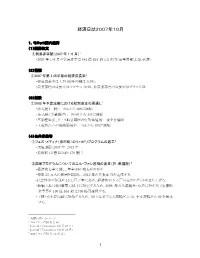
経済日誌2007年10月 1.モロッコ国内経済 (1)国際収支 ①貿易赤字額(2007 年 1-8 月)1 ・2007年1-8月の貿易赤字は 841 億 DH=約 1.2 兆円(前年同期比 26.4%増) (2)指標 ①2007 年第 2 四半期の経済成長率2 ・経済成長率は 1.7%(前年同期は 9.3%)。 ・農業部門の成長率はマイナス 20.9%、非農業部門の成長率はプラス 5.5% (3)財政 ①2008 年予算法案における税制改正の見通し3 ・法人税(一般): 35% から 30%に減額 ・法人税(金融関連): 39.6% から 35%に減額 ・不動産取引、リース取引関連の付加価値税: 税率を増額 ・工業製品への最高関税率: 45% から 40%に減額 (4)公共事業等 ①フェズ・メディナ(旧市街)のリハビリプログラムの着工4 ・実施期間:2007 年-2013 年 ・投資額12億DH=約170億円 ②国家プログラムについてのエル・ファシ首相の発言(於:衆議院)5 ・経済成長率に関し、年率 6%の成長を目指す ・毎年 25 万人の雇用を創設し、2012 年の失業率 7%を達成する。 ・社会住宅の建設を 15 万戸/年に高め、経済住宅 5 万戸国家プログラムを立ち上げる。 ・物価上昇に伴う購買力低下に対応するため、2008 年の基礎製品・石油に対する国家補助 金予算を 190 億 DH=約 2,700 億円確保する。 ・干魃・水不足問題に対処するため、2012 年までに大規模ダム 10、中小規模ダム 60 を建設 する。 1 為替局ホームページ 2 エコノマップ(10月1日) 3 Journal l’Economiste (10 月 25 日) 4 Journal l’Economiste (10 月 24 日) 5 エコノマップ(10 月 25,26 日) 1 ・今後5年間で、ホテルのベッド数を15万床から 26.5 万床に高め、8 万人の雇用を創設す る。観光収入を 600 億 DH から 900 億 DH(2012 年)=約 1.3 兆円まで高める ・高速道路建設第2次計画(380km の増設)を立ち上げる(都市 Beni Mellal を高速道路網に 組み入れる。ラバト~カサブランカ間の輸送能力増強。El Jadida-Safi 区間の建設)。 ・地中海道路(Tanger - Saidia 間)の 2011 年開通 ・地方道路整備計画に関し、道路整備を年 1,500km/年から 2,000km/年に加速し、2012 年 における地方住民の地方道路へのアクセス率を 80%に高める。 ・タンジェ~カサブランカ間高速鉄道(TGV)の第1区間工事を2009年に着工する。 (5)産業 ①国営製鉄会社(SONASID)の2007年上半期業績6 ・上半期売上高は 32.6 億 DH=約 450 億円(前年同期比 20.6%増) ・上半期利益は 4.94 億 DH=約 70 億円(前年同期比 52%増) ・SONASID 社は、2006年にArcelor/Mittal社とパートナーシップ協定を締結している。 (6)その他 ①カサブランカに北アフリカ最大のショッピングモールを建設する計画7 ・衣類流通業の Aksal 社と Nesk Investment 社の合弁会社が、総工費 20 億 DH=約 280 億円をかけ、10 ヘクタールの敷地に「モロッコ・モール」を建設 ・ファッション、宝飾などの 200 以上の国内、海外ブランドが出店、大型スーパーマーケット、 レストラン、3D ムービー・シアター、スポーツクラブ、5000 台収容の駐車場などが設置され る予定。 ②モロッコ人民銀行グループ(Le -

Morocco: 2011 Country Commercial Guide for U.S
Doing Business in Morocco: 2011 Country Commercial Guide for U.S. Companies INTERNATIONAL COPYRIGHT, U.S. & FOREIGN COMMERCIAL SERVICE AND U.S. DEPARTMENT OF STATE, 2010. ALL RIGHTS RESERVED OUTSIDE OF THE UNITED STATES. • Chapter 1: Doing Business In Morocco • Chapter 2: Political and Economic Environment • Chapter 3: Selling U.S. Products and Services • Chapter 4: Leading Sectors for U.S. Export and Investment • Chapter 5: Trade Regulations, Customs and Standards • Chapter 6: Investment Climate • Chapter 7: Trade and Project Financing • Chapter 8: Business Travel • Chapter 9: Contacts, Market Research and Trade Events • Chapter 10: Guide to Our Services Return to table of contents Chapter 1: Doing Business In Morocco • Market Overview • Market Challenges • Market Opportunities • Market Entry Strategy Market Overview Return to top The U.S.-Moroccan Free Trade Agreement (FTA), which went into effect in 2006, is one of the most comprehensive free trade agreements that the U.S. has ever negotiated. Morocco is the second Arab and first African nation to have an FTA with the U.S. The FTA provides U.S. exporters increased access to the Moroccan market by eliminating tariffs on 95% of currently traded consumer and industrial goods and levels the playing field with European competition. It provides enhanced protection for U.S. intellectual property, including trademarks and digital copyrights, expanded protection for patents and product approval information and tough penalties for piracy and counterfeiting. Morocco is steadily progressing toward greater internal modernization and globalization, with the creation of the country’s first commercial courts, streamlined customs services and 16 Regional Investment Centers dedicated solely to facilitating new business ventures. -

C.3.4. El Cdigo Familiar (Mudawwana) Como Fundamento Del Derec
Moroccan associationism in ethnical and sexual vindications: women and feminisms, Amazighs and social visibility1 Yolanda Aixelà Universitat d’Alacant Abstract: The aim of this paper is to show the vitality of Moroccan associationism in two identity vindications - sexual (women) and ethnical (Amazigh). These vindications have clearly materialized in the politics of the State at the beginning of the 21st century: women obtained a Family Code reform and the Amazighs some measures aimed at protecting their culture. Keywords: associationism, women, feminism, Amazigh, Morocco. Introduction In Moroccan society, as in other Maghreb countries, there have been areas where associative movements concerning sexual (women) and ethnical (Amazigh) identity have appeared and crystallized, especially after the arrival of colonial Independence. The objective of this paper is to describe the vitality and dynamism of this country and also to analyze how the collective vindications have materialized politically in the Moroccan State. In the case of women, they used the associations to favour their legal vindications (Daoud 1993). The difference in opinion regarding the changes to be made in the law during the 80s and 90s, and the coverage given by the mass media openly siding with one option or the other, propitiated the appearance of two kinds of feminism: Islamicizing feminism and emancipatory feminism. The former obtained a clear victory with the recent reform of the 1 Article published in: Y. Aixelà (2007), “Las ciudades marroquíes en las reivindicaciones étnicas y de sexo: mujeres y feminismos, beréberes y visibilidad sociopolítica", in: O. Aouad Lahrech y F. Benlabbah (eds.): Le Maroc et l’Espagne. Cinquante ans de cooperation, Rabat: Instituto de Estudios Hispano-Lusos, pp.133-146. -
Hdii-And-Karkaba-Gest Textbook.Pdf
Introduction to Gender Studies // Edited by Saida Hdii and Cherki Karkaba. – Publ. Societé Work Bureau, Beni Mellal, Morocco, 2019. – 179 pp. The publication has been prepared in the framework of the Erasmus+ project “Gender Studies Curriculum: A Step for Democracy and Peace in EU- Neighbouring Countries with Different Traditions”, No. 561785-EPP-1-2015-1- LT-EPPKA2-CBHE-JP. This project has been funded with support from the European Commission. The European Commission support for the production of this publication does not constitute an endorsement of the contents which reflects the views only of the authors, and the Commission cannot be held responsible for any use which may be made of the information contained therein. Legal Deposit: 2019MO3192 ISBN: 978-9920-37-993-9 Printed by: Work Bureau Sultan Moulay Slimane University 2019 Introduction to Gender Studies Editors Saida Hdii Cherki Karkaba Authors Saida Hdii Cherki Karkaba Farida Mokhtari Lalla Meriam Ouahidi Hayat Naciri Hamid Masfour Mustapha Fagroud Local Experts Prof. Jamal Koubali Senior professor and director of Interdisciplinary, Diversity and Development Research Laboratory (IDDRL) affiliated with the department of English in the faulty of Arts and Humanities, Beni Mellal. Prof. Nore-ddine Bourima Senior Professor and Head of the English department in the faulty of Arts and Humanities, Beni Mellal The Authors Dr. Saida Hdii is an Associate Professor at the School of Arts and Humanities, Sultan Moulay Sliman University, Beni Mellal. She holds a Doctorate in Discourse Analysis.She is Fulbright alumni(benefited from a Fulbright Joint Supervision Grant for 12 months in the USA). She is a member in the pedagogical team of the master programs “gender studies” and “Applied Linguistics.” She is a member at the (IDDRL) research laboratory in Beni Mellal faculty. -

13E Rencontre Interparlementaire UE-Maroc 25-29 Janvier 2009 À Rabat
DIRECTION GÉNÉRALE POUR LES POLITIQUES EXTERNES DE L’UNION DIRECTION B - DEPARTEMENT THEMATIQUE - NOTE 13e rencontre interparlementaire UE-Maroc 25-29 janvier 2009 à Rabat Contenu: Cette note fait le point sur les relations entre le Maroc et l’UE et rappelle les dernières activités du Parlement européen. Elle analyse la situation de politique intérieure en s’interrogeant en particulier sur le phénomène de la montée des islamistes. Par ailleurs, elle aborde les questions de la relation entre religion et Etat au Maroc, la situation des droits de l’homme, l’immigration, la lutte contre le terrorisme, la question de la réouverture de la frontière algéro-marocaine, les perspectives économiques ainsi que la situation au Sahara occidental. Toute opinion exprimée est celle de l’auteur et ne reflète pas nécessairement la position du Parlement européen. DGExPo/B:PolDep/2009_017 20/1/2009 FR FR Cette note a été demandée par la délégation du Parlement européen pour les relations avec les pays du Maghreb Le présent document est publié dans les langues suivantes: Français Auteur: Dr. Stefan KRAUSS WIB 06M051 tél.: 32256 Karolin Sengebusch (stagiaire) Manuscrit achevé en janvier 2009 Pour obtenir des copies, veuillez vous adresser par: E-mail: xp-secretariat@europarl.europa.eu Bruxelles, Parlement européen, janvier 2009 2 FR Relations entre l’UE et le Maroc L’accord d’association1, signé déjà en 1996 et entré en vigueur en mars 2000, établit un dialogue politique et sert de base à la libéralisation progressive des échanges ainsi qu’à la coopération dans les domaines économique, social et culturel entre l’UE et le Maroc. -

The Transatlantic Leadership Seminar
THE TRANSATLANTIC LEADERSHIP SEMINAR On Global North-South Cooperation – Tapping New Opportunities for Development and Growth May 25 – June 1, 2014 France and Morocco TABLE OF CONTENTS Welcome 3 Hotels 4 Background Information – France 5 Agenda — France 8 Speaker Biographies — France 10 Background Information – Morocco 15 Agenda — Morocco 18 Speaker Biographies — Morocco 22 Participants 29 Program Staff 36 Notes 38 GMF Staff Contact Information Filip Vojvodic Medic, Program Officer T: +1 202 683 2629 C: +1 202 352 9908 E: fmedic@gmfus.org 2 | Transatlantic Leadership Seminar, May 25-June 1, 2014 WELCOME Leaders today face rapidly changing circumstances which bring into question many of the assumptions that have informed decision making up to this point. The sudden collapse of allegedly stable regimes across the Mediterranean, the rising appeal of extreme politics in Europe and the United States, and uncertainty about future engines of economic growth all create a need to look at the world with fresh eyes and develop a new understanding about the way forward. The Transatlantic Leadership Seminar of the German Marshall Fund of the United States is designed to address this need. It provides transatlantic leaders from business, government, and civil society direct exposure to key actors and trends driving change inside and around Europe and the United States. Briefings, meetings, and site visits led by subject area experts allow a professionally and geographically diverse cohort to develop new insights and strategies for effective leadership in the 21st century. The seminar relies on GMF’s extensive network of partners and 30-plus years of cutting edge leadership development to create an intellectually stimulating experience of the highest quality.