FAHY, DANIEL P.; SPIELER, RICHARD E. Activity
Total Page:16
File Type:pdf, Size:1020Kb
Load more
Recommended publications
-

New Zealand Oceanographic Institute Memoir 100
ISSN 0083-7903, 100 (Print) ISSN 2538-1016; 100 (Online) , , II COVER PHOTO. Dictyodendrilla cf. cavernosa (Lendenfeld, 1883) (type species of Dictyodendri/la Bergquist, 1980) (see page 24), from NZOI Stn I827, near Rikoriko Cave entrance, Poor Knights Islands Marine Reserve. Photo: Ken Grange, NZOI. This work is licensed under the Creative Commons Attribution-NonCommercial-NoDerivs 3.0 Unported License. To view a copy of this license, visit http://creativecommons.org/licenses/by-nc-nd/3.0/ NATIONAL INSTITUTE OF WATER AND ATMOSPHERIC RESEARCH The Marine Fauna of New Zealand: Index to the Fauna 2. Porifera by ELLIOT W. DAWSON N .Z. Oceanographic Institute, Wellington New Zealand Oceanographic Institute Memoir 100 1993 • This work is licensed under the Creative Commons Attribution-NonCommercial-NoDerivs 3.0 Unported License. To view a copy of this license, visit http://creativecommons.org/licenses/by-nc-nd/3.0/ Cataloguing in publication DAWSON, E.W. The marine fauna of New Zealand: Index to the Fauna 2. Porifera / by Elliot W. Dawson - Wellington: New Zealand Oceanographic Institute, 1993. (New Zealand Oceanographic Institute memoir, ISSN 0083-7903, 100) ISBN 0-478-08310-6 I. Title II. Series UDC Series Editor Dennis P. Gordon Typeset by Rose-Marie C. Thompson NIWA Oceanographic (NZOI) National Institute of Water and Atmospheric Research Received for publication: 17 July 1991 © NIWA Copyright 1993 2 This work is licensed under the Creative Commons Attribution-NonCommercial-NoDerivs 3.0 Unported License. To view a copy of this license, visit http://creativecommons.org/licenses/by-nc-nd/3.0/ CONTENTS Page ABSTRACT 5 INTRODUCTION 5 SCOPE AND ARRANGEMENT 7 SYSTEMATIC LIST 8 Class DEMOSPONGIAE 8 Subclass Homosclcromorpha .............................................................................................. -

The Evolution of the Placenta Drives a Shift in Sexual Selection in Livebearing Fish
LETTER doi:10.1038/nature13451 The evolution of the placenta drives a shift in sexual selection in livebearing fish B. J. A. Pollux1,2, R. W. Meredith1,3, M. S. Springer1, T. Garland1 & D. N. Reznick1 The evolution of the placenta from a non-placental ancestor causes a species produce large, ‘costly’ (that is, fully provisioned) eggs5,6, gaining shift of maternal investment from pre- to post-fertilization, creating most reproductive benefits by carefully selecting suitable mates based a venue for parent–offspring conflicts during pregnancy1–4. Theory on phenotype or behaviour2. These females, however, run the risk of mat- predicts that the rise of these conflicts should drive a shift from a ing with genetically inferior (for example, closely related or dishonestly reliance on pre-copulatory female mate choice to polyandry in conjunc- signalling) males, because genetically incompatible males are generally tion with post-zygotic mechanisms of sexual selection2. This hypoth- not discernable at the phenotypic level10. Placental females may reduce esis has not yet been empirically tested. Here we apply comparative these risks by producing tiny, inexpensive eggs and creating large mixed- methods to test a key prediction of this hypothesis, which is that the paternity litters by mating with multiple males. They may then rely on evolution of placentation is associated with reduced pre-copulatory the expression of the paternal genomes to induce differential patterns of female mate choice. We exploit a unique quality of the livebearing fish post-zygotic maternal investment among the embryos and, in extreme family Poeciliidae: placentas have repeatedly evolved or been lost, cases, divert resources from genetically defective (incompatible) to viable creating diversity among closely related lineages in the presence or embryos1–4,6,11. -

Important Northeast Fish Provides Bait & Forage Needs
Species Profile: Atlantic Herring Atlantic Herring Clupea harengus Important Northeast Fish Provides Bait & Forage Needs Introduction Atlantic herring (Clupea harengus) is a member of the clupeid family, which are typically small, schooling marine fishes, such as menhaden, shad, and sardines. This species is also known as sea herring because it spends its entire life cycle in the ASMFC Management Area: ME - NJ ocean (unlike the anadromous river herring). Atlantic herring inhabits the coastal Common Names: Sea herring, sar- waters of the United States from Cape Hatteras, North Carolina through Labra- dine, herring dor, Canada, and also off the coasts of Europe. Herring form the base of the food web as a forage fish for marine mammals, seabirds, and many fish throughout the Interesting Facts: * Atlantic sea herring are often Mid-Atlantic and Northeast. They are an effective and affordable bait source for confused with river herring. Sea lobster, blue crab, and tuna fishermen, and were historically sold by fish canneries herring spend their entire life at as sardines. Whale watching/ecotourism and salt retailers are indirectly dependent sea, while river herring migrate on a steady supply of herring because whales migrate inshore in pursuit of schooling annually to freshwater to spawn. * Atlantic and Pacific herring have herring and fishermen buy salt to preserve their fish. Overseas, frozen and salted been found to produce a burst herring are a valued commodity. of sound, called a Fast Repetitive Tick, at night. Its believed that The Commission’s Atlantic Herring Section manages herring in state waters (0 - 3 this high-pitched click-like sound miles from shore), while the New England Fishery Management Council (Council) is used by herring to signal their location, thereby making it easier regulates the stock in federal waters (3 - 200 miles from shore). -

A Checklist of Fishes of the Aldermen Islands, North-Eastern New Zealand, with Additions to the Fishes of Red Mercury Island
13 A CHECKLIST OF FISHES OF THE ALDERMEN ISLANDS, NORTH-EASTERN NEW ZEALAND, WITH ADDITIONS TO THE FISHES OF RED MERCURY ISLAND by Roger V. Grace* SUMMARY Sixty-five species of marine fishes are listed for the Aldermen Islands, and additions made to an earlier list for Red Mercury Island (Grace, 1972), 35 km to the north. Warm water affinities of the faunas are briefly discussed. INTRODUCTION During recent years, and particularly the last four years, over 30 species of fishes have been added to the New Zealand fish fauna through observation by divers, mainly at the Poor Knights Islands (Russell, 1971; Stephenson, 1970, 1971; Doak, 1972; Whitley, 1968). A high proportion of the fishes of northern New Zealand have strong sub-tropical affinities (Moreland, 1958), and there is considerable evidence (Doak, 1972) to suggest that many of the recently discovered species are new arrivals from tropical and subtropical areas. These fishes probably arrive as eggs or larvae, carried by favourable ocean currents, and find suitable habitats for their development at the Poor Knights Islands, where the warm currents that transported the young fish or eggs maintain a water temperature higher than that on the adjacent coast, or islands to the south. Unless these fishes are able to establish breeding populations in New Zealand waters, they are likely to be merely transient. If they become established, they may begin to spread and colonise other off-shore islands and the coast. In order to monitor any spreading of new arrivals, or die-off due to inability to breed, it is desirable to compile a series of fish lists, as complete as possible, for the off-shore islands of the north-east coast of New Zealand. -

Alewives and Blueback Herring Juila Beaty University of Maine
The University of Maine DigitalCommons@UMaine Maine Sea Grant Publications Maine Sea Grant 2014 Fisheries Then: Alewives and Blueback Herring Juila Beaty University of Maine Follow this and additional works at: https://digitalcommons.library.umaine.edu/seagrant_pub Part of the Aquaculture and Fisheries Commons Repository Citation Beaty, Juila, "Fisheries Then: Alewives and Blueback Herring" (2014). Maine Sea Grant Publications. 71. https://digitalcommons.library.umaine.edu/seagrant_pub/71 This Article is brought to you for free and open access by DigitalCommons@UMaine. It has been accepted for inclusion in Maine Sea Grant Publications by an authorized administrator of DigitalCommons@UMaine. For more information, please contact um.library.technical.services@maine.edu. (http://www.downeastfisheriestrail.org) Alewives and Blueback Herring Fisheries Then: Alewives and Blueback Herring (i.e. River Herring) By Julia Beaty and Natalie Springuel Reviewed by Chris Bartlett, Dan Kircheis The term “river herring” collectively refers to two species: Alosa pseudoharengus, commonly known as alewife, and the closely related Alosa aestivalis, commonly known as blueback herring, or simply bluebacks. Records dating back to the early nineteenth century indicate that fishermen could tell the difference between alewives and bluebacks, which look very similar; however, historically they have been harvested together with little regard to the differences between the two (Collette and KleinMacPhee 2002). Alewives are the more common of the two species in most rivers in Maine (Collette and Klien MacPhee 2002). Fishermen in Maine often use the word “alewife” to refer to both alewives and bluebacks. Both alewives and bluebacks are anadromous fish, meaning that they are born in fresh water, but spend the majority of their adult lives at sea. -
Atlantic Herring
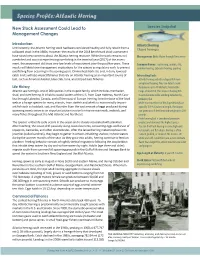
Species Profile: Atlantic Herring New Stock Assessment Could Lead to Species Snapshot Management Changes Introduction Atlantic Herring Until recently, the Atlantic herring stock had been considered healthy and fully rebuilt from a Clupea harengus collapsed stock in the 1980s. However, the results of the 2018 benchmark stock assessment have raised new concerns about the Atlantic herring resource. While the stock remains not Management Unit: Maine through New Jersey overfished and was not experiencing overfishing in the terminal year (2017) of the assess- ment, the assessment did show very low levels of recruitment over the past five years. These Common Names: Sea herring, sardine, sild, results will likely have management implications for the species as regulators work to prevent common herring, Labrador herring, sperling overfishing from occurring in the coming years. Diminished stock size and, in turn, lowered catch limits will also impact fisheries that rely on Atlantic herring as an important source of Interesting Facts: bait, such as American lobster, blue crab, tuna, and striped bass fisheries. • Atlantic herring and other clupeid fish have exceptional hearing. They can detect sound Life History frequencies up to 40 kilohertz, beyond the Atlantic sea herring is one of 200 species in the clupeid family, which includes menhaden, range of most fish. This allows schooling fish shad, and river herring. It inhabits coastal waters of the U.S. from Cape Hatteras, North Caro- to communicate while avoiding detection by lina through Labrador, Canada, and off the coast of Europe. Herring form the base of the food predatory fish. web as a forage species for many animals, from starfish and whelk to economically import- • While most members of the clupeid family are ant fish such as haddock, cod, and flounder. -
33 Abstract Dna Barcoding, Phylogenetic Diversity
DNA BARCODING, PHYLOGENETIC DIVERSITY STUDIES OF ETROPLUS SURATENSIS FISH FROM POORANANKUPPAM BRACKISH WATER, PUDUCHERRY Sachithanandam V.1, Mohan P.M.1, Muruganandam N.2, Chaaithanya I.K.2, Arun Kumar P3, Siva Sankar R3 1 ijcrr Department of Ocean Studies and Marine Biology, Pondicherry University, Vol 04 issue 08 Andaman 2Regional Medical Research Centre (ICMR), Andaman Category: Research 3Department of Ecology and Environmental Sciences, Pondicherry University, Received on:29/01/12 Puducherry Revised on:16/02/12 E-mail of Corresponding Author: pmmtu@yahoo.com Accepted on:03/03/12 ABSTRACT Etroplus suratensis is known for the high commercial value fish available in South India. The identification of the species of this fish cumbersome and inaccurate in different life stages of the fish. Therefore, DNA sequence of cytochrome Oxidase subunit I gene was analysed for the species identification and phylogenetic relationship of the species. The average genetic distance of conspecifics species value was found to be 0.005%. The present work suggests that COI sequence provides sufficient information on phylogenetic and evolutionary relationship to distinguish the Etroplus suratensis species, the brackish waters species of pearl spots, unambiguously. Further, this work revealed that every species having individual genetic distances depended upon the environmental stress and water quality, which play an important role for its minor morphometric variations. Therefore, it was concluded that a DNA COI barcoding tool can be used for fish identification by non technical personnel (other than taxonomist). ____________________________________________________________________________________ Keywords: DNA barcoding, COI, brackish of more than US$ 3/kg2. These fish is available water, Pooranankuppam and Etroplus suratensis throughout the year. -

Information on the NCWRC's Scientific Council of Fishes Rare
A Summary of the 2010 Reevaluation of Status Listings for Jeopardized Freshwater Fishes in North Carolina Submitted by Bryn H. Tracy North Carolina Division of Water Resources North Carolina Department of Environment and Natural Resources Raleigh, NC On behalf of the NCWRC’s Scientific Council of Fishes November 01, 2014 Bigeye Jumprock, Scartomyzon (Moxostoma) ariommum, State Threatened Photograph by Noel Burkhead and Robert Jenkins, courtesy of the Virginia Division of Game and Inland Fisheries and the Southeastern Fishes Council (http://www.sefishescouncil.org/). Table of Contents Page Introduction......................................................................................................................................... 3 2010 Reevaluation of Status Listings for Jeopardized Freshwater Fishes In North Carolina ........... 4 Summaries from the 2010 Reevaluation of Status Listings for Jeopardized Freshwater Fishes in North Carolina .......................................................................................................................... 12 Recent Activities of NCWRC’s Scientific Council of Fishes .................................................. 13 North Carolina’s Imperiled Fish Fauna, Part I, Ohio Lamprey .............................................. 14 North Carolina’s Imperiled Fish Fauna, Part II, “Atlantic” Highfin Carpsucker ...................... 17 North Carolina’s Imperiled Fish Fauna, Part III, Tennessee Darter ...................................... 20 North Carolina’s Imperiled Fish Fauna, Part -

Two New Species of the Genus Xenotoca Hubbs and Turner, 1939 (Teleostei, Goodeidae) from Central-Western Mexico
Zootaxa 4189 (1): 081–098 ISSN 1175-5326 (print edition) http://www.mapress.com/j/zt/ Article ZOOTAXA Copyright © 2016 Magnolia Press ISSN 1175-5334 (online edition) http://doi.org/10.11646/zootaxa.4189.1.3 http://zoobank.org/urn:lsid:zoobank.org:pub:9BF8660A-4817-4EEA-853F-5856D1B8F6FA Two new species of the genus Xenotoca Hubbs and Turner, 1939 (Teleostei, Goodeidae) from central-western Mexico OMAR DOMÍNGUEZ-DOMÍNGUEZ1,3, DULCE MARÍA BERNAL-ZUÑIGA1 & KYLE R. PILLER2 1Laboratorio de Biología Acuática, Facultad de Biología, Universidad Michoacana de San Nicolás de Hidalgo, Edificio “R” planta baja, Ciudad Universitaria, Morelia, Michoacán, México 2Department of Biological Sciences, Southeastern Louisiana University, Hammond, LA, 70402, USA 3Corresponding author. E-mail: goodeido@yahoo.com.mx Abstract The subfamily Goodeinae (Goodeidae) is one of the most representative and well-studied group of fishes from central Mexico, with around 18 genera and 40 species. Recent phylogenetic studies have documented a high degree of genetic diversity and divergences among populations, suggesting that the diversity of the group may be underestimated. The spe- cies Xenotoca eiseni has had several taxonomic changes since its description. Xenotoca eiseni is considered a widespread species along the Central Pacific Coastal drainages of Mexico, inhabiting six independent drainages. Recent molecular phylogenetic studies suggest that X. eiseni is a species complex, represented by at least three independent evolutionary lineages. We carried out a meristic and morphometric study in order to evaluate the morphological differences among these genetically divergent populations and describe two new species. The new species of goodeines, Xenotoca doadrioi and X. lyonsi, are described from the Etzatlan endorheic drainage and upper Coahuayana basin respectively. -

Endangered Species
FEATURE: ENDANGERED SPECIES Conservation Status of Imperiled North American Freshwater and Diadromous Fishes ABSTRACT: This is the third compilation of imperiled (i.e., endangered, threatened, vulnerable) plus extinct freshwater and diadromous fishes of North America prepared by the American Fisheries Society’s Endangered Species Committee. Since the last revision in 1989, imperilment of inland fishes has increased substantially. This list includes 700 extant taxa representing 133 genera and 36 families, a 92% increase over the 364 listed in 1989. The increase reflects the addition of distinct populations, previously non-imperiled fishes, and recently described or discovered taxa. Approximately 39% of described fish species of the continent are imperiled. There are 230 vulnerable, 190 threatened, and 280 endangered extant taxa, and 61 taxa presumed extinct or extirpated from nature. Of those that were imperiled in 1989, most (89%) are the same or worse in conservation status; only 6% have improved in status, and 5% were delisted for various reasons. Habitat degradation and nonindigenous species are the main threats to at-risk fishes, many of which are restricted to small ranges. Documenting the diversity and status of rare fishes is a critical step in identifying and implementing appropriate actions necessary for their protection and management. Howard L. Jelks, Frank McCormick, Stephen J. Walsh, Joseph S. Nelson, Noel M. Burkhead, Steven P. Platania, Salvador Contreras-Balderas, Brady A. Porter, Edmundo Díaz-Pardo, Claude B. Renaud, Dean A. Hendrickson, Juan Jacobo Schmitter-Soto, John Lyons, Eric B. Taylor, and Nicholas E. Mandrak, Melvin L. Warren, Jr. Jelks, Walsh, and Burkhead are research McCormick is a biologist with the biologists with the U.S. -

Updated Checklist of Marine Fishes (Chordata: Craniata) from Portugal and the Proposed Extension of the Portuguese Continental Shelf
European Journal of Taxonomy 73: 1-73 ISSN 2118-9773 http://dx.doi.org/10.5852/ejt.2014.73 www.europeanjournaloftaxonomy.eu 2014 · Carneiro M. et al. This work is licensed under a Creative Commons Attribution 3.0 License. Monograph urn:lsid:zoobank.org:pub:9A5F217D-8E7B-448A-9CAB-2CCC9CC6F857 Updated checklist of marine fishes (Chordata: Craniata) from Portugal and the proposed extension of the Portuguese continental shelf Miguel CARNEIRO1,5, Rogélia MARTINS2,6, Monica LANDI*,3,7 & Filipe O. COSTA4,8 1,2 DIV-RP (Modelling and Management Fishery Resources Division), Instituto Português do Mar e da Atmosfera, Av. Brasilia 1449-006 Lisboa, Portugal. E-mail: mcarneiro@ipma.pt, rmartins@ipma.pt 3,4 CBMA (Centre of Molecular and Environmental Biology), Department of Biology, University of Minho, Campus de Gualtar, 4710-057 Braga, Portugal. E-mail: mlandi@bio.uminho.pt, fcosta@bio.uminho.pt * corresponding author: mlandi@bio.uminho.pt 5 urn:lsid:zoobank.org:author:90A98A50-327E-4648-9DCE-75709C7A2472 6 urn:lsid:zoobank.org:author:1EB6DE00-9E91-407C-B7C4-34F31F29FD88 7 urn:lsid:zoobank.org:author:6D3AC760-77F2-4CFA-B5C7-665CB07F4CEB 8 urn:lsid:zoobank.org:author:48E53CF3-71C8-403C-BECD-10B20B3C15B4 Abstract. The study of the Portuguese marine ichthyofauna has a long historical tradition, rooted back in the 18th Century. Here we present an annotated checklist of the marine fishes from Portuguese waters, including the area encompassed by the proposed extension of the Portuguese continental shelf and the Economic Exclusive Zone (EEZ). The list is based on historical literature records and taxon occurrence data obtained from natural history collections, together with new revisions and occurrences. -

Documento Completo Descargar Archivo
Publicaciones científicas del Dr. Raúl A. Ringuelet Zoogeografía y ecología de los peces de aguas continentales de la Argentina y consideraciones sobre las áreas ictiológicas de América del Sur Ecosur, 2(3): 1-122, 1975 Contribución Científica N° 52 al Instituto de Limnología Versión electrónica por: Catalina Julia Saravia (CIC) Instituto de Limnología “Dr. Raúl A. Ringuelet” Enero de 2004 1 Zoogeografía y ecología de los peces de aguas continentales de la Argentina y consideraciones sobre las áreas ictiológicas de América del Sur RAÚL A. RINGUELET SUMMARY: The zoogeography and ecology of fresh water fishes from Argentina and comments on ichthyogeography of South America. This study comprises a critical review of relevant literature on the fish fauna, genocentres, means of dispersal, barriers, ecological groups, coactions, and ecological causality of distribution, including an analysis of allotopic species in the lame lake or pond, the application of indexes of diversity of severa¡ biotopes and comments on historical factors. Its wide scope allows to clarify several aspects of South American Ichthyogeography. The location of Argentina ichthyological fauna according to the above mentioned distributional scheme as well as its relation with the most important hydrography systems are also provided, followed by additional information on its distribution in the Argentine Republic, including an analysis through the application of Simpson's similitude test in several localities. SINOPSIS I. Introducción II. Las hipótesis paleogeográficas de Hermann von Ihering III. La ictiogeografía de Carl H. Eigenmann IV. Estudios de Emiliano J. Mac Donagh sobre distribución de peces argentinos de agua dulce V. El esquema de Pozzi según el patrón hidrográfico actual VI.