Classical Greek and Roman
Total Page:16
File Type:pdf, Size:1020Kb
Load more
Recommended publications
-

The Hellenic Saga Gaia (Earth)
The Hellenic Saga Gaia (Earth) Uranus (Heaven) Oceanus = Tethys Iapetus (Titan) = Clymene Themis Atlas Menoetius Prometheus Epimetheus = Pandora Prometheus • “Prometheus made humans out of earth and water, and he also gave them fire…” (Apollodorus Library 1.7.1) • … “and scatter-brained Epimetheus from the first was a mischief to men who eat bread; for it was he who first took of Zeus the woman, the maiden whom he had formed” (Hesiod Theogony ca. 509) Prometheus and Zeus • Zeus concealed the secret of life • Trick of the meat and fat • Zeus concealed fire • Prometheus stole it and gave it to man • Freidrich H. Fuger, 1751 - 1818 • Zeus ordered the creation of Pandora • Zeus chained Prometheus to a mountain • The accounts here are many and confused Maxfield Parish Prometheus 1919 Prometheus Chained Dirck van Baburen 1594 - 1624 Prometheus Nicolas-Sébastien Adam 1705 - 1778 Frankenstein: The Modern Prometheus • Novel by Mary Shelly • First published in 1818. • The first true Science Fiction novel • Victor Frankenstein is Prometheus • As with the story of Prometheus, the novel asks about cause and effect, and about responsibility. • Is man accountable for his creations? • Is God? • Are there moral, ethical constraints on man’s creative urges? Mary Shelly • “I saw the pale student of unhallowed arts kneeling beside the thing he had put together. I saw the hideous phantasm of a man stretched out, and then, on the working of some powerful engine, show signs of life, and stir with an uneasy, half vital motion. Frightful must it be; for supremely frightful would be the effect of any human endeavour to mock the stupendous mechanism of the Creator of the world” (Introduction to the 1831 edition) Did I request thee, from my clay To mould me man? Did I solicit thee From darkness to promote me? John Milton, Paradise Lost 10. -
Handout 2008 for Dialogue 20
Dialogue 20 The hero as mirror of men’s and women’s experiences. Key word: telos ‘coming full circle, rounding out, fulfillment, completion, ending, end; successfully passing through an ordeal; ritual, rite’. To be linked with another key word, athlos (aethlos) ‘contest, ordeal; competition’; derivative word: athlētēs ‘athlete’; related concepts are agōn ‘contest, ordeal; competition’ and ponos ‘pain’ [sharp, shooting pain] and kamatos ‘pain’ [dull, aching pain]. Note the beginning of the Hippolytus. At line 32, there is a reference to a sacred space in Athens where Aphroditē epi hippolutōi ‘Our Lady of Horses Unbridled’ is worshipped; this name contains the imagery of chariot-driving. Experiences that are ingredients for coming of age, initiation, rite of passage men’s experiences: song and dance, marriage; athletics; hunting, war women’s experiences: song and dance, marriage; athletics [mostly running]; menstruation, childbirth The underlinings indicate asymmetry from a modern point of view but symmetry from an ancient point of view. A) Euripides Hippolytus 73-87: For you, goddess, I bring this woven garland, culled from a virgin meadow, where it is not fit for the shepherd to pasture his flocks, nor has iron yet come there, but unspoiled still in springtime the bees fly through this meadow. Aidōs tends it with pure river water, and those who by their nature always use moderation [sōphrosunē] in all things, instead of having learned it, they can pick flowers, but it is not lawful [themis] for the kakos. Philē mistress, for your golden locks accept this headband from my reverent hand. I alone among mortals have this privilege: I keep company with you and make conversation, hearing your voice although not seeing your face. -

Sons and Fathers in the Catalogue of Argonauts in Apollonius Argonautica 1.23-233
Sons and fathers in the catalogue of Argonauts in Apollonius Argonautica 1.23-233 ANNETTE HARDER University of Groningen m.a.harder@rug.nl 1. Generations of heroes The Argonautica of Apollonius Rhodius brings emphatically to the attention of its readers the distinction between the generation of the Argonauts and the heroes of the Trojan War in the next genera- tion. Apollonius initially highlights this emphasis in the episode of the Argonauts’ departure, when the baby Achilles is watching them, at AR 1.557-5581 σὺν καί οἱ (sc. Chiron) παράκοιτις ἐπωλένιον φορέουσα | Πηλείδην Ἀχιλῆα, φίλωι δειδίσκετο πατρί (“and with him his wife, hold- ing Peleus’ son Achilles in her arms, showed him to his dear father”)2; he does so again in 4.866-879, which describes Thetis and Achilles as a baby. Accordingly, several scholars have focused on the ways in which 1 — On this marker of the generations see also Klooster 2014, 527. 2 — All translations of Apollonius are by Race 2008. EuGeStA - n°9 - 2019 2 ANNETTE HARDER Apollonius has avoided anachronisms by carefully distinguishing between the Argonauts and the heroes of the Trojan War3. More specifically Jacqueline Klooster (2014, 521-530), in discussing the treatment of time in the Argonautica, distinguishes four periods of time to which Apollonius refers: first, the time before the Argo sailed, from the beginning of the cosmos (featured in the song of Orpheus in AR 1.496-511); second, the time of its sailing (i.e. the time of the epic’s setting); third, the past after the Argo sailed and fourth the present inhab- ited by the narrator (both hinted at by numerous allusions and aitia). -

Sophocles' Philoctetes Roisman, Hanna M Greek, Roman and Byzantine Studies; Summer 1997; 38, 2; Proquest Pg
The appropriation of a son: Sophocles' Philoctetes Roisman, Hanna M Greek, Roman and Byzantine Studies; Summer 1997; 38, 2; ProQuest pg. 127 The Appropriation of a Son: Sophocles' Philoctetes Hanna M. Roisman ANHOOD in archaic and classical Greece-as in modern times-is generally manifested not so much in relation M ships with women as in relationships with other men, especially in the relationship between father and son. The Greek male is expected to produce sons who will continue his oikos (e.g. Soph. Ant. 641-45; Eur. Ale. 62lf, 654-57). Further, as Hesiod makes clear, sons should resemble their fathers in both looks and conduct, especially the latter (Op. 182,235; ef Ii. 6.476-81; Theophr. Char. 5.5). Such resemblance earns the father public esteem and proves his manliness; the lack of it may be cause for disparagement and calls his manliness into question. 1 We learn from Ajax and Philoctetes that Sophocles follows the Hesiodic imperative that sons should resemble their fathers in their natures and their accomplishments. Ajax sees himself as an unworthy son, having lost Achilles' arms to Odysseus, and prefers to commit suicide rather than face his father, Telamon, who took part in Heracles' expedition to Troy and got Hesione, the best part of the booty, as a reward (Aj. 430-40,462-65, 470ff, 1300-303; Diod. 4.32.5). At the same time, he expects his son, Eurysaces, to be like himself in nature, valor, and in everything else ('ttl.~' aA.A.' OIlOlO~, Aj. 545-51). Sophocles' Philoctetes, on the other hand, presents the strug gle between Odysseus and Philoctetes for the 'paternity' of Neoptolemus, as each tries to mold the young man in his own 1 Even in contemporary Greece the intense male rivalry for proving oneself takes place among men alone, while women and flocks serve as the object of this rivalry. -
© in This Web Service Cambridge University
Cambridge University Press 978-0-521-52929-7 - The Cambridge Companion to Archaic Greece Edited by H. A. Shapiro Index More information Index S Abdera, 43 agora, 46–48, 147, 204, 212, 213 Abydos, 208 Agylla/Caere, 226 Achaeans/Achaians, 48, 50, 51, 52, 57, Aiakos, 234 74, 112, 113, 118, 120, 123, 202, 207 Aigai, 51 Achaia, 49, 51, 56, 57 Aigeira, 51 Achilles, 103, 111, 112, 113, 114, 118, 119, Aigialeis, 56 120, 121, 122, 126, 268–269, 278 Aigila, 79 Acropolis. See Athens Aigimios. See Dorians Adrastus, 153 Aigina, 77 Aeaces I, tyrant of Samos, 34 Aineias Taktikos, 70 Aeaces II, son of Syloson, 34 Aischines, 50 Aeacids, 32, 34 Aisymnetes, 34 Aeantides, son of Hippocles, 30 Aitnissai. See Aeschylus Aelian, 166 Aitolia, 49, 50, 52 Aeneas, 66 Aitolians, 49, 50, 51 Aeolians, 23 Ajax, 120, 123, 268–269, 278 Aeolic dialect, 113 Akarnania, 49, 50 Aeolus, 216 Akragas, 207, 218, 220 Aeschines/Aiskhines, tyrant of Sicyon, Akrai, 207, 216 24, 243, 244 Al Mina, 203 Aeschylus, 242 Alcaeus/Alkaios of Mytilene, 16–17, 32, Aitnissai, 220 47, 67, 141, 142, 143, 147, 149–150 , Eumenides, 132 152 , 158 , 159 , 160, 162 Aethiopis. See Epic Cycle Alcidamas, poet. See Aetnans, 237 Alcinous, 113, 127 Africa, 207, 210, 211 Alcman of Sparta, 6, 94–95, 147 agalmata, 241 Alcmeonids/Alkmaionids, 29, 30, 31 , 33, Agamemnon, 48, 114, 119, 122–123, 247–251 125–126, 242 Alcock, Susan E., 77 Agariste, daughter of Cleisthenes, 22 Alexander the Great, 3, 6, 222 Agasicles of Halicarnassus, 232, 242, 248 Alexandros. See Paris Agasicles, tyrant of Halicarnassus, 232 Alkmaion, 233 agathoi, 48 Alkmaionides, 233–235, 237, 239, 247 agelai, 90–92, 97 Amaltheia, 236 agoge, 90 Amasis, pharaoh, 247 agonal warfare, 76–77 Ampheia, 77, 78 287 © in this web service Cambridge University Press www.cambridge.org Cambridge University Press 978-0-521-52929-7 - The Cambridge Companion to Archaic Greece Edited by H. -

BOZZETTO STYLE” the Renaissance Sculptor’S Handiwork*
“BOZZETTO STYLE” The Renaissance Sculptor’s Handiwork* Irving Lavin Institute for Advanced Study, Princeton NJ It takes most people much time and effort to become proficient at manipulating the tools of visual creation. But to execute in advance sketches, studies, plans for a work of art is not a necessary and inevitable part of the creative process. There is no evidence for such activity in the often astonishingly expert and sophisticated works of Paleolithic art, where images may be placed beside or on top of one another apparently at random, but certainly not as corrections, cancellations, or “improved” replacements. Although I am not aware of any general study of the subject, I venture to say that periods in which preliminary experimentation and planning were practiced were relatively rare in the history of art. While skillful execution requires prior practice and expertise, the creative act itself, springing from a more or less unselfconscious cultural and professional memory, might be quite autonomous and unpremeditated. A first affirmation of this hypothesis in the modern literature of art history occurred more than a century-and-a-half ago when one of the great French founding fathers of modern art history (especially the discipline of iconography), Adolphe Napoléon Didron, made a discovery that can be described, almost literally, as monumental. In the introduction to his publication — the first Greek-Byzantine treatise on painting, which he dedicated to his friend and enthusiastic fellow- medievalist, Victor Hugo — Didron gave a dramatic account of a moment of intellectual illumination that occurred during a pioneering exploratory visit to Greece in August and September 1839 for the purpose of studying the medieval fresco and mosaic decorations of the Byzantine churches.1 He had, he says, wondered at the uniformity and continuity of the Greek * This contribution is a much revised and expanded version of my original, brief sketch of the history of sculptors’ models, Irving Lavin, “Bozzetti and Modelli. -

On April 20Th, Dr. Anja Slaw
“How fast does a city recover from destruction? A new view of the creation of the Severe Style” On April 20th, Dr. Anja Slawisch, a research fellow at University of Cambridge, presented her careful reconsideration of the transition from Archaic period to Classical period in art, especially in sculpture. I will first give some historical background and conventional understanding of this transition, and then elaborate on her argument. Conventionally, the sack of Athens during the Persian War in 480 BCE spurred the artistic development from austere Archaic style (see statues of Kleobis and Biton below1) to the Severe Style (see Harmodius and Aristogeiton, the tyrannicides2), and hence marks the transition from Archaic period into Classical period in art. The most important feature that sets severe style apart from the Archaic is a more naturalistic depiction of the human anatomy. For statues of the tyrannicides, the human bodies were made as an organic system - their pelves shift according to their stances, as opposed to the awkward posture of Kleobis and Biton. In this widely-accepted narrative, the destruction of Athens, heavily influencing the psyche of Athenians, stimulated these stark changes and inventions in artistic style. As a consequence, 480 BCE became a reference point for archaeologists in dating these statues according to their features. Statues of Kleobis and Biton Harmodius and Aristogeiton 1 Statues of Kleobis and Biton (identified by inscriptions on the base) dedicated to Delphi by the city of Argos, signed by [Poly?]medes of Argos. Marble, ca. 580 BC. H. 1.97 m (6 ft. 5 ½ in.), after restoration. -

Greek Culture
HUMANITIES INSTITUTE GREEK CULTURE Course Description Greek Culture explores the culture of ancient Greece, with an emphasis on art, economics, political science, social customs, community organization, religion, and philosophy. About the Professor This course was developed by Frederick Will, Ph.D., professor emeritus from the University of Iowa. © 2015 by Humanities Institute Course Contents Week 1 Introduction TEMPLES AND THEIR ART Week 2 The Greek Temple Week 3 Greek Sculpture Week 4 Greek Pottery THE GREEK STATE Week 5 The Polis Week 6 Participation in the Polis Week 7 Economy and Society in the Polis PRIVATE LIFE Week 8 At the Dinner Table Week 9 Sex and Marriage Week 10 Clothing CAREERS AND TRAINING Week 11 Farmers and Athletes Week 12 Paideia RELIGION Week 13 The Olympian Gods Week 14 Worship of the Gods Week 15 Religious Scepticism and Criticism OVERVIEW OF GREEK CULTURE Week 16 Overview of Greek Culture Selected collateral readings Week 1 Introduction Greek culture. There is Greek literature, which is the fine art of Greek culture in language. There is Greek history, which is the study of the development of the Greek political and social world through time. Squeezed in between them, marked by each of its neighbors, is Greek culture, an expression, and little more, to indicate ‘the way a people lived,’ their life- style. As you will see, in the following syllabus, the ‘manner of life’ can indeed include the ‘products of the finer arts’—literature, philosophy, by which a people orients itself in its larger meanings—and the ‘manner of life’ can also be understood in terms of the chronological history of a people; but on the whole, and for our purposes here, ‘manner of life’ will tend to mean the way a people builds a society, arranges its eating and drinking habits, builds its places of worship, dispenses its value and ownership codes in terms of an economy, and arranges the ceremonies of marriage burial and social initiation. -
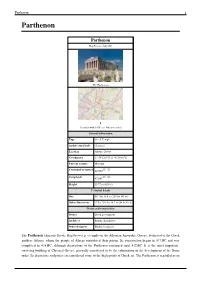
Parthenon 1 Parthenon
Parthenon 1 Parthenon Parthenon Παρθενών (Greek) The Parthenon Location within Greece Athens central General information Type Greek Temple Architectural style Classical Location Athens, Greece Coordinates 37°58′12.9″N 23°43′20.89″E Current tenants Museum [1] [2] Construction started 447 BC [1] [2] Completed 432 BC Height 13.72 m (45.0 ft) Technical details Size 69.5 by 30.9 m (228 by 101 ft) Other dimensions Cella: 29.8 by 19.2 m (98 by 63 ft) Design and construction Owner Greek government Architect Iktinos, Kallikrates Other designers Phidias (sculptor) The Parthenon (Ancient Greek: Παρθενών) is a temple on the Athenian Acropolis, Greece, dedicated to the Greek goddess Athena, whom the people of Athens considered their patron. Its construction began in 447 BC and was completed in 438 BC, although decorations of the Parthenon continued until 432 BC. It is the most important surviving building of Classical Greece, generally considered to be the culmination of the development of the Doric order. Its decorative sculptures are considered some of the high points of Greek art. The Parthenon is regarded as an Parthenon 2 enduring symbol of Ancient Greece and of Athenian democracy and one of the world's greatest cultural monuments. The Greek Ministry of Culture is currently carrying out a program of selective restoration and reconstruction to ensure the stability of the partially ruined structure.[3] The Parthenon itself replaced an older temple of Athena, which historians call the Pre-Parthenon or Older Parthenon, that was destroyed in the Persian invasion of 480 BC. Like most Greek temples, the Parthenon was used as a treasury. -

Ancient Greek Painting and Mosaics in Macedonia
ANCIENT GREEK PAINTING AND MOSAICS IN MACEDONIA All the manuals of Greek Art state that ancient Greek paintinG has been destroyed almost completely. Philological testimony, on the other hand, how ever rich, does no more than confirm the great loss. Vase painting affirms how skilful were the artisans in their drawings although it cannot replace the lost large paintinG compositions. Later wall-paintings of Roman towns such as Pompeii or Herculaneum testifying undoubted Greek or Hellenistic influ ence, enable us to have a glimpse of what the art of paintinG had achieved in Greece. Nevertheless, such paintings are chronologically too far removed from their probable Greek models for any accurate assessment to be made about the degree of dependence or the difference in quality they may have had between them. Archaeological investigation, undaunted, persists in revealing methodi cally more and more monuments that throw light into previously dark areas of the ancient world. Macedonia has always been a glorious name in later Greek history, illumined by the amazing brilliance of Alexander the Great. Yet knowledge was scarce about life in Macedonian towns where had reigned the ancestors and the descendants of that unique king, and so was life in many other Greek towns situated on the shores of the northern Aegean Sea. It is not many years ago, since systematic investigation began in these areas and we are still at the initial stage; but results are already very important, es pecially as they give the hope that we shall soon be able to reveal unknown folds of the Greek world in a district which has always been prominent in the his torical process of Hellenism. -

Influence of Science on Ancient Greek Sculptures
www.idosr.org Ahmed ©IDOSR PUBLICATIONS International Digital Organization for Scientific Research ISSN: 2579-0765 IDOSR JOURNAL OF CURRENT ISSUES IN SOCIAL SCIENCES 6(1): 45-49, 2020. Influence of Science on Ancient Greek Sculptures Ahmed Wahid Yusuf Department of Museum Studies, Menoufia University, Egypt. ABSTRACT The Greeks made major contributions to math and science. We owe our basic ideas about geometry and the concept of mathematical proofs to ancient Greek mathematicians such as Pythagoras, Euclid, and Archimedes. Some of the first astronomical models were developed by Ancient Greeks trying to describe planetary movement, the Earth’s axis, and the heliocentric system a model that places the Sun at the center of the solar system. The sculpture of ancient Greece is the main surviving type of fine ancient Greek art as, with the exception of painted ancient Greek pottery, almost no ancient Greek painting survives. The research further shows the influence science has in the ancient Greek sculptures. Keywords: Greek, Sculpture, Astronomers, Pottery. INTRODUCTION The sculpture of ancient Greece is the of the key points of Ancient Greek main surviving type of fine ancient Greek philosophy was the role of reason and art as, with the exception of painted inquiry. It emphasized logic and ancient Greek pottery, almost no ancient championed the idea of impartial, rational Greek painting survives. Modern observation of the natural world. scholarship identifies three major stages The Greeks made major contributions to in monumental sculpture in bronze and math and science. We owe our basic ideas stone: the Archaic (from about 650 to 480 about geometry and the concept of BC), Classical (480-323) and Hellenistic mathematical proofs to ancient Greek [1]. -

Epigraphic Bulletin for Greek Religion 2011 (EBGR 2011)
Kernos Revue internationale et pluridisciplinaire de religion grecque antique 27 | 2014 Varia Epigraphic Bulletin for Greek Religion 2011 (EBGR 2011) Angelos Chaniotis Electronic version URL: http://journals.openedition.org/kernos/2266 DOI: 10.4000/kernos.2266 ISSN: 2034-7871 Publisher Centre international d'étude de la religion grecque antique Printed version Date of publication: 1 November 2014 Number of pages: 321-378 ISBN: 978-2-87562-055-2 ISSN: 0776-3824 Electronic reference Angelos Chaniotis, « Epigraphic Bulletin for Greek Religion 2011 (EBGR 2011) », Kernos [Online], 27 | 2014, Online since 01 October 2016, connection on 15 September 2020. URL : http:// journals.openedition.org/kernos/2266 This text was automatically generated on 15 September 2020. Kernos Epigraphic Bulletin for Greek Religion 2011 (EBGR 2011) 1 Epigraphic Bulletin for Greek Religion 2011 (EBGR 2011) Angelos Chaniotis 1 The 24th issue of the Epigraphic Bulletin for Greek Religion presents epigraphic publications of 2011 and additions to earlier issues (publications of 2006–2010). Publications that could not be considered here, for reasons of space, will be presented in EBGR 2012. They include two of the most important books of 2011: N. PAPAZARKADAS’ Sacred and Public Land in Ancient Athens, Oxford 2011 and H.S. VERSNEL’s Coping with the Gods: Wayward Readings in Greek Theology, Leiden 2011. 2 A series of new important corpora is included in this issue. Two new IG volumes present the inscriptions of Eastern Lokris (119) and the first part of the inscriptions of Kos (21); the latter corpus is of great significance for the study of Greek religion, as it contains a large number of cult regulations; among the new texts, we single out the ‘sacred law of the tribe of the Elpanoridai’ in Halasarna.