LAS VEGAS Planet Hollywood Resort & Casino
Total Page:16
File Type:pdf, Size:1020Kb
Load more
Recommended publications
-

SANTA FE May 29 - June 2, 2019
The National Conference on Welcome to the Land of Enchantment! Wilderness Medicine SANTA FE May 29 - June 2, 2019 “Medicine and the Spirit of Adventure” Wilderness & Travel Medicine Worldwide Active CME Adventures See brochure inside for Adventure Travel CME ADVENTURE TRAVEL CME DESTINATIONS! 2019-2020 schedule WELCOME TO SANTA FE anta Fe is unlike any other destination in the country, and in Sfact, is nicknamed “The City Different.” There is a colorful, international-style charm about Santa Fe that has attracted people for over 400 years. It is the oldest capital city in the United States and is unique in the blending of Native American, Hispanic, and Anglo cultures. The center of town is the Plaza, a tree-lined park surrounded by shops and historic churches, much like in traditional European cities. SETTING/CLIMATE – Santa Fe is a place of enchanting beauty, set at 7,000 feet in the Rocky Mountain foothills. It has indescribable blue skies and boasts over 300 days of sunshine each year. As you experience its pure light, and feel its positive energy, you’ll understand why this city has attracted so many artists over the years and become an international art center. Daytime temperatures range from 70-80ºF. ART/FOOD/CULTURE – Despite its small population of 80,000 residents, Santa Fe overflows with world-renowned cuisine, art, and culture. Stroll the adobe-lined streets that feature over 250 art galleries, countless restaurants, and noted music, theater, and dance performances. Santa Fe is a city of museums including The Georgia O’Keeffe Museum, The International Folk Art Museum, and several that focus on indigenous history and culture. -
FIRST AID CERTIFICATIONS * for NYS Children’S Camp Staff Fact Sheet – February 2010 (Go to to View Most Current Certification List)
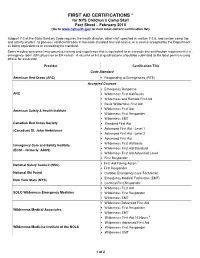
FIRST AID CERTIFICATIONS * for NYS Children’s Camp Staff Fact Sheet – February 2010 (Go to www.nyhealth.gov to view most current certification list) Subpart 7-2 of the State Sanitary Code requires the health director, other staff specified in section 7-2.8, and certain camp trip and activity leaders1 to possess valid certification in the code standard first aid course, or a course accepted by the Department as being equivalent to or exceeding the standard. Some medical personnel may possess training and experience that is equivalent to or exceeds this certification requirement (i.e., emergency room (ER) physician or ER nurse). A résumé or list of qualifications should be submitted to the local permit-issuing official for evaluation. Provider Certification Title Code Standard American Red Cross (ARC) • Responding to Emergencies (RTE) Accepted Courses • Emergency Response ARC • Wilderness First Aid Basics • Wilderness and Remote First Aid • Basic Wilderness First Aid • Wilderness First Aid American Safety & Health Institute • Wilderness First Responder • Wilderness EMT Canadian Red Cross Society • Standard First Aid • Advanced First Aid - Level 1 (Canadian) St. John Ambulance • Advanced First Aid - Level 2 • Advanced First Aid • Wilderness First Aid Basic Emergency Care and Safety Institute • Wilderness First Aid Standard (ECSI – formerly AAOS) • Wilderness First Aid Advanced Level • First Responder • First Aid Taking Action 2 National Safety Council (NSC) • First Responder National Ski Patrol • Outdoor Emergency Care Technician • Emergency -

Wilderness Medicine
Wilderness Medicine Howard Backer MD, MPH, FACEP, FAEMS, FAWM Director, California Emergency Medical Services Authority Past-president, Wilderness Medical Society Medical Advisor, Mountain Travel Sobek Objectives • Define and explain the field of wilderness medicine • Review some common risks of wilderness travel and field interventions for them • Discuss differences and overlap between Wilderness Medicine and EMS What is Wilderness Medicine? • Medicine in remote environments • Limited medical resources requiring improvisation Content includes • Problems caused by the environment • Dangerous fauna and flora – envenomation and toxicology, infectious diseases • Survival and wilderness search and rescue – prolonged operations and need for expanded scope Survival Wilderness Medicine Travel Medicine Military Medicine Medicine Sports Medicine Emergency Medicine and EMS Wilderness Events • Extreme event medicine: Any sporting event in a challenging environment that exceeds the capacity of local EMS systems either in transport time to definitive care or skills and equipment required for expedient extrication. • Wilderness event medicine: the healthcare response at any discrete event with more than 200 persons located more than 1 h from hospital • Injury/illness rates 1-10 per 1000 person-days of exposure – one order of magnitude greater for events that last many days or include extremes of environment (heat, altitude) Laskowski-Jones L, et al. Emerg Med J 2017;34:680–685 Adventure/Expedition Racing Teams of four M/F must stay together Multiple stages with different sports Hundreds of kilometers No marked route, only check stations Heat Illness 4 Desert Race Series 250 miles over 7 days • Increases heart rate • Decreases cardiac output • Decreases sweating • Reduces skin blood flow • Increases perceived exertion • Degrades aerobic performance Kenefick, RW • Reduces maximal U.S. -

Emresident Board of Directors
EMRA’s 4th The infamously EMRA EMRA’s newest Annual Photo difficult auricular schedule books and Contest Winners compression of events apps – get bandage yours today! EDITOR’S FORUM GUEST FEATURE SCIENTIFIC ASSEMBLY EMRA PUBLICATIONS Page 8 Page 24 Page 40 Page 53 October/November 2012 VOLUME 39, issue 5 EMThe Official Publication of the EmergencyResident Medicine Residents’ Association An emerging academic subspecialty of global importance Renee N. Salas, MD, MS, EMRA Wilderness Medicine Committee Co-Chair, University of Cincinnati, Cincinnati, OH “The wilderness holds answers to the deep sea to space. This obliges all questions man has not yet learned to ask.” emergency physicians to have a better - Nancy Newhall understanding of this subspecialty, which has, in turn, become a goal of the newly ilderness medicine is a well- created EMRA Wilderness Medicine Westablished and growing Committee. subspecialty in emergency medicine, “The scope and yet its existence, scope of practice, and Wilderness medicine is often defined as applicability [of wilderness applicability remain poorly understood the practice of medicine in an austere environment with limited resources, or in medicine] ... continue to to those outside the field. Many envision that wilderness medicine physicians an environment in which definitive care is expand as humans reach concentrate on those environmental greater than two hours away. However, in further into all corners of emergencies that all emergency physicians many ways, its practice actually is a return the world, from the deep must know (Table 1). And while this is to the roots of the medical profession. Beginning in the 1970s, editorials in sea to space.” indeed part of the foundation of wilderness medicine, the spectrum now is much more prominent journals (i.e., JAMA and expansive. -
Spine Immobilization in the Austere Environment: 2014 Update
WILDERNESS & ENVIRONMENTAL MEDICINE, 25, S105–S117 (2014) WILDERNESS MEDICAL SOCIETY PRACTICE GUIDELINES Wilderness Medical Society Practice Guidelines for Spine Immobilization in the Austere Environment: 2014 Update Robert H. Quinn, MD; Jason Williams, BS; Brad L. Bennett, PhD; Gregory Stiller, MD; Arthur A. Islas, MD; Seth McCord, MD From the Department of Orthopaedic Surgery, University of Texas Health Sciences Center, San Antonio, TX (Dr Quinn); the EMS Academy, University of New Mexico, Albuquerque, NM (Mr Williams); the Military and Emergency Medicine Department, Uniformed Services University of the Health Sciences, Bethesda, MD (Dr Bennett); the Department of Emergency Medicine, Sky Ridge Medical Center, Lone Tree, CO (Dr Stiller); the Department of Family and Community Medicine, Texas Tech Health Science Center, El Paso, TX (Dr Islas); and the Department of Orthopaedic Surgery, University of New Mexico, Albuquerque, NM (Dr McCord). In an effort to produce best practice guidelines for spine immobilization in the austere environment, the Wilderness Medical Society convened an expert panel charged with the development of evidence-based guidelines for management of the injured or potentially injured spine in an austere (dangerous or compromised) environment. Recommendations are made regarding several parameters related to spinal immobilization. These recommendations are graded on the basis of the quality of supporting evidence and balance between the benefits and risks or burdens for each parameter according to the methodology stipulated by the American College of Chest Physicians. A treatment algorithm based on the guidelines is presented. This is an updated version of original WMS Practice Guidelines for Spine Immobilization in the Austere Environment published in Wilderness & Environmental Medicine 2013;24(3):241–252. -

Core Content for Wilderness Medicine Training: Development of a Wilderness Medicine Track Within an Emergency Medicine Residency
Core Content for Wilderness Medicine Training: Development of a Wilderness Medicine Track within an Emergency Medicine Residency Jonathan Drew, MD, Indiana University Department of Emergency Medicine Residency Training Program Nicole Battaglioli, MD, WellSpan York Hospital Emergency Medicine Residency Training Program Walter A Schrading, MD, FACEP Department of Emergency Medicine, University of Alabama at Birmingham The Wilderness Medicine Residency Curriculum Subcommittee, Wilderness Medicine Section, American College of Emergency Medicine Introduction Wilderness medicine is the practice of medicine in environments with limited resources, particularly under austere conditions. Such conditions particularly occur in wilderness environments, but may also occur in areas where disaster has caused limitation of medical resources, as well as the practice of medicine in less developed countries. It is a study of the physiology and pathophysiology that occurs when humans encounter such environments. A large component of the field is concerned with preventative care and preparation for activities in these environments. Practical components for practitioners are the ability to assess, stabilize and evacuate an ill or injured person from the austere environment, while ensuring the safety of all rescuers. “Wilderness medicine shares many of the qualities and characteristics inherent to emergency medicine (EM). These include a large breadth of knowledge and improvisational skills, the ability to provide emergent interventions and stabilization, and proficiency in teamwork, often integrating personnel from varied health care backgrounds. What differentiates wilderness medicine from other disciplines is that application of the skills and knowledge base often occurs in locations where traditional medical infrastructure is limited or absent”(1). There has been a growing need and interest in the field since the publications of the first edition of Paul Auerbach's Wilderness Medicine and the formation of the Wilderness Medical Society (WMS) in 1983. -
Wilderness First Responder Course
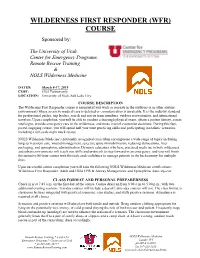
WILDERNESS FIRST RESPONDER (WFR) COURSE Sponsored by: The University of Utah, Center for Emergency Programs, Remote Rescue Training & NOLS Wilderness Medicine DATES: March 8-17, 2019 COST: $765 Tuition only LOCATION: University of Utah, Salt Lake City COURSE DESCRIPTION The Wilderness First Responder course is essential if you work or recreate in the outdoors or in other austere environments where access to medical care is delayed or communication is unreliable. It is the industry standard for professional guides, trip leaders, search and rescue team members, outdoor recreationists, and international travelers. Upon completion, you will be able to conduct a thorough physical exam, obtain a patient history, assess vital signs, provide emergency care in the wilderness, and make crucial evacuation decisions. During this fast- paced, engaging course, you will spend half your time practicing skills and participating in realistic scenarios, including a full-scale night mock rescue. NOLS Wilderness Medicine’s nationally recognized curriculum encompasses a wide range of topics including long-term patient care, wound management, selective spine immobilization, reducing dislocations, litter packaging, and epinephrine administration. Dynamic educators who have practiced medicine in both wilderness and urban environments will teach you skills and protocols to step forward in an emergency, and you will finish the intensive 80-hour course with the tools and confidence to manage patients in the backcountry for multiple days. Upon successful course completion you will earn the following NOLS Wilderness Medicine certifications: Wilderness First Responder, Adult and Child CPR & Airway Management, and Epinephrine Auto-injector. CLASS FORMAT AND PERSONAL PREPAREDNESS Check in is at 7:45 a.m. -

Wilderness First Responder
WILDERNESS FIRST RESPONDER Objectives and Outline GOAL: Our Wilderness First Responder course is designed with the outdoor professional and outdoor enthusiast in mind. It focuses on developing skills for treating problems outside the “golden hour” of first response, under extreme conditions or forced to improvise. It is based on the protocols set by the Wilderness Medical Society and instruction encourages the students ability to think through body systems in an effort to determine the best response to traumatic, environmental or medical situations. Classroom sessions are followed with hands on practice to integrate the information in a field setting. 100% attendance is required and there will be a night scenario included. Students will get to see their skills in action as video coverage of intensive scenarios will be reviewed towards the end of the class. A comprehensive written exam is also administered. The course includes AEHS/ OSHA approved adult, child and infant CPR certification. YOUR INSTRUCTORS: Sierra Rescue is committed to providing quality rescue instruction based on integrating information into practical skills while developing the ability to think through complicated wilderness and rescue problems. We integrate knowledge into practical field exercises that work on developing judgment as well as providing hands on training. OUR EXPERTISE Sierra Rescue was founded in order to offer quality professional courses for a multitude of individuals. We specialize in designing the best rescue course for each group’s specific needs. We are flexible with our curriculums and love the challenge of creating a course that is perfect for the environment and activities that you do. Sierra Rescue offers you the skills and the certification that you and your organization need. -
The Assessment and Management of Spine and Spinal Cord Injuries in the Field
This document may not be reproduced without the consent of the author. WRMC 2017 The Assessment & Management of Spine & Spinal Cord Injuries in the Field: Where We Started, Where We are Now, & Why ine edic Tra M in s in s g Paul Nicolazzo e n C r e e n d l t i e Director r W WMTC Wilderness Medicine Training Center International In l ternationa paul@wildmedcenter.com This document may not be reproduced without the consent of the author. WRMC 2017 Brief History of Prehospital Spine Management ✦ 1966 ~ Depart of Transportation (DOT) established due to high number of traffic deaths. ✦ 1972 ~ First Physician residency in Emergency Medicine (25 by 1975). • Minimal pre-hospital spinal immobilization prior to 1973; no nationally accepted criteria or EMS system. ✦ 1973 ~ EMS Act provided funding for 300+ national EMS systems and supplied a national curriculum, including spine immobilization. • Stabilize patient’s spine—prevent movement—during Basic Life Support (BLS) until the mechanism of injury (MOI) was established. • If the MOI was major trauma or unknown, the patient’s spine was fully immobilized based on the premise that movement of an unstable spine injury will result in a spinal cord injury and that external spinal immobilization will prevent that movement and full immobilization was not harmful. ✦ 1983 ~ Wilderness Medical Society (WMS) founded ✦ 1984 ~ National Association of EMS Physicians (NAEMSP) founded This document may not be reproduced without the consent of the author. WRMC 2017 ✦ 1984 ~ First formal WFR class taught; NOLS, WMA, SOLO, & WMS had their own FSA predating NEXUS (2000), CCR (2001), New Hampshire State Protocols, (Hubbell 1993), NEMSP (Goth 1993), State of ME (1990) & WMS (2013). -

Dr. Zubin Damania, MD Cyber Events for July
NH-ISAC Monthly Newsletter –TLP White July 2017 Announcing our Keynote Speaker for our Fall Summit! Top 10 Health Related Dr. Zubin Damania, MD Cyber Events for July: You may not know the name of one of the most talented and Fancy Bear Hackers Steal, Dump innovative forces in healthcare but there is a high probability Photos of Cosmetic Surgery Clinic that you have seen one of his video parodies about health. Patients This is because Zubin Damania, M.D., goes under the alias, ZDogg MD. HHS Targeting Outdated Regs In Dr. Zubin Damania, MD, is an internist and the founder of Wake of Damning Cybersecurity Turntable Health, an innovative healthcare startup that was Report, WannaCry part of an ambitious urban revitalization movement spear headed by Zappos.com CEO Tony Hsieh. During his 10-year Industroyer: Biggest threat to industrial control systems since hospitalist career at Stanford, he won clinical teaching awards while simultaneously Stuxnet maintaining a shadow career performing stand-up comedy for medical audiences worldwide. His videos and live Facebook shows, created under the pseudonym ZDoggMD, have gone HHS-OCR Cyber Quick Response epidemically viral with a quarter of a billion views on YouTube and Facebook. Checklist In Las Vegas, he implemented an innovative model of healthcare delivery that promotes FDA Plans to Address Risks of wellness at both the individual and community level. Turntable Health, a membership model Digital Health Products team-based primary care ecosystem, was a ground-up effort to get healthcare right by restoring the primacy of the human relationship, a concept they call “Health 3.0”. -
Interview with Dr. Zubin Damania (Zdoggmd)
Fixing Healthcare Episode 1 Transcript: Interview with Dr. Zubin Damania (ZDoggMD) Jeremy Corr: Hello and welcome to the inaugural episode of Fixing Healthcare with Dr. Robert Pearl and Jeremy Corr. I am one of your hosts, Jeremy Corr. I am also the host of New Books in Medicine. I have with me my co-host Doctor Robert Pearl. Robert is the former CEO of the Permanente Group, the largest physician group in the United States, responsible for caring for Kaiser Permanente members on both the East and West Coast. He is a Forbes contributor, a professor at both Stanford University School of Medicine and Business, and is the author of the best selling book "Mistreated: Why We Think We're Getting Good Healthcare-- and Why We're Usually Wrong." Robert Pearl: Hello everyone, and welcome to our monthly podcast aimed at addressing the failures of the current American healthcare system, and finding solutions to make it once again the best in the world. We are very excited to have you join us in this quest. Jeremy Corr: For 40 years our nation's political and medical leaders have talked about fixing the American healthcare system. No one has succeeded, yet. We need a hero. Our guests are the top leaders and thinkers in healthcare. Robert Pearl: The show's format is simple, a guest will have 10 minutes to present the roadmap for fixing American healthcare's biggest problems. From there, Jeremy and I will scrutinize the plan, posing questions that challenge our guests, and help our listeners separate real solutions from hype. -

The Future of Genomic Medicine IX Thursday, March 3 and Friday, March 4, 2016 • Scripps Institution of Oceanography • La Jolla, California
The Future of Genomic Medicine IX Thursday, March 3 and Friday, March 4, 2016 • Scripps Institution of Oceanography • La Jolla, California Presented in partnership with AAAS/Science Translational Medicine Course Introduction Conference Highlights • Voice of the patient represented Course Overview throughout the conference In collaboration with AAAS/Science Translational Medicine we invite you to • Renowned faculty representing the another exciting two day program on Thursday, March 3 and Friday, March country’s leading institutions • Multiple panel discussion segments 4, 2016 in beautiful San Diego, California. The 2016 program will again be with ample question and answer time with faculty held at Scripps Institution of Oceanography. • Additional networking opportunities The 9th Future of Genomic Medicine conference will be the next iteration Educational Objectives of taking genomic knowledge to transform the daily practice of medicine. After attending this activity, participants should be able to: To do this, we have patients present their story of how genomics affected • Demonstrate the unmet needs of their medical status, and have an international faculty of experts in genomics, medicine today with respect to more targeted, individualized prevention science and medical journalism, and the life science industry provide critical and treatments. perspective. This year we will be paying particular attention to the exciting • Discuss the opportunities of the genome, proteome, metabolome area of genomic editing to treat particular diseases, cancer (a disease of the discovery to change medical practice as it exists today. genome), and the genomics of rare and unknown diseases. Furthermore, we • Assess how changes and advances in will delve into to the hot topics of the microbiome, genomic-guided drug technology are rapidly ushering in a whole array of new pathways for therapies and genomic analytics.