Ii Grand Band Show News from the Countries
Total Page:16
File Type:pdf, Size:1020Kb
Load more
Recommended publications
-
The Synthesis of Jazz and Classical Styles in Three Piano Works of Nikolai Kapustin
THE SYNTHESIS OF JAZZ AND CLASSICAL STYLES IN THREE PIANO WORKS OF NIKOLAI KAPUSTIN __________________________________________________ A monograph Submitted to the Temple University Graduate Board __________________________________________________________ in Partial Fulfillment of the Requirements for the Degree of DOCTOR OF MUSICAL ARTS __________________________________________________________ by Tatiana Abramova August 2014 Examining Committee Members: Dr. Charles Abramovic, Advisory Chair, Professor of Piano Harvey Wedeen, Professor of Piano Dr. Cynthia Folio, Professor of Music Studies Richard Oatts, External Member, Professor, Artistic Director of Jazz Studies ABSTRACT The Synthesis of Jazz and Classical Styles in Three Piano Works of Nikolai Kapustin Tatiana Abramova Doctor of Musical Arts Temple University, 2014 Doctoral Advisory Committee Chair: Dr. Charles Abramovic The music of the Russian-Ukrainian composer Nikolai Kapustin is a fascinating synthesis of jazz and classical idioms. Kapustin has explored many existing traditional classical forms in conjunction with jazz. Among his works are: 20 piano sonatas, Suite in the Old Style, Op.28, preludes, etudes, variations, and six piano concerti. The most significant work in this regard is a cycle of 24 Preludes and Fugues, Op. 82, which was completed in 1997. He has also written numerous works for different instrumental ensembles and for orchestra. Well-known artists, such as Steven Osborn and Marc-Andre Hamelin have made a great contribution by recording Kapustin's music with Hyperion, one of the major recording companies. Being a brilliant pianist himself, Nikolai Kapustin has also released numerous recordings of his own music. Nikolai Kapustin was born in 1937 in Ukraine. He started his musical career as a classical pianist. In 1961 he graduated from the Moscow Conservatory, studying with the legendary pedagogue, Professor of Moscow Conservatory Alexander Goldenweiser, one of the greatest founders of the Russian piano school. -

Georgia, US Sign Agreements to Boost Economic Development
facebook.com/ georgiatoday Issue no: 908/59 • DECEMBER 27 - 29, 2016 • PUBLISHED TWICE WEEKLY PRICE: GEL 2.50 In this week’s issue... Georgian Leaders Congratulate Local Jews on Hanukkah NEWS PAGE 5 Kleptocrats Attack Ukraine’s Reform-Minded Central Banker PAGE 6 Georgian Foreign Ministry Hosts Meeting on US-Georgia FOCUS Strategic Partnership ON SKI RESORTS An unprecedented example of Public-Private-Partnership is witnessed in the opening of the new Mitarbi Ski Resort PAGE 2 PAGE 7 Christmas Concert Culminates Georgia, US Sign Agreements to Boost Economic another Year of Successful Growth at Confl ict Divide Development PAGE 8 BY THEA MORRISON Welcome to Georgia Wine Campaign he United States Agency for Inter- Kicks Off for the national Development (USAID) is to allocate USD 22 million for Holiday Season Georgia’s economic development. Georgia’s Finance Minister, Dim- PAGE 9 Titry Kumsishvili, and Director of USAID’s Cau- casus Mission, Douglas Ball, signed three agree- ments to that effect on Thursday. Bryza: Russia Will Use the Changes were made to previously signed agree- ments increasing the amount of a pre-existing Defi nition of Terrorism to grant to the current USD 22 million fi gure. governance, and a “stable, integrated and healthy” tors, as well as more effectively managing nat- The Finance Ministry reports that the agree- society. ural resources and creating market-oriented Advance its Own Political ments cover a number of high-priority areas, The activities planned within the agreements jobs. Increasing the societal integration of per- Interests including inclusive and sustainable economic will be aimed at introducing business standards sons with disabilities and of IDPs has also been growth, democratic controls and accountable and increasing competitiveness in various sec- fi ngered as a focus. -
Chicago Symphony Orchestra Tuesday Evening Radio Programs on Wfmt Extended Through June 2021
FROM THE CSO’S ARCHIVES: THE FIRST 130 YEARS — CHICAGO SYMPHONY ORCHESTRA TUESDAY EVENING RADIO PROGRAMS ON WFMT EXTENDED THROUGH JUNE 2021 CHICAGO – March 25, 2021 – The Chicago Symphony Orchestra Association (CSOA) and WFMT (Chicago’s Classical Music Station) announce the extension of Chicago Symphony Orchestra (CSO) Tuesday evening radio broadcasts From the CSO’s Archives: The First 130 Years through June 2021. Prepared with support from the Rosenthal Archives of the Chicago Symphony Orchestra Association, the broadcast series is part of the Orchestra’s 130th season and focuses on its extensive discography, featuring Grammy Award-winning releases, as well as recordings highlighting virtually every era in CSO history. Programs in the series are broadcast weekly on Tuesday evenings from 8:00 p.m. to 10:00 p.m. (Central Time) and will be available to listeners on WFMT (98.7 FM) and streaming on wfmt.com and the WFMT app (wfmt.com/app). More information about CSOradio broadcasts, including the nationally syndicated series that airs weekly on Sundays on WFMT, is also available at cso.org/radio. Program highlights for the first six broadcasts in April and May 2021 are below. Details for the remainder of the broadcasts in this series will be posted on cso.org/radio. April 6, 2021: Benny Goodman in Nielsen and Weber In the 1960s, legendary clarinetist Benny Goodman performed with the Chicago Symphony Orchestra and recorded concertos by Nielsen and Weber. This program also includes overtures by Weber and Nielsen’s Second Symphony, and a jazzy encore from Goodman, known as the “King of Swing,” performing Fred Fisher’s, “Chicago (That Toddlin’ Town).” April 13, 2021: Celebrating Victor Aitay A member of the Chicago Symphony Orchestra for 50 seasons, Victor Aitay (1921-2012) attended the Franz Liszt Royal Academy in his native Hungary, where Béla Bartók, Zoltán Kodály and Leo Weiner were on faculty. -

Tiff 2015 Lineup
TIFF PRE-PRODUCTION SPACE MOWGLI directed by Alexey Fedorchenko MALYSH dramatic space fantasy production 2015–2016, Russia, 29th February Film Company producer synopsis Aleksey Fedorchenko, The basis of the film is the Strugatskiy brothers’ famous fantastical novel Space Mowgli, Dmitri Vorobyov which recounts the tragic crash of the spaceship Pilgrim, whose mission was to establish con- screenplay tact with extraterrestrial civilizations. While entering the orbit of a distant, uninhabitable Mikhail Maslennikov, planet, Pilgrim is unexpectedly attacked by a satellite. Both pilots on board – Alexander and based on the novel Maria-Luisa Semyonov – perish, but their newborn child (“the Kid”) miraculously survives. Space Mowgli No one on Earth knows about the tragedy, as Pilgrim’s captain, the Kid’s father, de- by Arkadi and Boris Strugatskiy stroyed the ship’s logbook and had cut all communication with humans in fear of a pos- (authors Stalker by Andrey Tarkovsky, sible invasion of a hostile civilization. Hard to Be a God by Alexey German) Seventeen years later, a large-scale expedition from Earth is conducted to prepare the uninhabitable planet for colonization. As the exploration party is about to complete its mission, they find out that they are not alone on the planet. The presence who tries to make contact with the exploration team is that very same Kid – the sole survivor of the Pilgrim catastrophe. It turns out that the Kid was saved and raised by a local species very much unlike human beings. These aliens raised the Kid into someone not quite human. They saved him not out of humane considerations, but to use him as a negotiator to dissuade outside civilizations from ever attempting to reach this planet. -
Stephen Erdely
Music at MIT Oral History Project Stephen Erdely Interviewed by Forrest Larson March 24, 1999 Interview no. 1 Massachusetts Institute of Technology Lewis Music Library Transcribed by MIT Academic Media Services and 3Play Media. Cambridge, MA Transcript Proof Reader: Lois Beattie, Jennifer Peterson Transcript Editor: Forrest Larson ©2013 Massachusetts Institute of Technology Lewis Music Library, Cambridge, MA ii Table of Contents 1. Education and professional background (00:14) ......................................... 1 George Szell—playing in the Cleveland Orchestra—doctorate degree from Case Western Reserve University—teaching at Toledo University—education in Hungary—World War II—beginnings of ethnomusicology as a field of study—American Anthropological Society—Alan Merriam—Japp Kunst—Music Folklore Studies—Erick M. von Hornbostel and Comparative Musicology—dissertation: Methods and Principles of Hungarian Ethnomusicology —Walter Hendl—Eastman School of Music 2. Coming to MIT (19:51) .................................................................................4 Music faculty: Rufus Hallmark, John Buttrick, David Epstein, John Harbison, Barry Vercoe—Klaus Liepmann—music and the arts as academic disciplines—musical climate at MIT—MIT President Jerome Wiesner—Jacob den Hartog—performing with MIT faculty—performing duo with pianist Beatrice Erdely—Marcus Thompson 3. Music programs at MIT (31:19) ....................................................................7 Philosophy on music at MIT—introduction of ear training course—musical -

Students on the Cold War
STUDENTS ON THE COLD WAR New findings and interpretations Edited by Csaba Békés and Melinda Kalmár STUDENTS ON THE COLD WAR New findings and interpretations Edited by Csaba Békés and Melinda Kalmár Cold War History Research Center – Corvinus University of Budapest Budapest, 2019 Szerkesztette: Dévényi Kinga Szerzők: Csicsmann László (Bevezető) Dévényi Kinga (Iszlám) Farkas Mária Ildikó (Japán) Lehoczki Bernadett (Latin-Amerika) Matura Tamás (Kína) Renner Zsuzsanna (India) Sz. Bíró Zoltán (Oroszország) Szombathy Zoltán (Afrika) Zsinka László (Nyugat-Európa, Észak-Amerika) Zsom Dóra (Judaizmus) Térképek: Varga Ágnes Tördelés:Editors Jeney László Csaba BÉKÉS and Melinda KALMÁR A kötetben szereplő domborzati térképek a Maps Assistant editors for Free (https://maps-for-free.com/) szabad Laura Chiara CECCHI, Jennifer LOY, Lucia PERESZLÉNYI,felhasználású Valeria PUGA, térképek, a többi térkép az ArcGIS for Tsotne TCHANTURIA, Márton TŐKE Desktop 10.0 szoftverben elérhető Shaded Relief alaptérkép felhasználásával készültek. Editorial assistance Dionysios DRAGONAS, Joelle ERICKSON, Laura GOUSHA, Illaria LA TORRE, James MARINO,Lektor: Evangeline MOORE, StefanRostoványi TELLE Zsolt (nyomtatott könyv) ChaptersISBN 4, 5, 978-963-503-690-5 6 were supported by the National Research, DevelopmentISBN 978-963-503-691-2 and Innovation Office – NKFIH (on-line) (#120183) Borítókép: Google Earth, 2018. ISBN 978-963-503-764-3 ISBN (e-book) 978-963-503-765-0 A képfelvételeket készítette: Bagi Judit, Csicsmann László, Dévényi Kinga, Farkas Mária Ildikó, Iványi L. Máté, Muhammad Hafiz, Pór Andrea, Renner Zsuzsanna, Sárközy Miklós, Szombathy Zoltán, Tóth Erika. A szabad felhasználású képek forrását lásd az egyes illusztrációknál. Külön köszönet az MTA Könyvtár Keleti Gyűjteményének This book was published according to thea cooperationkéziratos ol dalakagreement felhasználásának between engedélyezéséért. -
Georg Solti (1)
___________________________________________________________________________ SWR2 Musikstunde 10.9.2012 Der legendäre Dirigentenjahrgang 1912 (1) Mit Rainer Damm Georg Solti (1) Kaum ein Dirigent von Weltrang kann auf ein vergleichbar bewegtes Leben zurückblicken wie der 1912 in Budapest als György Stern geborene Georg oder George Solti, den Königin Elisabeth 1971 seiner beispiellosen Verdienste um das britische Musikleben wegen mit dem Adelstitel Sir auszeichnete. Schon als dreizehnjähriger trat der mit dem absoluten Gehör gesegnete Sohn aus bescheidenen Verhältnissen in das Budapester Konservatorium ein. Dort prägten ihn Begegnungen mit Bela Bartok, Ernst von Dohnanyi, Leo Weiner und Zoltan Kodaly. Aber schon 1939 musste er wegen der einsetzenden Juden - Pogrome in die Schweiz fliehen. Den verwegensten Spät - Senkrechtstarter der neueren Interpretationsgeschichte beriefen die Amerikaner 1946 als Generalmusikdirektor der Bayerischen Staatsoper nach München, derweil die renommierten Pultheroen auf den Ausgang ihrer Entnazifizierungsprozesse warteten. Gleich, ob in München oder später in Frankfurt oder London: Immer wieder bescherte Solti seinem Publikum Sternstunden der Oper. Erst in reiferen Jahren entdeckte Solti seine Neigung für die Symphonik. Rund zwanzig Jahre lang blieb er künstlerischer Leiter des Chicago Symphony Orchestra. Aufbauend auf der Vorarbeit seines ungarischen Landsmannes Fritz Reiner machte er es zu einem der besten Orchester der Welt. _____________________________________________________________ CD Decca 410 116 - 2 track 1 ab 7‘32 (Horn) = 4‘10 _____________________________________________________________ Das Finale des 1. Satzes von Antonin Dvoraks Sinfonie Nr. 9 op. 95 Aus der Neuen Welt mit dem Chicago Symphony Orchestra unter der Leitung des damals 70jährigen Georg Solti, aufgenommen 1983. Das Orchester aus Chicago, im Branchenjargon The Machine genannt, entsprach in idealer Weise Soltis Wunsch nach unbedingter Präzision und schneidender Wucht des Klanges, insbesondere der Blechbläser. -
LEONORE OVERTURE No. 3, OP. 72
— PROGRAM — PROGRAM NOTES BEETHOVEN (1770–1827) struggled to produce an appropriate overture for Fidelio, and ultimately went through four versions. His first attempt, for the 1805 premiere, is believed to have been the overture now known LEONORE OVERTURE No. 3, OP. 72 ............. LUDWIG VAN BEETHOVEN as Leonore No. 2. Beethoven then focused this version for the per– (1770–1827) formances of 1806, creating Leonore No. 3. The latter is considered by many listeners as the greatest of the four overtures, but as an intensely dramatic, full-scale symphonic movement it had the defect of over– whelming the (rather light) initial scenes of the opera. Beethoven CONCERTO FOR CLARINET, VIOLA, AND ORCHESTRA accordingly experimented with cutting it back somewhat, for a planned IN E MINOR, OP. 88 .......................................................... MAX BRUCH 1807 performance in Prague; this is believed to be the version now called (1838–1920) Leonore No. 1. Finally, for the 1814 revival Beethoven began anew, and I. Andante con moto with fresh musical material wrote what we now know as the Fidelio II. Allegro moderato overture. III. Allegro molto MAX BRUCH (1838–1920) composed his Double Concerto for clarinet, Kent van Alstyne, clarinet viola, and orchestra in 1911, with his son, Max Felix, a fine player of the Sarah Bass, viola clarinet, particularly in mind. The concerto is unusual in beginning with a relatively slow movement, proceeding to a somewhat faster one, and ending with a vigorous Allegro molto. The most striking passages come at the very beginning, where first the viola and then the clarinet introduce — INTERMISSION — themselves, much as the cello and violin do in the Brahms Double Concerto. -

The 12 Days of Christmas
MOSCOW DECEMBER 2010 www.passportmagazine.ru THE 12 DAYS OF CHRISTMAS Why Am I Here? The Master of Malaya Bronnaya The 1991 Coup from atop the White House Sheffi eld Joins the Space Race Christmas Tipples The English word for фарт December_covers.indd 1 22.11.2010 14:16:04 December_covers.indd 2 22.11.2010 14:57:06 Contents 3. Editor’s Choice Alevitina Kalinina and Olga Slobodkina 8. Clubs Get ready Moscow, nightlife’s evolving! Max Karren- berg, DJs Eugene Noiz and Julia Belle, Imperia, Poch Friends, Rai Club, Imperia, Harleys and Lamborghinis, Miguel Francis 8 10. Theatre Review Play Actor & Uncle Vanya at the Tabakov Theatre. Don Juan at The Bolshoi Theatre, Our Man from Havanna at The Malaya Bronnaya Theatre, Por Una Cabeza and Salute to Sinatra at The Yauza Palace, Marina Lukanina 12. Art The 1940s-1950s, Olga Slobodkina Zinaida Serebriakova in Moscow, Ross Hunter 11 16. The Way it Was The Coup, John Harrison Inside the White House, John Harrison UK cosmonaut, Helen Sharman, Helen Womack Hungry Russians, Helen Womack 20. The Way It Is Why I Am Here part II, Franck Ebbecke 20 22. Real Estate Moscow’s Residential Architecture, Vladimir Kozlev Real Estate News, Vladimir Kozlev 26. Your Moscow The Master of Malaya Bronnaya, Katrina Marie 28. Wine & Dining New Year Wine Buyer Guide, Charles Borden 26 Christmas Tipples, Eleanora Scholes Tutto Bene (restaurant), Mandisa Baptiste Restaurant and Bar Guide Marseille (restaurant), Charles Borden Megu, Charles Borden 38. Out & About 42. My World Ordinary Heroes, Helen Womack 38 Dare to ask Deidre, Deidre Dare 44. -
UU Spring2019 Complete.Pdf (13.MB)
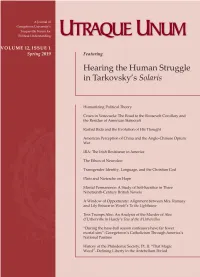
Volume 12 Issue 1 Spring 2019 A Journal of Georgetown University’s Tocqueville Forum for Political Understanding Editor-in-Chief Mark McNiskin Managing Editor Emily X. Ren Editor-at-Large Jacob Dyson Section Editors Christof Kuehne and Aidan Poling (The Forum) Benjamin Brazzel (The Archive) William Leo (The Sanctuary) Carrie Connelly and Savannah Willard (The Parlor) Mark McNiskin (The Clock Tower) Digital Editor Sachin Meier Copy Editor Nathalie Danso We are announcing our new website! The editorial staff of Utraque Unum is proud to present our new digital ver- sion of the journal, which can be found at utraqueunum.org. The website will feature digital-exclusive articles and interviews, letters from readers, a complete archive of the journal's collection, and the chance to engage other readers of the journal in conversation and scholarship. In addition, each new print edition will be available to read online. We encourage our readers to check out this exciting new chapter in our story. Please direct any reader responses or letters to utraque.unum@gmail.com. Happy reading! Acknowledgements The publication of Utraque Unum was made possible by the generous support of Bill Mumma, the Collegiate Network, and the Intercollegiate Studies Insti- tute. Additional funds were provided by the Tocqueville Forum for Political Understanding. The mission of the Tocqueville Forum for Political Understanding is to en- courage a deeper engagement with the intellectual and cultural traditions that form the basis of the American federal democratic republic. The Tocqueville Fo- rum sponsors these activities solely through the contributions of generous sup- porters of its mission. -

Tarkovsky's Musical Aesthetic in the Context of the Sonic Arts
ESSAY The Music of Sound Tarkovsky’s Musical Aesthetic in the Context of the Sonic Arts VOL. 110 (DECEMBER 2020) BY FLORIAN HOLLERWEGER In his book Sculpting in Time, Andrei Tarkovsky distills the essence of his perspective on cinematic sound into the following statement:1 Above all, I feel that the sounds of this world are so beautiful in themselves that if only we could learn to listen to them properly, cinema would have no need of music at all. This aesthetic is directly reflected in Tarkovsky’s oeuvre, such as in the extremely sparse use of film music in the traditional sense in his films Solaris (1972), Stalker (1979), and The Sacrifice (1986). Without additional context, Tarkovsky’s statement could therefore be understood to stand in contradiction to this special issue’s premise that music forms “an intricate component” of Russian cinema that is “weaved into” the very fabric of its films. The following account of a conversation with Tarkovsky by his musical collaborator Eduard Artemyev seems to further support such an argument.2 He [Tarkovsky] said: “[…] I do not need an ordinary film music. I cannot stand it, and I do my utmost in order to escape it …” […] In short, he told me at length and eloquently how he didn’t need film music – all these overtures, main themes, lyric songs… “Only ambience, only organisation of sounds and noises […].” These words could be interpreted as a rejection of the use of music in film altogether. In contrast to such a reading, however, I will argue that Tarkovsky’s vision of an “organisation of sounds and noises” exhibits remarkable parallels to larger developments in musical aesthetics of his time. -

UNIVERSITY of CALIFORNIA Los Angeles Making
UNIVERSITY OF CALIFORNIA Los Angeles Making Jazz Space: Clubs and Creative Practice in California, Chile, and Siberia A dissertation submitted in partial satisfaction of the requirements for the degree of Doctor of Philosophy in Ethnomusicology by Alex Warner Rodriguez 2018 © Copyright by Alex Warner Rodriguez 2018 ABSTRACT OF THE DISSERTATION Making Jazz Space: Clubs and Creative Practice in California, Chile, and Siberia by Alex Warner Rodriguez Doctor of Philosophy in Ethnomusicology University of California, Los Angeles, 2018 Professor Steven J. Loza, Chair Drawing from anthropological fieldwork in three jazz clubs, this dissertation explores the global scale of contemporary jazz practice through an examination of the communities that sustain them in Los Angeles, California; Santiago, Chile; and Novosibirsk, Siberia. These spaces, which bear striking similarities to one another both in terms of architectural aesthetics and community practices despite the vast distance between them, are investigated as instantiations of jazz space informed by logics of jazz listening, and as sites of jazz practice—a process that I call jazz anthropology. It argues that to understand why jazz practices continue to manifest anywhere, we must understand what they mean to people elsewhere—that is, beyond the music’s geographical centers of production on the U.S. East Coast. By attending to these peripheries, we can hear the music as a manifestation of jazz consciousness, as tendrils of black radical modes of thinking transposed to far-flung geographies—even ones that very few black people inhabit. To situate these practices in a longer genealogical timespan, the dissertation also includes brief historical ii sketches of jazz practice in each of the three locations in 1917, 1959, and 1990, demonstrating the long local histories that inform the music in each locale.