Drumand CROAKER
Total Page:16
File Type:pdf, Size:1020Kb
Load more
Recommended publications
-
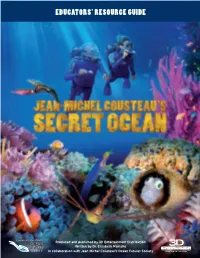
Educators' Resource Guide
EDUCATORS' RESOURCE GUIDE Produced and published by 3D Entertainment Distribution Written by Dr. Elisabeth Mantello In collaboration with Jean-Michel Cousteau’s Ocean Futures Society TABLE OF CONTENTS TO EDUCATORS .................................................................................................p 3 III. PART 3. ACTIVITIES FOR STUDENTS INTRODUCTION .................................................................................................p 4 ACTIVITY 1. DO YOU Know ME? ................................................................. p 20 PLANKton, SOURCE OF LIFE .....................................................................p 4 ACTIVITY 2. discoVER THE ANIMALS OF "SECRET OCEAN" ......... p 21-24 ACTIVITY 3. A. SECRET OCEAN word FIND ......................................... p 25 PART 1. SCENES FROM "SECRET OCEAN" ACTIVITY 3. B. ADD color to THE octoPUS! .................................... p 25 1. CHristmas TREE WORMS .........................................................................p 5 ACTIVITY 4. A. WHERE IS MY MOUTH? ..................................................... p 26 2. GIANT BasKET Star ..................................................................................p 6 ACTIVITY 4. B. WHat DO I USE to eat? .................................................. p 26 3. SEA ANEMONE AND Clown FISH ......................................................p 6 ACTIVITY 5. A. WHO eats WHat? .............................................................. p 27 4. GIANT CLAM AND ZOOXANTHELLAE ................................................p -

Zoology Marine Ornamental Fish Biodiversity of West Bengal ABSTRACT
Research Paper Volume : 4 | Issue : 8 | Aug 2015 • ISSN No 2277 - 8179 Zoology Marine Ornamental Fish Biodiversity of KEYWORDS : Marine fish, ornamental, West Bengal diversity, West Bengal. Principal Scientist and Scientist-in-Charge, ICAR-Central Institute of Fisheries Education, Dr. B. K. Mahapatra Salt Lake City, Kolkata-700091, India Director and Vice-Chancellor, ICAR-Central Institute of Fisheries Education, Versova, Dr. W. S. Lakra Mumbai- 400 061, India ABSTRACT The State of West Bengal, India endowed with 158 km coast line for marine water resources with inshore, up-shore areas and continental shelf of Bay of Bengal form an important fishery resource and also possesses a rich wealth of indigenous marine ornamental fishes.The present study recorded a total of 113 marine ornamental fish species, belonging to 75 genera under 45 families and 10 orders.Order Perciformes is represented by a maximum of 26 families having 79 species under 49 genera followed by Tetraodontiformes (5 family; 9 genus and 10 species), Scorpaeniformes (2 family; 3 genus and 6 species), Anguilliformes (2 family; 3 genus and 4 species), Syngnathiformes (2 family; 3 genus and 3 species), Pleuronectiformes (2 family; 2 genus and 4 species), Siluriformes (2 family; 2 genus and 3 species), Beloniformes (2 family; 2 genus and 2 species), Lophiformes (1 family; 1 genus and 1 species), Beryciformes(1 family; 1 genus and 1 species). Introduction Table 1: List of Marine ornamental fishes of West Bengal Ornamental fishery, which started centuries back as a hobby, ORDER 1: PERCIFORMES has now started taking the shape of a multi-billion dollar in- dustry. -
PHILIP HENRY GOSSE in the EASTERN TOWNSHIPS, 1835-38 J.L
THE NATURALIST'S LANDSCAPE: PHILIP HENRY GOSSE IN THE EASTERN TOWNSHIPS, 1835-38 j.l. Little History Department, Simon Fraser University This is what I prayed for. A piece of land-not so very big, with a garden and, near the house, a spring that never fails, and a bit ofwood to round it off. -Horace RESUME Philip Henry Gosse faisait partie d'un groupe de colons anglais instruits qui, dans les annees 1830, se sont laisses seduire par I'idee de devenir « gentilshommes rultivateurs » dans les Cantons de [,Est. Comme les autres, Gosse etait prindpalement attire par Ie pittoresque du paysage. n n'a pas tarde aretourner en Angleterre ou if est devenu un naturaliste renomme apres la publication de The Canadian Naturalist, ouvrage base sur I'observation minutieuse des plantes et des animaux des environs de sa ferme du canton de Compton. Cet article examine les descriptions faites par Gosse du paysage local et presente son regard porte sur les relations entre la sodete humaine et fa nature. ABSTRACT Philip Henry Gosse was one of a number of well-educated British settlers seduced by the vision of becoming gentlemen farmers in the Eastern Townships during the 1830s. Gosse, like the others, was attracted primarily by the picturesque landscape. He soon returned to England where he became a widely read naturalist after publishing The Canadian Naturalist, which was based on careful observations of the plants and animals in the vicinity of his Compton Township farm. This paper examines Gosse's descriptions of the local landscape and discusses his attitude to the relationship between human society and nature. -
Copyrighted Material
Index INDEX Note: page numbers in italics refer to fi gures, those in bold refer to tables and boxes. abducens nerve 55 activity cycles 499–522 inhibition 485 absorption effi ciency 72 annual patterns 515, 516, 517–22 interactions 485–6 abyssal zone 393 circadian rhythms 505 prey 445 Acanthaster planci (Crown-of-Thorns Starfi sh) diel patterns 499, 500, 501–2, 503–4, reduction 484 579 504–7 aggressive mimicry 428, 432–3 Acanthocybium (Wahoo) 15 light-induced 499, 500, 501–2, 503–4, aggressive resemblance 425–6 Acanthodii 178, 179 505 aglomerular 52 Acanthomorpha 284–8, 289 lunar patterns 507–9 agnathans Acanthopterygii 291–325 seasonal 509–15 gills 59, 60 Atherinomorpha 293–6 semilunar patterns 507–9 osmoregulation 101, 102 characteristics 291–2 supra-annual patterns 515, 516, 517–22 phylogeny 202 distribution 349, 350 tidal patterns 506–7 ventilation 59, 60 jaws 291 see also migration see also hagfi shes; lampreys Mugilomorpha 292–3, 294 adaptive response 106 agnathous fi shes see jawless fi shes pelagic 405 adaptive zones 534 agonistic interactions 83–4, 485–8 Percomorpha 296–325 adenohypophysis 91, 92 chemically mediated 484 pharyngeal jaws 291 adenosine triphosphate (ATP) 57 sound production 461–2 phylogeny 292, 293, 294 adipose fi n 35 visual 479 spines 449, 450 adrenocorticotropic hormone (ACTH) 92 agricultural chemicals 605 Acanthothoraciformes 177 adrianichthyids 295 air breathing 60, 61–2, 62–4 acanthurids 318–19 adult fi shes 153, 154, 155–7 ammonia production 64, 100–1 Acanthuroidei 12, 318–19 death 156–7 amphibious 60 Acanthurus bahianus -
Wild About Learning
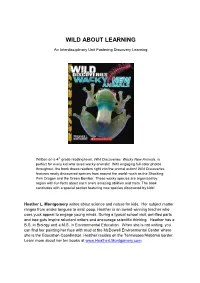
WILD ABOUT LEARNING An Interdisciplinary Unit Fostering Discovery Learning Written on a 4th grade reading level, Wild Discoveries: Wacky New Animals, is perfect for every kid who loves wacky animals! With engaging full-color photos throughout, the book draws readers right into the animal action! Wild Discoveries features newly discovered species from around the world--such as the Shocking Pink Dragon and the Green Bomber. These wacky species are organized by region with fun facts about each one's amazing abilities and traits. The book concludes with a special section featuring new species discovered by kids! Heather L. Montgomery writes about science and nature for kids. Her subject matter ranges from snake tongues to snail poop. Heather is an award-winning teacher who uses yuck appeal to engage young minds. During a typical school visit, petrified parts and tree guts inspire reluctant writers and encourage scientific thinking. Heather has a B.S. in Biology and a M.S. in Environmental Education. When she is not writing, you can find her painting her face with mud at the McDowell Environmental Center where she is the Education Coordinator. Heather resides on the Tennessee/Alabama border. Learn more about her ten books at www.HeatherLMontgomery.com. Dear Teachers, Photo by Sonya Sones As I wrote Wild Discoveries: Wacky New Animals, I was astounded by how much I learned. As expected, I learned amazing facts about animals and the process of scientifically describing new species, but my knowledge also grew in subjects such as geography, math and language arts. I have developed this unit to share that learning growth with children. -
Conducting Baseline Studies for Thane Creek
Conducting baseline studies for Thane Creek Project report submitted to Mangrove Cell, Maharashtra & GIZ, Mumbai Office. by Sálim Ali Centre for Ornithology and Natural History (SACON) Anaikatty (PO), Coimbatore - 641108, Tamil Nadu In collaboration with B.N. Bandodkar College of Science, Thane Conducting baseline studies for Thane Creek Project report submitted to Mangrove Cell, Maharashtra & GIZ, Mumbai Office. Project Investigator Dr. Goldin Quadros Co-Investigators Dr. P.A. Azeez, Dr. Mahendiran Mylswamy, Dr. Manchi Shirish S. In Collaboration With Prof. Dr. R.P. Athalye B.N. Bandodkar College of Science, Thane Research Team Mr. Siddhesh Bhave, Ms. Sonia Benjamin, Ms. Janice Vaz, Mr. Amol Tripathi, Mr. Prathamesh Gujarpadhaye Sálim Ali Centre for Ornithology and Natural History (SACON) Anaikatty (PO), Coimbatore - 641108, Tamil Nadu 2016 Acknowledgement Thane creek has been an ecosystem that has held our attention since the time we have known about its flamingos. When we were given the opportunity to conduct The baseline study for Thane creek” we felt blessed to learn more about this unique ecosystem the largest creek from asia. This study was possible due to Mr. N Vasudevan, IFS, CCF, Mangrove cell, Maharashtra whose vision for the mangrove habitats in Maharashtra has furthered the cause of conservation. Hence, we thank him for giving us this opportunity to be a part of his larger goal. The present study involved interactions with a number of research institutions, educational institutions, NGO’s and community, all of whom were cooperative in sharing information and helped us. Most important was the cooperation of librarians from all the institutions who went out of their way in our literature survey. -
Aquacultue OPEN COURSE: NOTES PART 1
OPEN COURSE AQ5 D01 ORNAMENTAL FISH CULTURE GENERAL INTRODUCTION An aquarium is a marvelous piece of nature in an enclosed space, gathering the attraction of every human being. It is an amazing window to the fascinating underwater world. The term ‘aquarium’is a derivative of two words in Latin, i.e aqua denoting ‘water’ and arium or orium indicating ‘compartment’. Philip Henry Gosse, an English naturalist, was the first person to actually use the word "aquarium", in 1854 in his book The Aquarium: An Unveiling of the Wonders of the Deep Sea. In this book, Gosse primarily discussed saltwater aquaria. Aquarium or ornamental fish keeping has grown from the status of a mere hobby to a global industry capable of generating international exchequer at considerable levels. History shows that Romans have kept aquaria (plural for ‘aquarium’) since 2500 B.C and Chinese in 1278-960 B.C. But they used aquaria primarily for rearing and fattening of food fishes. Chinese developed the art of selective breeding in carp and goldfish, probably the best known animal for an aquarium. Ancient Egyptians were probably the first to keep the fish for ornamental purpose. World’s first public aquarium was established in Regents Park in London in 1853. Earlier only coldwater fishes were kept as pets as there was no practical system of heating which is required for tropical freshwater fish. The invention of electricity opened a vast scope of development in aquarium keeping. The ease of quick transportation and facilities for carting in temperature controlled packaging has broadened the horizon for this hobby. -

Sharkcam Fishes
SharkCam Fishes A Guide to Nekton at Frying Pan Tower By Erin J. Burge, Christopher E. O’Brien, and jon-newbie 1 Table of Contents Identification Images Species Profiles Additional Info Index Trevor Mendelow, designer of SharkCam, on August 31, 2014, the day of the original SharkCam installation. SharkCam Fishes. A Guide to Nekton at Frying Pan Tower. 5th edition by Erin J. Burge, Christopher E. O’Brien, and jon-newbie is licensed under the Creative Commons Attribution-Noncommercial 4.0 International License. To view a copy of this license, visit http://creativecommons.org/licenses/by-nc/4.0/. For questions related to this guide or its usage contact Erin Burge. The suggested citation for this guide is: Burge EJ, CE O’Brien and jon-newbie. 2020. SharkCam Fishes. A Guide to Nekton at Frying Pan Tower. 5th edition. Los Angeles: Explore.org Ocean Frontiers. 201 pp. Available online http://explore.org/live-cams/player/shark-cam. Guide version 5.0. 24 February 2020. 2 Table of Contents Identification Images Species Profiles Additional Info Index TABLE OF CONTENTS SILVERY FISHES (23) ........................... 47 African Pompano ......................................... 48 FOREWORD AND INTRODUCTION .............. 6 Crevalle Jack ................................................. 49 IDENTIFICATION IMAGES ...................... 10 Permit .......................................................... 50 Sharks and Rays ........................................ 10 Almaco Jack ................................................. 51 Illustrations of SharkCam -
Ex-Situ Documentation of Ethnobiology
View metadata, citation and similar papers at core.ac.uk brought to you by CORE provided by ScholarSpace at University of Hawai'i at Manoa Vol. 8 (2014), pp. 788–809 http://nflrc.hawaii.edu/ldc http://hdl.handle.net/10125/24626 Ex-situ Documentation of Ethnobiology Francesca Lahe-Deklin Australian National University Aung Si University of Melbourne Migrant speakers of endangered languages living in urban centers in developed coun- tries represent a valuable resource through which these languages may be conveniently documented. Here, we first present a general methodology by which linguists can com- pile a meaningful set of visual (and sometimes audio) stimuli with which to carry out a reasonably detailed ethnobiological elicitation session in an ‘ex-situ’ setting, such as an urban university. We then showcase some preliminary results of such an elicitation carried out on the Dumo, or Vanimo, language of north-western Papua New Guinea during a linguistic field methods course at the Australian National University. With the help of a region-specific set of visual stimuli obtained from various sources, it was possible to document many fascinating aspects of the fish, and other marine-biological, knowledge of Dumo speakers, along with detailed ethnographic notes on the cultural significance of marine creatures. 1. INTRODUCTION. Developed countries such as Australia and the United States of Amer- ica have, in recent decades, become home to numerous ethnic communities of speakers of small, inadequately described or endangered languages (Roberts 2010). The presence of large numbers of such migrants in major urban centers, such as New York, London, or Melbourne, provides exciting opportunities for collaborations between linguists and the speakers of endangered languages, wherein the former document the language of the latter without the great expense of having to travel to a distant, possibly remote, location. -

Hookes Fossilien Und Die Anti-Evolutionisten
SPEKTRUM-ESSAY z Hookes Fossilien und die Anti-Evolutionisten Im 17. Jahrhundert begann ein Streit um das Alter der Erde und die Entwicklung der Organismen, den hartnäckige Evolutionsgegner bis zum heutigen Tag fortsetzen. Von Keith Stewart Thomson nen. Robert Boyle hingegen war der reiche Sohn des noch reicheren ersten Earl of Cork elegentlich erfahre ich, dass aus und besuchte nie eine Universität. Als Boyle meinen Beiträgen zur Evolutions- sich zwischen 1656 und 1668 in Oxford nie- theorie zitiert wurde, um damit ge- derließ, stellte er Hooke an, damit der ihm gen die biologische Evolution und bei seinen philosophischen Untersuchungen G für den Kreationismus zu argumentieren. über das Wesen der Gase und deren Gesetze Kürzlich verwendete das so genannte Discove- zur Hand ginge. Hooke war der Erfinder und ry Institute meine Arbeit bei einem Versuch, Techniker, der die berühmten Luftpumpen- den Kreationismus in den Schulen des US- versuche durchführte; sie bewiesen, dass es in Bundesstaats Ohio zu etablieren. Bei solchen der Luft einen – später entdeckten und Sauer- Anlässen weiß man nie, ob man lachen oder stoff genannten – Faktor geben muss, den weinen soll. Diese Leute durchstöbern die Tiere zum Leben brauchen. Wissenschaft nur so eifrig, um sie gegen uns Hookes Erfindungen reichten später von zu wenden. Doch letztlich setzen sie einen der Uhrfeder bis zum Universalgelenk. Er prinzipiellen Kampf um unsere Herzen und wurde Bauaufseher für London, als Christo- Hirne fort, der niemals wirklich enden wird: pher Wren dort Stadtarchitekt war, und ge- Lässt sich das Universum zur Gänze wissen- meinsam gestalteten sie nach dem großen schaftlich erklären oder gibt es ein letztes, Brand von 1666 London neu. -

Spatially Distinct and Regionally Endemic Symbiodinium Assemblages in the Threatened Caribbean Reef-Building Coral Orbicella Faveolata
Coral Reefs (2015) 34:535–547 DOI 10.1007/s00338-015-1277-z REPORT Spatially distinct and regionally endemic Symbiodinium assemblages in the threatened Caribbean reef-building coral Orbicella faveolata Dustin W. Kemp • Daniel J. Thornhill • Randi D. Rotjan • Roberto Iglesias-Prieto • William K. Fitt • Gregory W. Schmidt Received: 28 October 2014 / Accepted: 19 February 2015 / Published online: 27 February 2015 Ó Springer-Verlag Berlin Heidelberg 2015 Abstract Recently, the Caribbean reef-building coral Or- with species of Symbiodinium in clades A (type A3), B (B1 bicella faveolata was listed as ‘‘threatened’’ under the U.S. and B17), C (C3, C7, and C7a), and D (D1a/Symbiodinium Endangered Species Act. Despite attention to this species’ trenchii). Within-colony distributions of Symbiodinium conservation, the extent of geographic variation within O. species correlated with light availability, cardinal direction, faveolata warrants further investigation. O. faveolata is and depth, resulting in distinct zonation patterns of en- unusual in that it can simultaneously harbor multiple ge- dosymbionts within a host. Symbiodinium species from netically distinct and co-dominant species of endosymbiotic clades A and B occurred predominantly in the light-exposed dinoflagellates in the genus Symbiodinium. Here, we inves- tops, while species of clade C generally occurred in the tigate the geographic and within-colony complexity of shaded sides of colonies or in deeper-water habitats. Fur- Symbiodinium-O. faveolata associations from Florida Keys, thermore, geographic comparisons of host–symbiont asso- USA; Exuma Cays, Bahamas; Puerto Morelos, Mexico; and ciations revealed regional differences in Symbiodinium Carrie Bow Cay, Belize. We collected coral samples along associations. -

18 Special Habitats and Special Adaptations 395
THE DIVERSITY OF FISHES Dedications: To our parents, for their encouragement of our nascent interest in things biological; To our wives – Judy, Sara, Janice, and RuthEllen – for their patience and understanding during the production of this volume; And to students and lovers of fishes for their efforts toward preserving biodiversity for future generations. Front cover photo: A Leafy Sea Dragon, Phycodurus eques, South Australia. Well camouflaged in their natural, heavily vegetated habitat, Leafy Sea Dragons are closely related to seahorses (Gasterosteiformes: Syngnathidae). “Leafies” are protected by Australian and international law because of their limited distribution, rarity, and popularity in the aquarium trade. Legal collection is highly regulated, limited to one “pregnant” male per year. See Chapters 15, 21, and 26. Photo by D. Hall, www.seaphotos.com. Back cover photos (from top to bottom): A school of Blackfin Barracuda, Sphyraena qenie (Perciformes, Sphyraenidae). Most of the 21 species of barracuda occur in schools, highlighting the observation that predatory as well as prey fishes form aggregations (Chapters 19, 20, 22). Blackfins grow to about 1 m length, display the silvery coloration typical of water column dwellers, and are frequently encountered by divers around Indo-Pacific reefs. Barracudas are fast-start predators (Chapter 8), and the pan-tropical Great Barracuda, Sphyraena barracuda, frequently causes ciguatera fish poisoning among humans (Chapter 25). Longhorn Cowfish, Lactoria cornuta (Tetraodontiformes: Ostraciidae), Papua New Guinea. Slow moving and seemingly awkwardly shaped, the pattern of flattened, curved, and angular trunk areas made possible by the rigid dermal covering provides remarkable lift and stability (Chapter 8). A Silvertip Shark, Carcharhinus albimarginatus (Carcharhiniformes: Carcharhinidae), with a Sharksucker (Echeneis naucrates, Perciformes: Echeneidae) attached.