Attacks on Justice – Gibraltar
Total Page:16
File Type:pdf, Size:1020Kb
Load more
Recommended publications
-

Gambling Act 2005
Gambling 2005-72 GAMBLING ACT 2005 Principal Act Act. No. 2005-72 Commencement (LN. 2006/114) except for s. 55(b) 26.10.2006 Assent 22.12.2005 Amending Relevant current Commencement enactments provisions date None English sources: None EU Legislation/International Agreements involved: None © Government of Gibraltar (www.gibraltarlaws.gov.gi) 2005-72 Gambling ARRANGEMENT OF SECTIONS Section PART I PRELIMINARY 1. Title and commencement. 2. Interpretation. 3. Types and scope of licences, etc. 4. Terms of licences and procedural provisions. 5. The Licensing Authority. 6. The Gambling Commissioner. PART II NON-REMOTE BETTING AND BETTING OFFICES 7. Prohibition on non-remote bookmaking except under bookmaker’s licence. 8. Restriction on use of premises for betting transactions with persons resorting thereto. 9. Use for betting of premises not covered by bookmaker’s licence. 10. Prohibition on carrying on pool betting business except under pools promoter’s licence. PART III NON-REMOTE GAMING AND GAMING ESTABLISHMENTS 11. Prohibition on provision of gaming facilities, etc. except under gaming operator’s licence. 12. Prohibition on operation of gaming establishments except under gaming operator’s licence. 13. Playing etc. in unlicensed gaming establishments. 14. Exception for social occasion in residential hotels and private dwelling. 15. Prohibition on keeping gaming machines except under licence. PART IV NON-REMOTE LOTTERIES 16. Permitted non-remote lotteries. 17. Power to promote and conduct Government Lotteries. 18. Proceeds of Government Lotteries. 19. General regulations about Government Lotteries. 20. Scheduled lotteries. 21. Offences in connection with non-remote lotteries. PART V BETTING INTERMEDIARIES © Government of Gibraltar (www.gibraltarlaws.gov.gi) Gambling 2005-72 22. -

Hearing on the Report of the Chief Justice of Gibraltar
[2009] UKPC 43 Privy Council No 0016 of 2009 HEARING ON THE REPORT OF THE CHIEF JUSTICE OF GIBRALTAR REFERRAL UNDER SECTION 4 OF THE JUDICIAL COMMITTEE ACT 1833 before Lord Phillips Lord Hope Lord Rodger Lady Hale Lord Brown Lord Judge Lord Clarke ADVICE DELIVERED ON 12 November 2009 Heard on 15,16, 17, and 18 June 2009 Chief Justice of Gibraltar Governor of Gibraltar Michael Beloff QC Timothy Otty QC Paul Stanley (Instructed by Clifford (Instructed by Charles Chance LLP) Gomez & Co and Carter Ruck) Government of Gibraltar James Eadie QC (Instructed by R J M Garcia) LORD PHILLIPS : 1. The task of the Committee is to advise Her Majesty whether The Hon. Mr Justice Schofield, Chief Justice of Gibraltar, should be removed from office by reason of inability to discharge the functions of his office or for misbehaviour. The independence of the judiciary requires that a judge should never be removed without good cause and that the question of removal be determined by an appropriate independent and impartial tribunal. This principle applies with particular force where the judge in question is a Chief Justice. In this case the latter requirement has been abundantly satisfied both by the composition of the Tribunal that conducted the initial enquiry into the relevant facts and by the composition of this Committee. This is the advice of the majority of the Committee, namely, Lord Phillips, Lord Brown, Lord Judge and Lord Clarke. Security of tenure of judicial office under the Constitution 2. Gibraltar has two senior judges, the Chief Justice and a second Puisne Judge. -

The Sovereignty of the Crown Dependencies and the British Overseas Territories in the Brexit Era
Island Studies Journal, 15(1), 2020, 151-168 The sovereignty of the Crown Dependencies and the British Overseas Territories in the Brexit era Maria Mut Bosque School of Law, Universitat Internacional de Catalunya, Spain MINECO DER 2017-86138, Ministry of Economic Affairs & Digital Transformation, Spain Institute of Commonwealth Studies, University of London, UK mariamut@uic.es (corresponding author) Abstract: This paper focuses on an analysis of the sovereignty of two territorial entities that have unique relations with the United Kingdom: the Crown Dependencies and the British Overseas Territories (BOTs). Each of these entities includes very different territories, with different legal statuses and varying forms of self-administration and constitutional linkages with the UK. However, they also share similarities and challenges that enable an analysis of these territories as a complete set. The incomplete sovereignty of the Crown Dependencies and BOTs has entailed that all these territories (except Gibraltar) have not been allowed to participate in the 2016 Brexit referendum or in the withdrawal negotiations with the EU. Moreover, it is reasonable to assume that Brexit is not an exceptional situation. In the future there will be more and more relevant international issues for these territories which will remain outside of their direct control, but will have a direct impact on them. Thus, if no adjustments are made to their statuses, these territories will have to keep trusting that the UK will be able to represent their interests at the same level as its own interests. Keywords: Brexit, British Overseas Territories (BOTs), constitutional status, Crown Dependencies, sovereignty https://doi.org/10.24043/isj.114 • Received June 2019, accepted March 2020 © 2020—Institute of Island Studies, University of Prince Edward Island, Canada. -
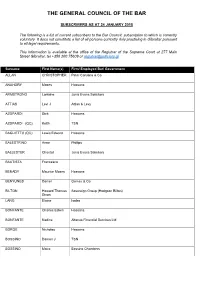
The General Council of the Bar
THE GENERAL COUNCIL OF THE BAR SUBSCRIBERS AS AT 24 JANUARY 2018 The following is a list of current subscribers to the Bar Council, subscription to which is currently voluntary. It does not constitute a list of all persons currently duly practising in Gibraltar pursuant to all legal requirements. This information is available at the office of the Registrar of the Supreme Court at 277 Main Street Gibraltar, tel +350 200 75608 or registrar@judiciary.gi Surname First Name(s) Firm/ Employed Bar/ Government ALLAN CHRISTOPHER Peter Caruana & Co ANAHORY Moses Hassans ARMSTRONG Lorraine Janis Evans Solicitors ATTIAS Levi J Attias & Levy AZOPARDI Dick Hassans AZOPARDI (QC) Keith TSN BAGLIETTO (QC) Lewis Edward Hassans BALESTRINO Anne Phillips BALLESTER Chantal Janis Evans Solicitors BAUTISTA Francesca BENADY Maurice Moses Hassans BENYUNES Daniel Gomez & Co BILTON Howard Thomas Sovereign Group (Hodgson Bilton) Dixon LANG Elaine Isolas BONFANTE Charles Edwin Hassans BONFANTE Nadine Abacus Financial Services Ltd BORGE Nicholas Hassans BOSSINO Damon J TSN BOSSINO Moira Bossino Chambers BRIDGE Mark Jason Bridge Legal Chambers BRUNT Christopher Phillips BUCHANAN Alan Isaac Triay & Triay BUDHRANI QC The Hon. Triay & Triay Haresh K. BUHAGIAR Janieve Ellul & Co BUTTIGIEG Richard.A Hassans CAETANO Christian James Isolas CAETANO Steven John Isolas CANESSA Patrick H. Triay & Triay CARDONA Andrew M.J Phillips CARRERAS Francis Nicholas Hassans CARRERAS Louise Triay & Triay CASTIEL Michael Hassans CASTIEL Victoria S. Massias & Co CATANIA Stephen V. Attias & Levy CAVILLA Anna Marie Andrew Haynes Chambers CHANDIRAMANI Sunil Gobind Attias & Levy CHIAPPE Ben C. Ellul & Co CHIAPPE Nicholas Sovereign Group CHINCOTTA Juan Xavier Hassans CORNELIO Abigail Hassans CRUZ Nicholas Peter Cruzlaw LLP CULATTO Lionel W.G.J Isolas CULATTO Nicholas TSN DALMEDO Stuart James Isolas DAVIS Chris Triay & Triay DEBONO Leigh Verralls De LARA John Steven Signature Litigation DIABLE Simon David Legal Orient DUMAS QC David J.V Hassans DUMAS Philip Hassans ELLUL Eric C. -

Commentary on the Bangalore Principles of Judicial Conduct
COMMENTARY ON THE BANGALORE PRINCIPLES OF JUDICIAL CONDUCT THE JUDICIAL INTEGRITY GROUP March 2007 2 CONTENTS PREFACE … 5 ACKNOWLEDGMENTS … 7 DRAFTING HISTORY … 9 PREAMBLE … 19 Value 1: INDEPENDENCE … 35 Value 2: IMPARTIALITY … 53 Value 3: INTEGRITY … 73 Value 4: PROPRIETY … 79 Value 5: EQUALITY … 111 Value 6: COMPETENCE AND DILIGENCE … 119 IMPLEMENTATION … 131 DEFINITIONS … 133 Appendix: CULTURAL AND RELIGIOUS TRADITIONS … 135 SELECT BIBLIOGRAPHY … 147 INDEX … 151 3 4 PREFACE A judiciary of undisputed integrity is the bedrock institution essential for ensuring compliance with democracy and the rule of law. Even when all other protections fail, it provides a bulwark to the public against any encroachments on its rights and freedoms under the law. These observations apply both domestically within the context of each nation State and globally, viewing the global judiciary as one great bastion of the rule of law throughout the world. Ensuring the integrity of the global judiciary is thus a task to which much energy, skill and experience must be devoted. This is precisely what the Judicial Group on Strengthening Judicial Integrity (The Judicial Integrity Group) has sought to do since it set out on this task in 2000. It commenced as an informal group of Chief Justices and Superior Court Judges from around the world who combined their experience and skill with a sense of dedication to this noble task. Since then, its work and achievements have grown to a point where they have made a significant impact on the global judicial scene. The principles tentatively worked out originally have received increasing acceptance over the past few years from the different sectors of the global judiciary and from international agencies interested in the integrity of the judicial process. -
Download the Guide
A Guide to Brexit Terminology This glossary has been designed to explain some of the key terms used in relation to Brexit. At the end of the glossary are links to additional resources and originals of key documents. The Glossary is not designed to be an exhaustive list and the authors hope that you find the explanations of key terms helpful. The UK which voted to join the EU had a different constitution to the UK that voted to leave the EU. This is reflected by some of the terminology used in the glossary and the inclusion of reference to the legislatures in Scotland, Wales and Northern Ireland. A | B | C | D | E | F | G | H | I | J | K | L | M | N |O| P | Q | R | S | T | U | V | W | X | Y | Z | A to Z of Brexit terms February 01 2019 version pg. 1 Advisory The Brexit referendum is often described as ‘only advisory’. The referendum was authorised and conducted under the European Union Referendum Act 2015. It is advisory because Parliament is sovereign and because the Act contained no enabling legislation. Enabling provisions are ones which explicitly state that Parliament is legally bound to implement the outcome of the referendum. Hence, Parliament was not legally obliged to enact the outcome of the Brexit referendum. In contrast, for countries with codified constitutions, the outcome of a referendum ‘may’, in some instances bind both parliament and the government to implement its result. In Britain, however, with an uncodified constitution, it is possible for the government to promise in advance that it would respect the result, but that promise would be only political and not legally binding as parliament cannot be bound be a previous parliament; it can change its mind. -

An Overlooked Colonial English of Europe: the Case of Gibraltar
.............................................................................................................................................................................................................WORK IN PROGESS WORK IN PROGRESS TOMASZ PACIORKOWSKI DOI: 10.15290/CR.2018.23.4.05 Adam Mickiewicz University in Poznań An Overlooked Colonial English of Europe: the Case of Gibraltar Abstract. Gibraltar, popularly known as “The Rock”, has been a British overseas territory since the Treaty of Utrecht was signed in 1713. The demographics of this unique colony reflect its turbulent past, with most of the population being of Spanish, Portuguese or Italian origin (Garcia 1994). Additionally, there are prominent minorities of Indians, Maltese, Moroccans and Jews, who have also continued to influence both the culture and the languages spoken in Gibraltar (Kellermann 2001). Despite its status as the only English overseas territory in continental Europe, Gibraltar has so far remained relatively neglected by scholars of sociolinguistics, new dialect formation, and World Englishes. The paper provides a summary of the current state of sociolinguistic research in Gibraltar, focusing on such aspects as identity formation, code-switching, language awareness, language attitudes, and norms. It also delineates a plan for further research on code-switching and national identity following the 2016 Brexit referendum. Keywords: Gibraltar, code-switching, sociolinguistics, New Englishes, dialect formation, Brexit. 1. Introduction Gibraltar is located on the southern tip of the Iberian Peninsula and measures just about 6 square kilometres. This small size, however, belies an extraordinarily complex political history and social fabric. In the Brexit referendum of 23rd of June 2016, the inhabitants of Gibraltar overwhelmingly expressed their willingness to continue belonging to the European Union, yet at the moment it appears that they will be forced to follow the decision of the British govern- ment and leave the EU (Garcia 2016). -

Gibraltar's Constitutional Future
RESEARCH PAPER 02/37 Gibraltar’s Constitutional 22 MAY 2002 Future “Our aims remain to agree proposals covering all outstanding issues, including those of co-operation and sovereignty. The guiding principle of those proposals is to build a secure, stable and prosperous future for Gibraltar and a modern sustainable status consistent with British and Spanish membership of the European Union and NATO. The proposals will rest on four important pillars: safeguarding Gibraltar's way of life; measures of practical co-operation underpinned by economic assistance to secure normalisation of relations with Spain and the EU; extended self-government; and sovereignty”. Peter Hain, HC Deb, 31 January 2002, c.137WH. In July 2001 the British and Spanish Governments embarked on a new round of negotiations under the auspices of the Brussels Process to resolve the sovereignty dispute over Gibraltar. They aim to reach agreement on all unresolved issues by the summer of 2002. The results will be put to a referendum in Gibraltar. The Government of Gibraltar has objected to the process and has rejected any arrangement involving shared sovereignty between Britain and Spain. Gibraltar is pressing for the right of self-determination with regard to its constitutional future. The Brussels Process covers a wide range of topics for discussion. This paper looks primarily at the sovereignty debate. It also considers how the Gibraltar issue has been dealt with at the United Nations. Vaughne Miller INTERNATIONAL AFFAIRS AND DEFENCE SECTION HOUSE OF COMMONS LIBRARY Recent Library Research Papers include: List of 15 most recent RPs 02/22 Social Indicators 10.04.02 02/23 The Patents Act 1977 (Amendment) (No. -

Gibraltar, the United Kingdom and Spain
RESEARCH PAPER 98/50 Gibraltar, the United 22 APRIL 1998 Kingdom and Spain This paper looks at some of the recent issues and developments in the UK, Spain and the European Union that have had an impact on Gibraltar. These include recent Spanish sovereignty proposals, Gibraltar’s constitutional status, defence matters and efforts to combat drug-trafficking. The background to the sovereignty dispute is not discussed in any detail here but can be found in Library Research Paper 95/80, Gibraltar, 27 June 1995. Vaughne Miller INTERNATIONAL AFFAIRS AND DEFENCE HOUSE OF COMMONS LIBRARY Recent Library Research Papers include: 98/35 EMU: the approach to the Third Stage and the 17.03.98 state of economic convergence 98/36 Unemployment by Constituency - February 1998 18.03.98 98/37 Personal Tax Allowances & Reliefs 1998-99 18.03.98 98/38 Cabinets, Committees and Elected Mayors 19.03.98 (revised edition) 98/39 EMU: Views in the other EU Member States 23.03.98 98/40 Economic Indicators 01.04.98 98/41 The National Lottery Bill [HL] 1997/98 Bill 148 02.04.98 98/42 Late Payment of Commercial Debts (Interest) Bill [HL] 02.04.98 1997/98 Bill 132 98/43 The Crime and Disorder Bill [HL] [Bill 167 of 1997-98]: 06.04.98 Youth Justice, Criminal Procedures and Sentencing 98/44 The Crime and Disorder Bill [HL], [Bill 167 of 1997-98]: 06.04.98 Anti-social neighbours, sex offenders, racially motivated offences and sentencing drug-dependent offenders 98/45 The 1998 Budget and Work Incentives Bill (forthcoming) 98/46 Working Families Tax Credit and Family Credit 09.04.98 98/47 Voting Systems - The Government's Proposals (revised edition) 09.04.98 98/48 The Data Protection Bill [HL]: Bill 158 of 1997-98 17.04.98 98/49 Unemployment by Constituency - March 1998 22.04.98 Library Research Papers are compiled for the benefit of Members of Parliament and their personal staff. -

Brexit: Gibraltar
HOUSE OF LORDS European Union Committee 13th Report of Session 2016–17 Brexit: Gibraltar Ordered to be printed 21 February 2017 and published 1 March 2017 Published by the Authority of the House of Lords HL Paper 116 The European Union Committee The European Union Committee is appointed each session “to scrutinise documents deposited in the House by a Minister, and other matters relating to the European Union”. In practice this means that the Select Committee, along with its Sub-Committees, scrutinises the UK Government’s policies and actions in respect of the EU; considers and seeks to influence the development of policies and draft laws proposed by the EU institutions; and more generally represents the House of Lords in its dealings with the EU institutions and other Member States. The six Sub-Committees are as follows: Energy and Environment Sub-Committee External Affairs Sub-Committee Financial Affairs Sub-Committee Home Affairs Sub-Committee Internal Market Sub-Committee Justice Sub-Committee Membership The Members of the European Union Select Committee are: Baroness Armstrong of Hill Top Baroness Kennedy of The Shaws Lord Trees Lord Boswell of Aynho (Chairman) Earl of Kinnoull Baroness Verma Baroness Brown of Cambridge Lord Liddle Lord Whitty Baroness Browning Baroness Prashar Baroness Wilcox Baroness Falkner of Margravine Lord Selkirk of Douglas Lord Woolmer of Leeds Lord Green of Hurstpierpoint Baroness Suttie Lord Jay of Ewelme Lord Teverson Further information Publications, press notices, details of membership, forthcoming meetings and other information is available at http://www.parliament.uk/hleu. General information about the House of Lords and its Committees is available at http://www.parliament.uk/business/lords. -

This Is a Pre-Copyedited, Author-Produced Version of an Article Accepted for Publication in the Journal of International and Comparative Law Following Peer Review
This is a pre-copyedited, author-produced version of an article accepted for publication in the Journal of International and Comparative Law following peer review. The definitive published version for Hatchard, John (2016). Some Thoughts on Judicial Integrity, Corruption and Accountability in Small Commonwealth African States, Journal of International and Comparative Law 3 (1), pp. 55-72 is available online on Westlaw UK or from Thomson Reuters DocDel service. 1 | P a g e JUDICIAL INTEGRITY, CORRUPTION AND ACCOUNTABILITY IN SMALL COMMONWEALTH AFRICAN STATES John Hatchard1 ‘We live in an era of greater public demand for accountability of the Judiciary. It is no longer considered a sacrosanct and inviolable haven of its occupants’. (Justice Anthony Gubbay)2 ‘We do not fear criticism, nor do we resent it’. (Lord Denning M.R.)3 Abstract: This article addresses some of the key challenges that judges in small states face in seeking to maintain judicial independence and uphold judicial integrity. It explores their appropriate reaction to public criticism of judgments, including the extent to which judges themselves and/or members of their family should use the media to respond to such criticism. The article then considers the appropriate response of judges to media allegations of judicial corruption and impropriety and argues, in particular, against the retention of the criminal offence of scandalising the court. A highly publicised dispute between two senior judges in Lesotho then highlights the importance of judges respecting the Values of ‘Integrity’ and ‘Propriety’ enshrined in the Bangalore Principles of Judicial Conduct. Keywords: small states; Commonwealth Africa; judicial response to criticism; corruption allegations against judges by the media; offence of scandalising the court; upholding judicial integrity. -

January 2017
January 2017 ROCK TALK Issue 12 1 Contents Editorials 2 Varied Career in Law in Gibraltar 18 Chairman‟s Letter 3 News from GHT 20 Diary of Society Events 2019 4 Witham‟s Cemetery 22 Report of Events 5 Devon to Gibraltar and back 24 Annual Friends‟ visit to Gibraltar 5 Nelson‟s Table – Fact or Fiction? 27 News from the Rock (Gibraltar House) 8 Gibraltar Street Names 28 London Talks 9 Gifts from the Friends 30 Annual Seminar and AGM 10 GGPE 60th Anniversary 30 Christmas Party report 13 Out and About in Gibraltar 31 Friends‟ Donations and Projects 14 Minutes of AGM 33 Membership Secretary‟s Jottings 15 Membership Form 35 My Rock Book 16 Editorials A belated Happy New year to all members and developments, and is an interesting read. readers of this edition of Rock Talk. We wish you a prosperous 2019, and hope to 2019 promises to be an interesting year in so see you in Gibraltar at some point over the many respects but one in particular sticks out like year. a 'sore thumb'. As we pen this editorial, the British Brian & Liz Gonzalez Parliament is in turmoil and this coming Tuesday will determine the future of the United Kingdom Another busy year for the society has come and Gibraltar vis a vis our future relationship with and gone, with the full range of events and Europe. By the time you read this we will be in a support for heritage projects in Gibraltar. better (or worse) position as to this 'relationship'. This issue hopes to update the membership We hope that politicians of all political colours on the various activities, and includes unite to deliver what is best for the United Kingdom and Gibraltar.