C.VI.4. Defining Moments in Israeli Cinema
Total Page:16
File Type:pdf, Size:1020Kb
Load more
Recommended publications
-
Asdfgeneral Assembly
United Nations A/67/PV.12 General Assembly Offi cial Records asdfSixty-seventh session 12 th plenary meeting Thursday, 27 September 2012, 9 a.m. New York President : Mr. Jeremić . (Serbia) The meeting was called to order at 9.15 a.m. I also want to commend the Secretary-General for his tireless efforts to advance dialogue and cooperation, Address by His Excellency Mr. Bakir Izetbegović, and for his firm commitment to the core values and Chairman of the Presidency of Bosnia principles of the United Nations. We in Bosnia and and Herzegovina Herzegovina recognize the importance of, and fully support, his action agenda, which identified five The President : The Assembly will hear an address generational imperatives: prevention, a more secure by the Chairman of the Presidency of Bosnia and world, helping countries in transition, empowering Herzegovina. women and youth, and sustainable development. Mr. Bakir Izetbegović, Chairman of the Presidency Today’s world is the scene of unfolding crises and of Bosnia and Herzegovina, was escorted into the mounting global challenges. The first and foremost of General Assembly Hall. these is the disaster in Syria. As we stand here, our The President : On behalf of the General Assembly, fellow Syrians are fighting against a brutal regime. I have the honour to welcome to the United Nations His They are fighting to take their destiny into their own Excellency Mr. Bakir Izetbegović, Chairman of the hands. The regime of Bashar Al-Assad is answering Presidency of Bosnia and Herzegovina, and to invite their yearning for freedom and democracy with guns him to address the Assembly. -

Filming Israel: a Conversation Author(S): Amos Gitai and Annette Michelson Source: October, Vol
Filming Israel: A Conversation Author(s): Amos Gitai and Annette Michelson Source: October, Vol. 98 (Autumn, 2001), pp. 47-75 Published by: The MIT Press Stable URL: http://www.jstor.org/stable/779062 Accessed: 16-05-2017 19:51 UTC JSTOR is a not-for-profit service that helps scholars, researchers, and students discover, use, and build upon a wide range of content in a trusted digital archive. We use information technology and tools to increase productivity and facilitate new forms of scholarship. For more information about JSTOR, please contact support@jstor.org. Your use of the JSTOR archive indicates your acceptance of the Terms & Conditions of Use, available at http://about.jstor.org/terms The MIT Press is collaborating with JSTOR to digitize, preserve and extend access to October This content downloaded from 143.117.16.36 on Tue, 16 May 2017 19:51:37 UTC All use subject to http://about.jstor.org/terms Filming Israel: A Conversation AMOS GITAI and ANNETTE MICHELSON Amos Gitai, the preeminent Israeli filmmaker of his generation, is the author of thirty- seven films. Trained as an architect in Israel and at Berkeley, he turned in 1980 to filmmak- ingfor reasons set forth in the following portion of conversations held in New York in 2000. The radically critical dimension of his investigation of Israel's policy on the Palestinian question generated an immediate response of alarm, hostility, and censorship. Although the corpus of Gitai's work is large and extremely varied, including documentary films shot in the Far East, the Philippines, France, Germany, Italy, and elsewhere, it is largely the transition from work in the documentary mode to that of the fiction feature film that has, as might be expected, enlarged the appreciative audience of his work. -

DUR 02/05/2014 : CUERPO E : 2 : Página 1
2 VIERNES 2 DE MAYO DE 2014 ETCÉTERA TRADICIÓN Y VERDAD EN CORTO Muereelcineastaisraelí Subastarán Shakira, Juanes manuscrito de y Rihanna en ‘Like a Rolling premios Assi Dayan Stone’, de Dylan iHeartRadio El manuscrito original de Shakira, Juanes y Pitbull cuatro páginas con la canción participaron el jueves por la El actor y director fue de Bob Dylan “Like a Rolling noche en la entrega de los Stone” saldrá a subasta en ju- premios iHeartRadio, junto unhéroedela nio con expectativas de que a artistas como Pharrell, contracultura. podría alcanzar un valor de Drake, Blake Shelton y más. AGENCIAS entre uno y dos millones de Rihanna, Diddy y Jenni- Jennifer Jerusalén dólares, dijo el jueves la casa fer López asistieron a la ce- de subastas Sotheby. Además Lawrence, la remonia en el Shrine Audi- El actor y director Assi Da- del texto del himno de Dylan, mujer más sexy torium de Los Ángeles, que yan, un ícono de la cultura is- considerada una de las mejo- se transmitió en vivo por del 2014 raelí conocido tanto por sus res canciones de rock de todos Jennifer Lawrence fue elegi- NBC desde las 8 p.m. hora innovadoras películas como los tiempos, la subasta bajo el da como la mujer más sexy del este. Aunque se repar- por sus problemas persona- nombre de “Presley to Punk” del 2014 en el listado anual tieron múltiples trofeos, les, murió el jueves en su ca- también incluirá objetos de que publica la revista mas- las actuaciones fueron el sa en Tel Aviv. Tenía 68 años. los Beatles, Jimi Hendrix, El- culina “FHM”. -

Exile and Holocaust Literature in German and Austrian Post-War Culture
Religions 2012, 3, 424–440; doi:10.3390/rel3020424 OPEN ACCESS religions ISSN 2077-1444 www.mdpi.com/journal/religions Article Haunted Encounters: Exile and Holocaust Literature in German and Austrian Post-war Culture Birgit Lang School of Languages and Linguistics, The University of Melbourne, Parkville 3010 VIC, Australia; E-Mail: langb@unimelb.edu.au Received: 2 May 2012; in revised form: 11 May 2012 / Accepted: 12 May 2012 / Published: 14 May 2012 Abstract: In an essay titled ‗The Exiled Tongue‘ (2002), Nobel Prize winner Imre Kertész develops a genealogy of Holocaust and émigré writing, in which the German language plays an important, albeit contradictory, role. While the German language signified intellectual independence and freedom of self-definition (against one‘s roots) for Kertész before the Holocaust, he notes (based on his engagement with fellow writer Jean Améry) that writing in German created severe difficulties in the post-war era. Using the examples of Hilde Spiel and Friedrich Torberg, this article explores this notion and asks how the loss of language experienced by Holocaust survivors impacted on these two Austrian-Jewish writers. The article argues that, while the works of Spiel and Torberg are haunted by the Shoah, the two writers do not write in the post-Auschwitz language that Kertész delineates in his essays, but are instead shaped by the exile experience of both writers. At the same time though, Kertész‘ concept seems to be haunted by exile, as his reception of Jean Améry‘s works, which form the basis of his linguistic genealogies, shows an inability to integrate the experience of exile. -

The Memory of the Yom Kippur War in Israeli Society
The Myth of Defeat: The Memory of the Yom Kippur War in Israeli Society CHARLES S. LIEBMAN The Yom Kippur War of October 1973 arouses an uncomfortable feeling among Israeli Jews. Many think of it as a disaster or a calamity. This is evident in references to the War in Israeli literature, or the way in which the War is recalled in the media, on the anniversary of its outbreak. 1 Whereas evidence ofthe gloom is easy to document, the reasons are more difficult to fathom. The Yom Kippur War can be described as failure or defeat by amassing one set of arguments but it can also be assessed as a great achievement by marshalling other sets of arguments. This article will first show why the arguments that have been offered in arriving at a negative assessment of the War are not conclusive and will demonstrate how the memory of the Yom Kippur War might have been transformed into an event to be recalled with satisfaction and pride. 2 This leads to the critical question: why has this not happened? The background to the Yom Kippur War, the battles and the outcome of the war, lend themselves to a variety of interpretations. 3 Since these are part of the problem which this article addresses, the author offers only the barest outline of events, avoiding insofar as it is possible, the adoption of one interpretive scheme or another. In 1973, Yom Kippur, the holiest day of the Jewish calendar, fell on Saturday, 6 October. On that day the Egyptians in the south and the Syrians in the north attacked Israel. -
Yitzhak Rabin
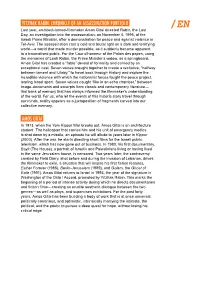
YITZHAK RABIN: CHRONICLE OF AN ASSASSINATION FORETOLD Last year, architect-turned-filmmaker Amos Gitaï directed Rabin, the Last EN Day, an investigation into the assassination, on November 4, 1995, of the / Israeli Prime Minister, after a demonstration for peace and against violence in Tel-Aviv. The assassination cast a cold and brutal light on a dark and terrifying world—a world that made murder possible, as it suddenly became apparent to a traumatised public. For the Cour d’honneur of the Palais des papes, using the memories of Leah Rabin, the Prime Minister’s widow, as a springboard, Amos GitaI has created a “fable” devoid of formality and carried by an exceptional cast. Seven voices brought together to create a recitative, “halfway between lament and lullaby,” to travel back through History and explore the incredible violence with which the nationalist forces fought the peace project, tearing Israel apart. Seven voices caught “like in an echo chamber,” between image-documents and excerpts from classic and contemporary literature— that bank of memory that has always informed the filmmaker’s understanding of the world. For us, who let the events of this historic story travel through our minds, reality appears as a juxtaposition of fragments carved into our collective memory. AMOS GITAI In 1973, when the Yom Kippur War breaks out, Amos Gitai is an architecture student. The helicopter that carries him and his unit of emergency medics is shot down by a missile, an episode he will allude to years later in Kippur (2000). After the war, he starts directing short films for the Israeli public television, which has now gone out of business. -

Modern Hebrew Literature in English Translation
1 Professor Naomi Sokoloff University of Washington Department of Near Eastern Languagse & Civilization Phone: 543-7145 FAX 685-7936 E-mail: naosok@u.washington.edu SYLLABUS MODERN HEBREW LITERATURE IN ENGLISH TRANSLATION NE 325/SISJE 490a 3 credits This survey of modern Hebrew literature and its major developments in the past 100 years includes selections of fiction and poetry by a range of writers from Europe, Israel and the U.S. Among the texts covered are pieces by H.N. Bialik, Dvorah Baron, S.Y. Agnon, Gabriel Preil, Yehuda Amichai, Aharon Appelfeld, Dan Pagis, A.B. Yehoshua, Amos Oz, Etgar Keret, Batya Gur, and more. This course aims to illuminate some of the factors that make this literature distinctive and fascinating. Hebrew is a language that has been in continuous literary use over millennia. Dramatic historical circumstances and ideological forces fostered the revival of the language as a modern tongue and shaped Hebrew literary endeavors up through current time. COURSE REQUIREMENTS: Students are expected to do the required reading, to attend class and to participate in class discussion. There will be several short written assignments, two quizzes and a take-home essay exam. This is a “W” course, which requires significant amounts of writing, editing, and revision. Final grades will be determined as follows: Assignments: #1. A close reading of a poem; 350-750 words (10%) #2. A summary of one of the secondary sources in the recommended reading; 350-750 words (10%) #3. A short essay; 500-750 words (10%) #4. 2 quizzes; one at midterm and one during finals week (20%) #5. -

Eine Lange Nacht Über Den Israelischen Filmemacher Amos Gitai
„Ich folge den Ablagerungen der Geschichte in mir“ Eine Lange Nacht über den israelischen Filmemacher Amos Gitai Autoren: Heike Brunkhorst und Roman Herzog Regie: Claudia Mützelfeldt Redaktion: Dr. Monika Künzel SprecherInnen: Renate Fuhrmann Volker Risch Josef Tratnik Nicole Engeln Uli Auer Sendetermine: Deutschlandfunk Kultur Deutschlandfunk __________________________________________________________________________ Urheberrechtlicher Hinweis: Dieses Manuskript ist urheberrechtlich geschützt und darf vom Empfänger ausschließlich zu rein privaten Zwecken genutzt werden. Jede Vervielfältigung, Verbreitung oder sonstige Nutzung, die über den in den §§ 45 bis 63 Urheberrechtsgesetz geregelten Umfang hinausgeht, ist unzulässig. © Deutschlandradio - unkorrigiertes Exemplar - insofern zutreffend. 1. Stunde Atmozuspiel (Filmanfang Berlin-Jerusalem) Klaviermusik, Explosionen, Schüsse, Sirenen, Radiostimmen auf Hebräisch, Helikopterrotor. Zuspiel (Amos Gitai) A: «I consider that I am a witness, you know. Since my position during the Kippur war, I find myself as a witness…» E: «…And I think, that it deserves a strong cinema, not complaisant, not caressing, but engaging with this history.» Sprecher Josef Tratnik Ich denke, seit dem Jom-Kippur-Krieg bin ich ein Zeuge, der aufgrund merkwürdiger Umstände überlebt hat, als mein Helikopter abgeschossen wurde. Ich bin extrem interessiert, fasziniert und verstört von diesem Land. Und ich denke, es braucht ein starkes Kino, kein schmeichelndes oder wohlgefälliges, sondern ein Kino, das sich mit der Geschichte -

El NORA ALILA (God of Might, God of Awe)- from Spain to the Four
El NORA ALILA (God of Might, God of Awe) From Spain to the Four Corners of the Earth Avner Bahat Thc Golden Age of Hebrew Poetry in Spain Moses lbn Ezra Yom Kippur--Nei 'la God of Might- The poem: Rhyming. structure. meter Geographical Di!>persion The Music: E,·idence!> in Notation., The Music: Recording~ Transcription~ h E GoLDEN Age of Judai.,m in Spain had witnessed The Hcbrew poet!. also emplo)cd a meter of 'long' the creation of Hebrew poetry unpreccdented in both syllables. avoiding thc 'hort onei. altogether (mishkal quantity and quality. unparalleled by an) thing since lwtenu 'ot). [... 1They developcd a ~yllab i c meter. based on biblical time'> through to modem times. The Hebrew a regular nurnber of ~yllablei. per Iíne (6 or 8). which poetry in Spain ha'> been intluenceJ by Arab poetry allowcd the free u~e of ~hort vowcls but disregarded them ai. ~yllable!> . (ldcm). in terms of rhyming. meter~. forms ami contents. encompassing secular and liturgical poetry. Thc number of voweb. pcr linc was constam. and the "hort onc!., shw1 an<l hawJ: wcrc not countcd. so The HcbrC\\ poetr) that floumhed in Spain from the tenth thal these were actually !.yllables in the mouern . ense to the fiftcenth ccntuf) \\ª' ha-,ed on thc Arabíc ~):.tem of of thc tcnn. poetic-. adapted to the Hebrc"' language. In <,ecular poetry the meter\\ª' quantitative. i.e. there wa-, a pattcm of long Onc of thc 1110\t common forms in Arab poetry is muwasllslwll, sllir e-:.or and !>hort '>) llablc-, throughout a líne repeated in ali the the or in Hebrew (a girdlc line<, of a pO\'!rn ('>imilar to thc '>ptcm u'ed in clas,ical poem). -

An Introduction to Israeli Cinema
Israeli Series Autumn/Winter 2016-2017 An Introduction to Israeli Cinema Cinema of Israel Article sourced from Wikiwand: http://www.wikiwand.com/en/Cinema_of_Israel History Movies were made in Mandatory Palestine from the beginning of the silent film era although the development of the local film industry accelerated after the establishment of the state. Early films were mainly documentary or news roundups, shown in Israeli cinemas before the movie started. One of the pioneers of cinema in Israel was Baruch Agadati. Agadati purchased cinematographer Yaakov Ben Dov's film archives in 1934 when Ben Dov retired from filmmaking and together with his brother Yitzhak established the AGA Newsreel. He directed the early Zionist film entitled This is the Land (1935). In 1948, Yosef Navon, a soundman, and Yitzhak Agadati, producer of the first Hebrew-language film with his brother, Baruch Agadati, found an investor, businessman Mordechai Navon, who invested his own money in film and lab equipment. Agadati used his connections among Haganah comrades to acquire land for a studio. In 1949 the Geva film labs were established on the site of an abandoned woodshed in Givatayim. .(הישראלי הסרט לעידוד החוק) In 1954, the Knesset passed the Law for the Encouragement of Israeli Films Leading filmmakers in the 1960s were Menahem Golan, Ephraim Kishon, and Uri Zohar. The first Bourekas film was Sallah Shabati, produced by Ephraim Kishon in 1964. In 1965 Uri Zohar produced the film Hole in the Moon, influenced by French New Wave films. In the first decade of the 21st century, several Israeli films won awards in film festivals around the world. -

JANUARY 30, 1970 for El!Cell~T Results, Adver to ESTABLISH CENTER , ( WJC .To Reappraise Tise in The, }Ieralcl
1:;:~·- l ~-r : I :n ·)" I C.A. L ssoc . Jl ~! L , , .• R . I • J E·.. tS!! l! I STO::H CAL ASSOC• 11 • f1 • I· 0 ~ Ob 209 A!-IGELL ST. PROV. b. R. I • ozqob French Aiccraft B,uilder ·Dassault Denies Connection With Policy PARIS, Jan, 23 - Marcel outside France. Pan American Dassault, the Frenc6 aircraft World Airways has ordered 250. bullder whose Mirages may be The company, which has no tipping the balance of power In stock In the hands of the public the Middle East, Indicated that he , . and Issues no financial reports, had nothing to do , with policy Is run, Mr. Dassault said, In a THE ONLY ENGLISH-JEW/SH W EEKLY IN R, /. AND SOUTHEAST MASS. regarding the sale of French way that Is more economical than mllltary planes. large American aircraft VOL. Lill. NO. 48 PRIDAY,JANUARY-30. 1970 15C PER COPY 16 PAGES He maintained that the sale of companle·s. Mirage jets to Libya and the Mr. Dassault said that when .1 embargo preventing Israel from he started - the company after ,..... taking delivery of 50 Mirages she World War U It was In effect a Prof. Pollak Feels Emergency Conference had already paid for were one-man show - "that Is to political matters. "It Is the say, I was at once the chief French Government that makes technician, Industrialist, Greatly Unified U.S. Jewish leadership the policy of France," he added. salesman, financier, etc." While never going so far as to Since 1951, when he was The National Emergency of the Brown University Physics pr a Is Ing President Nixon's disavow the embargo, which was elected to the National Assembly Conference on Peace In the Department, one of tht Rhode message to the conference. -

Windows to Israeli Society Through Literature
Windows to Israeli Society through Literature From the Danube to the Shores of the Mediterranean Hungarian Writers in Israel Theodore Herzl Altneuland Avigdor Hameiri From the Summit of Mount Scopus Hannah Szenes Walking to Caesarea Blessed is the Match Ephraim Kishon Introduction and Conclusion Agi Mishol Map of Budapest Ubi Sunt Singalong Miriam Neiger Fleishman I have Heard Amnon Groff You Do not Get to Choose your Family About My Grandmother 1 Theodor Herzl – Altneuland (excerpt) Attention was diverted from the humorists when an elderly gentleman sitting next to, Mrs. Loeffler remarked in a slightly raised voice that things were becoming worse in Moravia. "In the provincial towns," he said, "our people are in actual peril. When the Germans are in a bad mood, they break Jewish windows. When the Czechs are out of sorts, they break into Jewish homes. The poor are beginning to emigrate. But they don't know where to go." Mrs. Laschner chose this moment to scream to her husband, "Moriz! You must take me to the Burg Theatre the day after tomorrow!" "Don't interrupt!" replied the broker. "Dr. Weiss is telling us about the situation in Moravia. Not pleasant, 'pon my honor." Samuel Weinberger, father of the bridegroom, broke into the conversation. "Being a rabbi, Doctor, you see things rather black." "White (Weiss) always sees black," interjected one of the wits, but the pun went unnoticed. "I feel quite safe in my factory," continued the elder Weinberger. "When they make any trouble for me, I send for the police, or call on the commandant.