Download the Former Philippines Thru Foreign Eyes
Total Page:16
File Type:pdf, Size:1020Kb
Load more
Recommended publications
-

(Plumbaginaceae) from the Malesian Region
Phytotaxa 152 (1): 56–58 (2013) ISSN 1179-3155 (print edition) www.mapress.com/phytotaxa/ Correspondence PHYTOTAXA Copyright © 2013 Magnolia Press ISSN 1179-3163 (online edition) http://dx.doi.org/10.11646/phytotaxa.152.1.7 First record of the genus Limonium (Plumbaginaceae) from the Malesian region KOH NAKAMURA1*, ROSARIO RIVERA RUBITE2, GORO KOKUBUGATA3, YOSHIKO KONO1, MASATSUGU YOKOTA4 & CHING-I PENG1* 1Biodiversity Research Center, Academia Sinica, Taipei 11542, Taiwan; e-mail: kohnakamur@gmail.com, bopeng@sinica.edu.tw 2University of the Philippines Manila, Department of Biology, College of Arts and Sciences, Padre Faura, Manila, Philippines and Philippine National Herbarium, National Museum, Padre Burgos, Manila, the Philippines 3Department of Botany, National Museum of Nature and Science, Amakubo 4-1-1, Tsukuba, Ibaraki 305-0005, Japan 4Laboratory of Ecology and Systematics, Faculty of Science, University of the Ryukyus, Senbaru 1, Nishihara, Okinawa 903-0213, Japan * Authors for correspondence The absence of the cosmopolitan genus Limonium Miller (1754: no pagination) (Plumbaginaceae) in the mega-diverse flora of the Malesian region (comprising Brunei Darussalam, Indonesia, Malaysia, Papua New Guinea, the Philippines, and Singapore; Merrill 1923, Ridley 1923, Steenis 1949, Backer & Bakhuizen van den Brink Jr. 1965, Balgooy 1993, Coode et al. 1996, Balgooy 2001, Conn et al. 2004, Chong et al. 2009, Pelser et al. 2011) has intrigued taxonomists and biogeographers since Steenis (1949) noted this. During a field survey as part of the project on floristic and phylogenetic biogeography in the island chain of the Philippines, Taiwan, and southern Japan, we found a population of Limonium in the northern Philippines (Batan Islands) that represents the first record of the genus in the Malesian region. -

The Philippine Journal of Science
1 THE PHILIPPINE JOURNAL OF SCIENCE VOL. 58 SEPTEMBER, 1935 No.1 A REVISION OF THE PHILIPPINE LORANTHACEAE By B. H. DANSER Of the Botanical Laboratory of the University, Groningen, Netherlands TWO PLATES A revision of the Philippine Loranthaceae has already twice been given, though in a more concise form, by Merrill.1 The present revision is, in many respects, only an extension of Merrill’s. New are the keys for all genera and species; the complete descriptions for all species, usually after all materials available; the distribution lists as complete as possible; and many criticisms of the nomenclature. In many points, such as the synonymy of older Philippine literature, I have had to follow Merrill blindly; also it deserves to be mentioned that the careful labeling of the material in the Bureau of Science herbarium and the clear indication of good types are Merrill’s work. I am, however, also greatly indebted to Dr. Eduardo Quisumbing, curator of the Philippine National Herbarium, Bureau of Science, for his kindness in twice sending me the Philippine Loranthaceae - once to Buitenzorg and once to Groningen. Also to the directors of other herbaria, who kindly sent me Philippine Loranthacese to be taken up in my revision, I feel very thankful. The herbaria from which material was received are here listed: B; Herbarium of the Botanic Gardens, Buitenzorg, Java. Be; Herbarium of the Botanic Garden and Museum, Berlin-Dahlem. Br; Herbarium of the Botanic Garden of the University, Breslau. G; Herbarium of the Botanical Laboratory of the University, Groningen. L; The State Herbarium, Leiden. -

Cebu 1(Mun to City)
TABLE OF CONTENTS Map of Cebu Province i Map of Cebu City ii - iii Map of Mactan Island iv Map of Cebu v A. Overview I. Brief History................................................................... 1 - 2 II. Geography...................................................................... 3 III. Topography..................................................................... 3 IV. Climate........................................................................... 3 V. Population....................................................................... 3 VI. Dialect............................................................................. 4 VII. Political Subdivision: Cebu Province........................................................... 4 - 8 Cebu City ................................................................. 8 - 9 Bogo City.................................................................. 9 - 10 Carcar City............................................................... 10 - 11 Danao City................................................................ 11 - 12 Lapu-lapu City........................................................... 13 - 14 Mandaue City............................................................ 14 - 15 City of Naga............................................................. 15 Talisay City............................................................... 16 Toledo City................................................................. 16 - 17 B. Tourist Attractions I. Historical........................................................................ -
1 Introduction
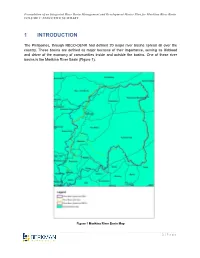
Formulation of an Integrated River Basin Management and Development Master Plan for Marikina River Basin VOLUME 1: EXECUTIVE SUMMARY 1 INTRODUCTION The Philippines, through RBCO-DENR had defined 20 major river basins spread all over the country. These basins are defined as major because of their importance, serving as lifeblood and driver of the economy of communities inside and outside the basins. One of these river basins is the Marikina River Basin (Figure 1). Figure 1 Marikina River Basin Map 1 | P a g e Formulation of an Integrated River Basin Management and Development Master Plan for Marikina River Basin VOLUME 1: EXECUTIVE SUMMARY Marikina River Basin is currently not in its best of condition. Just like other river basins of the Philippines, MRB is faced with problems. These include: a) rapid urban development and rapid increase in population and the consequent excessive and indiscriminate discharge of pollutants and wastes which are; b) Improper land use management and increase in conflicts over land uses and allocation; c) Rapidly depleting water resources and consequent conflicts over water use and allocation; and e) lack of capacity and resources of stakeholders and responsible organizations to pursue appropriate developmental solutions. The consequence of the confluence of the above problems is the decline in the ability of the river basin to provide the goods and services it should ideally provide if it were in desirable state or condition. This is further specifically manifested in its lack of ability to provide the service of preventing or reducing floods in the lower catchments of the basin. There is rising trend in occurrence of floods, water pollution and water induced disasters within and in the lower catchments of the basin. -

Policy Briefing
WAVES Policy Brieng Philippines Policy October 2015 Brieng Summary Ecosystem Accounts Inform Policies for Better A pilot ecosystem Resource Management of Laguna de Bay account was developed for the Laguna de Bay Laguna de Bay is the largest inland body of water in the Philippines to provide information providing livelihood, food, transportation and recreation to key on ood mitigation capacity, water, shery provinces and cities within and around the metropolitan area of Manila. resource management; Competing uses, unsustainable land and water uses coupled with to identify priority areas population and industrial expansion have caused the rapid degradation for protection, regulation of the lake and its watershed. The data from the ecosystem accounts of pollution and sediment can help counter the factors that are threatening the Laguna de Bay's loading; and to inform water quality and ecology. strategies on water pricing and sustainable Land Cover Condition Water Quality development planning. Land conversion due to urban Pollution coming from domestic, sprawl and rapid industrial industrial and agricultural/forest Background development are causing a decline wastes contribute to the The development of the in forest cover and impacting degradation of the water quality. agriculture production. ecosystem accounts is Fish Production based on data collection Flood Mitigation The lake can still sustain sheries and analysis conducted Increase in soil erosion from the production but is threatened by by the Laguna Lake watershed has changed the pollution. Development Authority contours of the lake. (LLDA), the agency responsible for the water and land management of the Laguna Lake Basin. 2003 2010 Technical staff from the different units of the LLDA undertook the analyses supported by international and local experts under the World Bank's Wealth Accounting and the Valuation of Ecosystem Services (WAVES) Global Partnership Programme. -

Taguig City Rivers and Waterways
Taguig City Rivers and Waterways This is not an ADB material. The views expressed in this document are the views of the author/s and/or their organizations and do not necessarily reflect the views or policies of the Asian Development Bank, or its Board of Governors, or the governments they represent. ADB does not guarantee the accuracy and/or completeness of the material’s contents, and accepts no responsibility for any direct or indirect consequence of their use or reliance, whether wholly or partially. Please feel free to contact the authors directly should you have queries. Outline Taguig waterways Issues and concerns A. Informal settlers B. Solid waste C. Waste water D. Erosion Actions Taken TAGUIG CITY LENGTH OF RIVER/CREEK LOCATION LENGTH WIDTH 1 Bagumbayan River 1,700 m 15.00 m 2 Mauling Creek 950 m 10.00 m 3 Conga Creek 3,750 m 8.00 m 4 Old conga Creek 1,400 m 5.00 m 5 Hagonoy River 1,100 m 10.00 m 6 Daang Kalabao Creek 2,750 m 10.00 m 7 Sapang malaki creek 650 m 10.00 m 8 Sapang Ususan Creek 1,720 m 10.00 m 9 Maysapang Creek 420 m 10.00 m 10 Commando Creek 300 m 5.00 m 11 Pinagsama Creek 1,650 m 8.00 m 12 Palingon Creek 340 m 10.00 m 13 Maricaban Creek 2,790 m 10.00 m 14 Pagadling Creek 740 m 10.00 m 15 Taguig River 3,000 m 50.00 m 16 Tipas River 1,360 m 20.00 m 17 Sukol Creek 800 m 10.00 m 18 Daang Manunuso Creek 740 m 10.00 m 19 Ibayo Creek 1,500 m 5.00 m 20 Sto. -

AUG QUITO.Indd
QUITO A student at work in the carpentry workshop of the Escuela Taller Quito, which was established in 1992 to teach traditional construction techniques to underprivileged youngsters HEART AND SOUL Quito’s World Heritage-listed colonial centre is the largest in the Americas. And thanks to municipal intervention and the eff orts of a school for disadvantaged children, the Ecuadorian capital’s historic heart is being revitalised. Dominic Hamilton reports rom the outside, the Escuela Taller Quito (Quito Workshop School) is deceiving. A two-storey mansion F set on one of the narrow streets in the Ecuadorian capital’s historic centre, it looks like a family home. Pass through its ornately carved doorway, however, and it’s another story. Pupils in blue overalls hurry between classrooms, criss-crossing the elegant patio in gaggles of three or four. A bell rings and a hush returns, although this, too, is deceptive. Enter one of the classrooms that ring the patio and you’re confronted with a hive of activity. The fi rst, adjacent to the entrance, is dedicated to carpentry. Inside, pupils are hard at work around half a dozen workbenches. Sketches and examples of completed works in marquetry and inlay decorate the walls. Sculptures at various stages of completion are scattered across the worktops, alongside tools of every size and function. There is a constant hum of knocking, carving, chipping, scraping and banging. The class is led by Maestro Carlos Vinicio Pazmiño, a tall, energetic man in his early 40s who passes from table to table surveying his pupils’ work. A room off to the right is quieter, bathed in studious silence. -

WEDNESDAY Kerosene BLANKETS R Leu^Nttm I K R a Lb ^
J -■ f c . Manchester Evening Herald TUESDAY, DECEMBER l2, IW r^ ►AGE T W E L V E Bonds Keep Bombs Falling—Buy an Extra $100 Bhnd Today! 'an church at the comer of Win «s*etng puopls to Bond IRsfar eontrt- The eleventh Nurses’ Aide cla.sa ter and Garden streets. Y Drive Here b’jtlons promptly so that tlv# drtvo will meet tomorrow afternoon at Noted Soloist k M , Tertiary who has studied will not bs prolonged. About Town 1:30 o’clock, with Mrs. Anno l-al- and traveled extensively, will sing The needed $6,000 has not been ATcragre Daily Cireulatioii raised to date nd with the exten- Shop All Day kowkkl, 68 Alton street. aU the soprano oolo parU and Seen Lagging For the Month of November, 1$44 In Church Role it abould be a musical treat for aive program planned for the The Weather "llAmorial Hospital and Its The Salvation Army Youiik Peo the music lovers and congrega present season thera la urgent Fomeoet ol U. «. Weather niiniaii rutura" wlU be the subject of a ple's Christmas party whlth was tion of Concordli church and need for all In Manchester who are 9,016 ph Contrihutions to Cam interested In the boys and girls, talk to be given before the Rotary to have been held tomorrow eve M . Yerbiiry to Assist Manchester to heai^ Mrs. Yerbury. Member o f the AteUt Fair and moeh aaider toolghli Club thla evening at ttia Y. M. C. ning, has been postpone one Mrs. Yerbury. better known In paign Cximing in Slow to act- ^ tolr and eoaBnoed ceM; A. -

Biodiversity Assessment Study for New
Technical Assistance Consultant’s Report Project Number: 50159-001 July 2019 Technical Assistance Number: 9461 Regional: Protecting and Investing in Natural Capital in Asia and the Pacific (Cofinanced by the Climate Change Fund and the Global Environment Facility) Prepared by: Lorenzo V. Cordova, Jr. M.A., Prof. Pastor L. Malabrigo, Jr. Prof. Cristino L. Tiburan, Jr., Prof. Anna Pauline O. de Guia, Bonifacio V. Labatos, Jr., Prof. Juancho B. Balatibat, Prof. Arthur Glenn A. Umali, Khryss V. Pantua, Gerald T. Eduarte, Adriane B. Tobias, Joresa Marie J. Evasco, and Angelica N. Divina. PRO-SEEDS DEVELOPMENT ASSOCIATION, INC. Los Baños, Laguna, Philippines Asian Development Bank is the executing and implementing agency. This consultant’s report does not necessarily reflect the views of ADB or the Government concerned, and ADB and the Government cannot be held liable for its contents. (For project preparatory technical assistance: All the views expressed herein may not be incorporated into the proposed project’s design. Biodiversity Assessment Study for New Clark City New scientific information on the flora, fauna, and ecosystems in New Clark City Full Biodiversity Assessment Study for New Clark City Project Pro-Seeds Development Association, Inc. Final Report Biodiversity Assessment Study for New Clark City Project Contract No.: 149285-S53389 Final Report July 2019 Prepared for: ASIAN DEVELOPMENT BANK 6 ADB Avenue, Mandaluyong City 1550, Metro Manila, Philippines T +63 2 632 4444 Prepared by: PRO-SEEDS DEVELOPMENT ASSOCIATION, INC C2A Sandrose Place, Ruby St., Umali Subdivision Brgy. Batong Malake, Los Banos, Laguna T (049) 525-1609 © Pro-Seeds Development Association, Inc. 2019 The information contained in this document produced by Pro-Seeds Development Association, Inc. -

November Artists of the Western Hemisphere: Precursors of Modernism 1860- 1930 Dr
1967 ● September – November Artists of the Western Hemisphere: Precursors of Modernism 1860- 1930 Dr. Atl (Gerardo Murillo), Juan Manuel Blanes, Humberto Causa, Joaquín Clausell, Maurice Gallbraith Cullen, Stuart Davis, Thomas Eakins, Pedro Figari, Juan Francisco González, Childe Hassam, Saturnino Herrán, Winslow Homer, George Inness, Francisco Laso, Martín Malharro, John Marin, Vicente do Rego Monteiro, James Wilson Morrice, José Clemente Orozco, Amelia Peláez, Emilio Pettoruti, José Guadalupe Posada, Maurice Brazil Prendergast, Armando Reverón, Diego Rivera, Julio Ruelas, Albert P. Ryder , Andrés de Santa María, Eduardo Sivori , Joseph Stella, Tarsila do Amaral, Tom Thomson, Joaquín Torres-García, José María Velasco Elyseu d’Angelo Visconti Curator: Stanton Loomis Catlin ● December 1967 – January 1968 Five Latin American Artists at Work in New York Julio Alpuy , Carmen Herrera, Fernando Maza, Rudolfo Mishaan, Ricardo Yrarrázaval Curator: Stanton Loomis Catlin 1968 ● February – March Pissarro in Venezuela Fritz George Melbye, Camille Pissarro Curator: Alfredo Boulton ● March – May Beyond Geometry: An Extension of Visual-Artistic Language in Our Time Ary Brizzi, Oscar Bony, David Lamelas, Lía Maisonave, Eduardo Mac Entyre, Gabriel Messil, César Paternosto, Alejandro Puente , Rogelio Polesello, Eduardo Rodríguez, Carlos Silva, María Simón, Miguel Angel Vidal Curator: Jorge Romero Brest ● May – June Minucode 1 Marta Minujín ● September From Cézanne to Miró1 Balthus (Balthazar Klossowski de Rola), Max Beckmann, Umberto Boccioni, Pierre Bonnard, -
After the Fire at the Church of La Compañia De Jesus, Quito, Ecuador
Article: After the fire at the Church of La Compañia de Jesus, Quito, Ecuador Author(s): Constance Stromberg Source: Objects Specialty Group Postprints, Volume Six, 1999 Pages: 112-133 Compilers: Virginia Greene and Emily Kaplan th © 2000 by The American Institute for Conservation of Historic & Artistic Works, 1156 15 Street NW, Suite 320, Washington, DC 20005. (202) 452-9545 www.conservation-us.org Under a licensing agreement, individual authors retain copyright to their work and extend publications rights to the American Institute for Conservation. Objects Specialty Group Postprints is published annually by the Objects Specialty Group (OSG) of the American Institute for Conservation of Historic & Artistic Works (AIC). A membership benefit of the Objects Specialty Group, Objects Specialty Group Postprints is mainly comprised of papers presented at OSG sessions at AIC Annual Meetings and is intended to inform and educate conservation-related disciplines. Papers presented in Objects Specialty Group Postprints, Volume Six, 1999 have been edited for clarity and content but have not undergone a formal process of peer review. This publication is primarily intended for the members of the Objects Specialty Group of the American Institute for Conservation of Historic & Artistic Works. Responsibility for the methods and materials described herein rests solely with the authors, whose articles should not be considered official statements of the OSG or the AIC. The OSG is an approved division of the AIC but does not necessarily represent the AIC policy or opinions. AFTER THE FIRE AT THE CHURCH OF LA COMPAÑIA DE JESUS, QUITO, ECUADOR Constance Stromberg Abstract La Compañía de Jesús is a high style Baroque church built between 1605 and 1767. -
<I> Vanoverberghia </I> (<I>Zingiberaceae</I>) from The
Blumea 63, 2018: 130–134 www.ingentaconnect.com/content/nhn/blumea RESEARCH ARTICLE https://doi.org/10.3767/blumea.2018.63.02.07 A new species of Vanoverberghia (Zingiberaceae) from the Philippines J.H.B. Ambida1, A.M.A. Alviar1, P.S.A. Co1, F.G.M. Concepcion1, C.I. Banag1,2, R.V.A. Docot3 Key words Abstract A new species from the Philippines, Vanoverberghia rubrobracteata, is described and illustrated here. The new species is most similar to Vanoverberghia sepulchrei from which it differs in its leaves with oblong to nar- least concern rowly elliptic lamina, unevenly truncate ligule apex, glabrous and red floral bracts, red calyx, white or pink corolla new species tube and lobes, and absence of spots on the style. Philippines Vanoverberghia Published on 5 September 2018 Zingiberaceae INTRODUCTION TAXONOMIC TREATMENT Vanoverberghia Merr. is currently comprised of only two species Key to Vanoverberghia species namely V. sepulchrei Merr. from the Philippines and V. sasa 1. Pseudostem 2–3 m long; peduncle yellowish green; apices kiana Funak. & H.Ohashi from Taiwan (Zingiberaceae Resource of labellum lobes bifid; mature fruits mid-green. — Taiwan Centre 2018). The type species of the genus, V. sepulchrei, is .................................... V. sasakiana known to be restricted within Northern Luzon to the provinces of 1. Pseudostem 4–8 m long; peduncle red; apices of labellum Mountain Province (type locality), Benguet, and Ifugao (Funa- lobes entire; mature fruits deep red. — Philippines ..... 2 koshi & Ohashi 2000). Herbarium specimens and photographs posted online (e.g., Co’s Digital Flora of the Philippines: www. 2. Lamina oblong; ligule apex rounded; bracts pubescent and philippineplants.org), however, document that V.