Film Synopsis
Total Page:16
File Type:pdf, Size:1020Kb
Load more
Recommended publications
-

Blood Diamond 2006
Blood Diamond 2006 To an extent, Blood Diamond is a victim of its own length. While the film includes a number of disturbing political and sociological insights, the adventure story is tepid and loses momentum as the storyline bogs down. The main character, played by Leonardo DiCaprio, has an effective arc that is believable because it does not force him to act contrary to his nature, but it takes a long time for Blood Diamond to get us to DiCaprio's moment of recognition. Pacing issues aside, this is a well constructed movie - clearly the product of a director who understands how to make a top- notch motion picture. It looks great and sounds great. If only Edward Zwick's mastery of the medium had extended to pruning the screenplay and editing the final result, Blood Diamond might have been a tremendous film rather than one worthy of only a lukewarm recommendation. The story takes place in 1999 Sierra Leone, when the country is embroiled in a civil war. In this struggle, it's hard to determine which side is worse: the government or the rebels. As is often the case in this sort of bloodbath, atrocities abound and it's the innocent farmers and villagers caught in between who pay the price. Diamonds, one of the country's largest exportable commodities, are being smuggled out and purchased on the open market despite a supposed international ban on the purchase of so-called "conflict diamonds" or "blood diamonds." This historical background (which is more complicated as presented in the movie) is accurate, although the three primary characters embroiled in events are fictional. -

Blood Diamond
Blood Diamond Synopsis This story is about an ex-mercenary turned smuggler Danny Archer (Leonard DiCaprio) and a Mende fisherman Soloman Vandy (Djimon Hounsou). Amid the explosive civil war overtaking 1999 Sierra Leone, these men join for two desperate missions: recovering a rare pink diamond of immense value and rescuing the fisherman's son, conscripted as a child soldier into the brutal rebel forces ripping a swath of torture and bloodshed across the alternately beautiful and ravaged countryside. Introduction This resource is aimed at GCSE, AS, A2 and Highers students. The questions and points of discussion raised throughout this resource are connected to the official website for the film. Clip references refer to sequences that can be found on the official website: http://blooddiamondmovie.warnerbros.com/ In addition to the questions and discussion points raised, there is an existing Amnesty Resource (see link at the end of this document) developed to accompany the film and covers in-depth context and tasks. These materials combined touch on topics that teachers may find useful for Film and Media Studies, Citizenship, Politics and Business Studies. www.filmeducation.org 1 ©Film Education 2007. Film Education is not responsible for the content of external sites. Trailer Analysis How is the setting established? Think about the types of shots that are used. The structure of the trailer shows us the credentials of the director. What does this tell us about the film’s potential audience? How important is this to you as a cinemagoer? Does it affect your choice? The trailer is designed to establish a sense of the story for the widest potential audience. -

Making Defiance Where He Built a Trucking Business with His Wife Lilka, (Played in the Film by Alexa Davalos)
24 | Lexington’s Colonial Times Magazine MARCH | APRIL 2009 a book, and a book is not a movie. So it has to be different. I cannot put everything that comes from years of work into two hours.’” “Did you actually talk to Tuvia?” prompted Leon Tec. His wife introduced him to the audience as “The troublemaker, my husband.” After the war Tuvia Bielski moved first to Israel and then to New York, Making Defiance where he built a trucking business with his wife Lilka, (played in the film by Alexa Davalos). Nechama Tec had spoken with him by telephone while researching her book “In the Lion’s Den,” but all attempts to meet in person had been stymied by Lilka Bielski’s excuses. Finally, Tec secured a meeting at the Bielskis’ Brooklyn home in May 1987. She hired a driver for the two-hour drive from Westport, Conn., and was greeted by Lilka, who told her that Tuvia had had a bad night, was very sick, and could not see her as planned. Tec said that she was leaving for Israel the next day on a research trip, and was politely insistent. “I want to get a sense of the man before I go,” she told Lilka. “So we’re going back and forth on the doorstep and she doesn’t let me in, and we hear a voice from the other room, ‘Let her in,’” recalled Tec. Tuvia Bielski, clearly weak and very sick, came out to meet her, dismissed the hovering Lilka, and sat down with Tec and her tape recorder. -
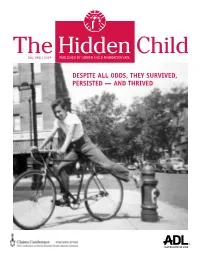
Despite All Odds, They Survived, Persisted — and Thrived Despite All Odds, They Survived, Persisted — and Thrived
The Hidden® Child VOL. XXVII 2019 PUBLISHED BY HIDDEN CHILD FOUNDATION /ADL DESPITE ALL ODDS, THEY SURVIVED, PERSISTED — AND THRIVED DESPITE ALL ODDS, THEY SURVIVED, PERSISTED — AND THRIVED FROM HUNTED ESCAPEE TO FEARFUL REFUGEE: POLAND, 1935-1946 Anna Rabkin hen the mass slaughter of Jews ended, the remnants’ sole desire was to go 3 back to ‘normalcy.’ Children yearned for the return of their parents and their previous family life. For most child survivors, this wasn’t to be. As WEva Fogelman says, “Liberation was not an exhilarating moment. To learn that one is all alone in the world is to move from one nightmarish world to another.” A MISCHLING’S STORY Anna Rabkin writes, “After years of living with fear and deprivation, what did I imagine Maren Friedman peace would bring? Foremost, I hoped it would mean the end of hunger and a return to 9 school. Although I clutched at the hope that our parents would return, the fatalistic per- son I had become knew deep down it was improbable.” Maren Friedman, a mischling who lived openly with her sister and Jewish mother in wartime Germany states, “My father, who had been captured by the Russians and been a prisoner of war in Siberia, MY LIFE returned to Kiel in 1949. I had yearned for his return and had the fantasy that now that Rivka Pardes Bimbaum the war was over and he was home, all would be well. That was not the way it turned out.” Rebecca Birnbaum had both her parents by war’s end. She was able to return to 12 school one month after the liberation of Brussels, and to this day, she considers herself among the luckiest of all hidden children. -
PDF (751.18 Kib)
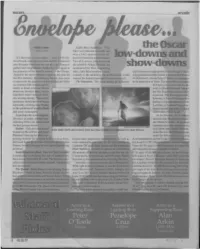
arcade II Annie Jones Little Miss Sunshine: Thi5. staff writer film's very talented en emble ca t won a SAG award for their col- It's that time of year again - エ ゥ ュ セ for Holly- lectively heartfelt performances. wood hunks and silver screen starlets to squeeze Two of its actors, Alan Arkin and into designer eveningwear and pile into limos to the adorable Abagail Brc lin, arc gather and congratulate them elves yet again at nominated for their supporting the pinnacle of the wards season - the Oscars. roles. Little Miss Sunshine, a semi- ety of characters ranging from Ryan Go ling's tum as Arguably the most important night of the year for comcdy, is the underdog, but an Oscar win would a drug-addicted middle school teacher in HalfNelson the film industry, the Academy Awards has come cement the hopeful message of the movie itself. to Hollywood veteran Peter O'Toole's performance to represent the glamour of movies and provides The Departed: This crime drama set in Boston as an aging actor in Venus. The oft- nubbcd Leonardo us common folk with an oppor- DiCaprio received a nod for his tunity to drool over and dream work in Blood Diamond, but not about our favorite stars, ju t m for The Departed, a wa widely case there wasn't enough celeb- expected. The frontrunner here, rity worship already. This year's however, is Fore. t Whitaker, who ceremony should prove to be an portrays a Ugandan dictator in The especially exciting one, thanks Last King ofScotland. -

Gazeta Spring 2019 Roman Vishniac (1897-1990) Albert Einstein in His Office, Princeton University, New Jersey, 1942
Volume 26, No. 1 Gazeta Spring 2019 Roman Vishniac (1897-1990) Albert Einstein in his office, Princeton University, New Jersey, 1942. Gelatin Silver print. The Magnes Collection of Jewish Art and Life, University of California, Berkeley, gift of Mara Vishniac Kohn, 2016.6.10. A quarterly publication of the American Association for Polish-Jewish Studies and Taube Foundation for Jewish Life & Culture Editorial & Design: Tressa Berman, Fay Bussgang, Julian Bussgang, Shana Penn, Antony Polonsky, Adam Schorin, Maayan Stanton, Agnieszka Ilwicka, William Zeisel, LaserCom Design. CONTENTS Message from Irene Pipes ............................................................................................... 2 Message from Tad Taube and Shana Penn ................................................................... 3 FEATURES The Road to September 1939 Jehuda Reinharz and Yaacov Shavit ........................................................................................ 4 Honoring the Memory of Paweł Adamowicz Antony Polonsky .................................................................................................................... 8 Roman Vishniac Archive Gifted to Magnes Collection of Jewish Art and Life Francesco Spagnolo ............................................................................................................ 11 Keeping Jewish Memory Alive in Poland Leora Tec ............................................................................................................................ 15 The Untorn Life of Yaakov -

Teaching Social Studies Through Film
Teaching Social Studies Through Film Written, Produced, and Directed by John Burkowski Jr. Xose Manuel Alvarino Social Studies Teacher Social Studies Teacher Miami-Dade County Miami-Dade County Academy for Advanced Academics at Hialeah Gardens Middle School Florida International University 11690 NW 92 Ave 11200 SW 8 St. Hialeah Gardens, FL 33018 VH130 Telephone: 305-817-0017 Miami, FL 33199 E-mail: alvarino@dadeschools.net Telephone: 305-348-7043 E-mail: jburkj@dadeschools.net For information concerning IMPACT II opportunities, Adapter and Disseminator grants, please contact: The Education Fund 305-892-5099, Ext. 18 E-mail: Lvalle@educationfund.org Web site: www.educationfund.org - 1 - INTRODUCTION Students are entertained and acquire knowledge through images; Internet, television, and films are examples. Though the printed word is essential in learning, educators have been taking notice of the new visual and oratory stimuli and incorporated them into classroom teaching. The purpose of this idea packet is to further introduce teacher colleagues to this methodology and share a compilation of films which may be easily implemented in secondary social studies instruction. Though this project focuses in grades 6-12 social studies we believe that media should be infused into all K-12 subject areas, from language arts, math, and foreign languages, to science, the arts, physical education, and more. In this day and age, students have become accustomed to acquiring knowledge through mediums such as television and movies. Though books and text are essential in learning, teachers should take notice of the new visual stimuli. Films are familiar in the everyday lives of students. -

Time to Rethink the Kimberley Process: the Zimbabwe Case - International Crisis Group
Time to Rethink the Kimberley Process: The Zimbabwe Case - International Crisis Group English Français Regions / Countries Browse by Publication Type Key Issues About Crisis Group Support Crisis Group ••••••• Other emailtwitter alerts Press Sitemap Text only RSS Login facebook Register Regions / Countries Homepage > Regions / Countries > Africa > Southern Africa > Zimbabwe > Time to Rethink the Kimberley Process: The Zimbabwe Case ● Africa ❍ Time to Rethink the Kimberley Process: The Zimbabwe Case Central Africa Thierry Vircoulon, On the African Peacebuilding Agenda | 4 Nov 2010 ❍ Horn of Africa On 11-12 September 2010, Zimbabwe auctioned diamonds from the controversial Marange mines. There was ❍ Southern Africa little international condemnation, especially compared to the controversy over the first sale of Marange diamonds in August. Since an export ban was imposed on diamonds from Marangein November 2009, the Kimberley ■ Angola Process (KP)[1] has permitted Zimbabwe to hold two auctions, although the country has not been able to guarantee that widespread human rights violations in the mines and smuggling have stopped. Criticised by both ■ Madagascar those who favour and those who oppose the ban, this unusual compromise demonstrates that the KP’s narrow ■ Zimbabwe definition of conflict diamonds is inadequate, and that the body must expand its authority if it is not to loose its credibility and legitimacy as the diamond-trade watchdog. ❍ West Africa A. Zimbabwe: Still Trying for Democracy Zimbabwe, a landlocked country of some 12.5 million inhabitants, is stuck in a decade-long political crisis and ● Asia struggling to move from dictatorship to democracy. For 28 years from independence in 1980, Robert Mugabe ● Europe ruled uninterrupted. -

1984 Holocaust Conference at Yale Education And
1984 HOLOCAUST CONFERENCE AT YALE EDUCATION AND THE HOLOCAUST: NEW RESPONSIBILITIES AND COOPERATIVE VENTURES Sponsored by the Video Archive for Holocaust Testimonies at Yale and Facing History and Ourselves October 28 - 29, 1984 Whitney Humanities Center 53 Wall Street New Haven, Connecticut PROGRAM SUNDAY, OCTOBER 28,1984 Registration Display of Materials of Participants (Auditorium) Materials for display will be accepted from 10:OOam Conference Introduction (Room 208) Welcoming Remarks by Geoffrey Hartman Introduction of Participants and Organizations by Margot Stern Strom Challenges in the Field of Education Moderated by William Parsons An Urban Perspective - Marcia Littell The Washington Museum - David Altschuler A State University - Alvin Rosenfeld State Mandated Education - Edwin Reynolds Coffee Break Witness Accounts: Problems and Promises Lawrence Langer Discussion moderated by Lawrence Langer and Geoffrey Hartrnan Cocktails and Dinner Focus Abroad - Special Public Event CANADA ALAN BARDIKOFF FRANCE MICHAEL POLLAK HOLLAND RABBI AWRAHAM SOETENDORP ISRAEL YEHUDA BAUER WEST GERMANY JACOV KATWAN Auditorium - Open to the Public MONDAY, OCTOBER 29, 1984 8:30am - 9:OOam Coffee 9:OOam - 9:30am Connections: An Open Discussion (Room 208) 9:30am - 10:OOam Trying to Get Things Together: The Case of New Haven - Dorothy and Jerome Singer 10:OOam - 11:Wam Archival ~at&ial:Coordinating Access and Retrieval A Researcher's Perspective - Joan Ringelheim An Archivist's Perspective - Sandra Rosenstock Toward a Shared Communication System- Katharine -

How Much Do You Know About the Holocaust and Jewish Resistance?
TO BEGIN... HOW MUCH DO YOU KNOW ABOUT THE HOLOCAUST AND JEWISH RESISTANCE? Answer each of these questions with TO LEARN MORE... “true” or “false”: ________1. Adolf Hitler took advantage of the dire WEBSITES economic conditions in Germany in his ascent • Defiance, www.defiancemovie.com to power. • Anti-Defamation League, www.adl.org • Jewish Partisans Educational Foundation, ________2. The Nuremberg Laws were an outcome of the www.jewishpartisans.org Nuremberg War Crime Trials. • Museum of Jewish Heritage, www.mjhnyc.org • Simon Wiesenthal Center, www.wiesenthal.com ________3. The Ribbentrop-Molotov Pact was also known • The Jewish Foundation for the Righteous, www.jfr.org as the German-Soviet Non-aggression Pact. • The United States Holocaust Memorial Museum, www.ushmm.org ________4. Russian partisans and Jewish partisans fought against the Nazis during World War II. BOOKS ________5. Jewish resistance during the Holocaust • Defiance: The Bielski Partisans, by Nechama Tec. Oxford consisted of guerilla fighters who continually University Press, 1993. engaged the German troops in combat. • Daring to Resist: Jewish Defiance During the Holocaust by Yitzhak Mais (ed). Museum of Jewish Heritage, April 2007. ________6. There were about 5,000 Jewish partisans— • Jewish Resistance in Nazi-Occupied Eastern Europe, by Jews who formed organized, armed resistance Reuben Ainsztein. Harper & Row, 1974. groups and who fought back against the Nazis. • On Both Sides of the Wall, by Vladkka Meed. Schocken Books, June 1993. ________7. Spiritual resistance during World War II was • Resisting the Holocaust, by Ruby Rohrlich (ed.). limited to prayer. Berg, 1998. FILMS ________8. Jewish partisans in or near the Soviet Union relied heavily on the support of Russian • Defiance (2008) partisan groups in their efforts to undermine • Daring to Resist: Three Women Face the Holocaust (1986) the Nazis. -

The Kimberley Process: Conflict Diamonds, WTO Obligations, and the Universality Debate Tracey Michelle Price
University of Minnesota Law School Scholarship Repository Minnesota Journal of International Law 2003 The Kimberley Process: Conflict Diamonds, WTO Obligations, and the Universality Debate Tracey Michelle Price Follow this and additional works at: https://scholarship.law.umn.edu/mjil Part of the Law Commons Recommended Citation Price, Tracey Michelle, "The Kimberley Process: Conflict Diamonds, WTO Obligations, and the Universality Debate" (2003). Minnesota Journal of International Law. 115. https://scholarship.law.umn.edu/mjil/115 This Article is brought to you for free and open access by the University of Minnesota Law School. It has been accepted for inclusion in Minnesota Journal of International Law collection by an authorized administrator of the Scholarship Repository. For more information, please contact lenzx009@umn.edu. Articles The Kimberley Process: Conflict Diamonds, WTO Obligations, and the Universality Debate Tracey Michelle Price" "Diamondsare forever, it is often said. But lives are not. We must spare people the ordeal of war, mutilations and death for the sake of conflict diamonds."' INTRODUCTION At the hands of rebels, dictators, and terrorists, diamonds have crystallized into a source of financing for conflict and civil wars, which have caused the deaths of more than two million people.2 These "conflict" diamonds have additionally threatened to tarnish the legitimate diamond trade by associating dia- monds with hardened brutality. The international community has attempted to curb the trade of conflict diamonds and pro- mote peace and stability in Angola, the Mano River Union states,3 and the Great Lakes region 4 of Africa. In the last two * LL.M. Candidate, Georgetown University Law Center; J.D., 1997, University of Baltimore School of Law; B.A., University of Georgia. -
Produced with the Participation of Blue Ice Docs
Cinephil presents An Ink & Pepper / Big World Cinema / Appian Way production In Association with Gabriel Films Produced with the participation of Blue Ice Docs A film by Anjali Nayar World Premiere at 80 minutes English, Liberian English • • Canada/South Africa/Kenya 2017 • Contacts at TIFF: Producer: Producer: Steven Markovitz Anjali Nayar Big World Cinema Ink & Pepper Productions E: steven@bigworld.co.za E: T: +27 83 2611 044 T: +1- 415-910-4625 Sales Agent: Publicist: Philippa Kowarsky Charlene Coy Cinephil C2C Communications E: philippa@cinephil.com E: charlene@c2ccommunications.com T: +972 3 566 4129 T: +1-416-451-1471 Tagline: No more business as usual Logline With a network of dedicated citizen reporters by his side, seasoned Liberian activist Silas Siakor challenges the corrupt and nepotistic status quo in his fight for local communities. Synopsis Liberian activist, Silas Siakor is a tireless crusader, fighting to crush corruption and environmental destruction in the country he loves. Through the focus on one country, Silas is a global tale that