Alan Ryan: on Politics, Book One Study Guide, 2013
Total Page:16
File Type:pdf, Size:1020Kb
Load more
Recommended publications
-
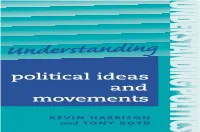
Political Ideas and Movements That Created the Modern World
harri+b.cov 27/5/03 4:15 pm Page 1 UNDERSTANDINGPOLITICS Understanding RITTEN with the A2 component of the GCE WGovernment and Politics A level in mind, this book is a comprehensive introduction to the political ideas and movements that created the modern world. Underpinned by the work of major thinkers such as Hobbes, Locke, Marx, Mill, Weber and others, the first half of the book looks at core political concepts including the British and European political issues state and sovereignty, the nation, democracy, representation and legitimacy, freedom, equality and rights, obligation and citizenship. The role of ideology in modern politics and society is also discussed. The second half of the book addresses established ideologies such as Conservatism, Liberalism, Socialism, Marxism and Nationalism, before moving on to more recent movements such as Environmentalism and Ecologism, Fascism, and Feminism. The subject is covered in a clear, accessible style, including Understanding a number of student-friendly features, such as chapter summaries, key points to consider, definitions and tips for further sources of information. There is a definite need for a text of this kind. It will be invaluable for students of Government and Politics on introductory courses, whether they be A level candidates or undergraduates. political ideas KEVIN HARRISON IS A LECTURER IN POLITICS AND HISTORY AT MANCHESTER COLLEGE OF ARTS AND TECHNOLOGY. HE IS ALSO AN ASSOCIATE McNAUGHTON LECTURER IN SOCIAL SCIENCES WITH THE OPEN UNIVERSITY. HE HAS WRITTEN ARTICLES ON POLITICS AND HISTORY AND IS JOINT AUTHOR, WITH TONY BOYD, OF THE BRITISH CONSTITUTION: EVOLUTION OR REVOLUTION? and TONY BOYD WAS FORMERLY HEAD OF GENERAL STUDIES AT XAVERIAN VI FORM COLLEGE, MANCHESTER, WHERE HE TAUGHT POLITICS AND HISTORY. -

Michels's Iron Law of Oligarchy
MICHELS’S IRON LAW OF OLIGARCHY Robert Michels ( 1876– 1936), was a young historian who had been unable to get a job in the German university system, despite the recommendation of Max Weber, because he was a member of the Social Democrats. Michels had participated extensively in party activities and had come to the conclusion that the Socialists did not live up to their own ideals. Although the party advocated democracy, it was not internally democratic itself. The revolutionary Marxism of the speeches at conventions and on the floor of the Reichstag was just a way of whipping up support among the workers, while the party leaders built a bureaucratic trade union and party machine to provide sinecures for themselves. Michels’s analysis appeared in 1911 in a book called Political Parties. The phenomenon of party oligarchy was quite general, stated Michels; if internal democracy could not be found in an organization that was avowedly democratic, it would certainly not exist in parties which did not claim to be democratic. This principle was called the Iron Law of Oligarchy, and it constitutes one of the great generalizations about the functioning of mass‐ membership organizations, as subsequent research has borne out. The Iron Law of Oligarchy works as follows: First of all, there is always a rather small number of persons in the organization who actually make decisions, even if the authority is formally vested in the body of the membership at large. The reason for this is purely functional and will be obvious to anyone who has attended a public meeting or even a large committee session. -

Of Kings and Popes and Law
Of Kings and Popes and Law: An Examination of the Church and State Relationship in England During the High Middle Ages and the Influence of that Relationship on the Structure and Processes of English Law by Jan Katherine Clark B.A., University of Calgary, 1976 M.Sc., University of Calgary, 1986 LL.B., University of Calgary, 1989 A Thesis Submitted in Partial Fulfillment of the Requirements for the Degree of MASTER OF LAWS in the Faculty of Law © Jan Katherine Clark, 2012 University of Victoria All rights reserved. This thesis may not be reproduced in whole or in part, by photocopy or other means, without the permission of the author. ii Supervisory Committee Of Kings and Popes and Law: An Examination of the Church and State Relationship in England During the High Middle Ages and the Influence of that Relationship on the Structure and Processes of English Law by Jan Katherine Clark B.A., University of Calgary, 1976 M.Sc., University of Calgary, 1986 LL.B., University of Calgary, 1989 Supervisory Committee Professor Emeritus John McLaren, Co-Supervisor (Faculty of Law) Professor Hamar Foster, Q.C., Co-Supervisor (Faculty of Law) iii Abstract Supervisory Committee Professor Emeritus John McLaren, Co-Supervisor (Faculty of Law) Professor Hamar Foster, Q.C., Co-Supervisor (Faculty of Law) During the latter half of the 11th century through to the end of the 13th century, Europe was experiencing what is considered by some historians as “the” medieval renaissance, otherwise referred to as the European Renaissance of the Twelfth Century. The time appears to have been ripe for an explosion of cultural and intellectual advancement and change. -

Tilly Goes to Church: the Religious and Medieval Roots of State Formation in Europe
Tilly Goes to Church: The Religious and Medieval Roots of State Formation in Europe Anna Grzymala-Busse Stanford University August 31, 2020 Abstract How did the state arise in Europe? Canonical accounts argue that war made the state: inter state conflict led to taxation and state formation. These accounts focus on the early modern period and start with the territorial fragmentation as a given. Yet once we move back the analysis to the Middle Ages, a powerful actor appears: the Roman Catholic Church. The Medieval Church was a powerful rival to monarchs and rulers, challenging their sovereignty and the authority of nascent states, and deliberately fragmenting medieval Europe. It was also a rich source of human capital and administrative solutions, the building blocks of state institutions. Religious rivalry and emulation in the middle ages fundamentally shaped state formation in Europe. Very drafty version: Cite at your own risk Acknowledgments: I am grateful to Arun Advait and Hans Lueders for their expert research assistance. 1 1 Introduction How did the modern state arise? Charles Tilly's answer is as succinct as it is canonical: \war made the state and the state made war" (Tilly 1975, 42). In early modern Europe, violent rivalry among fragmented nascent states for territory and resources led them to tax their populations to extract resources. Rulers who succeeded in building up the administrative and military apparatus of war went on to consolidate their territorial gains and ensure the survival of their states. Yet pushing back the analysis a few centuries, to the Middle Ages, reveals new perspectives on this powerful and venerated \bellicist" account. -
Philip David Handyside Class of 2006 “Rise
Philip David Handyside Class of 2006 “Rise and Fall of the Knights Templar: From Power to Persecution” History (major) May 2006-10-24 With gratitude to E. Kurlander, K. Reiter, P. Steeves, and M. McNicholas Pledged: P. D. Handyside Approved: E. Kurlander, Faculty Advisor M. Venzke, Chair, History Senior Research Submitted in partial fulfilment of the requirements for HY 499 Stetson University 6th December, 2005 Abstract Created around 1230 CE, the Poor Knights of Christ and of the Temple of Solomon were created in order to protect pilgrims on their journey through the new Christian kingdom in Palestine. Starting out as a small group, these warrior monks soon grew in power and prestige under the benefaction of St. Bernard and were charged with the protection of the Catholic Church by Pope Innocent II. Along with this favour bestowed upon them, the Templars quickly accumulated a great amount of wealth and territory across Europe. However, their power base was always in the Holy Land. The capture by Muslims of the city of Acre, the final Christian stronghold in Palestine, deprived them of this power base. Following this they were free to the predations of ambitious secular rulers, such as Philip IV of France. Philip, anxious to establish his authority and to acquire more revenue producing lands, was able to bring charges against the Templars accusing them of heresy which led to the eventual arrest and disbandment of the Knights Templar. The loss of their power base left the Templars vulnerable to condemnation by the society at large and, as such, they were unable to protect themselves, or be protected by others, when they came under threat. -

The Heart of Peace: Christine De Pizan and Christian Theology
The Heart of Peace: Christine de Pizan and Christian Theology The Harvard community has made this article openly available. Please share how this access benefits you. Your story matters Citation Gower, Margaret Marion. 2015. The Heart of Peace: Christine de Pizan and Christian Theology. Doctoral dissertation, Harvard University, Graduate School of Arts & Sciences. Citable link http://nrs.harvard.edu/urn-3:HUL.InstRepos:23845469 Terms of Use This article was downloaded from Harvard University’s DASH repository, and is made available under the terms and conditions applicable to Other Posted Material, as set forth at http:// nrs.harvard.edu/urn-3:HUL.InstRepos:dash.current.terms-of- use#LAA The Heart of Peace: Christine de Pizan and Christian Theology A dissertation presented by Margaret Marion Gower to The Committee on the Study of Religion in partial fulfillment of the requirements for the degree of Doctor of Philosophy in the subject of The Study of Religion Harvard University Cambridge, Massachusetts August 2015 © 2015 Margaret Marion Gower All rights reserved. Dissertation Advisor: Professor Amy Hollywood Margaret Marion Gower The Heart of Peace: Christine de Pizan and Christian Theology Abstract This dissertation argues that, across her corpus, Christine de Pizan (c.1364-c.1431) advanced a notion of the common good that is both, and inseparably, political and theological. The project critically analyzes Christine’s theological notions of human personhood, moral formation, prudential self-interest, and destructive preoccupation with personal good. It demonstrates that Christine responded to, retooled, and restructured authoritative texts and traditions in order to compose a constructive notion of the common good. -

The Iron Law of Oligarchy: a Tale of 14 Islands ∗
The Iron Law of Oligarchy: A Tale of 14 Islands ∗ Christian Dippely Jean Paul Carvalhoz December 15, 2014 Abstract The great puzzle of Caribbean history in the mid-19th century is that this was a time of radical institutional change – with all but one of the long-established Caribbean parliaments voting themselves out of existence inside a twenty-year window – despite very stable conditions in the (exogenous) terms-of-trade and in the (endogenous) local plantation economy. This paper argues that the post-slavery change of the planter elite into a more creole and colored composition did not change the incentives of the coercive Caribbean plantation economy, but that it did undermine the elite’s ability to dominate the political process within the given set of formal institutions, i.e. the locally elected parliaments. The new elite needed a new set of formal institutions to maintain the existing coercive institutional bundle. The first argument is a version of the ”iron law of oligarchy” (Michels (1911)), the second a version of the ”seesaw of de jure and de facto institutions” (Acemoglu and Robinson (2008)). Guided by a model of elite coherence and institutional choice, we explore our two arguments in a combination of very rich micro-data on islands’ parliamentary politics and sugar plantations, as well as colony-level regression analysis. Keywords: Iron law of Oligarchy, Bankruptcy, de jure and de facto Institutions, Economic Development JEL Codes: F54, N26, O43, P16 ∗Financial support from UCLA’s Burkle Center, Center for Economic History and Price Center are gratefully acknowledged. yUniversity of California, Los Angeles, and NBER. -
Satire and the Corpus Mysticum During Crises of Fragmentation
UNIVERSITY OF CALIFORNIA Los Angeles The Body Satyrical: Satire and the Corpus Mysticum during Crises of Fragmentation in Late Medieval and Early Modern France A dissertation submitted in partial satisfaction of the requirements for the degree Doctor of Philosophy in French and Francophone Studies by Christopher Martin Flood 2013 © Copyright by Christopher Martin Flood 2013 ABSTRACT OF THE DISSERTATION The Body Satyrical: Satire and the Corpus Mysticum during Crises of Fragmentation in Medieval and Early Modern France by Christopher Martin Flood Doctor of Philosophy in French and Francophone Studies University of California, Los Angeles, 2013 Professor Jean-Claude Carron, Chair The later Middle Ages and early modern period in France were marked by divisive conflicts (i.e. the Western Schism, the Hundred Years’ War, and the Protestant Reformation) that threatened the stability and unity of two powerful yet seemingly fragile social entities, Christendom and the kingdom of France. The anxiety engendered by these crises was heightened by the implicit violence of a looming fragmentation of those entities that, perceived through the lens of the Pauline corporeal metaphor, were imagined as corpora mystica (mystical bodies). Despite the gravity of these crises of fragmentation, ii each met with a somewhat unexpected and, at times, prolific response in the form of satirical literature. Since that time, these satirical works have been reductively catalogued under the unwieldy genre of traditional satire and read superficially as mere vituperation or ridiculing didacticism. However, when studied against the background of sixteenth- century theories of satire and the corporeal metaphor, a previously unnoticed element of these works emerges that sets them apart from traditional satire and provides an original insight into the culture of the time. -

History of the Christian Church, Volume VI: the Middle Ages
History of the Christian Church, Volume VI: The Middle Ages. A.D. 1294-1517 Author(s): Schaff, Philip (1819-1893) Publisher: Grand Rapids, MI: Christian CLassics Ethereal Library Description: Philip Schaff©s History of the Christian Church excels at providing an impressive and instructive historical treatment of the Christian church. This eight volume work begins with the early Church and ends at 1605 with the Swiss Reforma- tion. Schaff©s treatment is comprehensive and in depth, dis- cussing all the major (and minor!) figures, time periods, and movements of the Church. He includes many footnotes, maps, and charts; he even provides copies of original texts in his treatment. One feature of the History of the Christian Church that readers immediately notice is just how beautifully written it is--especially in comparison to other texts of a sim- ilar nature. Simply put, Schaff©s prose is lively and engaging. As one reader puts it, these volumes are "history written with heart and soul." Although at points the scholarship is slightly outdated, overall History of the Christian Church is great for historical referencing. Countless people have found History of the Christian Church useful. Whether for serious scholar- ship, sermon preparation, daily devotions, or simply edifying reading, History of the Christian Church comes highly recom- mended. Tim Perrine CCEL Staff Writer Subjects: Christianity History i Contents Title Page 1 Preface 2 History of the Christian Church, Volume VI 4 Introductory Survey 4 The Decline Of The Papacy And The Avignon Exile 7 Sources and Literature 8 Pope Boniface VIII. 1294-1303 13 Boniface VIII. -

THE LOST SOUL of the BODY POLITIC a Dissertation by JESSE ALLEN CHUPP Submitted to the Office of Graduate Studies of Texas A&
THE LOST SOUL OF THE BODY POLITIC A Dissertation by JESSE ALLEN CHUPP Submitted to the Office of Graduate Studies of Texas A&M University in partial fulfillment of the requirements for the degree of DOCTOR OF PHILOSOPHY May 2012 Major Subject: Political Science THE LOST SOUL OF THE BODY POLITIC A Dissertation by JESSE ALLEN CHUPP Submitted to the Office of Graduate Studies of Texas A&M University in partial fulfillment of the requirements for the degree of DOCTOR OF PHILOSOPHY Approved by: Chair of Committee, Cary J. Nederman Committee Members, Robert Harmel Judith Baer Leah DeVun Head of Department, James Rogers May 2012 Major Subject: Political Science iii ABSTRACT The Lost Soul of the Body Politic. (May 2012) Jesse Allen Chupp, B.S., Indiana Wesleyan University; M.A., Ball State University Chair of Advisory Committee: Dr. Cary J. Nederman The modern nation-state is the product of a gradual process in which the religiously concerned medieval political and ecclesiastical synthesis became more secular and centralized. Mirroring this external institutional development, the theoretical conception of the state changed from one of a natural organic unity of diverse corporate members, often described metaphorically as a Body Politic, to a consent-based compact among atomized individuals. This change can be traced in the Body Politic metaphor of four authors: John of Salisbury, Christine de Pizan, Johannes Althusius, and Jean-Jacques Rousseau. In this project, I argue that the Body Politic metaphor, particularly the inclusion or exclusion of a soul of the Body Politic, is uniquely appropriate for capturing the complexity of political life in general across differing levels of aggregation and for elucidating the political and religious commitments of the authors who employ it, as they critique their own contemporary political and religious institutions and describe their ideal societies. -

How Political Parties Shape Democracy
UC Irvine CSD Working Papers Title HOW POLITICAL PARTIES SHAPE DEMOCRACY Permalink https://escholarship.org/uc/item/17p1m0dx Author van Biezen, Ingrid Publication Date 2004-11-01 eScholarship.org Powered by the California Digital Library University of California CSD Center for the Study of Democracy An Organized Research Unit University of California, Irvine www.democ.uci.edu This paper assesses the relationship between the nature of political parties and varieties of democracy1. It is argued that the changing role of parties can be attributed to an ideational transformation by which parties have gradually come to be seen as necessary and desirable institutions for democracy, and that this has contributed to a changing conception of parties from voluntary private associations towards the political party as a ‘public utility’, i.e. the party as an essential public good for democracy. Recent cases of democratization, where parties were attributed a markedly privileged position within the democratic institutional framework, provide the most unequivocal testimony of such a conception of the relationship between parties and democracy. At the same time, however, fundamental disagreements persist about the meaning of democracy and the actual role of political parties within it. Regrettably, however, the literatures on parties and democratic theory have developed to a large degree in mutual isolation. This paper provides a preliminary attempt to move beyond the consensus which exists on the surface that modern democracy is unthinkable save in terms of parties by considering varieties of party and different conceptions of democracy. On the Paradox of Party As Schattschneider famously asserted more than half a century ago, ‘the political parties created democracy and modern democracy is unthinkable save in terms of the political parties’ (Schattschneider, 1942:1). -

The Situation of Dominican Political Thought and Activities in France and England
THE SITUATION OF DOMINICAN POLITICAL THOUGHT AND ACTIVITIES IN FRANCE AND ENGLAND by BARRIE ALFRED BRILL B.A., University of British Columbia, 1966 A THESIS SUBMITTED IN PARTIAL FULFILMENT OF THE REQUIREMENTS FOR THE DEGREE OF MASTER OF ARTS in the Department of History We accept this thesis as conforming to the required standard THE UNIVERSITY OF BRITISH COLUMBIA May, 1968 In presenting this thesis in partial fulfilment of the requirements for an advanced degree at the University of British Columbia, I agree that the Library shall make it freely available for reference and study. I further agree that permission for extensive copying of this thesis for scholarly purposes may be granted by the Head of my Department or by his represen• tatives. It is understood that copying or publication of this thesis for financial gain shall not be allowed without my written permission. Department of History The University of British Columbia Vancouver 8, Canada Date May 2nd, 1968 THESIS ABSTRACT Chairman: Father T. J. Hanrahan. Title: The Situation o£ Dominican Political Thought and Activities in France and England. Examiners: This thesis investigates the political thought and activities of the French and English Dominicans. It began historically with a question concerning the nature of the work of John of Paris. Can his De potestate regia et papali be described as a fundamentally theological and philosophical exposition? Such a description would seem to imply a partial separation from the political situation in which he wrote and would see his treatise in relation to the vast mass of the theological literature of the day.