Newzh Vijiizna
Total Page:16
File Type:pdf, Size:1020Kb
Load more
Recommended publications
-

Colorado Journal of Asian Studies
COLORADO JOURNAL OF ASIAN STUDIES Volume 4, Issue 1 (Summer 2015) 1. Capitalist Influences on Chinese Masculinities through Cinema Earl Grey Chrysogelos 18. Working Hard or Hardly Working: An Examination of Factors Contributing to Workloads of Tokugawa Era Peasants Laura Graham 34. Newars of Kathmandu Valley Chandan Maharjan 48. Nationalist Archaeologies of Korea and Applying Multivocal Interpretations Jessica Wolff Colorado'Journal'of'Asian'Studies' Volume'4,'Issue'1'(Summer'2015)' ! ! Center'for'Asian'Studies,'University'of'Colorado' 1424'Broadway'Street,'Boulder'CO'80309' Colorado'Journal'of'Asian'Studies' Volume'3,'Issue'1'(Summer'2014)' The'Colorado'Journal'of'Asian'Studies'is'an'undergraduate'journal'published'by'the'Center'for'Asian'Studies' at'the'University'of'Colorado'at'Boulder.'Each'year'we'highlight'outstanding'theses'from'our'graduating' seniors'in'the'Asian'Studies'major.' ! ! ! EXECUTIVE!BOARD! AY'2014P2015' ' Tim!Oakes,'Director' ' Tim!Weston,'Associate'Director' Danielle!Rocheleau!Salaz,'Executive'Director' Steve!Chan! Jennifer!Fluri! Chris!Hammons! Faye!Kleeman! Dennis!McGilvray! Rob!McNown! Meg!Moritz! ' ' ' CURRICULUM!COMMITTEE! AY'2014P2015' ' Tim!Weston,'Chair' David!Atherton! Colleen!Berry! Holly!Gayley! Rob!McNown! Mithi!Mukherjee'' ' Ex4Officio' Sylvie!BurnetPJones,'Office'of'International'Education' Allison!Frey,'Academic'Advisor' Manuel!Laguna,"Leeds'School'of'Business' Center'for'Asian'Studies,'University'of'Colorado' 1424'Broadway'Street,'Boulder'CO'80309' Colorado'Journal'of'Asian'Studies' Volume'4,'Issue'1'(Summer'2015)' -
From Being 'Untouchable' to Being 'Dalit'
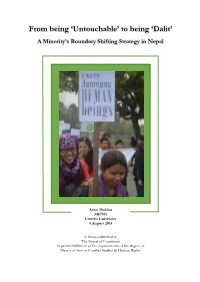
From being ‘Untouchable’ to being ‘Dalit’ A Minority’s Boundary Shifting Strategy in Nepal Anne Duklau 3467015 Utrecht University 4 August 2014 A thesis submitted to The Board of Examiners in partial fulfilment of the requirements of the degree of Master of Arts in Conflict Studies & Human Rights Supervisor: Jolle Demmers Submitted: 4 August 2014 Programme Trajectory: Compulsory Courses Term 1 & 2 (30 ECTS) Internship (15 ECTS) Research & Thesis Writing (15 ECTS) Word Count: 16 659 “I always say: We are all Dalits in Nepal, because discrimination between non-Dalit groups exists, as well.” - Suman Poudel1 Picture on the front page: A Dalit student participating in a rally for the elimination of cast-based discrimination and untouchability, organised by the Dalit civil society, on occasion of 21st March 2014, the International Day for the Elimination of Racial Discrimination. The picture was taken by the author. 1 Author’s interview with Suman Poudel, Executive Director of DNF, on 27 May 2014 Dedicated to the people of Nepal: That they may free themselves from the tight grip untouchability has on their lives. Acknowledgments First of all, I would like to express my gratitude to all the interviewees that gave me their precious time and shared their views and ideas with me. Without the support of these persons, this thesis would not have been possible. Further, I cannot express the indebtedness I feel in regard to my dear colleagues at DNF. Many thanks to Suman, who had the patience for a second interview after I lost the recording of the original one and who assisted me in all phases of realising this thesis. -

Influence of Modernization in Funeral Guthi (A Socio-Religious Association) ― Case of Gubhaju and Bare Castes of Kathmandu City ―
Influence of Modernization in Funeral Guthi (A Socio-religious Association) ― Case of Gubhaju and Bare Castes of Kathmandu City ― Arija VAIDYA Graduate Student Hiroshima University Graduate School for International Development and Cooperation 1-5-1 Kagamiyama, Higashi-Hiroshima, 739-8529 Japan Journal of International Development and Cooperation, Vol.21, 2015, pp. 1-7 IDEC (Graduate School for International Development and Cooperation) Hiroshima University JAPAN 『国際協力研究誌』 広島大学大学院国際協力研究科 2015年3月 【Article】 1 Influence of Modernization in Funeral Guthi (A Socio-religious Association) ― Case of Gubhaju and Bare Castes of Kathmandu City ― Arija VAIDYA Graduate Student Hiroshima University Graduate School for International Development and Cooperation 1-5-1 Kagamiyama, Higashi-Hiroshima, 739-8529 Japan 1. Introduction This paper aims to explore the influence of modernization in Newar society in general and funeral ceremony of Newars in particular. The funeral ceremony is conducted through guthi (a socio-religious association), which is in the process of transformation due to social change in Newar society. This paper also attempts to show that in the process of transformation how funeral guthi is trying to secure their traditional beliefs and values. Additionally, it aims to study how people are changing their attitude towards traditional funeral guthi system due to dynamic social development in Kathmandu city of Kathmandu valley. Doing so, this paper picks up Gubhaju1 and Bare2 castes of two settlements of Kathmandu city i.e., Om bahah and Lagan as a case study in order to understand how people who were excluded from their former funeral guthi for conducting inter-caste marriage formed a new funeral guthi, which was not possible in Newar society many years ago. -

Rural Vulnerability and Tea Plantation Migration in Eastern Nepal and Darjeeling Sarah Besky
University of New Mexico UNM Digital Repository Himalayan Research Papers Archive Nepal Study Center 9-21-2007 Rural Vulnerability and Tea Plantation Migration in Eastern Nepal and Darjeeling Sarah Besky Follow this and additional works at: https://digitalrepository.unm.edu/nsc_research Recommended Citation Besky, Sarah. "Rural Vulnerability and Tea Plantation Migration in Eastern Nepal and Darjeeling." (2007). https://digitalrepository.unm.edu/nsc_research/11 This Article is brought to you for free and open access by the Nepal Study Center at UNM Digital Repository. It has been accepted for inclusion in Himalayan Research Papers Archive by an authorized administrator of UNM Digital Repository. For more information, please contact disc@unm.edu. Rural Vulnerability and Tea Plantation Migration in Eastern Nepal and Darjeeling Sarah Besky Department of Anthropology University of Wisconsin – Madison This paper will analyze migration from rural eastern Nepal to tea plantations in eastern Nepal and Darjeeling and the potentials such migration might represent for coping with rural vulnerability and food scarcity. I will contextualize this paper in a regional history of agricultural intensification and migration, which began in the eighteenth century with Gorkhali conquests of today’s Mechi region and continued in the nineteenth and twentieth centuries with the recruitment of plantation laborers from Nepal to British India. For many Kiranti ethnic groups, agricultural intensification resulted in social marginalization, land degradation due to over-population and over-farming, and eventual migration to Darjeeling to work on British tea plantations. The British lured Rais, Limbus, and other tribal peoples to Darjeeling with hopes of prosperity. When these migrants arrived, they benefited from social welfare like free housing, health care, food rations, nurseries, and plantation schools – things unknown to them under Nepal’s oppressive monarchal regime. -
Nepal Side, We Must Mention Prof
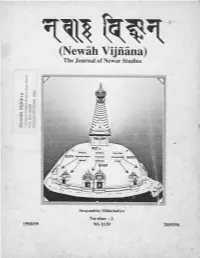
The Journal of Newar Studies Swayambhv, Ifliihichaitya Number - 2 NS 1119 (TheJournal Of Newar Studies) NUmkL2 U19fi99&99 It has ken a great pleasure bringing out the second issue of EdltLlo the journal d Newar Studies lijiiiina'. We would like to thank Daya R Sha a Gauriehankar Marw&~r Ph.D all the members an bers for their encouraging comments and financial support. ivc csp~iilly:-l*-. urank Prof. Uma Shrestha, Western Prof.- Todd ttwria Oregon Univers~ty,who gave life to this journd while it was still in its embryonic stage. From the Nepal side, we must mention Prof. Tej Shta Sudip Sbakya Ratna Kanskar, Mr. Ram Shakya and Mr. Labha Ram Tuladhar who helped us in so many ways. Due to our wish to publish the first issue of the journal on the Sd Fl~ternatioaalNepal Rh&a levi occasion of New Nepal Samht Year day {Mhapujii), we mhed at the (INBSS) Pdand. Orcgon USA last minute and spent less time in careful editing. Our computer Nepfh %P Puch3h Amaica Orcgon Branch software caused us muble in converting the files fm various subrmttd formats into a unified format. We learn while we work. Constructive are welcome we try Daya R Shakya comments and will to incorporate - suggestions as much as we can. Atedew We have received an enormous st mount of comments, Uma Shrcdha P$.D.Gaurisbankar Manandhar PIID .-m -C-.. Lhwakar Mabajan, Jagadish B Mathema suggestions, appreciations and so forth, (pia IcleI to page 94) Puma Babndur Ranjht including some ~riousconcern abut whether or not this journal Rt&ld Rqmmtatieca should include languages other than English. -

Body As Theatre in Bode Jatra
Body as Theatre in Bode Jatra A Dissertation Presented to the Central Department of English, Tribhuvan University In Partial Fulfillment of the Requirements for the Degree of Master of Philosophy By Hukum Thapa Central Department of English Tribhuvan University January, 2010 DISSERTATION APPROVAL We hereby recommend that the dissertation entitled “ Body as Theatre in Bode Jatra ” by Hukum Thapa be accepted in partial fulfillment of the requirement for the Master of Philosophy in English degree. ---------------------------------------------------- Supervisor ---------------------------------------------------- External Examiner Date: ---------------------------- Table of Contents Pages Dissertation Approval Acknowledgements Abstracts Chapter 1. Body and Ritual 1 2. Locating body in Newari Cultural Performance 24 3. Body as Theatre in Bode Jatra 38 4. Conclusion 62 5. Works Cited 6. Appendix I: Questionnaires Acknowledgements This dissertation owes much to the encouragement and shared knowledge offered by my advisor Prof.Dr.Abhi Subedi and my colleague cum teacher Dr.Shiv Rijal.Their brainwaves inspired me to delve into the performance study and to engross in the research of pioneering field of relation between body –theatre and theatre-ritual. Their association with the theatre for a long time whipped up support to lay bare snooping in the theatricality. I am grateful to Sajib Shrestha, Juju Bhai Bas Shrestha and Dil Krishna Prajapati of Bode for communicating copious facets of Bode Jatra , whose descriptions on Bode Jatra lent me a hand to bring it in such a silhouette. I would also like to thank the locals of Bode for their hold up to amass the information and cross the threshold of their cultural heritage that grew to be a foundation to put the last touches on my mission. -
PDF Generated By
OUP UNCORRECTED PROOF – FIRSTPROOFS, Mon Dec 07 2015, NEWGEN 3 Vajrayāna Traditions in Nepal Todd Lewis and Naresh Man Bajracarya Introduction The existence of tantric traditions in the Kathmandu Valley dates back at least a thousand years and has been integral to the Hindu– Buddhist civi- lization of the Newars, its indigenous people, until the present day. This chapter introduces what is known about the history of the tantric Buddhist tradition there, then presents an analysis of its development in the pre- modern era during the Malla period (1200–1768 ce), and then charts changes under Shah rule (1769–2007). We then sketch Newar Vajrayāna Buddhism’s current characteristics, its leading tantric masters,1 and efforts in recent decades to revitalize it among Newar practitioners. This portrait,2 especially its history of Newar Buddhism, cannot yet be more than tentative in many places, since scholarship has not even adequately documented the textual and epigraphic sources, much less analyzed them systematically.3 The epigraphic record includes over a thousand inscrip- tions, the earliest dating back to 464 ce, tens of thousands of manuscripts, the earliest dating back to 998 ce, as well as the myriad cultural traditions related to them, from art and architecture, to music and ritual. The religious traditions still practiced by the Newars of the Kathmandu Valley represent a unique, continuing survival of Indic religions, including Mahāyāna- Vajrayāna forms of Buddhism (Lienhard 1984; Gellner 1992). Rivaling in historical importance the Sanskrit texts in Nepal’s libraries that informed the Western “discovery” of Buddhism in the nineteenth century (Hodgson 1868; Levi 1905– 1908; Locke 1980, 1985), Newar Vajrayāna acprof-9780199763689.indd 872C28B.1F1 Master Template has been finalized on 19- 02- 2015 12/7/2015 6:28:54 PM OUP UNCORRECTED PROOF – FIRSTPROOFS, Mon Dec 07 2015, NEWGEN 88 TanTric TradiTions in Transmission and TranslaTion tradition in the Kathmandu Valley preserves a rich legacy of vernacular texts, rituals, and institutions. -
The Journey of Nepal Bhasa from Decline to Revitalization — Resha Maharjan Master of Philosophy in Indigenous Studies May 2018
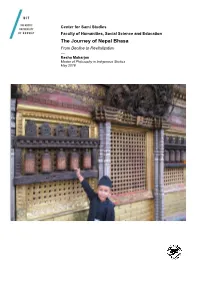
Center for Sami Studies Faculty of Humanities, Social Science and Education The Journey of Nepal Bhasa From Decline to Revitalization — Resha Maharjan Master of Philosophy in Indigenous Studies May 2018 The Journey of Nepal Bhasa From Decline to Revitalization A thesis submitted by Resha Maharjan Master of Philosophy in Indigenous Studies The Centre of Sami Studies (SESAM) Faculty of Humanities, Social Science and Education UIT The Arctic University of Norway May 2018 Dedicated to My grandma, Nani Maya Dangol & My children, Prathamesh and Pranavi मा車भाय् झीगु म्हसिका ख: (Ma Bhay Jhigu Mhasika Kha) ‘MOTHER TONGUE IS OUR IDENTITY’ Cover Photo: A boy trying to spin the prayer wheels behind the Harati temple, Swoyambhu. The mantra Om Mane Padme Hum in these prayer wheels are written in Ranjana lipi. The boy in the photo is wearing the traditional Newari dress. Model: Master Prathamesh Prakash Shrestha Photo courtesy: Er. Rashil Maharjan I ABSTRACT Nepal Bhasa is a rich and highly developed language with a vast literature in both ancient and modern times. It is the language of Newar, mostly local inhabitant of Kathmandu. The once administrative language, Nepal Bhasa has been replaced by Nepali (Khas) language and has a limited area where it can be used. The language has faced almost 100 years of suppression and now is listed in the definitely endangered language list of UNESCO. Various revitalization programs have been brought up, but with limited success. This main goal of this thesis on Nepal Bhasa is to find the actual reason behind the fall of this language and hesitation of the people who know Nepal Bhasa to use it. -

Status of Wetland in Dhorpatan Hunting Reserve, Nepal
Open Journal of Ecology, 2014, 4, 245-252 Published Online April 2014 in SciRes. http://www.scirp.org/journal/oje http://dx.doi.org/10.4236/oje.2014.45023 Status of Wetland in Dhorpatan Hunting Reserve, Nepal Saroj Panthi1*, Maheshwar Dhakal2, Sher Singh Thagunna2, Barna Bahadur Thapa2 1Department of National Parks and Wildlife Conservation, Api Nampa Conservation Area, Darchula, Nepal 2Department of National Parks and Wildlife Conservation, Kathmandu, Nepal Email: *mountsaroj@gmail.com Received 2 November 2013; revised 2 January 2014; accepted 10 January 2014 Copyright © 2014 by authors and Scientific Research Publishing Inc. This work is licensed under the Creative Commons Attribution International License (CC BY). http://creativecommons.org/licenses/by/4.0/ Abstract Wetland means the surface of the earth that is permanently or seasonally or partially covered with water. Wetlands are most productive areas for biodiversity and local livelihood support. Nepal ra- tified Ramsar convention in 1987 and started to include the wetland in Ramsar site and till now nine wetland sites are included in Ramsar site. There are still lacking systematic research and con- servation approach for these wetlands; therefore, our study attempted to assess the status of wet- lands in the Dhorpatan Hunting Reserve, Nepal; and explored threats and conservation chal- lenges. We prepared list of streams and lakes and collected detail information regarding area, district, block, elevation and cultural as well as ecological importance of lakes. We recorded total 11 lakes with total 304477 m2 areas. The Sundaha lake is largest lake of the reserve having signif- icant religious importance. We also recorded 7 streams in the reserve. -

Birds of Dhorpatan Hunting Reserve, Nepal
Open Journal of Forestry 2013. Vol.3, No.4, 109-114 Published Online October 2013 in SciRes (http://www.scirp.org/journal/ojf) http://dx.doi.org/10.4236/ojf.2013.34018 Birds of Dhorpatan Hunting Reserve, Nepal Saroj Panthi1*, Sher Singh Thagunna2 1Department of National Park and Wildlife Conservation, Dhorpatan Hunting Reserve, Baglung, Nepal 2Department of National Park and Wildlife Conservation, Api-Nampa Conservation Area, Darchula, Nepal Email: *mountsaroj@gmail.com Received June 18th, 2013; revised July 22nd, 2013; accepted August 7th, 2013 Copyright © 2013 Saroj Panthi, Sher Singh Thagunna. This is an open access article distributed under the Crea- tive Commons Attribution License, which permits unrestricted use, distribution, and reproduction in any me- dium, provided the original work is properly cited. Nepal is rich in bird diversity and recorded 871 bird species. Our study aimed to update bird diversity of Dhorpatan Hunting Reserve (DHR) of Nepal which is an Important Birds Area (IBA) out of 27 IBAs of Nepal. One hundred forty nine species of birds were recorded in DHR; out of them Catreus wallichii was globally threatened bird which has faced different anthropogenic problem. Twelve species of birds were included in CITIES Appendices and 3 species were nationally threatened. Most of the species of order Passeriformis were recorded. Only one species of order Upupiformes i.e. Upupa epops was recorded dur- ing the study. Keywords: Bird; Checklist; Threatened; Dhorpatan Hunting Reserve Introduction Myadgi districts of Nepal (Figure 1). The reserve supports 14 ecosystems types represented in the mid hill to higher Himala- Birds (class Aves) are feathered, winged, bipedal, endother- yan ecosystem (Shrestha et al., 2002; Lillesø et al., 2005; Bhuju mic, egg-laying, vertebrate animals (Wikipedia, 2013). -
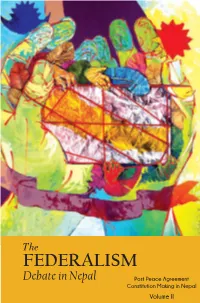
Federalism Is Debated in Nepal More As an ‘Ism’ Than a System
The FEDERALISM Debate in Nepal Post Peace Agreement Constitution Making in Nepal Volume II Post Peace Agreement Constitution Making in Nepal Volume II The FEDERALISM Debate in Nepal Edited by Budhi Karki Rohan Edrisinha Published by United Nations Development Programme (UNDP) Support to Participatory Constitution Building in Nepal (SPCBN) 2014 United Nations Development Programme (UNDP) Support to Participatory Constitution Building in Nepal (SPCBN) UNDP is the UN’s global development network, advocating for change and connecting countries to knowledge, experience and resources to help people build a better life. United Nations Development Programme UN House, Pulchowk, GPO Box: 107 Kathmandu, Nepal Phone: +977 1 5523200 Fax: +977 1 5523991, 5523986 ISBN : 978 9937 8942 1 0 © UNDP, Nepal 2014 Book Cover: The painting on the cover page art is taken from ‘A Federal Life’, a joint publication of UNDP/ SPCBN and Kathmandu University, School of Art. The publication was the culmination of an initiative in which 22 artists came together for a workshop on the concept of and debate on federalism in Nepal and then were invited to depict their perspective on the subject through art. The painting on the cover art titled ‘’Emblem” is created by Supriya Manandhar. DISCLAIMER: The views expressed in the book are those of the authors and do not necessarily represent the views of UNDP/ SPCBN. PREFACE A new Constitution for a new Nepal drafted and adopted by an elected and inclusive Constituent Assembly (CA) is a key element of the Comprehensive Peace Agreement (CPA) of November 2006 that ended a decade long Maoist insurgency. -

New Accessions, July– September 2019) Compiled by Karl-Heinz Krämer [Excerpt from the Complete Literature Index of Nepal Research]
ACADEMIC WORKS AND SELECTED PRESS ARTICLES (New accessions, July– September 2019) Compiled by Karl-Heinz Krämer [Excerpt from the complete literature index of Nepal Research] Acharya, Vagyadi. 2019. Decline of constitutionalism: Ensure separation of powers. The Himalayan Times, 2 July 2019 Adhikari, Ajaya Kusum. 2019. Digitalizing farming: Digitalizing farming process by providing farmers access to the internet can help solve most of the problems facing Nepali farmers, including improving competitiveness in farming. República, 25 July 2019 Adhikari, Ajaya Kusum. 2019. State of real estate: How is it possible that land prices in Nepali cities with poor infrastructure are close to land prices in London, New York, Tokyo and Shanghai?. República, 11 September 2019 Adhikari, Bipin. 2019. Building District Coordination Committees. Annapurna Express, 16 August 2019 Adhikari, Chandra Shekhar. 2019. ‘Honorary’ foreign policy: NRNs are honorary consuls in Australia, Canada, Portugal, the US and Germany. They have no responsibility besides catering to high level Nepali dignitaries when they visit these countries. Annapurna Express, 12 July 2019 Adhikari, Devendra. 2019. Solar energy promotion: Learn from Bangladesh. The Himalayan Times, 5 September 2019 Adhikari, Jagannath. 2019. Reviving Nepal’s rural economy: Nepal can take cues from post-second world war Tuscany and promote agro-tourism. The Kathmandu Post, 20 August 2019 Adhikari, Kriti. 2019. Children of slain journalists find succor: But for how long?. Annapurna Express, 12 July 2019 Adhikari, Pradip. 2019. Reimagining education: Students need to be trained to challenge conventional wisdom and to create new ideas. These skills can be garnered if students are allowed free thought and taught questioning skills.